





Written by Jorge Argota · Legal Marketing · United States
Last Updated: March 2026
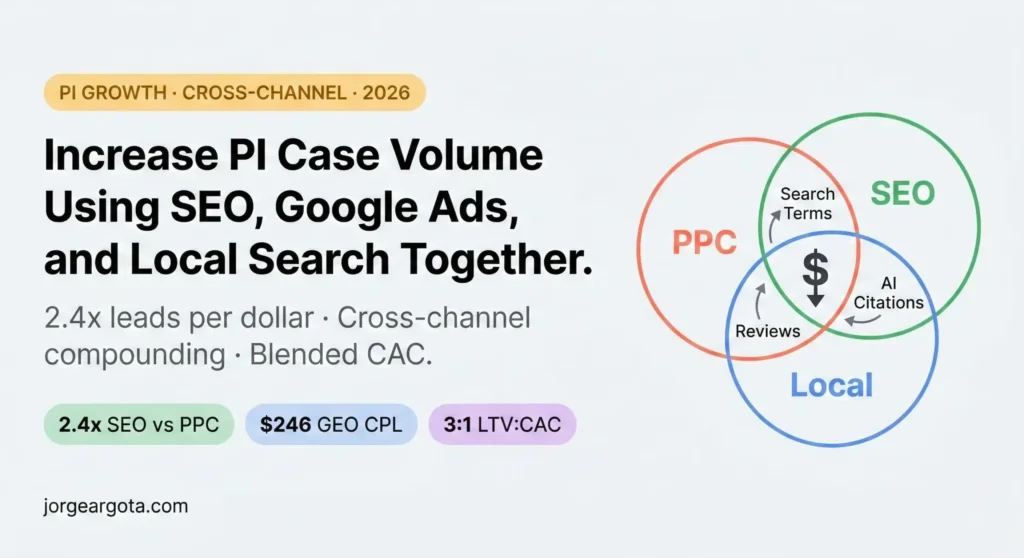
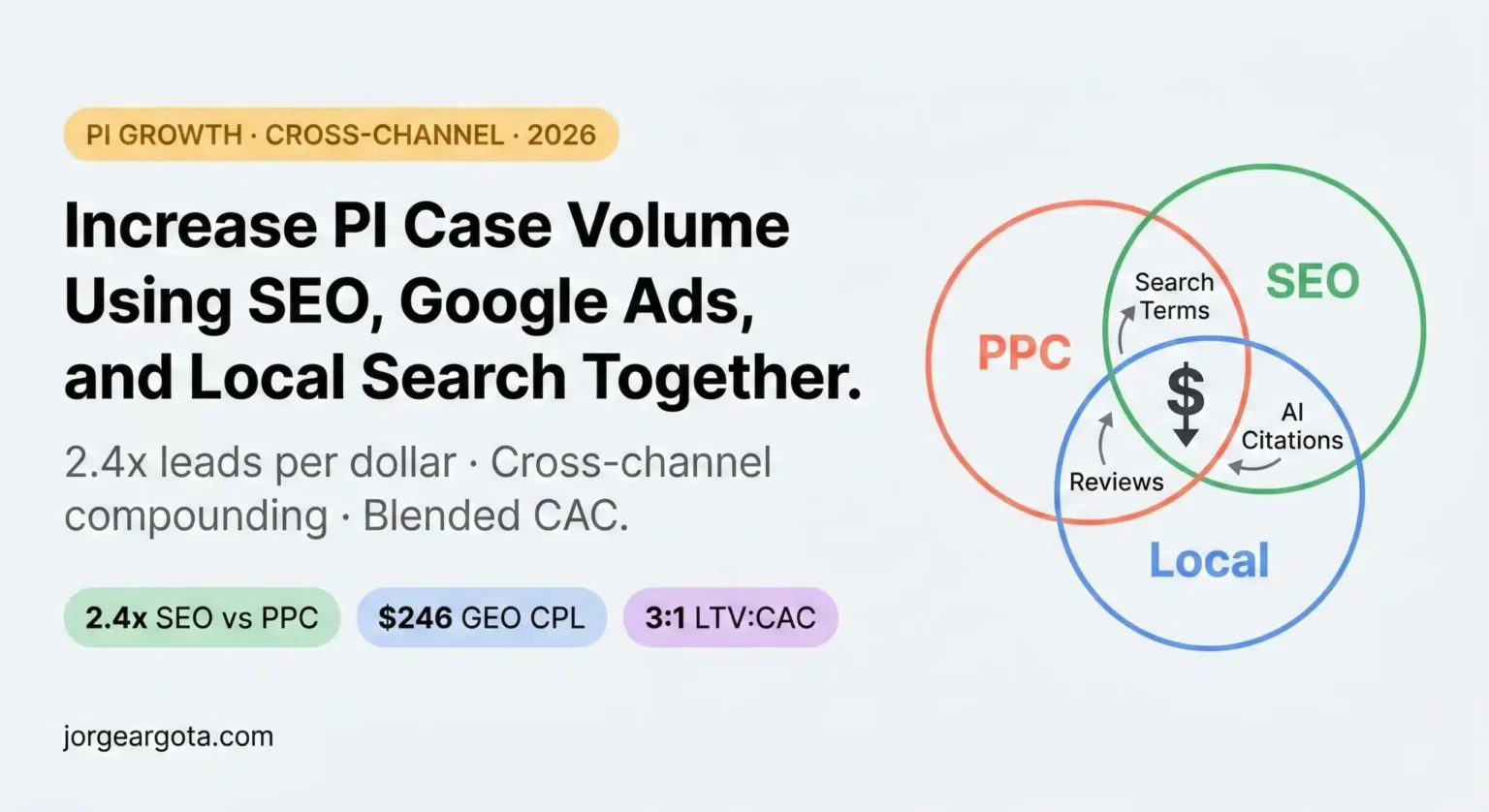
SEO delivers roughly 2.4 times more leads per dollar than PPC. But PPC produces cases this week while SEO takes 6 months to mature. The firms growing fastest don’t pick one. They run all three channels simultaneously and use each one’s data to make the others convert better, which produces a compounding effect that no single channel achieves on its own.
TL;DR
How do SEO, Google Ads, and local search work together for personal injury attorneys? They compound. A firm holding the paid ad, the organic listing, and the local pack position on the same results page sees 8% to 15% more total clicks than any single position alone. Firms cited in AI Overviews earn 35% more organic clicks and 91% more paid clicks for the same search. PPC data tells you which queries produce signed cases this month; you hand those exact phrases to your SEO team and build organic content that ranks for free within 6 to 12 months. Running LSAs alongside traditional search ads lifted signed case volume 18% in the markets I’ve measured. The compounding effect across all three channels produces a declining blended cost per signed case over time. That’s the mechanism. This page explains how to connect them. Source: Jorge Argota, 10 years in legal marketing, 5 inside a PI firm.
8–15%
More clicks when paid + organic appear together
91%
More paid clicks when cited in AI Overviews
18%
Case volume lift running LSAs + PPC together
THE COMPOUNDING EFFECT: HOW THREE CHANNELS BECOME MORE THAN THREE
Studies show that a firm holding both a paid ad and the #1 organic listing on the same search results page sees 8% to 15% more total clicks than either position produces alone. That’s not a theoretical model; it’s a measured lift from multiple independent uplift studies and it holds across verticals. The paid ad captures the skimmers who click whatever’s on top. The organic listing captures the people who skip ads on principle. And the presence of both creates a recognition signal that makes each position convert at a higher rate than it would in isolation.
Now add the Local Services Ad slot above both of those. On mobile, that’s three positions from the same firm visible before the user scrolls once. The prospect who skips the text ad taps the Google Screened badge instead. The prospect who skips both sees the firm in the local map pack with a 4.8 star rating and 500+ reviews and calls directly. Running LSAs and traditional search ads together lifted total signed case volume 18% in the Florida markets where I’ve measured it, because the two channels catch different behavioral patterns on the same SERP.
And then there’s the AI layer. Firms cited in AI Overviews earn 35% more organic clicks and 91% more paid clicks than firms that just rank in the standard blue links below. That’s the stat I keep coming back to because it means the work you do to get your firm visible in ChatGPT and AI search results doesn’t just produce a separate traffic stream; it lifts the performance of every other position you hold on the same page. The visibility compounds across the entire SERP in a way that running any single channel in isolation never captures.
GOOGLE ADS AS THE INTELLIGENCE ENGINE FOR SEO
The most expensive thing about PPC for personal injury isn’t the cost per lead; it’s paying that cost forever on queries you could eventually rank for organically. The intelligence engine concept flips the economics. Instead of treating Google Ads as a standalone acquisition channel, you treat it as a real-time research tool that tells you exactly which search queries produce signed retainers, and then you build organic content around those queries so you stop paying for them permanently.
Every 30 days, export the converting queries from your Search Terms report. Not the queries that produced clicks. The queries that produced signed cases, which you know because your CRM tracks the original click through to retainer signature. Identify the long-tail queries costing you $200 to $400 per click. Hand that exact list to your content team and build dedicated organic pages around those phrases using the keyword research framework I’ve written about separately. Over 6 to 12 months those pages start ranking. The firm begins getting those same leads for free. The PPC budget gets reallocated to the next set of expensive queries, and the cycle repeats.
The PPC-to-SEO Handoff Cycle
Month 1: PPC data reveals “rear-end collision settlement timeline [city]” converts at a 22% rate to consultations. You’re paying $380 per click for it.
Months 2 to 4: Your content team publishes a dedicated page targeting that exact query with jurisdictional specifics, statute references, and settlement range context.
Months 6 to 9: The page reaches page one organically. You start getting those leads at $0 incremental cost.
Month 10: You pause the PPC bid on that query and reallocate the $380 per click budget to the next high-converting, expensive keyword your Search Terms report identified.
Repeat this cycle across 20 to 30 queries over 18 months and your blended cost per signed case drops substantially even though the total budget stays flat.
The attribution system that makes this handoff work, including UTM hidden fields, offline conversion imports, and CRM feedback loops, is covered in detail in our guide to building a predictable PI lead pipeline. The short version: firms running offline conversion imports see their cost per signed case drop 20% to 30% over 60 to 90 days without changing the budget, because the algorithm learns what a signed retainer looks like instead of optimizing for cheap phone calls that go nowhere.
SEO CONTENT THAT LIFTS EVERY OTHER CHANNEL
The organic content that compounds fastest for PI firms in 2026 is the content that gets cited by generative AI. When someone types “what should I do after a rear-end car accident in Florida” into ChatGPT or Perplexity, the AI pulls answers from pages structured around clear question-and-answer pairs with named entities; statute numbers, court names, specific procedural deadlines. If your page gets cited, two things happen simultaneously. First, you get direct referral traffic from the AI platform at a conversion rate that runs 6 to 15 times higher than standard organic. Second, and this is the part most firms miss, the AI citation lifts your visibility across the traditional SERP too.
That 35% more organic clicks and 91% more paid clicks stat isn’t about the AI traffic itself. It’s about the halo effect. When your firm shows up in the AI Overview at the top of the page, and then the user scrolls down and sees your paid ad, and then sees your organic listing, the triple exposure creates a familiarity signal that converts at a rate none of those positions produce independently. The AI citation makes your Google Ads cheaper and your organic listing more clickable at the same time, which is exactly the kind of compounding that single-channel measurement completely misses.
How the Budget Allocation Shifts as SEO Matures
Months 1 to 6: Budget weighted 70% PPC and LSAs, 30% SEO. PPC generates immediate cash flow and the Search Terms data feeds the SEO content calendar. This is the timeline comparison between PPC and SEO where the paid channels subsidize the organic build.
Months 6 to 12: SEO begins ranking on the queries your PPC data identified. Shift to 50% paid, 50% organic. Organic leads start replacing paid leads on queries where the content now ranks, and the PPC budget reallocates to the next expensive keyword batch.
Months 12+: Flip to 30% paid, 70% organic. PPC becomes a surgical tool for high-value specialty cases rather than the main volume driver. Blended cost per signed case drops because organic leads arrive at a fraction of the paid cost and the PPC data already told you which pages to build.
LOCAL SEARCH AS THE AMPLIFIER FOR EVERYTHING ELSE
About 60% of all PI leads come directly from local map rankings. The Google Business Profile isn’t a directory listing; it’s the conversion engine that sits between your ads and your phone. When someone sees your paid ad, then sees your firm in the local pack with a 4.8 star rating and 500+ reviews, then sees your organic listing below that, the combined visibility creates a trust signal that none of those positions produce alone. The review velocity on the GBP directly influences how well the paid and organic channels convert because people check the reviews before they call regardless of which listing they clicked first.
LSAs specifically compound with PPC in a way that’s worth understanding mechanically. LSAs charge per lead, not per click, which makes them the lower-risk paid channel. The prospect who skips the text ad often taps the Google Screened badge instead. The prospect who skips both checks the map pack. Running all three means you’re catching three different decision-making patterns on the same search, and the specific GBP and Google Ads tactics that make each position convert better are covered separately.
Adding answer engine optimization on top of all three means the firm’s content also shows up in the AI-generated answers above everything else, which is where an increasing number of legal searches are resolving before the person ever scrolls to the traditional results. The compounding runs in every direction: AI visibility lifts paid and organic, organic authority improves local ranking signals, local reviews increase paid ad conversion rates, and PPC data tells you what organic content to build next.
WHAT THE COMPOUNDING LOOKS LIKE OVER 18 MONTHS
Month 1, the firm is running PPC and LSAs at full spend, GBP is optimized with review automation running, and the SEO content calendar is populated with converting queries from the PPC Search Terms report. Blended cost per signed case is high because 100% of leads are paid.
Month 6, the first batch of organic pages start ranking. Some of those pages appear in AI Overviews. The paid ads on those same queries start converting at a higher rate because of the dual-presence lift. Blended cost per signed case starts declining even though the budget hasn’t changed.
Month 12, organic traffic is replacing paid traffic on 15 to 20 queries. The PPC budget reallocates to the next batch of expensive keywords. AI citations are driving referral traffic that converts at multiples of standard organic. The GBP review count has compounded past 400 and the local pack position is pulling 60% of leads without any ad spend attached.
Month 18, the firm is spending the same total budget but signing more cases because each channel is amplifying the others. The organic content built from PPC intelligence is ranking. The AI citations are lifting ad performance. The local pack is converting people who saw the ad but called directly. None of that shows up if you’re measuring each channel in isolation, which is why the firms I work with track blended cost per signed case across all three channels together rather than optimizing each one independently. The full measurement infrastructure, from conversion tracking through CRM feedback loops, is covered in the predictable pipeline guide.

For the full channel-by-channel cost breakdown including signed-case economics, see the marketing channels ranked by signed cases guide.
The total doesn’t change. The split does.
The difference between a firm spending $15,000 a month and signing 4 cases versus signing 8 cases is almost never the budget. It’s whether the channels are feeding each other or running independently. If you want me to look at your current channel split and tell you where the compounding is breaking down, send me your last 90 days of data by channel. If it’s already working I’ll tell you that too.
P.S. If you want the specific platform tactics for each channel individually, I wrote about the hidden gem moves inside Google Ads and GBP that most firms miss. If you want to understand how the measurement and attribution system connects all of this, the predictable pipeline architecture covers the five layers from traffic to feedback loops. And if you want to understand why AI search traffic converts at 6 to 15 times the rate of standard organic, the AI Overviews traffic analysis breaks down the behavioral economics behind it.