

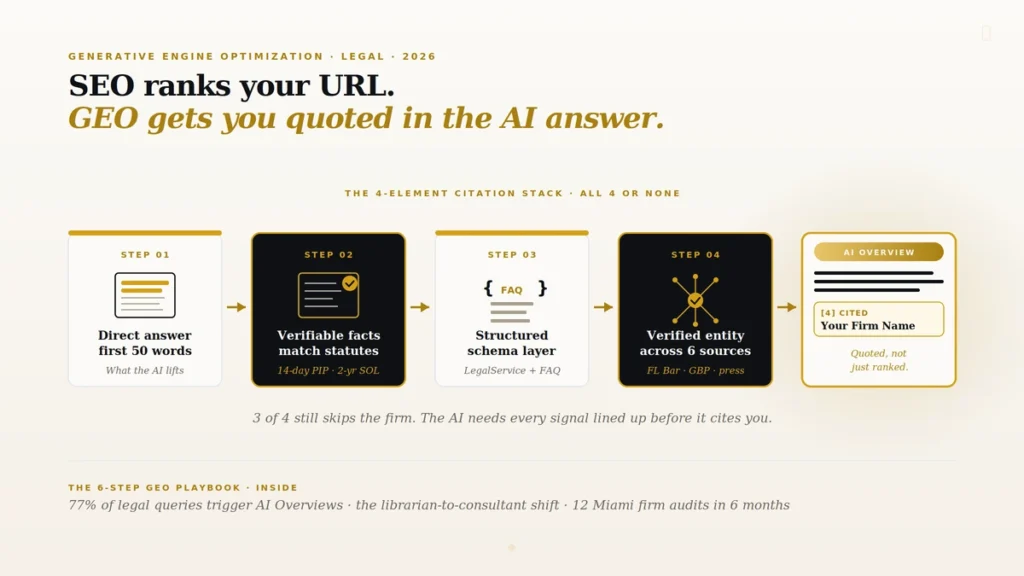

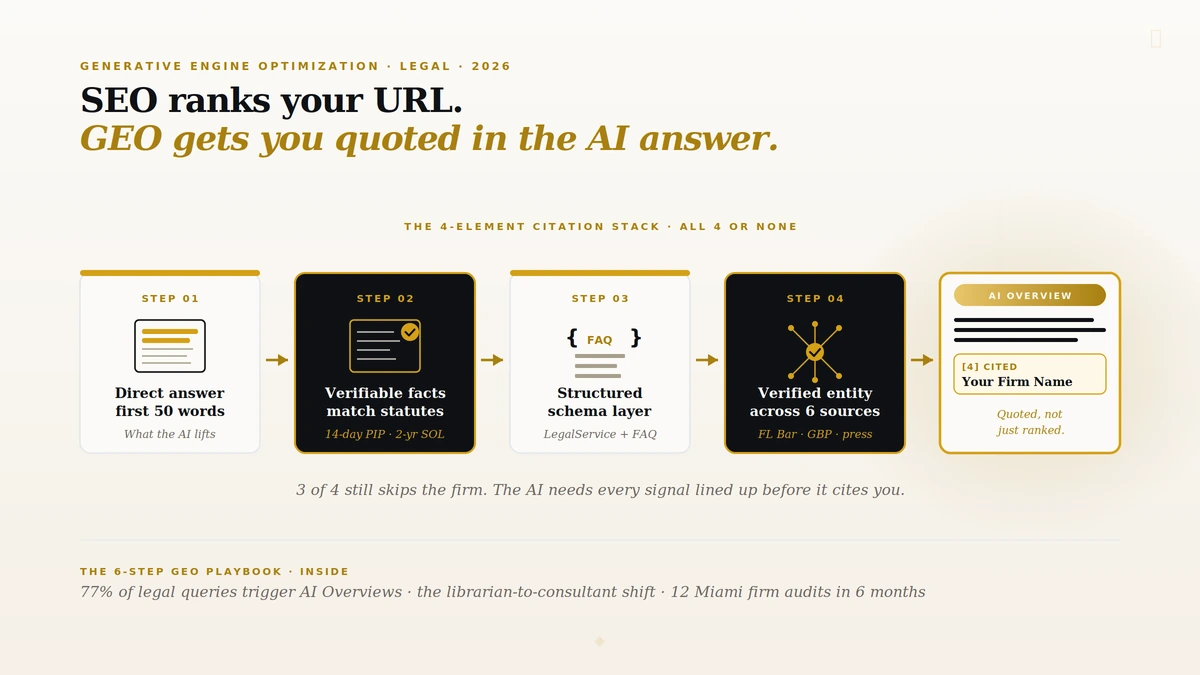





The behavior change: Future clients ask ChatGPT, Gemini, and Perplexity first, then Google, then maybe your website. As of 2026, 77 percent of legal queries trigger an AI Overview in our tracking, which means the answer appears above the blue links.
How AI picks firms: The AI cross references your firm against The Florida Bar, Google Business Profile, court records, news mentions, and directory listings. If your data does not match exactly, the AI treats you as multiple separate entities and your citation odds drop. This is called entity authority.
What to do: Run an AI prompt audit, fix entity and schema signals, rewrite commodity posts into non commodity content with real local facts, and build authority signals in trusted sources like the Daily Business Review.
What GEO actually looks like in a real AI Overview
Before going deep on definitions, the clearest way to understand GEO is to see one real AI Overview and break down why some firms got cited and others did not.
Below is a recreation of a real Google AI Overview (powered by Gemini, which reaches 2+ billion monthly users through Search integration as of 2026) for a high intent Miami legal query.
After a car accident in Miami, take these steps in order:
- Call 911 if anyone is injured or if the damage exceeds $500 (Florida law requires it).
- Move vehicles out of traffic if drivable and safe; Florida is a no fault state, so fault does not affect medical coverage initially.
- Exchange insurance, driver license, and registration information with the other driver.
- Document the scene with photos of all vehicles, license plates, and road conditions.
- Seek medical attention within 14 days; Florida PIP benefits require treatment within this window to qualify.
- Contact a Miami personal injury attorney before speaking with insurance adjusters about settlement.
The Florida statute of limitations for personal injury claims is 2 years from the date of the accident.
The AI cited 4 sources out of dozens of available legal sites in Miami. The state bar and 1 directory are predictable. The interesting one is the firm citation: out of every PI firm in Miami, why did Percy Martinez get picked?
Why this firm got cited (and most did not)
The cited firm had 3 things working in its favor that most Miami PI firms do not. Side by side breakdown:
- Entity signals: “The Law Office of X” on website, “Law Offices of X” on Avvo, missing Florida Bar link in schema
- Content structure: “10 things to do after a car accident” blog post buries the answer under 800 words of intro
- Schema: Generic LocalBusiness only, no LegalService, no Wikidata links, no Person schema on attorneys
- Authority signals: 12 Google reviews, no press mentions, no court record verification
- Entity signals: Exact name match across Florida Bar, GBP, Avvo, Justia, and website (NAP audit clean)
- Content structure: Dedicated page answers “what to do after a Miami car accident” in 50 words at the top, then expands
- Schema: LegalService schema with Wikidata links for Florida + personal injury, Person schema on every attorney bio
- Authority signals: 94 reviews, 4 Daily Business Review mentions in 18 months, attorney quoted in Miami Herald twice
The 4 specific elements that triggered the citation
Pulling apart what the AI extracted from the cited firm’s page, 4 elements lined up that turned the URL from “indexed” into “cited”:
GEO is not a single trick. It is the stack: direct answer at the top + verifiable facts + structured schema + clean entity signals across 5+ sources. The firm with 3 of the 4 elements still does not get cited. All 4 need to line up before the AI treats the firm as a trustworthy source.
The traffic was up but the phone was not matching
18 months ago the analytics looked fine. Traffic was up on most pages. The phone was flat.
The reason showed up when I actually checked the SERP: Google was pulling the answer straight from the page and displaying it inline. The user got what they needed without ever clicking through. Crawled, indexed, ranked, and ignored.
Most firms in Florida have not noticed this yet because their agencies still report on rankings and traffic. Nobody mentions that the traffic is producing fewer calls than it used to.
What GEO actually means for law firms
Google’s AI Overview reads the firm’s website, Florida Bar profile, reviews, court records, and news mentions, then stitches together an answer from the 3 to 5 sources it trusts most. If the firm’s content does not directly answer the question, the firm does not get cited. Ranking position is not the gate; trust as a source is.
The clearest way to explain the shift: traditional Google was a librarian. The AI is a consultant.
At Percy we had pages ranking number 1 for certain keywords and the traffic was still dropping because Google was pulling our answer into the AI Overview. Technically winning. Practically losing. The old win condition (be one of 10 books on the shelf) and the new one (be the book the consultant opens) are different jobs.
How legal consumers research before they ever Google
Legal consumers are increasingly asking AI tools “what should I do if…” before they ever start with Google. Legal is one of the verticals with the highest AI Overview trigger rates because the questions are factual, the answers are bounded, and the AI feels confident summarizing them. The trigger rates break down by query type, and understanding the split is the difference between writing content the AI cites and writing content the AI absorbs.
The pattern is brutal for blog content and friendly to hire intent searches. “What should I do after a car accident in Los Angeles” gets answered by the AI. “Best car accident lawyer in Los Angeles” still drives a click because Google monetizes that query with ads and the Map Pack. The firms losing visibility are the ones whose strategy was built entirely around the first kind of query.
Entity authority and why most firms get it wrong
Entity authority is how confidently AI systems can identify the firm as a real, verified source for a specific topic in a specific location.
The AI cross references the website against The Florida Bar, Daily Business Review, Miami Dade court records, Google Business Profile, and directory listings. Names and addresses must match exactly. If they do not, authority gets split and the AI skips the firm entirely.
Most agencies skip entity authority because it does not show up on a dashboard. No chart going up and to the right. But it is the single most important signal for AI visibility right now.
Legal is a YMYL topic (“Your Money or Your Life”). If the AI gets it wrong, someone gets hurt. So the AI cross checks everything before citing a firm, which means even small mismatches matter.
If your Florida Bar profile says one address and your Google Business Profile says another and your Avvo listing has a slightly different firm name, the AI treats those as maybe 2 or 3 different entities instead of 1 strong one. Your authority gets split across all of them. Same thing with your review profile. If you have 4 reviews on Google and your competitor across town has 98, the AI reads that as a trust gap.
I have audited maybe a dozen Miami firms in the last 6 months. Every single one had at least a few of these mismatches. None of them knew about it, which you would think would be easy to fix but apparently it is not. The most common one is “The Law Office of X” on one platform and “Law Offices of X” on another. The AI reads those as 2 different firms.
GEO vs SEO vs Local SEO, and why you need all 3
The 3 channels solve different problems. SEO ranks URLs. Local SEO captures the Map Pack and “near me” searches. GEO gets the firm cited inside AI answers. Skipping any one creates a hole; running all 3 builds compounding authority.
SEO rewards backlinks. How many other sites link to yours.
GEO rewards entity authority. Whether the AI has seen the firm’s name tied to the right topics in enough trusted places. A firm that shows up in the Daily Business Review, on The Florida Bar website, and in 11th Judicial Circuit court records gets cited even without a backlink in sight, which throws traditional SEO people off.
The other difference is structure. SEO rewards 1 great page per topic. GEO rewards a cluster of connected pages because the AI breaks big questions into smaller ones.
Instead of 1 “Personal Injury” page, the firm needs a page on I-95 accidents, another on Brickell slip and falls, another on Florida medical malpractice notice requirements. All linked. That depth is what the AI reads as topical authority.
At Percy we stumbled into this accidentally by writing about specific case types. I did not realize it was building exactly the kind of authority the AI was looking for.
SEO is getting your name on a billboard. GEO is getting personally recommended by someone the client trusts. They are related but they are not the same job.
What GEO looks like in competitive cities
The same playbook plays differently across metros. NYC and LA reward depth and brand authority. Houston rewards niche venue content. Miami rewards bilingual authenticity. Below is what I see when I run AI audits in each market.
The 6 step GEO playbook for law firms
6 moves in the order I run them on every GEO audit. Each maps to a specific lever that affects AI citation odds.
How to start GEO in the next 30 days
Theory is fine but execution is what moves the needle. Here is the 30 day starter sequence I use with firms that are starting from zero on GEO. None of this requires new agency contracts. Most of it is the existing team plus the firm’s web developer for a few hours.
- Week 1 to 2 Run the AI prompt audit. 10 to 15 prompts across the firm’s top practice areas. Document who gets cited. Identify entity mismatches across Florida Bar, GBP, and directories.
- Week 2 to 3 Fix the worst entity mismatches first (firm name variations, address inconsistencies, missing schema). Add LegalService schema to the homepage. Add Person schema to attorney bio pages with Wikidata links.
- Week 3 to 4 Upgrade 3 to 5 commodity blog posts into non commodity assets with local fact patterns, anonymized case data, and direct answer formatting. Publish 1 new GEO hub page targeting the highest volume prompt from the audit.
- Week 4 Re run the original prompt audit. Compare. If even 1 new citation appears, the system is working. If not, the gap is usually in step 2 (schema is still inconsistent across platforms).
The firms that figure this out in the next year or 2 get a real edge over the ones still running the same SEO playbook.
Most firms know something has changed. They just do not know what to do about it. I was in the same spot 18 months ago and I am still figuring parts of it out honestly.
Where GEO connects to the rest of the system
Common questions about GEO for law firms
What is GEO for law firms?
How is GEO different from SEO for lawyers?
What percentage of legal searches trigger AI Overviews?
What is entity authority for law firms?
How do lawyers get cited in ChatGPT and Google AI Overview?
What schema do law firms need for GEO?
Want me to audit your firm’s AI visibility?
I run 10 to 15 prompts across the firm’s practice areas in ChatGPT, Gemini, Claude, Perplexity, and Google AI Overview. Document who gets cited, where the entity mismatches live, and what content gaps exist. Hand back a 30 day GEO plan with schema fixes, content priorities, and authority signal targets. If the firm is already showing up in AI answers, I tell you that. Select PI, family, criminal, immigration, and complex civil firms.
Request a GEO audit →