Google Local Service Ads for Lawyers (2026): The Ranking System
Google killed the Screened badge in October 2025 and replaced it with a generic blue checkmark, and most of the LSA guides out there are still telling you how to get a badge that doesn't exist anymore.
10 years working alongside Percy Martinez P.A. on LSA optimization, intake automation, and the ranking factor math agencies treat as a black box. Managed LSA accounts for 10 plus Florida firms since the legal vertical launched in 2020.
Specializes in
LSA optimizationResponse time SOPsIntake feedback loopFL Bar complianceMetro CPL modeling
Solution and decision. “How does LSA actually rank our firm and how do we win it?”
The promise
A weighted ranking factor model, the Metro Premium Index, and the intake feedback loop diagram. Not “what is LSA” content.
The proof
Real LSA cost per lead by metro. 18 legal account audits since 2024. $8,200 weekly client teardown with response time and disposition data.
Compliance
ABA Model Rules 7.1 and 7.2, Florida Bar Rules 4-7.13 and 4-7.14, attorney client privilege risks in call recording, triage protocol for protected communications.
TL;DR · LSA is not an ad platform
LSA is a machine learning feedback loop. Firms that feed it disposition signals win.
The shift: Google replaced Screened with a generic Verified badge in October 2025. The legal differentiation is gone; response time, review velocity, and disposition now carry the ranking.
The math: Response time drives 30% of placement. Review velocity drives 20%. Disposition drives another 20%. Budget is the smallest variable.
What to do: Under 30 second response time, 2 to 5 reviews per month, weekly disposition. Run the 90 minute optimization sprint below before requesting an audit.
The contrast
What most LSA guides get wrong
3 patterns show up across most LSA content for lawyers, and all 3 lead firms in the wrong direction. The diagnostic in this article is built around the corrections.
Most guides
Treat LSA like a bidding auction (raise budget to win)
Ignore response time benchmarks and disposition feedback
Skip metro tier budgeting and bar compliance entirely
What actually works
LSA is a feedback loop, not an auction; signal beats spend
Response time and disposition discipline drive 50%+ of ranking
Metro Premium Index + compliance moat compound over 90 days
The shiftStage: Awareness
The 2025 badge shift, and what actually changed
In October 2025, Google retired the legal specific Google Screened badge and replaced it with a generic Google Verified checkmark, the same one locksmiths and HVAC technicians earn. The vetting (background check, bar verification, malpractice insurance) did not change. What changed was the visual differentiation that made the legal vertical look distinct in the LSA card.
Before October 2025
Google Screened (legal only)
Legal specific badge with shield icon
Visual differentiation from contractors
Strong trust signal in the LSA card
Bar number prominently displayed
After October 2025
Google Verified (generic)
Same checkmark as locksmiths, HVAC, dental
No legal specific visual cue
Trust signal carried by reviews and rating
Differentiation moved to operational signals
Google Screened to Google Verified: the Oct 2025 timeline
Visual differentiation timeline for the legal LSA vertical. Source: tracked across 10 firm accounts since 2024.
Firms whose LSA strategy leaned on the badge (“we are Google Screened” as positioning) lost their wedge overnight. Firms already winning on review velocity and response speed kept their top 3 spots.
Why legal got hit harder than other verticals
Locksmiths and HVAC technicians never had a legal specific badge. They were already competing on reviews and response time. Legal had a 5 year head start on visual differentiation, and the firms that leaned on that head start instead of building review velocity and response SOPs are the ones now scrambling. The badge change did not break LSA. It exposed firms that had been coasting.
The modelStage: Solution design
The LSA ranking factor model (weighted)
Google ranks LSA for lawyers primarily by how fast the firm answers the phone, not how much it spends. Across 18 tracked legal accounts since 2024, the placement signals weight out roughly like this. The weights are inferred, not officially published.
01
Response timeunder 30 seconds = top 3
30%
02
Review velocity2 to 5 new reviews per month
20%
03
Lead dispositionbooked, retained, not a fit, spam
20%
04
Proximityservice area distance from searcher
15%
05
Profile precisionpractice areas, hours, photos, languages
10%
06
Budget / ad rankweekly cap and bid strategy
5%
Budget is a 5% tie breaker, not the main lever, which is why outspending a faster firm fails.
By metroStage: Decision · cost benchmarks
The Metro Premium Index for legal LSA
LSA cost per lead is not uniform across the US. The same legal vertical pays $400 per PI lead in Manhattan and $90 per PI lead in Tampa. The Metro Premium Index below is the rough segmentation I use as a starting point on every audit. The premium column is how much each tier runs above the national LSA average for the same practice area.
Tier
Example metros
PI lead range
Premium vs national
Tier 1
New York, Los Angeles, Chicago, Houston
$250 to $500
+35 to 60%
Tier 2
Miami, Dallas, Atlanta, Phoenix
$150 to $300
+20 to 40%
Tier 3
Tampa, Orlando, Nashville, Charlotte
$80 to $180
Baseline
Tier 4
Smaller markets, county seats
$50 to $120
-15 to -30%
The premium tracks population density and auction pressure, not case value (a NYC PI lead costs 4x a Tampa lead at the same case value). Bilingual metros (Miami, LA, Houston) effectively run 2 auctions. The response time bar tightens by tier too: under 60 sec wins in Tier 3, under 30 sec is required in Tier 1.
Budget against the tier, not the national average
A $5,000 monthly budget that produces 50 leads in Tampa produces 10 to 15 in NYC at the same conversion rate. Most firms discover this 60 days in, after the Tier 1 premium has already burned the budget.
The loopStage: System design
The intake to ranking feedback loop
LSA is a closed loop. The firm’s intake behavior trains Google’s algorithm on what a good lead looks like for this firm specifically.
Step 01
Lead arrives
Searcher clicks the LSA card. Call routes to the firm. Timer starts the moment the call connects.
Step 02
Response tracked
Google measures pick up speed. Under 30 seconds = ranking lift. Over 2 minutes = ranking drop within days.
Step 03
Disposition logged
Firm marks lead status in LSA dashboard or via CRM integration. Booked, retained, not a fit, spam.
Step 04
Signal sent
Disposition feeds Google’s model. The algorithm learns what a quality lead looks like for the firm.
Step 05
Targeting refines
Future leads better match the firm’s quality profile. Lead quality climbs without budget changes.
The LSA intake to ranking feedback loop, as a cycle
The 5 step cycle runs whether the firm participates or not. Disposition discipline is the only lever that closes the loop intentionally.
The highest converting LSA accounts in my audits all run CRM integrations (Clio, Lawmatics, Filevine) that auto push status changes back to LSA. After 30 to 60 days of consistent disposition flow, lead quality climbs 25 to 40 percent without a budget change. Firms that never log disposition send Google a “every lead was a problem” pattern, and the algorithm responds by cutting impressions or shifting to lower intent pools. The loop runs either way; the only choice is whether to participate intentionally.
The risksStage: Risk management
The compliance traps most firms miss
LSA participation creates 3 attorney advertising and ethics issues that most firms never address because the platform feels like a passive directory. It is not. The firm is the advertiser, the firm controls the content, and the firm is responsible for everything that happens on a call routed through LSA.
Privileged call recordingThe biggest exposure
LSA call recording captures every word the caller says. If the caller starts describing case facts before the firm establishes whether representation will happen, those statements can become discoverable. The fix: a triage script that pauses recording before substantive case discussion begins and resumes it only after the caller declines representation or the firm declines the matter. Recording without a triage protocol violates Florida Bar Ethics Opinion 2018-1 guidance on protecting attorney client confidentiality during intake.
Past results disclaimersFL Bar Rule 4-7.13
If the LSA profile includes any review that implies a past result (“the firm got me $X”), Florida Bar Rule 4-7.13(b)(3) requires the disclaimer “prospective clients may not obtain the same or similar results.” LSA does not provide a built in disclaimer field, which means the firm needs to monitor reviews and either request edits or add the disclaimer in the firm description. New York Rule 7.1(e) has a similar requirement statewide.
Third party intake answeringUPL exposure
Firms using outsourced 24/7 intake services to answer LSA calls create unauthorized practice of law (UPL) exposure if the intake agent gives legal advice or makes representations about case viability. The fix: a written intake script the agent reads verbatim, with explicit “I cannot answer that, the attorney will follow up” responses to substantive legal questions. The firm remains responsible for everything the intake agent says under ABA Model Rule 5.3.
The triage call protocol
The 4 step intake script that protects privilege
Step 1: Open with “Thank you for calling [firm]. This call is being recorded for quality purposes. Before we discuss your matter, I have a few intake questions.” This warns the caller and creates a clean recording boundary.
Step 2: Collect non substantive information first (name, phone, general practice area). Do not let the caller describe case facts yet.
Step 3: Confirm conflict check and scheduling: “I can schedule a consultation with the attorney. The consultation itself is where you will share case details under attorney client privilege.”
Step 4: If the caller insists on sharing facts before the consultation, the agent says: “I am going to pause the recording before you share those details. The attorney will hear them directly during the consultation.” Pausing the recording before substantive disclosure protects the firm and the caller.
The playbookStage: Execution
The optimization playbook, in order of impact
5 moves in the order I run them on every LSA audit, weighted by impact on placement. Each one maps to a specific lever in the ranking factor model from Section 2. The order matters because moves 1 and 2 unlock the gains from moves 3 to 5.
01
Response time SOP under 30 seconds
Audit pick up speed across noon, 5:15 PM, and Saturday morning. If average pickup is over 60 seconds, fix this before touching anything else. Options: dedicated intake line, after hours answering service, mobile forwarding for nights and weekends. No other optimization matters if calls go to voicemail.
02
Disposition discipline (weekly)
Mark every lead status within 7 days. Dispute spam or off practice area leads within 24 hours. In 2026, Google auto credits short calls and obvious spam, so the dispute is now mostly a training signal rather than a refund mechanism. Occasional manual credits still happen, but profile hygiene and disposition discipline are the real levers. Firms that never log disposition send Google a “no signal” pattern, which tanks ranking faster than any single bad lead.
03
Review velocity 2 to 5 per month
Build an automated review request workflow triggered by case closure. Below 2 reviews per month signals dormancy. Above 5 risks triggering spam filters. The middle range signals an active practice and lifts ranking. See the dedicated Google reviews playbook for the compliant request script.
04
Profile precision audit
Practice areas (specific, not “personal injury” alone), hours (24/7 if the firm answers calls 24/7), languages (Spanish flagged if applicable), and 8 to 12 high quality photos including bar credentials and office exterior. Each missing field reduces ranking weight in the profile precision factor.
05
Service area pruning
Most firms set service areas too wide on day one and never prune them. Cut service areas where conversion is under 5 percent and concentrate spend in the 3 to 5 ZIP codes producing 70 percent of signed cases. Wider service areas dilute proximity ranking; tighter service areas concentrate spend.
The 90 minute optimization sprint
5 things any LSA account owner can fix today
Open Local Services Ads dashboard → Leads tab. Sort by date. Scan the last 30 days for any lead older than 7 days with no disposition. Log it now.
Click Settings → Schedule. Verify hours match actual answering coverage. If the firm advertises 24/7 but voicemail picks up after 6 PM, fix one or the other.
Settings → Service area. Remove every ZIP outside the firm’s top 3 to 5 conversion zones. Tighter beats wider.
Reviews tab. Confirm the firm has gotten at least 2 reviews in the last 30 days. If not, send 5 review requests using the script in the reviews playbook before closing this tab.
Profile precision. Verify all 6 practice area fields are filled, Spanish flag is on if applicable, and 8+ photos including bar credentials are uploaded. Each missing field reduces ranking weight.
Time: 90 minutes. Who: firm administrator or marketing director. Expected lift: visible movement in placement within 14 days if response time SOP is also in place.
By practiceStage: Channel fit
LSA performance by practice area
LSA is not equally valuable across legal practice areas. The trigger urgency, the case value, and the searcher behavior all shift the math. The matrix below covers the 6 most common LSA practice areas with the lead cost range, conversion rate range, and best fit profile.
Practice area
Lead cost
Sign rate
Best fit profile
Personal injury
$150 to $500
8 to 14%
High urgency, high case value. Best ROI when intake answers within 30 seconds. Worst ROI when intake misses calls.
Criminal defense / DUI
$100 to $300
12 to 22%
Pure urgency. Caller wants a lawyer tonight. 24/7 intake is the differentiator. LSA is the best paid channel for this practice.
Family law / divorce
$80 to $200
8 to 16%
Lower urgency than PI or criminal. Reviews matter more here than response speed. Long consultation cycle.
Immigration
$50 to $150
15 to 28%
Best LSA ROI in legal. Bilingual practices double the auction. High intent, lower cost, higher conversion than any other practice.
Estate planning
$60 to $180
6 to 12%
Long sales cycle. Booking friendly callers. Better with email follow up than phone urgency. LSA secondary to SEO here.
Workers comp
$120 to $280
10 to 18%
Mid urgency. Strong fit for LSA. Bilingual conversion higher than English only in most metros. Often paired with PI by the same firm.
Decision layerStage: Strategic choice
When LSA wins, and when it does not
LSA is one channel in a 3 channel stack. Knowing when LSA is the right starting point and when PPC or SEO should lead instead is the difference between an account that compounds and one that plateaus. The full channel comparison lives in the SEO vs Google Ads vs LSA decision framework; the summary below covers the LSA specific question.
LSA wins when
Case velocity is urgent. Firm needs cases this month. PI, criminal, DUI, immigration. Practice area where the caller wants a lawyer today.
Intake is operational. Calls answered under 30 seconds, 24/7 coverage in place, disposition logged weekly. Without intake, LSA fails regardless of budget.
Tier 2 or Tier 3 market. Tier 1 metros may need LSA paired with PPC for volume. Smaller markets can run LSA alone profitably.
PPC wins when
The firm has $15K+ monthly capital. PPC requires enough click volume for data optimization. Below threshold, the auction is unwinnable.
Practice has low LSA volume. Specific case types (medical device litigation, mass tort) may not get enough LSA volume to scale; PPC fills the gap.
Geographic targeting needs precision. PPC allows ZIP level targeting; LSA service areas are broader.
SEO wins when
The firm is building a 5+ year asset. SEO compounds. LSA does not. The asset transfers if the firm is ever sold.
Long buying cycles dominate. Estate planning, family law, immigration. Clients research for weeks before hiring.
Brand differentiation matters. SEO content carries firm voice and positioning; LSA cards do not.
The right answer for most firms is not “pick one.” Sequence them: LSA for cash flow now, SEO for the asset over 14 months, PPC as the volume lever when capital allows. Treating LSA as the entire strategy is the most common mistake.
Real client workStage: Proof · teardown
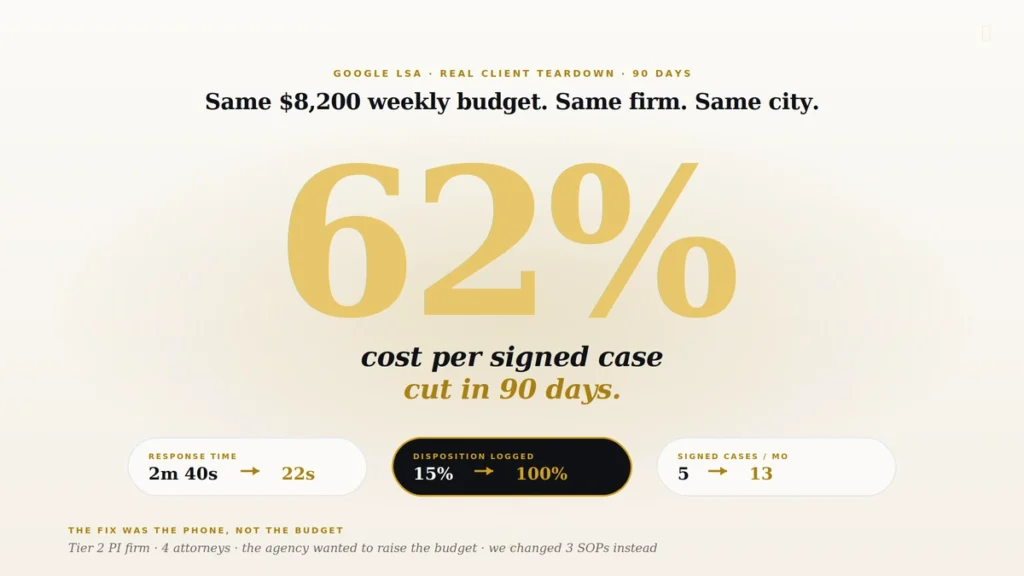
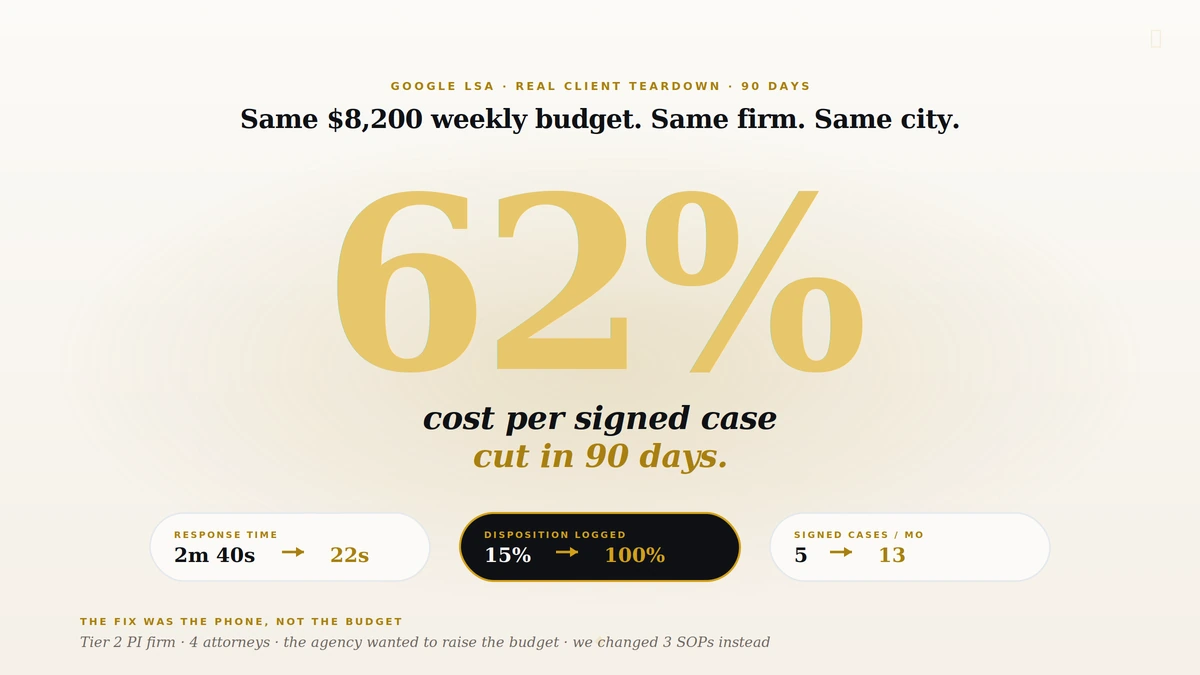
The $8,200 weekly LSA spend that was almost wasted
One of my clients (Florida PI firm, Tier 2 metro, 4 attorney shop) was running $8,200 per week through LSA when they hired me for an audit in mid 2025. Placement was inconsistent, signed cases were 4 to 6 per month against a target of 10 to 12. The audit found that intake and disposition were the leak, not budget. The 90 day teardown is below.
Real client teardown
Tier 2 PI firm: $8,200 weekly LSA over 90 days
Before (Q2 2025)
Average response time2 min 40 sec
Calls answered72%
Disposition logged15%
Disputed bad leads0 per month
Signed cases / month5
$6,560 per signed caseat $8,200 weekly spend
After (Q4 2025, 90 days)
Average response time22 sec
Calls answered96%
Disposition logged100%
Disputed bad leads9 per month
Signed cases / month13
$2,523 per signed caseat same $8,200 weekly spend
90 day shift: response time, then cost per signed case
Same firm. Same $8,200 weekly LSA spend. Response time fell from 160 to 22 seconds. Cost per signed case followed.
3 moves drove the change. One: dedicated intake line with after hours forwarding (response time 160 sec to 22 sec). Two: CRM integration auto pushing disposition from Clio to LSA. Three: weekly dispute discipline recovering $400 to $700 per week in invalid charges.
The pattern across audits
Across 18 LSA audits since 2024, response time and disposition fixes produced 40 to 70 percent improvement in signed case count without a budget increase in 12 of them. The 6 that did not improve all had broken intake operations underneath; nothing compounds without the answer the phone foundation.
What changed with the Google Screened to Google Verified badge for lawyers?
In October 2025, Google replaced the legal Google Screened badge with a generic Google Verified checkmark, the same one locksmiths and HVAC technicians earn. Vetting (background check, bar verification, malpractice insurance) still applies. The signals that now determine ranking are review count, review velocity, response time, and lead disposition. Firms whose LSA strategy was built on the badge alone lost their differentiation overnight.
How does Google rank Local Service Ads for lawyers?
Based on tracking 18 legal LSA accounts since 2024, the ranking factors break down roughly as: response time (30 percent), review velocity (20 percent), lead disposition signals (20 percent), proximity (15 percent), profile precision (10 percent), and budget or ad rank (5 percent). Response time is the single most heavily weighted signal: firms answering within 30 seconds consistently outrank firms answering in 4 minutes, even at lower budgets. Missing 3 calls in a row can drop a firm from the top 3 spots for days.
How much does an LSA lead cost for lawyers by city?
LSA cost per lead varies by metro tier and practice area. Tier 1 cities (NYC, LA, Chicago, Houston) run $250 to $500 per PI lead and 35 to 60 percent above the national average. Tier 2 (Miami, Dallas, Atlanta, Phoenix) runs $150 to $300, 25 to 40 percent premium. Tier 3 (Tampa, Orlando, Nashville) runs $80 to $180. Smaller markets run $50 to $120. Family law and immigration leads run 40 to 60 percent cheaper than PI in every tier. The Metro Premium Index in this article covers the full breakdown.
Why am I not getting LSA leads even though my budget is set?
The most common cause is the intake feedback loop being broken. LSA is not a traditional ad platform; it is a machine learning system that requires the firm to send lead disposition signals (booked, retained, not a fit, spam) back to Google. If the firm never disputes bad leads or marks retained clients, the algorithm has no quality signal and either reduces impressions or sends lower quality leads. The second most common cause is response time degradation; firms answering inconsistently lose ranking within days.
Is Google LSA compliant with attorney advertising rules?
Yes, with caveats. ABA Model Rules and most state bars (including Florida Rule 4-7.13) allow LSA participation if the firm controls the ad content and the calls are answered by the firm or an authorized agent. Three compliance traps: 1) LSA routed call recordings may capture privileged communications, so the firm needs a triage script that pauses recording when representation is discussed; 2) Florida requires the disclaimer that prospective clients may not obtain the same or similar results if any review or claim implies past performance; 3) third party intake services answering as the firm can create unauthorized practice of law exposure if not properly supervised.
What is the LSA response time benchmark for top ranked law firms?
As of 2026, under 30 seconds is the threshold that separates top 3 LSA spots from positions 4 and below. Firms answering in 30 to 60 seconds rank consistently but cycle through positions. Firms answering in 60 to 120 seconds rank intermittently. Firms answering above 2 minutes see ranking degrade within 30 days. Industry data on lead conversion shows clients contacted within 5 minutes are 9 times more likely to convert. The LSA algorithm rewards the same behavior because conversion velocity is the metric Google optimizes for.
Next step
Want me to audit your LSA account and find the leak?
I pull the LSA dashboard, audit response time and disposition, score the profile, and hand back a 90 day plan with the ranking factor model attached. If the account is running clean, I tell you that. If there is a 5 figure leak (usually there is), I show exactly where. Select PI, family, criminal, immigration, and complex civil firms.