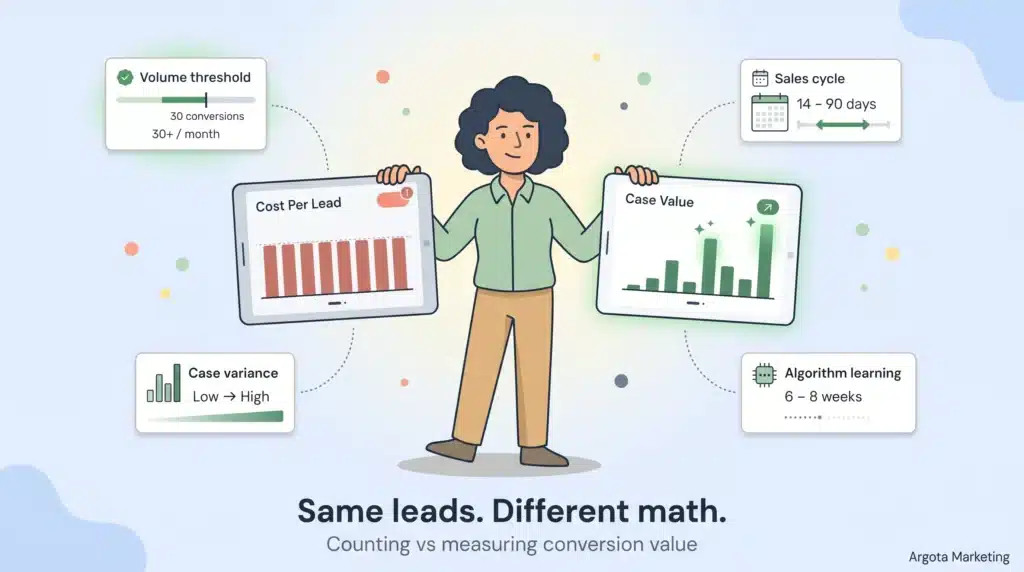
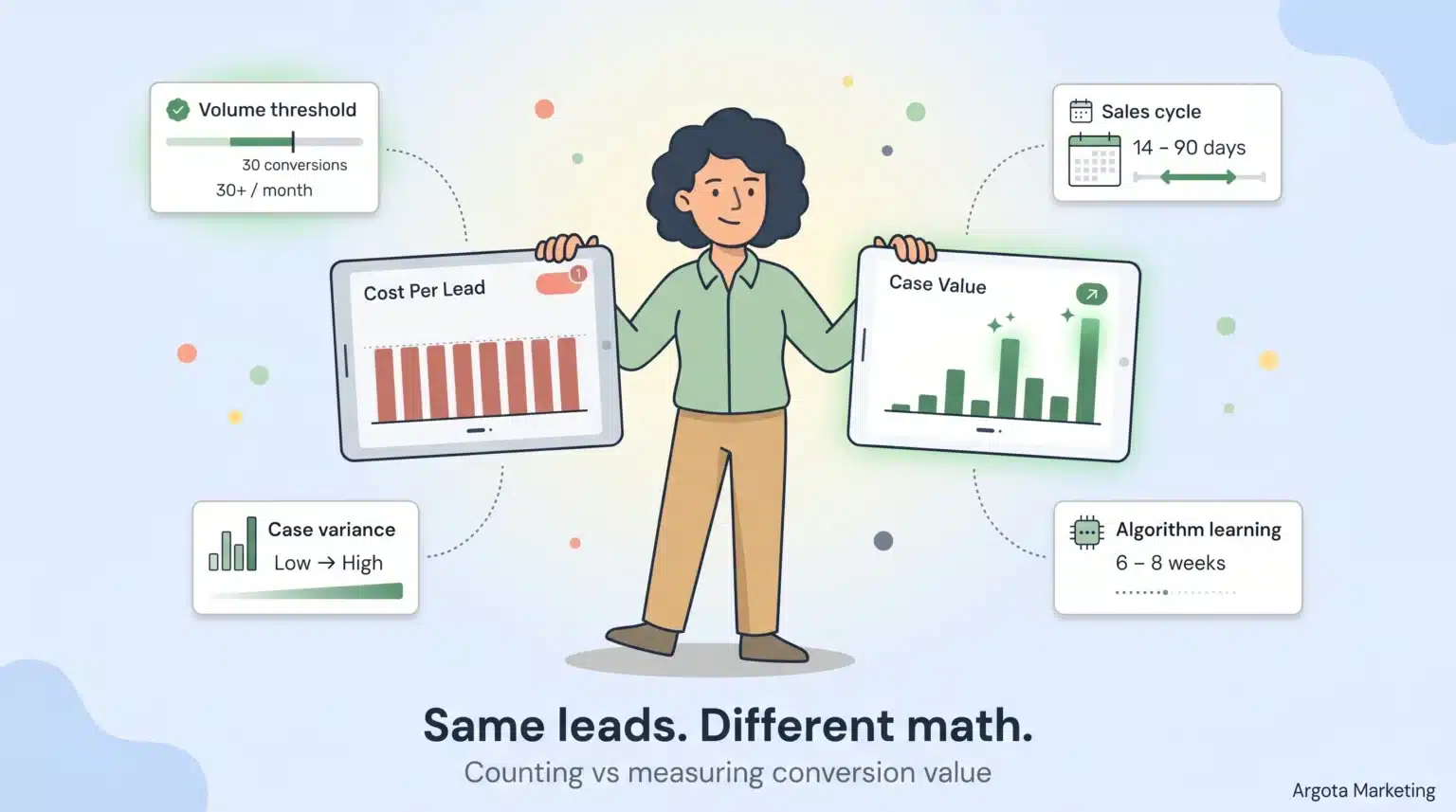
Cost per lead bidding optimizes for any lead at a target price. Case value bidding tells Google which leads are worth more and lets the algorithm bid up for them. Below is the decision framework, the volume thresholds, the city by city analysis, and the migration playbook for moving from one to the other without flushing the budget.
Jorge Argota · 10 years in legal marketing · Miami
10 years working alongside Percy Martinez P.A. on marketing, intake, and client acquisition. Built and managed paid campaigns for 10 plus Florida firms since 2016.
Specializes in
Google Ads biddingOffline conversionsSmart biddingCRM integrationFL Bar compliance
Conversion volume decides the strategy. Case value variance decides whether the strategy is worth the work.
Below 30 monthly conversions per campaign, stay on cost per lead bidding. Between 30 and 100, target CPA toward an offline qualified lead conversion. Above 100, target ROAS with imported case values. The algorithm needs volume to learn, and case value bidding needs case value variance to be worth the implementation cost. Personal injury, med mal, and mass tort have the variance. Workers comp and fixed fee work do not.
Decision framework
The 60 second answer, by monthly conversion volume
Google’s smart bidding algorithm has volume thresholds. Below the threshold, value-based bidding underperforms cost per lead bidding because the algorithm cannot tell signal from noise. The thresholds below are pulled from Google Ads documentation and verified against real campaign data on Florida law firm campaigns.
Under 30
Monthly conversions
CPL with offline layering
Maximize Conversions or target CPA. Use a “contacted lead” event as the primary signal and a “retained client” event as a secondary signal weighted higher. Skip case value bidding until volume scales.
30 to 100
Monthly conversions
Hybrid: tCPA on qualified leads
Target CPA bidding toward a single offline qualified lead conversion. The algorithm has enough data to optimize toward quality, not just volume. Begin importing case values in parallel for the future move.
100 plus
Monthly conversions
Target ROAS with case values
Full case value bidding. Import actual signed case values from the CRM. Set tROAS targets based on practice area economics. Allow 6 to 8 weeks for the algorithm to recalibrate.
Volume is the floor, not the ceiling. Case value bidding only outperforms CPL when there is meaningful variance between leads. A firm signing $1,200 fender benders alongside $400,000 wrongful death cases benefits more from case value bidding than a firm where every signed case is roughly the same fee.
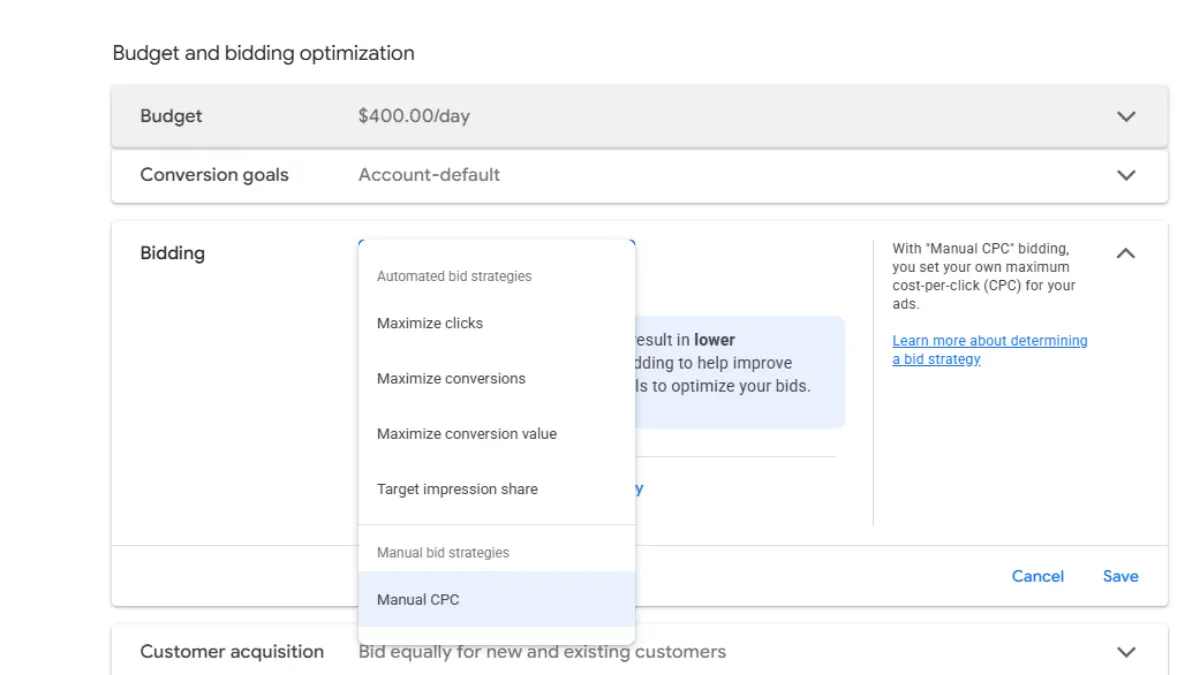
The actual bidding strategy options inside Google Ads. Target CPA and Target ROAS map directly to the framework above: CPL bidding and case value bidding.
Side by side
Where each strategy actually wins
Most of the published comparisons get this wrong by recommending one strategy across the board. The honest answer is that each strategy wins under specific conditions. The matrix below shows the dimensions that matter and the conditions under which each one wins.
Dimension
Cost per lead
Case value
Winner
Minimum monthly volume
15 conversions per campaign
30 conversions per campaign
CPL low volume
Sales cycle length
Works for 7 to 45 days
Optimized for 14 to 90 plus days
Value long cycle
Case value variance
Treats every lead the same
Bids up for higher value leads
Value PI / med mal
Setup complexity
2 to 3 hours
8 to 12 hours plus CRM integration
CPL fast deploy
Algorithm learning period
2 to 3 weeks
6 to 8 weeks
CPL fast learning
Budget efficiency at scale
Consistent CPL, variable ROI
Variable CPL, optimized ROI
Value high spend
Best practice areas
Workers comp, traffic tickets, fixed fee
PI, med mal, mass tort, complex civil
Context dependent
The pattern most firms miss: setup time and learning period are not minor inconveniences. Case value bidding takes weeks to stabilize, and a firm running tight monthly budgets cannot afford a 6 week learning period that produces noisy results. CPL is sometimes the right answer not because it produces better results, but because the firm cannot absorb the variance during the learning phase.
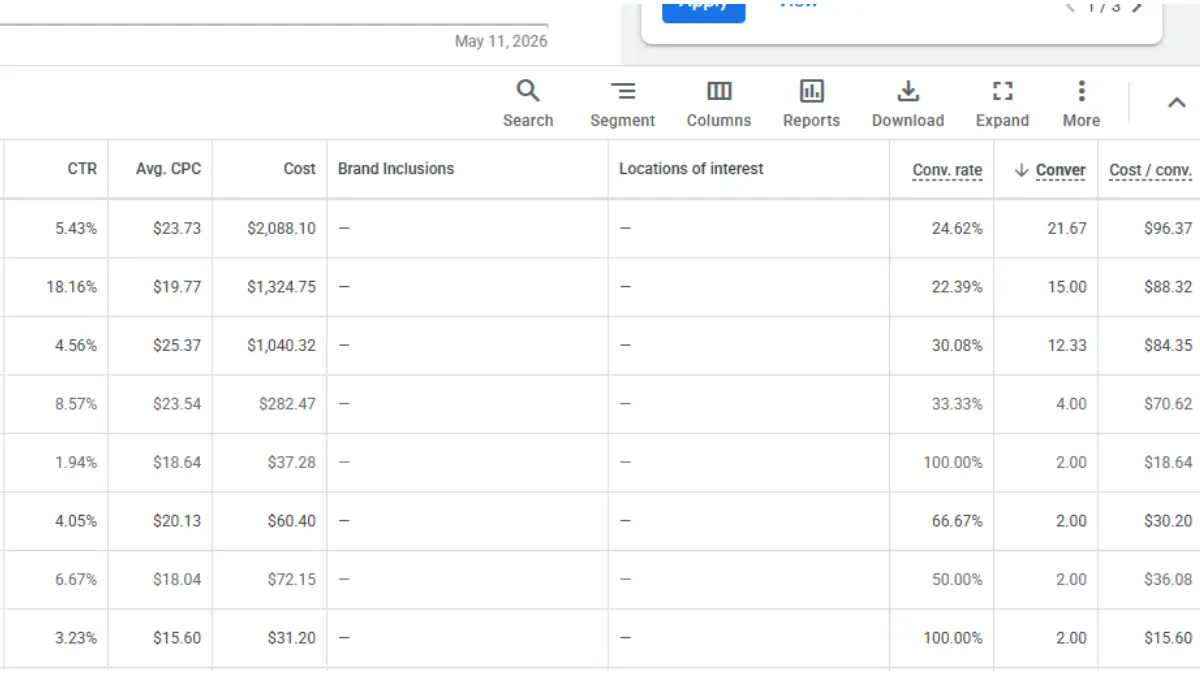
A live CPA campaign view showing the metrics that drive the bidding decision. Cost per conversion alone tells one story. Cost per signed case tells the real one.
By metro
What the data says by city tier
Personal injury CPCs vary by 6x across the top 10 US legal markets. The optimal strategy varies with them. Below are the 3 tiers, the cities in each, the CPC and CPL ranges, and the recommended starting strategy.
Tier 1 · Case value required
Volume and value variance both justify the work
New York, NY $150 to $450 CPC
Los Angeles, CA $120 to $380 CPC
Chicago, IL $110 to $320 CPC
San Diego, CA $105 to $310 CPC
The play: Case value bidding with tiered offline values. Volume is high enough that the algorithm gets clean signal. Case value variance ranges from $50K fender benders to $2M plus catastrophic injuries. CPL bidding leaves significant ROI on the table in these markets because the algorithm cannot distinguish high value cases from filler leads.
Tier 2 · Hybrid wins
Strong case value math, but volume warrants caution during transition
Miami, FL $95 to $280 CPC
Dallas, TX $90 to $270 CPC
Houston, TX $85 to $260 CPC
Philadelphia, PA $100 to $295 CPC
The play: Run hybrid for 90 days. CPL on prospecting campaigns to maintain volume, case value bidding on remarketing and high intent campaigns where the data is cleanest. Move fully to case value once the offline import match rate clears 50 percent and monthly conversions stabilize above 100.
Tier 3 · CPL with conversion ladder
Volume is the constraint, not value variance
Phoenix, AZ $75 to $220 CPC
San Antonio, TX $70 to $200 CPC
The play: Stay on target CPA with offline conversion imports as supporting signal. The algorithm does not have enough monthly conversions to optimize on value cleanly. Use a multi step value ladder (MQL, SQL, retained) as offline conversion events, weighted by close rate, to feed the algorithm quality signal without requiring full case value bidding.
The wrong question is “case value or CPL”. The right question is “do I have enough volume and enough case value variance to make case value bidding outperform CPL after the learning period”. For most Tier 2 firms, the answer is yes within 90 days. For most Tier 3 firms, the answer is no.
Jorge Argota · May 2026
Implementation
How to assign values: the conversion value ladder
Case value bidding only works if the values you import are real. Generic “form fill = $100” assignments produce generic results. The right method is a conversion value ladder: each step in the lead lifecycle gets a value calculated as the average case fee times the close rate at that step. The formulas below are the ladders I use across active client campaigns.
Practice area
Personal injury
Form fill 5 percent close x $1,000 avg fee
$50
Qualified call 20 percent close
$200
Consultation scheduled 50 percent close
$500
Case retained actual fee
$800 to $15,000
Practice area
Medical malpractice
Initial inquiry 2 percent close x $5,000 avg fee
$100
Case review completed 15 percent close
$800
Expert review passed 60 percent close
$3,000
Case filed actual contingency value
$8,000 to $80,000
Practice area
Mass tort / class action
Qualified plaintiff high volume, lower individual value
$150
Medical records received
$400
Settlement eligible
$800
Settlement received per plaintiff payout
$1,500 to $25,000
Practice area
Workers comp / fixed fee
Form fill or call
$80
Qualified intake
$300
Retained client flat per matter
$1,200 avg
Fixed fee work low value variance
Use CPL
The numbers shift firm by firm. The structure does not. Each step gets a value tied to that step’s close rate and the average fee at retention. The algorithm uses the values to bid up for traffic that produces signal at the higher rungs, not just the form fill rung. The fewer rungs you import, the less the algorithm has to work with.
The conversion value ladder as it actually appears flowing into Google Ads. GCLID matches the user, conversion value tells the algorithm what that user was worth.
Migration playbook
Moving from CPL to case value: a 6 month roadmap
The mistake most firms make is flipping from CPL bidding to case value bidding in a single change and watching CPL spike for 4 weeks while the algorithm relearns. The right method is a phased transition with parallel tracking, hybrid bidding, and rollback triggers built in.
Weeks 1 to 2
Baseline and instrumentCapture current CPL performance across campaigns. Install offline conversion tracking. Set up GCLID capture in the CRM. Define the value ladder for each practice area. Do not change bidding yet.
Weeks 3 to 4
Parallel value trackingBegin importing offline conversion values alongside the existing CPL bidding. The algorithm sees the values but bids on the existing CPL target. This is the data accumulation phase. Watch the offline import match rate. Target 45 to 65 percent.
Weeks 5 to 8
Hybrid bidding splitMove 40 percent of budget to maximize conversion value with target ROAS. Keep 60 percent on the existing CPL bidding. Compare cost per signed case across both halves. If the value half outperforms by 15 percent or more, plan the full migration.
Weeks 9 to 16
Full case value biddingMigrate remaining campaigns to target ROAS with imported case values. Allow 6 to 8 weeks for the algorithm to fully relearn. Expect noise in weeks 9 to 12. The performance baseline reasserts in weeks 13 to 16. Do not panic-revert during the noise window.
Weeks 17 to 24
Optimize and scaleRefine target ROAS by campaign and practice area. Add geo modifiers and audience layers. Scale budget on campaigns where cost per signed case is improving. Cut campaigns where the algorithm has not stabilized after 16 weeks; those usually have insufficient volume or value variance.
Build rollback triggers into the migration. If CPL increases by 40 percent or more for 3 consecutive weeks during weeks 5 to 8, revert to the prior structure and reassess. If the offline import match rate stays below 35 percent after week 4, the data pipeline has a problem and case value bidding will not work until it is fixed.
Compliance
What state bar rules actually require
The bidding strategy itself is internal to Google Ads. State bar rules do not regulate which bidding strategy a firm uses. The compliance issue is in the ad copy, landing pages, and intake flows that drive the conversions the bidding strategy optimizes for. Below is the Florida specific framing. Out of state firms map to their own state bar rules, which are similar in most jurisdictions.
Florida specific
Three rules carry most of the weight. Rule 4-7.13(b)(3) prohibits comparative superiority claims like “best” or “top” in any ad copy that drives conversions. Rule 4-7.14(a)(4) restricts “specialist” and “expert” to attorneys with Florida Bar Board Certification. Past results in ad copy or landing pages trigger Rubenstein v. Florida Bar (2014) disclosure requirements. The bidding strategy does not change any of this. Whether the firm runs CPL or case value bidding, the same rules apply to everything the algorithm is optimizing for.
For med mal specifically, HIPAA considerations apply if the offline conversion data flowing into Google Ads contains any protected health information. Most firm CRMs are HIPAA compliant, but the data pipeline between the CRM and Google Ads is the place to verify. Hashed identifiers and case value numbers without diagnosis or treatment data are usually safe. Raw medical record references are not.
Related reading
Where bidding strategy connects to the rest of the system
Bidding strategy lives downstream of channel allocation and upstream of intake. These pieces cover the adjacent decisions.
What is the difference between case value bidding and cost per lead bidding?
Cost per lead bidding tells Google to optimize for any lead at a target cost. Case value bidding tells Google which leads are actually worth more and lets the algorithm bid up for the higher value ones. CPL treats every form fill the same. Case value treats a $50,000 personal injury claim differently than a parking ticket inquiry. CPL is simpler to deploy and works at lower volumes. Case value requires offline conversion imports and at least 30 conversions per month to hit the algorithm’s learning threshold, but it produces a meaningfully higher signed case ROI when the firm can feed it real values.
How many conversions do you need for case value bidding to work?
Google’s smart bidding algorithm needs at least 30 conversions per month per campaign to optimize on value, with at least 15 of those carrying meaningful value differentiation. Below 30, the algorithm cannot tell signal from noise and case value bidding underperforms cost per lead bidding. Between 30 and 100 conversions, target CPA bidding toward the primary offline conversion is usually the better choice. Above 100, target ROAS with imported case values is the strongest play.
When should a law firm switch from CPL to case value bidding?
Switch when three things are true. First, monthly conversion volume is consistently above 30 per campaign. Second, the firm has reliable offline data tying form fills and calls back to actual signed case values, usually through a CRM like Clio or Salesforce. Third, case values vary meaningfully across leads, which is true in PI, med mal, and mass tort but not workers comp or fixed fee work. If any of those three are missing, stay on CPL until they are in place.
What is the right CPL for personal injury lawyers?
It depends on the metro. NYC personal injury runs $800 to $2,500 per lead. LA runs $700 to $2,200. Chicago $650 to $1,900. Miami $550 to $1,600. Houston $500 to $1,500. Phoenix $450 to $1,300. CPL alone is the wrong question though. The right question is cost per signed case. A $1,500 lead that converts at 25 percent is cheaper per signed case than a $400 lead that converts at 5 percent.
How do you assign conversion values to legal leads?
Use a conversion value ladder. Each step in the lead lifecycle gets a value calculated as: average case fee multiplied by close rate at that step. For personal injury: form fill $50 (5 percent close times $1,000 average fee), qualified call $200 (20 percent close), consultation scheduled $500 (50 percent close), case retained at the actual fee value. Med mal uses the same formula with higher averages. Workers comp and estate planning use fixed values per matter type because case value variance is low.
Does Florida Bar Rule 4-7.13 affect what conversion values a law firm can use?
The bidding strategy itself is internal to Google Ads and does not violate any state bar rule. The compliance issue is in the ad copy and landing pages that drive the conversions. Florida Bar Rule 4-7.13(b)(3) prohibits comparative superiority claims like ‘best’ or ‘top’ in the ad copy. Rule 4-7.14(a)(4) restricts ‘specialist’ and ‘expert’ to attorneys with Florida Bar Board Certification. Past results in ad copy or landing pages trigger Rubenstein v. Florida Bar (2014) disclosure requirements. Out of state firms map to their own state bar rules with similar restrictions.
Next step
Want me to audit your bidding strategy and tell you which one fits your firm?
I review your conversion volume, value variance, CRM setup, and city tier, then recommend whether to stay on CPL, run hybrid, or move to full case value. Available for select PI, med mal, and complex civil firms.