



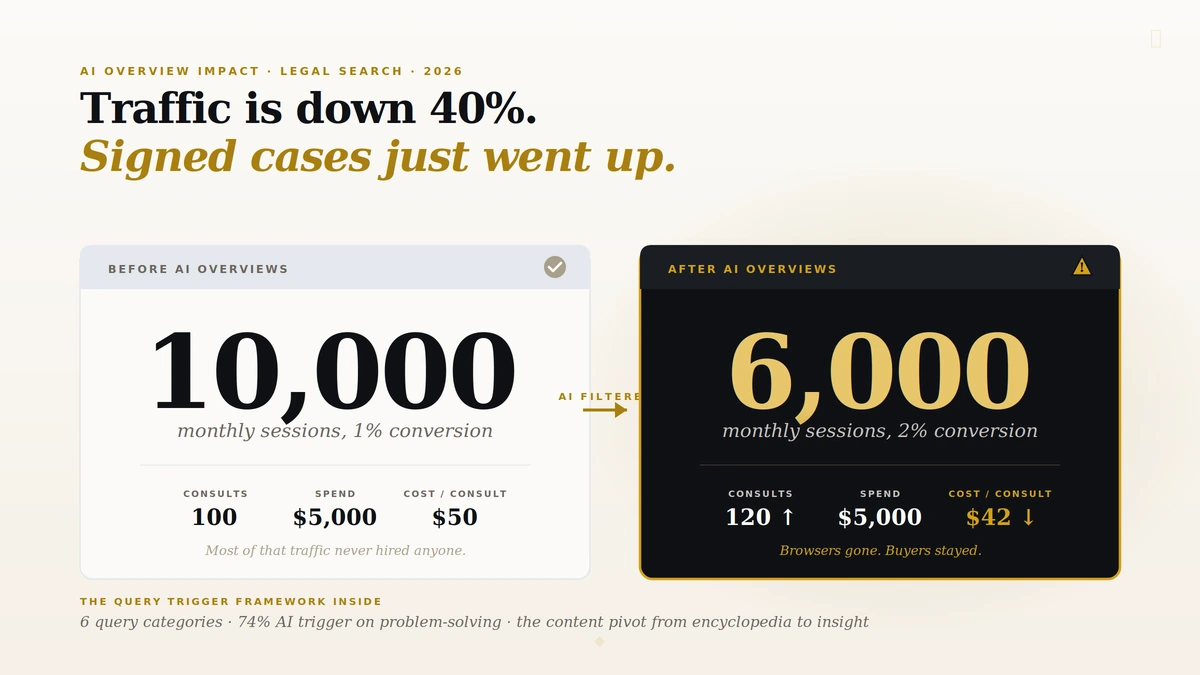





Impact: AI Overviews dropped legal organic CTR 61 percent and paid CTR 68 percent. Zero click rates hit 70 percent of legal queries by end of 2026.
The counter narrative: The traffic AI is taking converted at 1 percent anyway. The traffic that still clicks converts 185 to 2,300 percent higher because the AI handled the education phase.
What to do now: Pivot content from encyclopedia (“what is”) to insight (proprietary data), and shift KPIs from total sessions to cost per signed case. Based on 10 years of Florida legal account work and 18 law firm site audits since the SGE beta.
The pages that lost traffic were never the ones generating cases
Pulling analytics for a bunch of law firm sites over the last 6 months, the same pattern showed up everywhere: traffic down 30 to 40 percent on a chunk of pages, leads flat or actually up. The math should not work; if fewer people visit, fewer leads should follow. Then I sorted which pages lost traffic and which kept it.
- “what is the statute of limitations for PI in Florida”
- “how much does a DUI lawyer cost”
- “how to file for divorce in Texas”
- “Miami car accident lawyer”
- “best medical malpractice attorney near me”
- “divorce attorney Austin TX”
AI search is not killing law firm marketing. It is killing the part of the funnel that produced the worst ROI, while leaving hire intent traffic untouched.
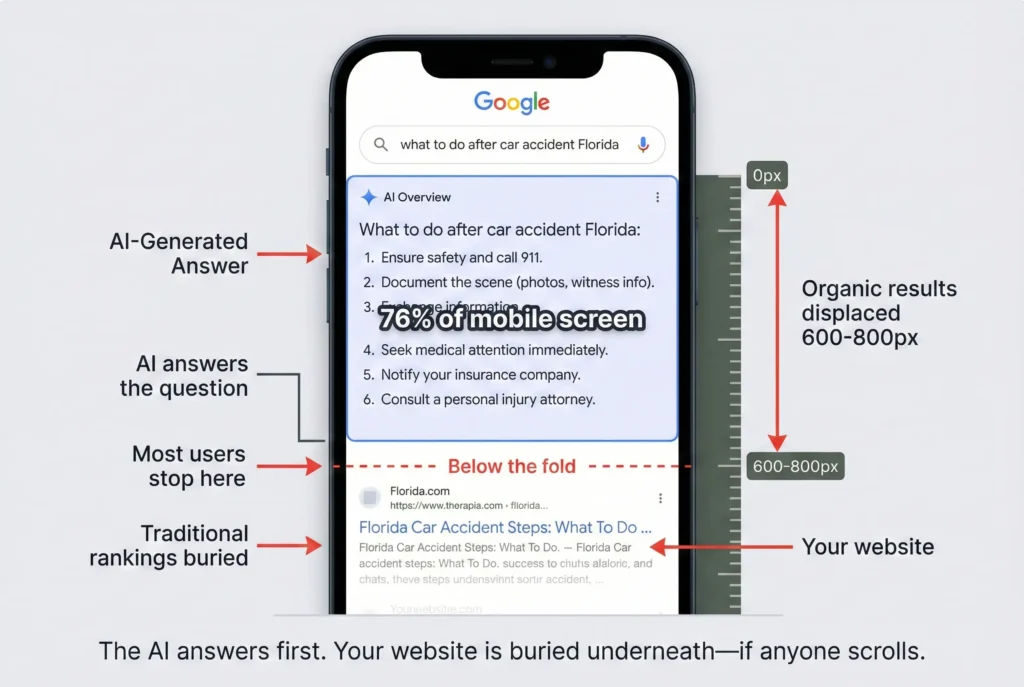
AI Overviews impact on law firm traffic
When an AI Overview appears on a legal query, organic CTR drops 61 percent and paid drops 68 percent. Out of every 1,000 Google searches, only about 360 clicks reach any non Google site. On mobile, where most legal searches happen, the zero click rate is closer to 77 percent. SparkToro and Semrush data line up on this.
QS Digital analyzed 18 law firm sites in late 2025 and found a median traffic drop of 19 percent, with some firms losing close to 80 percent of blog and FAQ traffic. Meanwhile PPC costs on the surviving traffic keep rising: PI keywords are up roughly 568 percent per click since 2021, with certain terms topping $1,000.
rate for legal queries
by end of 2026
The Query Trigger Framework for legal search
Not every search triggers an AI Overview. The trigger rate breaks down by query type, and understanding the split is the difference between writing content the AI will steal and writing content the AI cannot replace. Below is the 6 category framework I use on every audit.
The risk gets worse as the query gets longer. Short searches like “divorce lawyer” trigger the Map Pack. Long tail searches like “can I keep my house if I divorce my husband for cheating in Georgia” trigger AI Overviews almost every time. Long tail blog content is exactly what most law firm SEO strategies have been built around for the last decade. That is the whole problem.
Pull every page from Google Search Console. Sort each into the 6 categories above. If 70 to 80 percent of pages fall into the top 4 high or medium risk categories (which is the case for most law firm sites I audit), 70 to 80 percent of the content strategy is sitting in the AI’s kill zone.
AI filtered traffic and the conversion rate shift
The traffic AI Overviews are taking is mostly people looking for free information. They want to know what comparative fault means or how long they have to file a claim. These were the lowest converting visitors anyway. The AI is not stealing buyers; it is stealing browsers. The people who read the AI answer and still click through already know the basics. They are looking at the site because they want to hire someone. Early data shows AI filtered visitors convert at 185 to 2,300 percent higher rates than traditional organic.
Martindale Avvo’s 2026 data shows a True Contacts Multiplier of about 2.1: for every 10 leads the firm tracks, roughly 11 more happen off platform. Someone sees the firm in an AI Overview, reads the reviews, types the firm name into Google Maps, and calls. The dashboard logs that as a direct lead and misses the AI Overview attribution entirely.
This is not about losing traffic. It is about losing commodity visibility and gaining qualified demand. The firms that figure that out first own the next 5 years.
The blog strategy has to change
The blog strategy that worked for the last 10 years (4 to 8 posts a month answering common legal questions) is dying. Every one of those posts answers a question the AI can answer itself, often citing the firm’s own post as the source. The firm wrote the content. The AI took the value.
- “What is comparative negligence in Florida”
- “How to file for divorce in Texas”
- “Penalties for first time DUI in California”
- Generic process and definition articles
- “200 intersection accidents in Miami Dade: timeline data”
- “3 custody arguments that work in Harris County”
- “300 DUI cases in Orange County: outcome breakdown”
- Proprietary data with verifiable numbers
The pattern is the same across practice areas. PI: replace “what is comparative negligence” with “we tracked 200 intersection accidents in Miami Dade and here is what the timeline from filing to settlement looked like.” Family: replace “how to file for divorce in Texas” with “the 3 custody arguments I have seen work consistently in Harris County and the 2 that judges seem to hate.” Criminal: replace “penalties for first time DUI in California” with “300 DUI cases in Orange County and what actually happens versus what the statute says.” The AI can summarize a statute. It cannot summarize the firm’s experience in a specific courthouse with a specific judge.
The 5 part template for every page that survives
Every page on this site is built on the same 5 part template. The template is what makes content non commodity at scale, and the AI cites the firm as the source. Reusable for any topic, practice area, or future platform.
Worked example, this page: intent is problem identification. Promise is a query level diagnostic with conversion math, not generic “AI is changing search” content. Proof is the CTR data and True Contacts Multiplier. Compliance overlay is YMYL accuracy and FL Bar Rule 4-7.13. Semantic bank covers zero click searches and AI Overview impact.
The agent layer that comes after this one
The bigger shift past 2026 is AI moving from answering questions to doing things. Soon a client will say “find me a top divorce lawyer in Austin who handles custody and book me Tuesday at 10 AM” and the AI agent will do all of it without a browser opening. In that world the website does not matter. What matters is whether the firm exists as a verified entity in the Knowledge Graph. If the firm’s name, bar number, practice areas, and address are not consistent across every database the AI checks, the agent will not consider the firm. Getting visible in AI answers is the prerequisite for the agent layer that comes next.
3 moves the firm should make this month
Three concrete moves, in order, based on what 18 firm audits since 2024 actually changed when implemented:
Pull every indexed page from Google Search Console. Sort each into the 6 query categories from the table above. Pages in the top 4 categories are sitting in the AI’s kill zone. Stop writing more of them. Pages in the bottom 2 are the survivors; double down on those.
Replace the next 3 months of planned encyclopedia content with insight content using the 5 part template. One proprietary data piece, one courthouse specific piece, one subjective strategy piece per month. Stop writing what the AI can already answer.
Stop reporting total sessions in monthly marketing reviews. Start reporting engaged sessions, conversion rate by source, and cost per signed case. A firm whose sessions drop 40 percent while signed cases hold flat is not failing; it is succeeding under a measurement system that no longer reflects how clients find lawyers.
Where this connects to the rest
Common questions about AI Overviews and legal search
How much has AI Overview reduced law firm website traffic?
Which legal queries trigger Google AI Overviews?
Is AI Overview traffic more valuable for law firms?
Should law firms stop blogging because of AI Overviews?
How should law firms measure marketing now that AI Overviews are eating traffic?
Want me to run the AI Overview audit on your site?
I pull the firm’s Search Console data, sort every indexed page into the 6 query categories, identify the pages sitting in the AI’s kill zone, and hand back a content pivot plan with the KPI shift attached. If the numbers look fine, I tell you that. Available for select PI, family, criminal defense, immigration, and complex civil firms.
Request an AI traffic audit →