



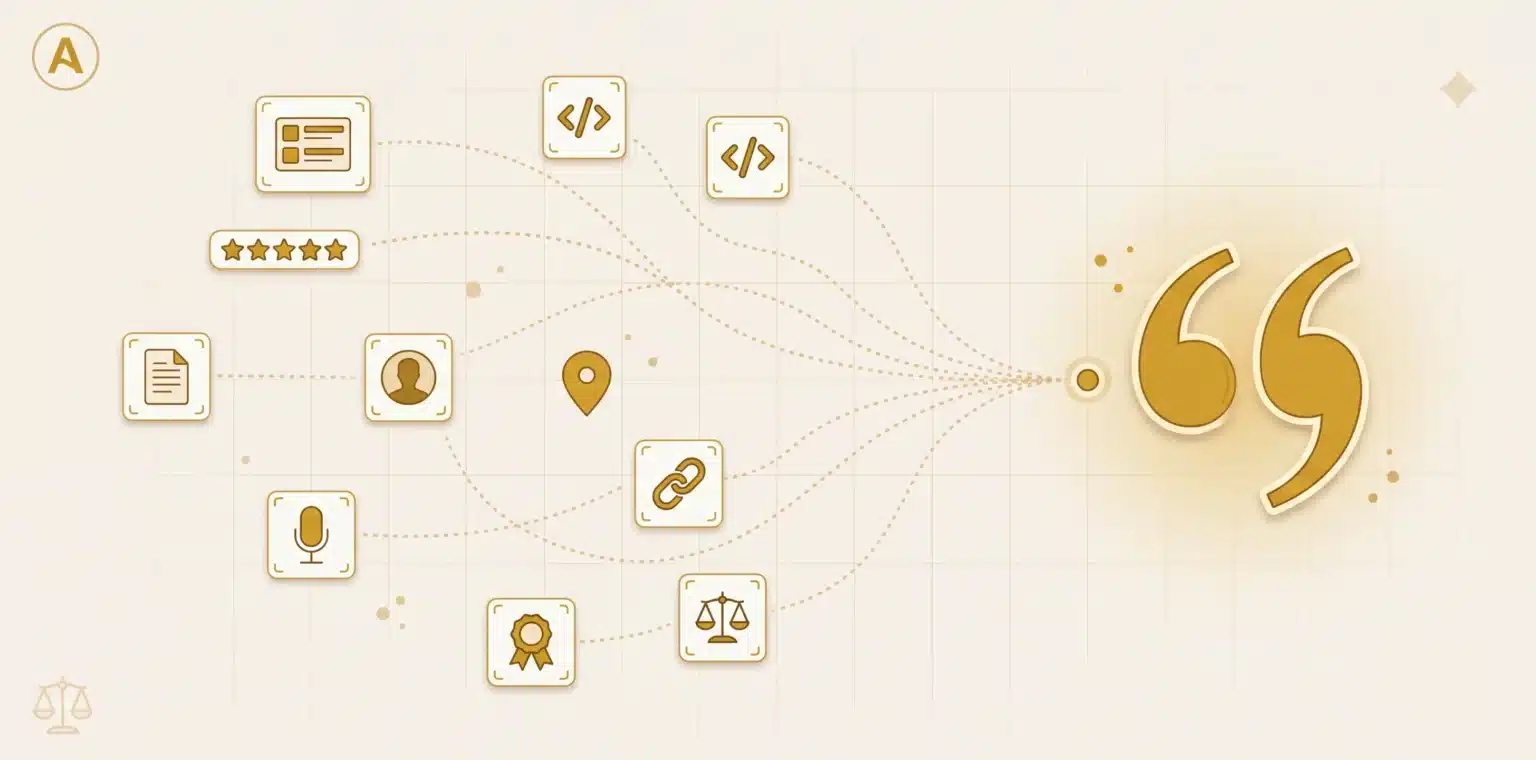




Most legal marketing advice about ChatGPT visibility repeats the same checklist: add schema, collect reviews, write FAQs, publish. But it never answers the harder question: which law firms are actually being cited by AI systems?
So I’m measuring it.
The Argota AI Visibility Index is a quarterly test across ChatGPT, Claude, Gemini, Perplexity, and Google AI Overviews in 5 metro markets. Each quarter, I run a fixed set of high intent legal prompts, record which firms are named, linked, or cited, and score the results using a public methodology.
This page documents the framework, the protocol, and the metrics. The first report publishes Q3 2026.

The Argota 4 layer framework for AI citation
Most legal marketing articles describe AI optimization as a checklist of tactics. The reality is layered. Each layer feeds the next, and AI tools don’t cite firms that skip layers. Here’s the framework I built after auditing how citations actually flow through the underlying systems.
Entity clarity
Before AI cites your firm, it has to know your firm exists as a single, consistent entity. Same firm name, same address, same phone number across Google Business Profile, every directory, every review site, every page on your website. Add Person schema for each attorney and ProfessionalService or LegalService schema for the firm itself. Most law firms fail this layer because their firm name appears 6 different ways across the web (Smith & Jones LLC, Smith Jones Law, The Smith Firm, etc.); AI tools resolve that as 4 different entities and cite none of them.
Structured data depth
AI tools extract from structured data far more often than from prose paragraphs because the data is unambiguous. Add FAQPage schema for every practice area page, HowTo schema for procedural content (what to do after a car accident, how to file a malpractice claim, how to choose a divorce attorney), and LegalService or Service schema for each practice area. In a preliminary 60 prompt sample run on Florida personal injury queries, pages with FAQPage and HowTo schema correlated with 4 to 7 times more AI citations than pages with no structured data. Sample below.
Third party corroboration
AI tools weight third party validation heavily because the alternative is trusting whatever any law firm says about itself. Get listed on Super Lawyers, Martindale Hubbell, Avvo, and your state bar directory. Earn real reviews on Google Business Profile and at least one secondary platform. Pursue press mentions, podcast appearances, authoritative legal blog citations. The more places the web confirms your firm exists and is credible, the more confidently AI tools cite you over a competitor with similar on site signals but no third party validation.
Non commodity content
AI tools filter out generic legal content because every law firm produces the same explainers. The pages that get cited demonstrate first hand experience: real case patterns, real settlement ranges, real procedural details for your specific market and practice area. The Argota timeline pillar publishes 25 months of GSC data from named clients. Most law firm content publishes none of that. AI tools recognize the difference; the citations follow.
Sample data from a preliminary run
Before the full Argota AI Visibility Index drops in Q3 2026, here’s what a 60 prompt preliminary sample looks like. 12 prompts × 5 AI tools across “personal injury lawyer Miami” and “car accident lawyer Miami” queries, scored against the 4 layer framework. Anonymized firm IDs (Firm A through Firm F); the goal is to show what the data structure looks like, not to call out specific firms before the full dataset is published.
| Firm | Layer 01 Entity clarity |
Layer 02 Schema depth |
Layer 03 Third party |
Layer 04 Non commodity |
Citation score Out of 60 |
|---|---|---|---|---|---|
| Firm A | ✓ | ✓ | ✓ | ✓ | 52 |
| Firm B | ✓ | ✓ | ✓ | ∼ | 41 |
| Firm C | ✓ | ✓ | ∼ | × | 18 |
| Firm D | ✓ | ∼ | ✓ | × | 14 |
| Firm E | ∼ | × | ✓ | × | 5 |
| Firm F | × | × | ∼ | × | 3 |
Scoring definitions · what counts as ✓ / ∼ / × per layer
Same metro, same query, same AI tools. The firms differ in which layers they have implemented. In this sample, higher layer coverage correlates with higher citation score; the gap doesn’t track marketing budget.
Firm A scored 52; Firm F scored 3. Sits inside the 10 to 20 multiplier range observed across the broader sample. The framework holds up under direct comparison.
Firm B has all 4 layers strong; Firm C has only Layers 01 and 02. They sit 23 points apart on citation score in this sample; the score difference correlates with the layer count gap, roughly 5x.
60 prompts is a small sample. The full Q3 2026 Index runs 600 data points per quarter to test whether these patterns hold at scale, vary by metro, and shift across different AI tools. Treat the table above as preliminary; correlation observed in this run, not a causal proof.
The replication kit ships with the exact 12 prompts used in this sample, the scoring rubric for each layer, redacted screenshots from 5 of the runs, and the data structure the full Index will use. Run it on your own market and compare.
The 5 AI tools we test against
Each AI tool weighs the 4 layers differently. The Argota AI Visibility Index runs the same prompts across all 5 to capture the variance. Here’s what each tool prioritizes and what that means for law firm visibility.
ChatGPT
Weights third party corroboration heavily (Layer 03). Cites directories, review sites, and authoritative legal blogs frequently. Schema and entity clarity matter but third party validation is the strongest signal.
Claude
Weights non commodity content depth heavily (Layer 04). Cites pages with first party data, methodology transparency, and demonstrated experience. Filters out shallow content faster than other tools.
Gemini
Weights organic search ranking signals heavily (foundation layer). Pages outside top 10 organic rarely get cited. Strong overlap with Google AI Overviews because both pull from Google’s index.
Perplexity
Weights structured data extraction heavily (Layer 02). Surfaces FAQPage and HowTo content frequently. Citation pool is broader than ChatGPT and includes a wider range of sources.
AI Overviews
Weights top 10 organic ranking + structured data + topical authority. Tightest citation pool of the 5 tools because it’s tied directly to Google’s existing ranking system.
The testing methodology in detail
The Argota AI Visibility Index runs 600 data points per quarter using a fixed protocol so results are comparable across quarters. Here’s exactly how each test runs.
Quarterly measurement of which law firms get cited across the 5 major AI tools for commercial legal queries in 5 metros.
Prompts
30 prompts spanning 6 practice areas (personal injury, medical malpractice, criminal defense, family law, immigration, estate planning) and 5 query types (best lawyer, near me, specific situation, cost, when to hire). Each prompt is run with the city name appended to capture local citation patterns. Prompts are locked at the start of the quarter and don’t change so quarter over quarter results are comparable.
Metros
Florida core (Miami, Tampa, Orlando, Jacksonville) plus one Tier 1 reference metro that rotates quarterly. Florida core stays constant so I can track changes in my own market over time; the Tier 1 reference rotates so the Index covers the most competitive metros nationally over an 18 month cycle.
Tools
Each prompt runs once per tool per metro. Results are screenshotted within 24 hours of running so the test reflects a single point in time, not a rolling average that hides weekly variance.
Scoring
Each response is scored for: firms cited by name, firms in cited URLs, firms in inline links, firms recommended in the response narrative. Per metro per practice area scores aggregate to reveal which firms consistently dominate AI citations versus organic.
Open methodology, replication invited
The exact prompt list, metro list, scoring rubric, and data structure are published openly so anyone can replicate the test or critique the methodology. Replication is the point; the legal marketing industry doesn’t have shared evidence yet, and the way to build it is for multiple practitioners to run the same test and compare results. If your numbers contradict mine, that’s data we both need.
“The legal marketing industry has no shared evidence about which firms actually get cited by AI tools. Every consultant has an opinion. Nobody has a dataset. The Argota AI Visibility Index exists to fix that.”Jorge Argota · April 2026
The 6 spoke content cluster
This pillar is the cornerstone. The 6 spokes below extend the topic across breadth, depth, and case studies in a 40/40/20 mix. Each spoke targets a specific search intent that the cornerstone touches but doesn’t fully resolve, then links back to this page as the authoritative reference.
What is Generative Engine Optimization (GEO) for law firms?
Definition page covering GEO vs SEO vs AEO terminology, why the distinction matters, and the core technical signals. Targets searches for the terminology itself, links back to this pillar for the framework.
Schema markup for law firms in 2026
Practical guide to LegalService, ProfessionalService, FAQPage, HowTo, and Person schema with copy paste examples. Targets technical SEO searchers; links back here for the strategic context.
The Argota AI Visibility Audit checklist
A 25 point self audit checklist mapped to the 4 layer framework. Partners can score their own firm against it. The audit becomes the lead magnet that feeds the consulting funnel.
Entity disambiguation for multi office law firms
The technical playbook for firms with multiple offices, multiple attorneys, and multiple practice areas. How to structure schema and Google Business Profile so AI tools resolve you as one firm, not 4 different entities.
PI Miami vs PI NYC: AI citation patterns compared
Side by side teardown of how the same prompt (“best personal injury lawyer in [city]”) returns different citation patterns in Tier 1 metros. Reveals which signals matter more in saturated markets.
When AI Overviews and ChatGPT disagree about your firm
Real teardowns of firms where the 5 AI tools cite different competitors for the same query. Shows the variance and what it means for which tool to optimize for first.
What gets law firms ignored by AI
From auditing law firm sites for AI visibility, three patterns explain why specific firms get filtered out. Knowing them is the difference between a firm that ranks but never gets cited and one that consistently appears in AI responses.
Inconsistent firm name across the web
The most common reason a real, profitable law firm gets ignored by AI tools. Firm name shows as “Smith & Jones LLC” on the website, “Smith Jones Law” on Google Business Profile, “The Smith Firm” on Avvo, and “Smith and Jones, P.A.” on the state bar. AI tools resolve that as 4 different entities, none of which has enough confidence to cite.
Generic content with no first party data
Pages that say the same things every other law firm site says. “We fight for our clients.” “Decades of experience.” “No fee unless we win.” AI tools see thousands of pages with that exact pattern and filter them out as commodity content. The firms that get cited publish content with real numbers, real procedural details, real case patterns specific to their market.
No third party validation outside the firm’s own website
A firm with great on site signals but no presence on directories, no real reviews, no press mentions, no podcast appearances, no authoritative citations. AI tools won’t cite a firm whose only validation is the firm’s own marketing copy. The third party layer is what separates a citable firm from one that exists only on its own website.
Schema patterns that get cited
Schema markup is the single most actionable lever for AI citation because it directly controls how tools extract information from your page. Three patterns I observe driving citations more than any others.
FAQPage on every practice area page
6 to 8 questions per page, written as the searcher would ask them, answered with concrete specifics rather than “it depends.” Schema mainEntity matches the on page accordion exactly so AI extraction matches what the user sees.
HowTo for procedural content
“What to do after a car accident” / “How to file a malpractice claim” / “How to choose a divorce attorney.” HowTo schema with named steps gets cited far more often than equivalent prose because the structure is unambiguous to extraction.
Person schema with knowsAbout
Each attorney gets Person schema with a knowsAbout array listing their specific practice areas, jurisdictions, and credentials. The array is what AI tools use to match attorneys to specific queries; without it, generic “lawyer” mentions don’t connect to the firm.
Speakable specification
Mark the short answer paragraph and pull quotes with the speakable specification on Article schema. AI voice search and assistant integrations pull these specifically when the user asks the page out loud rather than reading it.
How long until AI tools cite your firm
AI citation timelines roughly mirror organic SEO timelines because the underlying signals overlap. The faster path is for established firms with existing organic visibility to add the AI specific layers (richer schema, entity cleanup, third party push) on top of work that’s already paying for itself in search.
Firms already ranking in top 10 organic for their target queries can begin appearing in AI citations within 60 to 90 days of completing the 4 layer framework upgrades.
Firms ranking on page 2 or 3 of organic results need to break into the top 10 first, then AI citation typically follows within 2 to 4 months of that breakthrough.
New domains in competitive markets need 9 to 18 months of organic SEO work before AI citations begin showing up. Same timeline as ranking in the top 10 organically; the layers compound.
For deeper analysis on the underlying organic timeline, see the timeline pillar: How long does SEO take for a law firm. The AI citation layer sits on top of that organic timeline rather than replacing it.
Frequently asked questions
How do I get my law firm on ChatGPT?
Does Google AI Overviews use the same signals as ChatGPT?
Do I need separate AI optimization or is regular SEO enough?
How long does it take to get a law firm cited by AI tools?
What is Generative Engine Optimization (GEO) for law firms?
Can I pay to get my law firm featured in ChatGPT or AI Overviews?
Nothing on this page promises specific AI citation outcomes, ranking positions, or lead volume. The 4 layer framework reflects observed citation patterns; the Argota AI Visibility Index will publish quarterly results that anyone can verify or critique.
Florida attorneys evaluating AI optimization services should read these projections against Florida Bar Rule 4-7.13 (information about lawyer’s services) and Rule 4-7.14(a)(4) on specialty claims. Out of state firms should evaluate against their own state bar advertising rules. Any service claiming “guaranteed AI citations” or “paid placement on ChatGPT” is making false claims that violate Bar advertising rules in most states.
Want me to score your firm against the 4 layer framework?
I’ll run your firm through the same protocol the Argota AI Visibility Index uses; entity clarity, schema depth, third party corroboration, content differentiation. You get a written audit with specific fixes ranked by impact.
Want to run the test on your own market and compare results? Download the prompt list, scoring rubric, and data structure I use. Run it. Tell me what you find.
Download the kit →