A managing partner sent me his Google Ads account last week and the first headline I saw said “Florida’s Best Personal Injury Lawyer,” which is a Bar Rule 4-7.2 violation that’s been running for eleven months and his agency had no idea, and that’s the part of this decision nobody tells you about until you’re the one writing the response to the grievance complaint.
The honest answer
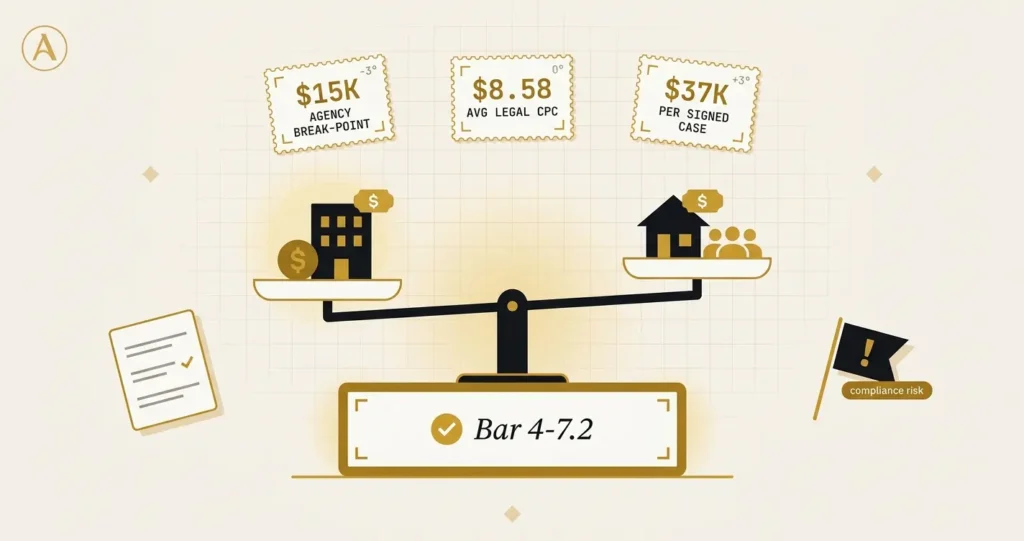
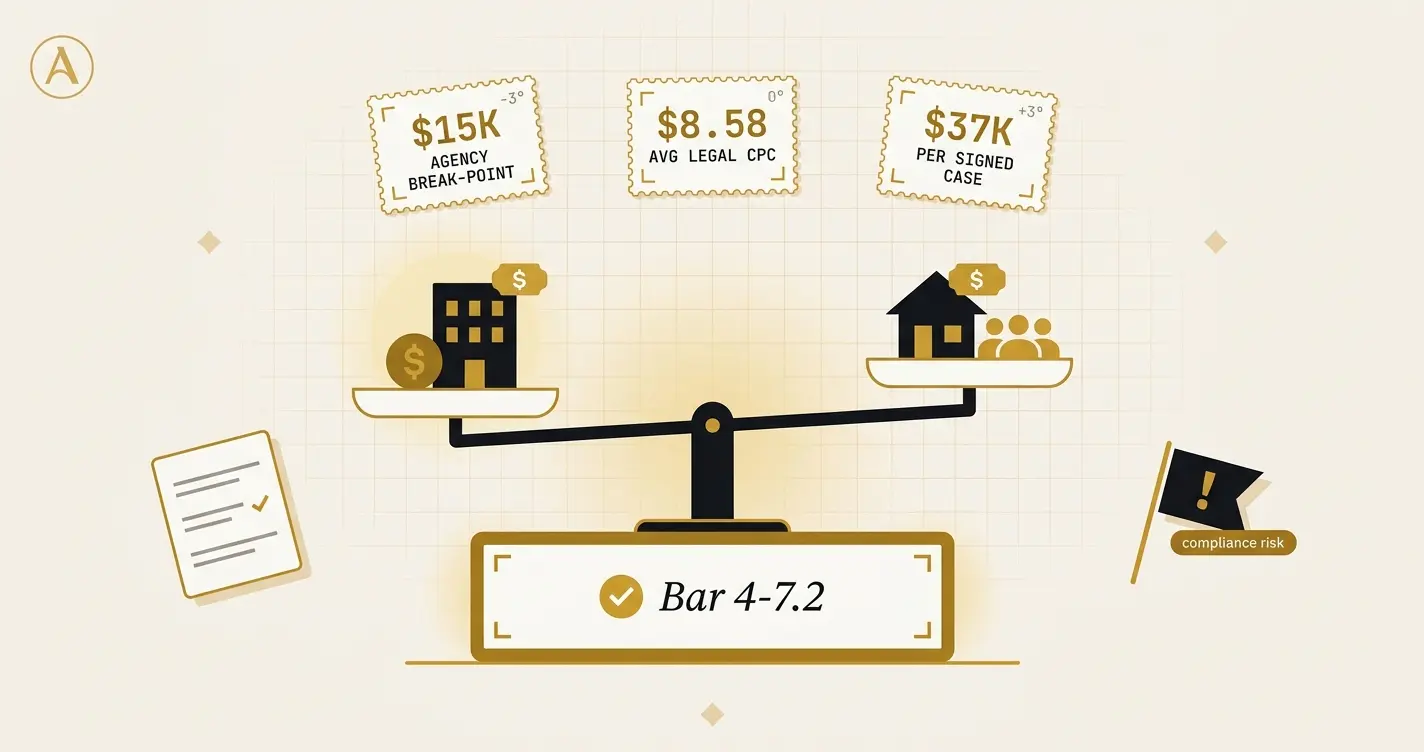
Should a law firm hire a PPC agency or bring it in house? Under $15,000 a month in ad spend the agency wins on both cost and bar compliance risk. Between $75,000 and $200,000 monthly the hybrid model wins; intake stays in house and the agency runs the ad execution. Above $200,000 monthly with a dedicated marketing director who knows legal advertising compliance, in house wins. Most firms calling me are in the middle bucket and don’t know it yet. Source: Jorge Argota, 10 years in legal marketing, Miami.
Why this decision isn’t the same as for other industries
Most agency versus in house articles treat law firm PPC like SaaS PPC or ecommerce PPC, and the math just doesn’t work that way. Three things make legal a different problem.
First, the cost per click. Legal averages $8.58 per click across all keywords, and personal injury terms in competitive metros run $70 to $250 a click. SaaS averages $6 and ecommerce sits around $1 to $3. A bad spend day in legal that wastes $2,000 becomes a $30,000 wasted month, which is real money even for midsize firms.
$8.58
Average legal cost per click across all keywords. SaaS sits at $6.29; ecommerce at $1 to $3. Personal injury in NYC, LA, and Miami runs $70 to $250 a click during peak hours.
Second, bar compliance. Florida Bar Rule 4-7.2 governs every Google Ads headline, every landing page claim, and every testimonial that appears in your funnel. New York Rule 7.1, California Rule 7.2, Texas DR 7.04 do the same thing in their states. One noncompliant ad headline running for nine months is a grievance complaint waiting to be filed by a competitor, and most in house marketing hires don’t have legal advertising training, which I’d argue is the single biggest risk in this whole decision.
Third, the unit economics. A single PI case can be worth $30,000 to $500,000 in fees. Med mal cases run $150,000 to $2 million. So the question stops being “what’s our cost per lead” and starts being “what’s our cost per signed case,” and that’s a different math problem that no general vertical PPC agency does honestly because it forces them to be transparent about how few of their leads actually sign.
$8K–$40K
Cost per signed case at typical Florida PI rates ($150 click, 5% landing page conversion, 7% intake conversion). Worth it on cases averaging $50K+ in fees; brutal math on anything smaller.
“The right metric for a law firm running PPC isn’t cost per lead. It’s cost per signed case, and most agencies will never show you that number because it makes them look bad.”
Jorge Argota · April 2026
What it actually costs both ways
Most agency versus in house articles compare the agency retainer to the salary line for an in house specialist and call it done, which is wrong because it ignores the loaded cost of the in house hire and the bar compliance training that’s required for legal. Here’s the actual side by side.
Tampa note: the average PPC specialist salary in Tampa is $96,000, the highest in the country, which makes the in house math even worse for Florida firms specifically. Most of my Florida clients run hybrid for exactly this reason.
The break even table your agency won’t show you
This is the table I run on a whiteboard with every law firm partner who calls me asking the agency versus in house question. The columns are honest, the math is the same math the agency is running on you privately, and the “winner” column is what most agencies don’t want you to see.
Monthly spend
Agency @ 15%
In house
Compliance risk
Winner
$5,000
$750
$10K–$13K
High
Agency
$20,000
$3,000
$10K–$13K
High
Agency
$50,000
$7,500
$10K–$13K
Medium
Agency
$100,000
$15,000
$10K–$13K
Medium
Hybrid
$250,000+
$37,500
$15K (senior)
Low
In house + audit
Read the last row carefully: even at $250K+ monthly spend where in house wins on cost, you still need an outside audit agency for quarterly bar compliance review. The compliance risk doesn’t go away just because your in house team is bigger; it just changes who’s missing the violation.
The Florida Bar Rule 4-7.2 layer nobody is showing you
This is the section that decides the agency versus in house question for most firms, and it’s the section every other article on this topic skips. Florida Bar Rule 4-7.2 governs what a Florida licensed attorney can say in advertising, and Google Ads headlines are advertising, full stop.
Here are the kinds of headlines I see passing and failing in the accounts I audit. I’m sticking to Florida because that’s my market, but the equivalents in NY, CA, TX, and IL all hit similar things.
Fails Rule 4-7.2
“Florida’s Best Personal Injury Lawyer”
Why it fails: “Best” is a comparative superiority claim, restricted under 4-7.2. “Florida’s top,” “leading,” “premier,” same problem.
“Won $4M for Our Last Client”
Why it fails: Past results are actually permitted in Florida ads after Rubenstein v. Florida Bar (2014), but they require a verifiable factual basis plus a disclaimer that doesn’t fit in a Google Ads headline character limit. Specific dollar predictions in the headline are still restricted on top of that.
“Miami’s PI Specialist”
Why it fails: “Specialist” is a regulated term in most states and requires bar certification to claim. If your attorney isn’t bar certified, the headline is a violation.
Passes Rule 4-7.2
“Miami Personal Injury Attorney”
Why it passes: Factual description of the practice and location. No comparative claim. No outcome implication. Lower click through than “best” headlines, but it doesn’t get you reported.
“Free Consultation, No Fee Unless We Win”
Why it passes: Standard contingency fee language is permitted, and it answers the question claimants actually have when clicking a PI ad.
“Hablamos Español · 24/7 Intake”
Why it passes: Factual practice attribute, no superiority claim, no outcome implication. Spanish language compliance is identical to English under Rule 4-7.2; “el mejor abogado” fails the same way “the best lawyer” does.
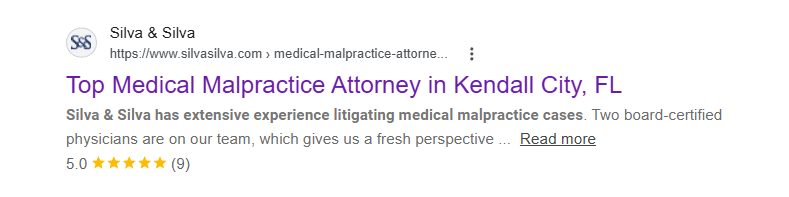
Real Google Ads search result, Florida. Firm name redacted. The bolded headline language is a Florida Bar Rule 4-7.2 violation that’s been running unchallenged for months in this account. This is the pattern competitors screenshot and submit to the Bar Advertising Department.
The grievance pattern: the violation that gets a Florida firm reported most often isn’t a single bad headline, it’s a competitor’s paralegal screenshotting your live ads on a Tuesday afternoon and filing a complaint with the Florida Bar Advertising Department on Friday. By the time you get the letter, the ad has been running for months. Every Google Ads agency working in Florida should have these rules memorized; most don’t.
The math that actually matters; cost per signed case
Every PPC agency I’ve ever audited reports cost per lead. Almost none of them report cost per signed case, because cost per signed case is the number that decides whether the campaign is making the firm money, and most campaigns don’t survive that math. Here’s the calculation any partner should be running before signing the agency contract.
01
Start with the click
PI keywords in Miami, Tampa, or Orlando run $100 to $200 per click. Med mal terms can hit $300. So a click costs roughly $150 on average for a Florida firm running a competitive campaign.
$150 per click
02
Apply landing page conversion
A bar compliant landing page with a TCPA compliant intake form converts roughly 5% of clicks into a phone call or form fill. Below 3% the agency is doing something wrong; above 8% somebody’s lying to you.
$150 ÷ 5% = $3,000 per lead
03
Apply intake conversion
Of every 100 leads, about 25% qualify as actual cases. Of those qualified leads, about 30 to 40% sign with the firm, depending on intake speed. So roughly 7 to 10% of leads become signed cases.
$3,000 ÷ 8% = $37,500 per signed case
04
Compare to case fee
PI cases average $30K to $500K in fees. Med mal cases average $150K to $2M. So $37,500 per signed case is breakeven on a small PI case and a strong return on anything bigger. Estate planning at $1,500 average value, the math doesn’t work.
$37,500 cost vs $50K–$2M case
The actual question: not “can we afford to run PPC,” but “can our intake convert $37,500 cost leads into the kind of cases that pay back many times that number.” Firms with broken intake operations lose money on PPC at any spend level, agency or in house. Related reading: does SEO work for law firms covers why organic compounds at lower cost per case than paid, and how to build a law firm website walks through the bar compliant landing pages your PPC depends on.
The hybrid model most firms should actually run
Most law firms calling me asking the agency versus in house question end up running some version of a hybrid, and the configuration that works for the most firms is the same one I built at Percy Martinez. Three setups depending on firm size.
The firm runs intake and CRM in house because nobody outside your firm can convert leads as well as your trained intake team, especially in a 5 minute response window. The agency runs Google Ads, Local Service Ads, landing pages, and bar compliance review. This is the configuration I’d recommend to roughly 70% of the firms that call me, and it’s the model we ran at Percy Martinez during the years that took the firm from $500 marketing budget to ranking above Morgan & Morgan in Hialeah Local Service Ads. The split works because intake is the bottleneck most firms underestimate, and ad execution is the part most agencies are actually good at. Cost: $5K to $15K monthly agency retainer plus your existing intake staff.
A trained paralegal coordinator handles compliance review, intake handoff, and reporting on the firm side. The agency handles ad execution. This is the model I built around for solo and small firms in Coral Springs, Hollywood, and Cape Coral, where the paralegal already knows the firm’s case types and can flag a noncompliant ad headline before it runs. The paralegal needs Google Ads certification (about $200, two weeks of study) and bar advertising rule training, and they need protected time, roughly 8 to 12 hours a week. Total cost: agency retainer plus the paralegal’s allocated salary share, usually $1,500 to $3,000 monthly equivalent.
A fractional CMO (typically a few days a month at $5K to $12K monthly) runs strategy. The managing partner reviews monthly. The agency executes. This works for firms running $100K to $250K monthly in ad spend that aren’t quite at the scale where a full time marketing director earns the cost back. The fractional CMO catches the strategic mistakes (like running PPC when LSAs would convert better, or chasing keywords with no signed case math behind them) that an agency wouldn’t push back on because pushing back loses the account. Total cost: agency retainer plus $60K to $144K annually for the fractional CMO.
Proof · Percy Martinez, P.A.
A Miami solo med mal firm outranking Morgan & Morgan in Local Service Ads
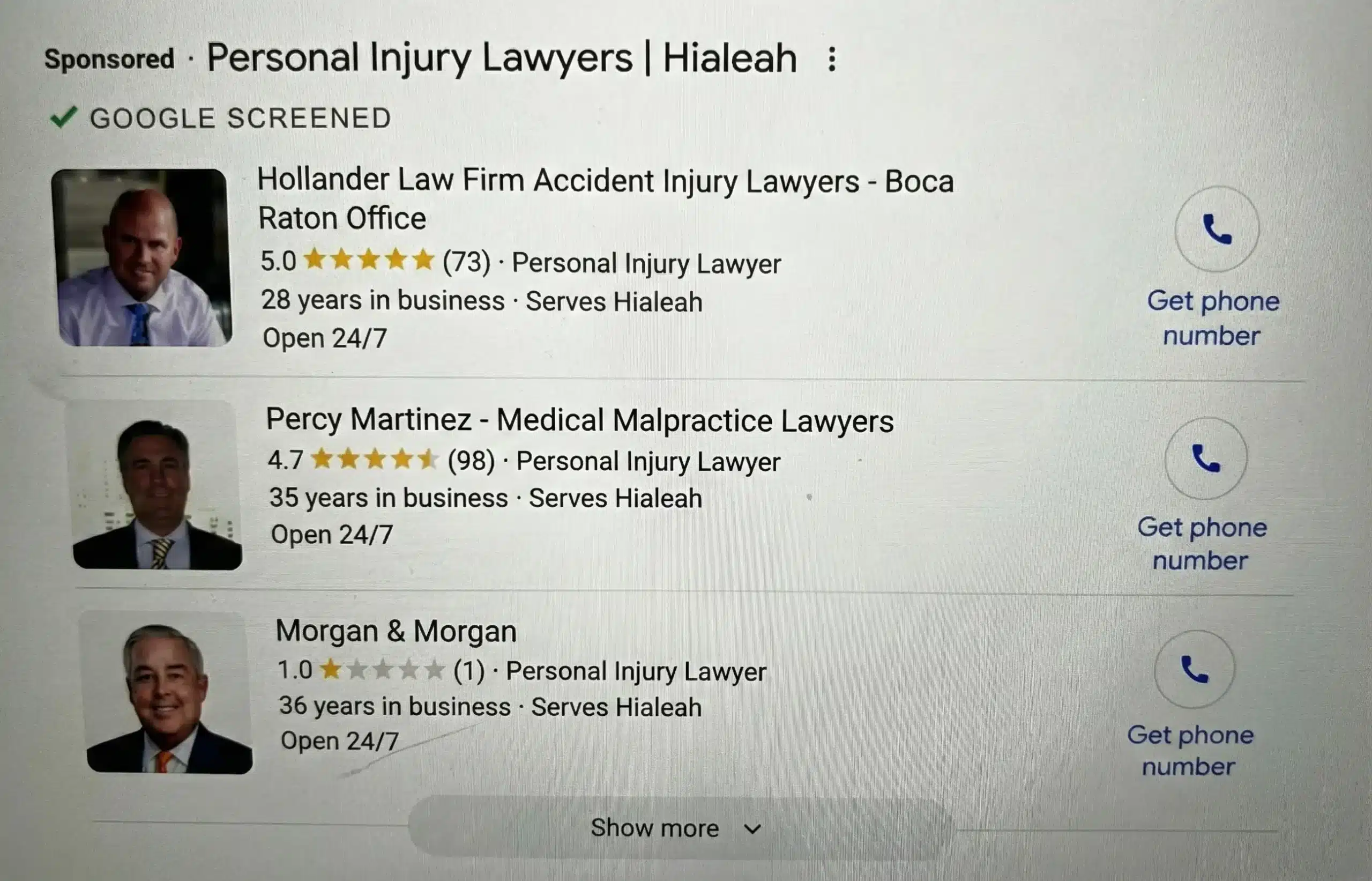
Percy Martinez, P.A. ran the Configuration 1 hybrid for years. Intake in house, ad execution agency side, with bar compliance review baked into every ad rotation. The firm started with a $500 marketing budget and the goal was just to compete; the actual outcome was that Percy now ranks above Morgan & Morgan in the Hialeah Local Service Ads, which is the kind of competitive position billboard firms spending $50,000 a month on TV haven’t figured out how to take back.
Hialeah Local Service Ads, April 2026. Percy Martinez P.A. (top result, Google-Screened verified) ranks above Morgan & Morgan for medical malpractice queries. Names of competing firms partially redacted for client privacy; full screenshot available on request.
Local Service Ads in Hialeah, above Morgan & Morgan
The Local Service Ads piece is the one most agencies can’t replicate because LSAs require a different verification and bar licensing layer than Google Ads, and the firms that figure them out for personal injury and med mal can outflank much bigger billboard competitors at lower per lead cost.
When I tell partners to skip PPC entirely
PPC isn’t the right channel for every law firm, and I’d rather lose the engagement than take a retainer from a firm where the unit economics don’t support it. Three patterns where I send firms in a different direction.
If your average case fee is under $2,000: the cost per signed case math from the section above doesn’t work. A firm running estate planning, document drafting, or volume immigration work usually can’t absorb a $25,000 to $40,000 cost per signed case, and the math gets worse in competitive metros where the click cost is higher. Run Local Service Ads only, or run paid social where the targeting is broader and the click cost is a tenth of Google Ads.
If your intake is broken: the conversion math at step 3 above assumes a 5 minute response time and a trained intake person. Firms responding within 30 minutes convert at roughly a quarter of the rate. So if your phones ring to voicemail after 5pm or your intake person is also the receptionist, fix that before spending a dollar on Google Ads. Otherwise the agency or the in house team is just funneling leads into a leaky bucket.
400%
Higher conversion for firms responding in under 5 minutes versus firms responding in 30. The PPC budget doesn’t matter if the phones aren’t answered. Source: industry intake studies, confirmed in my own Percy Martinez data.
If you have less than 90 days of runway: PPC works on signed cases, not on impressions, and signed cases close on a different timeline than ad spend. A PI case from a Tuesday click might not sign for two weeks and might not pay fees for eighteen months. So if you need cases this month for cash flow reasons, run Local Service Ads where leads come in faster and bar compliance review is built into Google’s verification, or work the referral network harder. PPC isn’t the right tool for an emergency, and most agencies will sell it to you anyway because the math is worse for them if they tell the truth.
“A firm with broken intake spending $30,000 a month on Google Ads is just funneling leads into a leaky bucket. Fix the bucket first, then turn on the ads.”
FAQ
Questions partners ask before signing the agency contract, or before posting the in house job listing.
Should a law firm hire a PPC agency or bring it in house?+
Most law firms end up running a hybrid; intake stays in house because nobody outside the firm converts leads as well as a trained intake team, and ad execution goes to a legal specialized agency that has bar advertising rules memorized. The exception on the lower end is small firms under $15K monthly spend, where the agency retainer is cheaper than any in house hire that’s properly trained on Florida Bar Rule 4-7.2 or its state equivalent. The exception on the upper end is firms over $200K monthly with a full time marketing director who has legal compliance training; at that scale the in house team earns back the agency fee, but you still need an outside compliance audit quarterly.
How much does a legal PPC agency cost?+
Legal specialized PPC agencies typically charge $3,500 to $15,000 monthly as a flat retainer or 10 to 20 percent of ad spend, with 15 percent being the most common rate because legal carries higher compliance overhead than other verticals. Retainers usually include Google Ads management, Local Service Ad management, call tracking, intake integration, and bar compliant landing page builds. Spend under $5,000 monthly and most legal agencies won’t take the work.
Can my paralegal run our Google Ads in house?+
A paralegal can run Google Ads compliantly with the right training, but two things have to be true. First, they need formal Google Ads certification plus working knowledge of the firm’s state bar advertising rules (Florida Rule 4-7.2 or equivalent). Second, they need protected time; legal PPC needs roughly 15 to 25 hours a week of attention to perform, not a paralegal’s spare hours between intake calls. The total cost of a properly trained in house paralegal usually exceeds an agency retainer until ad spend passes $30,000 monthly.
What does in house legal PPC actually cost?+
A dedicated PPC specialist for a law firm runs $75,000 to $120,000 in base salary, plus 30 percent loaded for benefits, taxes, payroll, training, and ad management tools, which puts fully loaded cost between $98,000 and $156,000 yearly. Add bar advertising compliance training and a senior paid search manager skilled in legal verticals can run $130,000 to $180,000 fully loaded. Tampa specifically averages $96,000 base for PPC specialists, the highest in the country.
What happens if our Google Ads violate Florida Bar Rule 4-7.2?+
Bar Rule 4-7.2 violations on Google Ads can trigger a competitor filed grievance with the Florida Bar Advertising Department, which moves the violation into the formal bar discipline process. Common headline violations include comparative superiority claims (“the best,” “Florida’s top”), past results headlines that lack the verifiable disclaimer Rubenstein requires (typical example, “Won $4M for Our Last Client”), and “specialist” claims without bar certification. Penalties range from a private letter to suspension. The fastest fix is removing the language and confirming the agency or in house team has the rule memorized for headline review.
Is PPC worth it for a small law firm?+
PPC works for small law firms when the average case value supports the cost per signed case math. Personal injury cases at $30,000 to $500,000 in fees can absorb a $40,000 cost per signed case at 5 percent landing page conversion. Estate planning at $1,500 average value cannot. Run the math both ways before signing the agency contract; if your unit economics don’t support it, run Local Service Ads and Google Business Profile first, both of which cost less and convert better for smaller firms.
Free PPC account audit
Send me your last 90 days of Google Ads and I’ll run the cost per signed case math
If you want someone to pull the actual cost per signed case number out of your Google Ads dashboard and tell you whether the campaign is paying for itself, send me 90 days of access. Takes about 90 minutes and you get back a written assessment, the bar compliance review on every active ad, and the honest verdict on whether the agency versus in house question is the right question for your firm to be asking.
Best fit: Florida PI, med mal, criminal defense, or family law firms spending $5K+ monthly on Google Ads. One firm per practice area per market.
Response within 1 business day · No pitch deck · No contracts
If the math doesn’t work
“I’d rather tell you to keep your money than take a retainer for a campaign I know won’t pay you back. The 90 minute audit is genuinely free.”
— Jorge
Nothing on this page is legal advice or a substitute for review by an ethics attorney admitted in your state. State bar advertising rules vary and change; always confirm current Rule 4-7.2 (or your state equivalent) requirements with your state bar before publishing ad copy. Cost ranges, salary benchmarks, and platform recommendations reflect 2026 market conditions and the author’s experience managing Florida law firm PPC accounts. Cost per signed case math is illustrative; actual results vary by practice area, market tier, intake operations, and case mix.