So a managing partner called me maybe two weeks ago and said his firm has been paying $4,800 a month for SEO for nineteen months and they’ve signed exactly two cases from it and he wanted to know if SEO is just dead now or if his agency is bad, and the answer was kind of both and kind of neither, which I’ll get into.
The honest answer
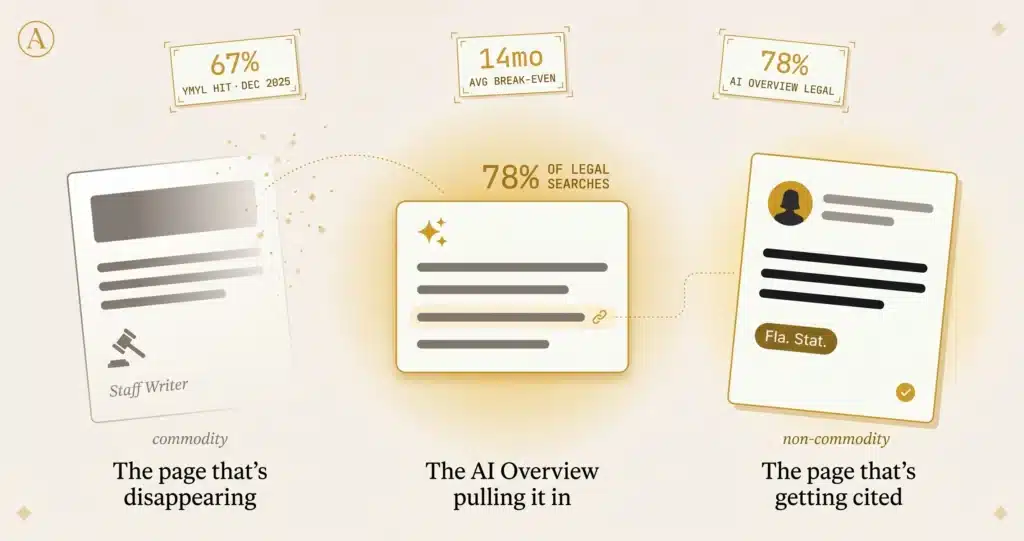
Does SEO work for law firms? Yes, when the content is built around real client intent and first-hand experience. The average competitive law firm spending consistently on SEO breaks even around month 14 and sees compounding traffic after that, and the top three organic positions in legal queries capture over 70% of click-through traffic. But last December’s core update changed the floor; an audit of 847 high-stakes legal and financial sites found 67% lost rankings, and AI Overviews now trigger on 78% of legal searches, the highest rate of any industry. Source: Jorge Argota, 10 years in legal marketing, Miami.
For maybe twelve years the standard play was to publish a 1,000 word page on every practice area times every city you wanted to rank in, written by someone who’d never touched a case file. It worked because Google didn’t have a way to tell your page was basically the same as 800 other pages on the same topic.
Then last December’s update changed that. The audit cited above (67% of legal content suppressed) was the visible damage. In April, Google itself put a name on what got hit; commodity content, which is their term for a page so generic that if it vanished, twenty other pages could fill the gap and nobody would miss it.
Google doesn’t really penalize commodity content. It just answers the question itself, inside an AI Overview, before the user clicks anything. And since AI Overviews now appear on 78% of legal searches (the highest rate of any industry), the traffic that used to come to your page disappears into Google’s answer box.
“Most law firm SEO campaigns aren’t failing because SEO stopped working. They’re failing because the agencies kept publishing the kind of content the algorithm just stopped ranking, and nobody updated the contract.”
Jorge Argota · April 2026
What commodity looks like versus what ranks now
Read your firm’s last ten blog posts; if you can’t tell whether they were written by your agency or someone else’s, that’s the answer. The prompts and templates circulate in the same agency networks, and the result is interchangeable.
Commodity
Pages that don’t sign cases
× “What is a personal injury claim in Florida?”
× “Why hire a DUI lawyer?”
× “Top 5 mistakes after a car accident”
× Author byline reads “The Firm” or “Staff Writer”
× Stock photos of gavels, scales, handshakes
× Could be moved to a Phoenix firm with a zip-code change
vs
Non-commodity
Pages that bring claimants
✓ “My mother died after surgery and the hospital won’t release records”
✓ “What happens if I refuse a breathalyzer in Hillsborough County”
✓ “How long do I have to sue under Fla. Stat. § 95.11?”
✓ Named attorney byline with bar number and headshot
✓ Photos of your actual office, your actual lawyers
✓ Couldn’t exist outside your jurisdiction or your practice
The simplest test; if your “DUI 101” page could be moved to a Phoenix firm’s site by changing two zip codes and a phone number, it’s commodity, and Google already knows.
The proof SEO still works
I’m going to use Percy Martinez because that’s my account and I know every number on the spreadsheet, and I think this matters because Percy is a solo attorney origin firm in Miami competing against Morgan & Morgan and the billboard firms with TV budgets above $50,000 a month, which is supposed to be the matchup where small firms can’t win.
Case studyPercy Martinez, P.A. · Miami med mal · 4 FL cities
A solo med mal firm beating Morgan & Morgan; the actual timeline
01
Year 1 · The wrong content
We were publishing what every other PI firm was publishing; “what is medical malpractice in Florida,” “elements of a med mal claim,” generic explainers paraphrased from textbooks. Traffic grew but signed cases didn’t, and I couldn’t figure out why for maybe four months until I realized the people landing on those pages were law students, not claimants.
02
Year 2 · The intake pivot
We started recording intake calls and pulling the questions claimants actually asked, and they weren’t keyword research questions; they were things like “my mother died after surgery and the hospital won’t release the records, what do I do,” and we wrote the page that answered that, with statute references and the actual procedure for requesting records under Florida’s medical record laws.
03
Year 3 · The math started working
Traffic was up 483% over the prior baseline and clicks hit 16,300 in 16 months, but the number that mattered was 287 leads in 5 weeks during one campaign push. And Percy started ranking above Morgan & Morgan in the Hialeah Local Service Ads, which I have screenshots of because I still can’t quite believe it.
04
Now · The compounding asset
Percy ranks across Miami, Orlando, Tampa, and Jacksonville and the cost per signed case from organic keeps falling because the work compounds, and when last December’s update wiped out two-thirds of legal sites, the firm gained because the content was already non-commodity. We don’t run TV. We don’t run billboards. The whole thing started from a $500 marketing budget, which I bring up not to brag but because the industry tells solo attorneys they can’t compete with billboard firms and that’s just not true if the content is right.
Why your city changes the entire math
A managing partner in Manhattan and a managing partner in Tampa need different answers to the same question because the competitive landscape is genuinely different, and most agencies pretend it isn’t. Which is one of the reasons partners feel lied to after eighteen months.
City
Avg legal CPC
Difficulty
What that means for your SEO budget
New York
$200–$400+
Extreme
9.6 lawyers per 1,000 residents; the densest legal market in America, and a top-3 organic position is worth millions in avoided ad spend annually. $15K to $25K monthly is the floor.
Los Angeles
$180–$350
Extreme
Highly fragmented by neighborhood and language; bilingual content is a structural requirement, not optional, and the firms winning publish hyperlocal pages by zip code.
Chicago
$150–$300
Very high
PI and criminal defense are saturated with 10+ year content veterans; the win condition is hyper-specific practice area depth, not breadth.
Houston
$120–$250
Very high
A Houston PI firm I looked at last quarter moved page 3 to position 1 in 127 days by rebuilding 11 practice area pages around intake-call questions; commodity-to-non-commodity flip is faster here than in NYC.
Miami
$100–$200
High
70% of Miami-Dade speaks non-English at home; firms publishing only English content are leaving roughly two-thirds of the market on the table, which is what Percy figured out around year 2.
Atlanta
$80–$160
High but open
Growing market with thinner legacy content footprint; first-mover content advantage still exists in 2026 and the budget needed is roughly half what NYC requires.
Tampa
$70–$140
Open
A Tampa firm fixing 47 inconsistencies in how its name, address, and phone appeared across directories saw Google Business Profile views jump 340% in 60 days; the entity-cleanup play still produces outsized returns in Tier 4 metros.
If you’re in Tampa, Orlando, Jacksonville, or Atlanta: the window is open right now. Most firms in your market still haven’t done the entity work or the intake-driven content rebuild, and whoever moves first gets the AI Overview slot too.
So how long does it actually take
The number every agency quotes is “3 to 6 months” and that number is wrong for legal because legal SEO operates on a different curve than e-commerce or local services, and the curve has three phases that nobody walks you through honestly.
Phase
What’s actually happening
What you’ll see
Month 0–3
Foundation
Technical audit, structured data added so Google can identify your firm and your attorneys, attorney bylines on every page, directory cleanup so your firm’s name and phone match everywhere, intake recording starts, and the first deeply-experienced practice area pages get written. Most agencies stop here and call it a strategy.
Almost nothing. Maybe ranking improvements on long-tail terms. No signed cases yet.
Month 4–9
Compounding
Pages start ranking on the searches claimants actually run, the site’s internal links connect properly so Google can see how the practice areas relate, your FAQ answers start showing up inside Google’s AI Overviews, and the call volume shifts from law students to actual claimants.
First signed cases from organic. Cost per case still high but trending down.
Month 10–18
Asset · break-even
The site is now hard to dislodge, you have 30 to 60 pages each ranking on something, organic search becomes the cheapest source of new cases, your firm starts getting cited inside AI Overviews, and you could pause new content for a quarter and traffic would still grow. Average break-even hits at month 14.
Compounding cases. Cost per signed case below paid. Asset value building.
If your agency is reporting traffic in month 3 and you’re frustrated there are no signed cases, that’s the curve working as expected, but if you’re at month 14 and still no signed cases, the content is the problem and probably always was, which is sad but true.
How law firm SEO compares to other service verticals
Partners ask me all the time whether SEO works “in legal specifically” versus their dentist friend or their wife’s real estate brokerage. The honest answer is that legal is the hardest vertical to win, and at the same time the one with the most room left to differentiate, which is the opportunity.
Vertical
Break-even
Google scrutiny
Where the opportunity sits
Law firms
Strictest content review
14–18 mo
Highest
Untapped. Most legal content is still commodity in 2026; first-movers capture outsized share.
Medical practices
Health content review
10–14 mo
High
Moderate; clinical content is well-developed and physician bylines are standard, less room to differentiate.
Financial advisors
Money content review
12–18 mo
High
Moderate; regulatory compliance content is strong, but advisor bios are mostly generic.
Real estate
Standard review
8–12 mo
Low–Mod
Moderate; neighborhood data and transaction stories are widely used.
Dental practices
Standard review
8–12 mo
Moderate
Low; before/after visuals are well-used and procedure cost transparency is standard.
So legal takes longer to break even and operates under harsher quality scrutiny, but it has more room left for content differentiation than any other vertical, which is the moat; medical and financial don’t get to play this game.
Who this honestly doesn’t work for
Anti-sell moment because I’d rather lose the lead than waste somebody’s money; SEO is not the right primary channel for every law firm and I’ll list the cases where I tell people to put the money somewhere else.
SEO is a 6 to 18 month curve with break-even averaging month 14; if you’ve got payroll problems or need cases right now, run Google Local Service Ads and Google Ads on bottom-funnel terms because that’s what buys traffic this week, and start SEO in parallel so you have an asset by next year. I tell maybe one in five firms that calls me to do this exact thing.
At Percy we treated intake like an emergency room because firms responding within 5 minutes see 400% higher conversion than firms responding within 30 minutes, and 67% of claimants base the hiring decision on response speed. If your intake is broken, every SEO lead just goes to your competitor with the better intake and you paid the agency anyway, which is the worst possible math.
Legal SEO costs $3,000 to $12,000 a month and the work compounds over 12 to 18 months; if your average case value is small claims or document drafting volume work, you’ll need a higher case count to break even and the math may not pencil. I’ve told two estate planning firms in the last year to run Facebook ads instead because the unit economics weren’t going to support a real SEO program.
Legal content needs attorney review or it’s just a writer paraphrasing the internet, which is the exact thing the algorithm now suppresses. If the partners in your firm won’t spend an hour a month on a Zoom call walking through intake questions and reviewing draft pages, the agency will publish commodity because there’s nothing else to publish, and the campaign will fail no matter who’s running it. I’ve watched this happen maybe a dozen times.
“Personal injury lawyer NYC” is locked up by firms that have been publishing for 10 or 15 years and have backlink profiles in the thousands, and you’re not going to dislodge them with a 12 month SEO program. The play in those markets is hyper-local long tail (specific neighborhoods, specific case types, specific languages) plus paid LSAs for the head terms, and a different agency than the one that pitched you, probably.
How to tell if your current SEO is working
If you’ve been paying for SEO for nine months or more, here’s the simple test I run when partners send me their dashboards and ask me to look at it.
01
The signed-case test
Open your reporting and ignore traffic, ignore impressions, ignore keyword count, and find me the line that says “consultations or signed cases attributed to organic search.” If that line is missing or fuzzy, your agency is producing activity not outcomes, and you’re paying for something that won’t show up at the bank.
02
The byline test
Open the last five blog posts on your site and look at the author. If it says “The Firm” or “Staff Writer” or “Admin,” Google has no way to verify a real expert wrote the content, and any rankings you have now are borrowed time until the next update.
03
The “could it be moved” test
Read your last practice area page and ask yourself; could this be moved to a Phoenix firm’s site by changing the city name and the phone number, and would anyone notice? If yes, it’s commodity content and that’s why your campaign isn’t producing signed cases.
04
The intake-question test
Ask your intake person what the last ten people who called actually asked about. If those exact questions don’t appear as page titles or section headers anywhere on your site, your agency isn’t writing the content claimants need and Google’s helpful content systems already know.
“If your reporting can’t tell you which signed cases came from organic search, your agency is producing activity, not outcomes.”
FAQ
Questions partners ask after they’ve read this far.
Does SEO really work for law firms, or is it just hype?+
Yes, SEO works for law firms when the content is built around real client intent and first-hand experience. The average law firm investing consistently in SEO breaks even at 14 months and sees compounding organic traffic after that. In Tier 1 markets like New York, Los Angeles, Chicago, Houston, and Miami, organic positions 1 to 3 capture over 70% of all click-through traffic on high-intent legal queries. What does not work is commodity content; the generic 800 word DUI 101 page Google now actively summarizes away in AI Overviews.
How long does SEO take to produce results for a law firm?+
Most firms see meaningful organic traffic gains in 4 to 8 months, the first signed case from organic in 6 to 10 months, and break-even on monthly retainers around month 12 to 18. Personal injury in Tier 1 metros sits at the long end of that range; estate planning, family law, and criminal defense usually move faster because case values and competitive density are lower. The 3-month timeline most agencies quote is wrong for legal.
Is SEO better than Google Ads for lawyers?+
Neither is universally better; they solve different problems. Google Ads buys traffic this week at $200 to $400 per click for personal injury terms in NYC and Los Angeles, and stops the day the budget stops. SEO builds a compounding traffic asset that costs more upfront but produces leads at falling cost per acquisition over 18 to 36 months. Performing law firms run both; ads for cases now, SEO for the asset that keeps producing.
What makes law firm SEO different from regular SEO?+
Legal sites get reviewed under the strictest content standard Google applies, the same one used for medical and financial sites; the idea being that bad information in those categories can hurt people. So every page needs an attorney byline or attorney review, jurisdiction-specific statute citations, and content that demonstrates first-hand experience. Generic content that ranks fine for a plumber gets actively suppressed for a law firm because the trust threshold is higher.
Can a small law firm compete with large firms in SEO?+
Yes, in mid-size and smaller markets a focused firm publishing 30 deeply-experienced pages outranks national mills publishing 3,000 generic pages because Google rewards specificity over volume. Percy Martinez, a solo-origin Miami medical malpractice firm, ranks above Morgan & Morgan in Hialeah Local Service Ads using exactly that approach; specificity, attorney attribution, and content built from intake calls instead of keyword research.
How much should a law firm spend on SEO?+
The average competitive law firm spends roughly $150,000 a year on SEO, which works out to $12,500 monthly. Solo and small firms in Tier 3 and Tier 4 markets often perform well at $3,000 to $5,000 monthly. PI firms in NYC, LA, Chicago, and Miami typically need $10,000 to $20,000+ monthly to compete because organic positions 1 to 3 in those markets are worth millions in avoided ad spend annually.
Free content audit
Send me your last 5 blog posts and I’ll tell you if it’s commodity
If you want someone to read your last five practice area pages and tell you whether Google is rating them as commodity content or actually-helpful content, send them over. I’ll send back the four-test diagnostic from above with a written assessment, and if your content is fine I’ll tell you that too which I know is a weird thing for a marketing person to say but here we are.
Best fit: Florida PI, med mal, criminal defense, or family law firms with 9+ months of SEO history. One firm per practice area per market.
Response within 1 business day · No pitch deck · No contracts
If the math doesn’t work
“I’ll tell you that too. I’d rather lose the lead than waste somebody’s money, which is the entire reason I built this practice the way I did.”
— Jorge
Nothing on this page is a guarantee of SEO results, signed cases, or Google rankings. Outcomes vary by practice area, market tier, content quality, intake operations, and Florida Bar compliance. Frequency and impact percentages cited reflect cross-vertical audit data published after last December’s core update. Always confirm advertising practices comply with your state bar’s ethics rules; in Florida specifically, Rule 4-7.2.