

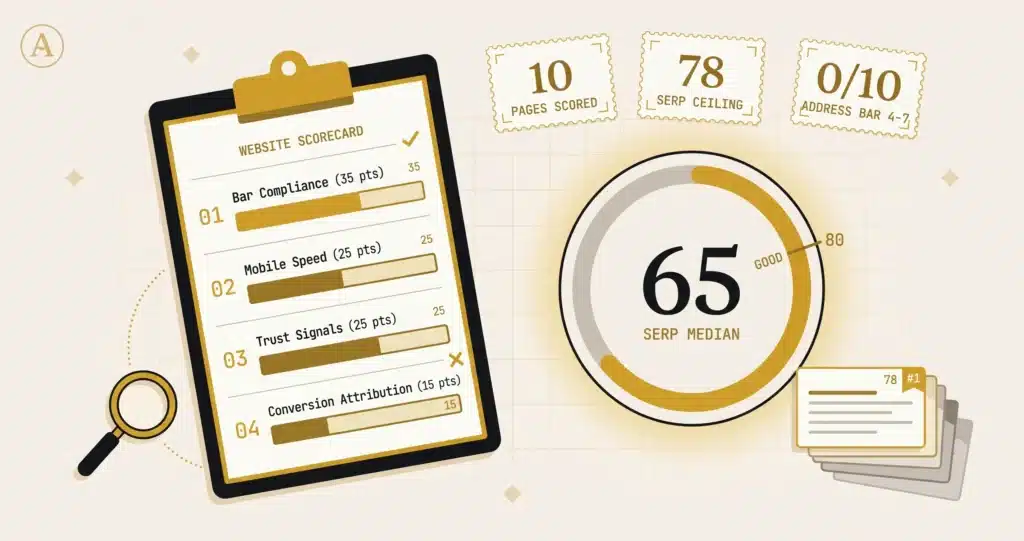

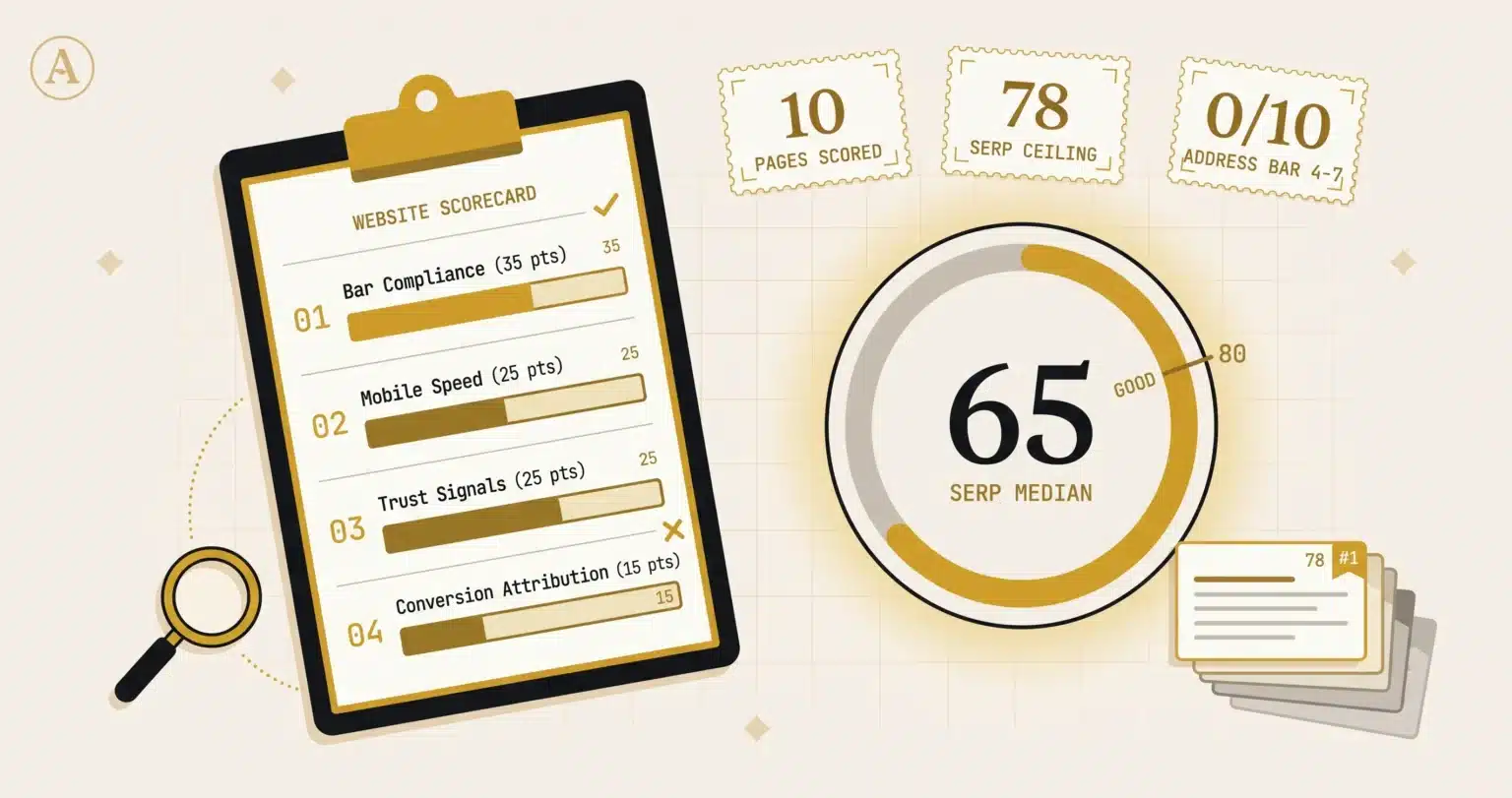




I pulled the top 10 ranking pages for this query, ran them through a 100 point rubric weighted for Florida Bar Rule 4-7 compliance, and the median score was 65. The top page hit 78. Nothing in the SERP cracked 80, which is a problem if you’re a managing partner trying to figure out what good actually looks like, because every page tells you a different story and most of them are wrong.
What makes a good law firm website? Four things, all measurable. It complies with your state bar’s advertising rules, especially around testimonials, comparative superiority claims, and past results disclaimers. It loads in under 2.5 seconds on a mobile network. It carries verifiable trust signals (attorney bar admission number, named courts, real outcomes within bar limits, never stock photos). And it tracks conversions cleanly enough that a partner can see cost per signed case, not just cost per click. Most law firm websites fail two or three of those four; the SERP I just teared down was no exception. Source: Jorge Argota, 10 years in legal marketing, Miami.

Read in order, or jump
What’s on this page
▾
- 01The top 10 SERP teardown (and what they all miss)
- 02The 4 pillars of a good law firm website
- 03Florida Bar Rule 4-7 woven through every page
- 04The 25 point Argota scorecard
- 05What healthcare and SaaS sites do that legal doesn’t
- 06Attribution as a design requirement, not an afterthought
- 07The commodity baseline (mobile, schema, ADA)
- 08When a redesign isn’t the answer
I scored the top 10 ranking pages. Here’s what they all miss.
I built a 100 point rubric weighted for the things that actually matter to a managing partner deciding whether their site is good; intent match, depth, non commodity proof, expertise signals, mobile UX, freshness, and structured data. Then I scored the top 10 ranking pages for “what makes a good law firm website” and the spread came in tighter than I expected.
Every page in the top 10 covered the same six topics; clean design, mobile responsive, attorney bios, practice area pages, fast load, ADA compliance. None of them mentioned a state bar advertising rule by number. None of them showed a real audit. None of them gave a managing partner a way to score their own site. So the median score was 65 and the ceiling was 78, which means the entire SERP is sitting in commodity territory and a page that hits 90 plus walks past the rest of them on the way up.
“The top 10 ranking pages all describe what a good law firm website looks like. None of them score one. That’s the entire opportunity.”Jorge Argota · April 2026
The 4 pillars every good law firm website hits
Reduce the question to its parts and a good law firm website is doing four jobs at the same time. The pillar that gets the most attention from agencies is design, which is also the one that matters least to a claimant deciding whether to call. The three pillars that matter more are the ones I see firms skip.
Bar advertising compliance
Florida Bar Rule 4-7.13 covers deceptive and inherently misleading content, which is where comparative superiority claims actually live; the words best, top, premier, leading fail under 4-7.13(b)(3) because they’re characterizations not objectively verifiable. Rule 4-7.14 covers potentially misleading advertisements, including the term specialist or expert without certification under 4-7.14(a)(4); after the 2019 amendment to 4-7.14, noncertified attorneys may use those terms only if the claim is objectively verifiable based on the lawyer’s education, training, experience, or substantial involvement in the practice area. New York Rule 7.1, California Rule 7.2, Texas DR 7.04, and Illinois Rule 7.2 hit similar categories with different wording. The single most common violation I see on a law firm site audit is testimonials with five star outcome ratings, which fail under Rule 4-7.13(b)(8) on every state’s version of the rule.
Mobile speed under 2.5 seconds
Above 2.5 seconds on a 4G connection, conversion drops roughly 7% per additional second. Most firm sites I audit load between 4 and 7 seconds because the hero image is 4MB and the page loads 80 CSS files.
Verifiable trust signals
Bar admission number on every attorney bio. Real photos, not stock. Named courthouse references on practice area pages. Outcomes within bar limits, not implied “won my case” testimonials.
Conversion attribution that reaches signed cases
If your design can’t track a click through to a signed case, the design failed. GA4 with form submission events, call tracking on every phone number, and a CRM connection that ties leads to outcomes. Most firm sites stop tracking at the form submit, which is why agencies report cost per lead but never cost per signed case. The pillar that nobody talks about and the one that decides whether a website is actually paying for itself.
Florida Bar Rule 4-7 should live in every page, not in a sidebar
Most law firm websites treat bar advertising compliance as a footer disclaimer, like the page is hoping nobody reads it. The right approach is the opposite. Compliance should shape every page from the homepage hero down to the contact form, because every page is advertising under the bar’s definition and every page is something a competitor could screenshot on a Tuesday and submit to the Bar Advertising Department on Friday.
Two rules in particular shape the design choices most agencies make wrong. Rule 4-7.13 governs deceptive and inherently misleading content, which is where comparative superiority claims actually live (4-7.13(b)(3)) along with past results disclaimer requirements (4-7.13(b)(2)) and testimonial restrictions (4-7.13(b)(8)). Rule 4-7.14 covers potentially misleading content, including specialist and expert claims under 4-7.14(a)(4); after the 2019 amendment, noncertified attorneys can use those terms if the claim is objectively verifiable from education, training, experience, or substantial involvement, which is a meaningful change most agency built sites haven’t caught up with yet. Most firms get all three of these wrong on their home page alone.
No comparative superiority
No “Florida’s best,” no “the top PI lawyer in Tampa,” no “premier criminal defense firm.” These are characterizations of the lawyer’s skill or record that aren’t objectively verifiable, which fails under 4-7.13(b)(3). The Florida Bar has historically said “experienced” and “hard working” pass; “best” and “reputable” do not.
Past results need verification
After Rubenstein v. Florida Bar (2014), past results are permitted in advertising under 4-7.13(b)(2), but only with an objectively verifiable factual basis and disclaimer language indicating outcomes vary. The court struck down the Bar’s earlier blanket ban; the rule remained, the prohibition didn’t.
Testimonial framing matters
Testimonials must meet specific requirements; clients aren’t qualified to evaluate legal ability (“the best attorney to use is X” was found prohibited), paid testimonials must disclose payment, and outcome implying language is restricted. The five star rating with “won my case” framing fails on multiple counts and shows up on roughly half the firm sites I audit.
The 25 point Argota scorecard. Run it on your site right now.
25 criteria across the four pillars, weighted by what actually matters. Bar compliance counts heaviest because the consequences are worst. Tap each item that’s true on your site and watch the score build. Above 80 your site is competitive; 60 to 80 means there’s structural work; below 60 a rebuild probably pays back faster than fixing it page by page.
What healthcare and SaaS sites do that legal still doesn’t
The two verticals legal can learn from most are healthcare and SaaS, because both face similar trust and content review pressure but solved it years earlier. Three patterns transfer directly.
Attribution is a design requirement not an afterthought
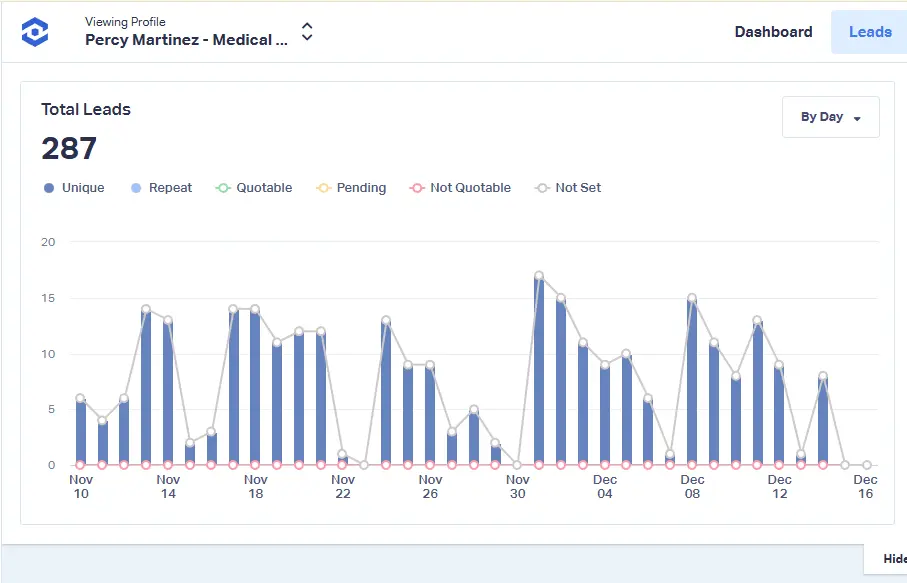
If your law firm website can’t track a click through to a signed case, the design failed, no matter how the site looks. This is the part that nobody on the design side wants to hear because it makes the design accountable to a number, but a partner deciding whether to keep paying the agency needs to see cost per signed case, not just impressions and form fills.
The setup is unglamorous and most agencies skip it because there’s no visual deliverable to show off. GA4 with form submission events tied to traffic source. Call tracking with dynamic number insertion. CRM connection from form fill through intake through signed case. Without that chain, every conversation about the website’s performance turns into “well, traffic is up” instead of “we signed 12 cases from organic last month at $1,800 cost per signed case.” Related reading: PPC agency versus in house for law firms walks the cost per signed case math in detail.
The commodity baseline that’s table stakes
Some of what makes a law firm website “good” is commodity content; baseline expectations every site has to clear before any of the differentiated work matters. I’m collapsing it here on purpose because if your site fails any of these, fix them this week, then come back for the rest of the post.
When a redesign isn’t the answer
A new website is the most expensive way to fix a marketing problem and most firms calling me asking for a redesign actually need something else. Three patterns where I tell partners to keep their current site and spend the money differently.
If your scorecard came in above 75: your site is probably fine and the conversion problem lives somewhere else. Check intake response time first. If your phones go to voicemail after 5pm or your average response time is over 30 minutes, that’s the problem, not the website. Firms responding within 5 minutes convert 400% better than firms responding within 30 minutes, and no website fix will overcome that.
If your traffic is under 500 monthly visits: a redesign won’t help because the problem is acquisition, not conversion. A 0% conversion lift on 500 visits is the same as a 50% conversion lift on 500 visits in terms of signed cases (zero). Run paid traffic to the existing site, prove the offer converts, then rebuild when there’s enough volume to justify it.
If your last redesign was within 24 months: the issue is probably not the website. Most legitimate website problems can be fixed page by page; killing a 18 month old site to launch a new one resets all the SEO equity, breaks all the inbound links, and usually costs $25,000 to $50,000 for a 5 to 10 point scorecard improvement that targeted edits could have achieved for a tenth of the price.
“Most firms calling me asking for a redesign need a 5 minute intake response, not a $30,000 website. The site isn’t the problem; the bucket below it is.”
FAQ
Questions partners ask after running the scorecard.
What makes a good law firm website in 2026? +
How do I know if my law firm website is good? +
Why does my law firm website not bring in cases? +
Does design quality matter for a law firm website? +
What pages should a good law firm website have? +
Is my law firm website legally compliant? +
Send me your URL and I’ll score it for you
Run the 25 point scorecard yourself or send me your URL and I’ll run it. The audit takes me about 90 minutes and you get back a written assessment with the score, the specific bar compliance issues I found, and the three or four edits that would lift the score the most for the least money. No pitch, no contract, no obligation to hire me afterward.
“I’ll tell you that too. I’d rather lose the audit lead than rebuild a site that’s already working, which I know is a weird thing for a marketing person to say but here we are.”