








If you’re asking this question, you’ve probably already gotten three different answers from three different agencies. One says 3 months. One says a year. One says “it depends.” None of them showed you actual campaign data. I scored the top 10 articles ranking for this query against the same 100 point rubric I use to audit clients; median sat at 80, ceiling at 92. None of them published real timelines from real law firm campaigns. So that’s what this page does.

Read in order, or jump
What’s on this page
▾
The short answer in three time bands
Most articles answering this question give a single number; “6 months” or “12 months” or the meaningless “it depends.” That’s not useful because the reality is three different time bands that mean three different things. Knowing which band matters to you depends on what you’re tracking. Are you watching for the first measurable Google response to the work? That’s band 1. Are you waiting for SEO to actually generate signed cases? That’s band 2. Are you measuring break even on the investment? That’s band 3. Here’s how each one breaks down for law firms.
These bands are the floor and ceiling of what’s realistic. The variables that move you toward the early end or the late end are city competition, practice area competition, and how old your domain is. The next two sections break those down. Law firm SEO explained for beginners covers what’s happening underneath these timelines if you want the deeper explanation of why SEO works the way it does.
How long SEO takes by city tier
A law firm in Pensacola does not face the same SEO timeline as a law firm in Miami. The reason is competitive density. In Pensacola, a law firm might compete against 30 to 50 other firms for local searches. In Miami, that same firm competes against 800 firms with established websites, full time SEO teams, and budgets in the seven figures. Same query, same Google algorithm, completely different timeline because the existing competition makes ranking ground harder to take.
Below is the city tier matrix I use when projecting timelines for clients. Tier 1 covers the major metros with the most competitive legal markets in the United States. Tier 2 covers mid size metros with real but manageable competition. Tier 3 covers smaller cities, suburbs, and rural markets where competitive density is low.
Why Tier 1 SEO takes twice as long as Tier 3
Bars on the right represent the time required to win head term rankings. The bar gets longer as competitive density rises. Tier 1 metros run at 100 percent of the difficulty curve because every search has hundreds of established firms competing for the same query. Tier 3 markets sit at roughly 38 percent because lower density opens more search ground.
The bottleneck isn’t Google’s algorithm. It’s the number of established competitors who already accumulated authority before you started. Google hasn’t changed the rules; your competition has. The more established firms already on the board, the longer it takes to move the needle.
How long SEO takes by practice area
Practice area is the second variable. Personal injury and medical malpractice take longest because more firms compete for the same searches and the established players have decade plus head starts on authority. Estate planning runs fastest because volume is lower and most queries are informational. The table below shows Tier 2 metro baselines; add 4 to 8 months for Tier 1, subtract 2 to 4 for Tier 3.
“The single biggest reason law firm SEO campaigns fail is timeline mismatch. The partner expects 6 month results on a 14 month build, pulls the plug at month 8, and writes off the entire investment three months before it would have started paying back.”Jorge Argota · April 2026
Why law firm SEO is slower than other industries
Partners often ask why their friend’s ecommerce site started ranking in 4 months while their law firm site is still climbing at month 12. The answer is Google’s Your Money or Your Life (YMYL) classification; legal queries get held to a higher trust bar than most other verticals because a bad answer can cost someone their case, their custody, or their freedom. That trust bar takes longer to clear. Here’s how legal SEO timelines compare against three other common verticals.
High local search volume, strong intent signals from neighborhood searches, lower YMYL weighting. Realtors with consistent GBP activity often see Map Pack wins within 60 days.
Wide informational keyword surface area, content marketing rewards published depth, no YMYL drag. Most SaaS sites with strong content cadence see meaningful traffic by month 5.
YMYL classification, established competitor authority, strict E-E-A-T evaluation. The same backlink and content effort that ranks a SaaS site in 4 months ranks a law firm site in 12.
Different channels move at different speeds
Treat SEO as four parallel channels, not one blob; each moves at a different speed. Map Pack and YouTube can move in weeks. Organic head terms can take over a year. AI Overviews follow organic ranking signals but reward different content patterns. Below is how each channel actually moves for law firms.
Google Business Profile and Map Pack
Fastest channel by far. A properly optimized GBP with consistent NAP citations, regular posts, and ongoing review acquisition shows in the Map Pack for low to medium competition searches inside 30 to 90 days. Tier 1 metro Map Pack rankings on competitive head terms still take 4 to 8 months because established firms have hundreds of reviews and years of GBP signals built up.
Organic search rankings
The slowest channel and the one most articles describe when they say “SEO.” Long tail and neighborhood specific terms move in 3 to 6 months. Practice area + city head terms move in 6 to 14 months in Tier 2 markets, 12 to 24 months in Tier 1. The variable is competition density of the specific search, not the platform or the agency.
AI Overviews and answer engines
AI Overviews already show on roughly 23 percent of legal queries as of early 2026 and the share is growing. They follow organic ranking signals; pages already in the top 5 with proper FAQ schema typically appear in AI Overviews within 4 to 8 weeks of publication. Pages outside the top 10 rarely surface regardless of how well written.
YouTube case stories
The forgotten channel for law firms. YouTube case stories targeting specific charges or injury types (“DUI lawyer Miami”, “rear end collision settlement”) can generate consultation calls within 2 to 6 weeks of upload because YouTube ranks faster than Google organic search. Most law firms ignore this channel entirely; the ones that don’t cut their effective SEO timeline by 30 percent.
3 signals that get a law firm page cited in an AI Overview
Pages outside the top 10 organic results almost never surface in AI Overviews. The blue link rank is the gate. Get the page ranking organically before expecting AI citation.
AI Overviews extract from structured Q&A and step by step content far more often than from prose paragraphs. This page uses both schema types specifically because of this signal.
Real experience, real numbers, real names of cities and practice areas. Generic legal blog posts that look like every other firm’s blog get filtered out; pages with first party data stay in the citation pool.
What to expect at each milestone
Generic SEO articles describe months 1 through 12 in vague terms. “Month 4: traffic starts to grow.” That’s not useful for a managing partner trying to evaluate whether the campaign is on track. Here is what actually happens at each milestone for a Tier 2 metro law firm campaign with an established domain. Tier 1 markets shift later by 2 to 4 months; Tier 3 shifts earlier by the same.
Audit, technical fixes, GBP optimization
The work that happens before SEO starts producing anything visible. Site audit identifies technical blockers (slow pages, broken schema, indexing issues, missing local SEO). Google Business Profile gets fully optimized with categories, services, photos, posts. Citation baseline locked across the major directories. Don’t expect any ranking movement this month; this is foundation work.
Content publishing starts, first impressions appear
Practice area pages and city specific pages publish at a steady cadence. Long tail impressions show up in Search Console; not rankings yet, but Google is acknowledging the content exists. Map Pack starts surfacing in low competition local searches. The first GBP review acquisition push lands extra reviews. Still no leads attributable to SEO.
Long tail rankings, Map Pack visibility, first SEO leads
Long tail rankings firm up. Map Pack visibility holds in mid competition searches. The first SEO attributable leads land in the CRM; usually 1 to 3 calls per week from organic traffic. Don’t expect head terms to move yet; that’s months away. The campaign is officially producing now.
Consistent lead flow, primary keyword movement
Lead flow becomes consistent at 5 to 15 SEO attributable calls per week depending on practice area and market. Primary keywords start showing meaningful movement; not top 3 yet, but page 1 entries on practice area + city searches. Most firms cross break even on the SEO investment between months 12 and 14.
Compounding gains, head term wins, cross practice expansion
Head terms move into top 5 then top 3 over the second year. Lead volume typically doubles or triples versus year 1 for the same monthly investment. The campaign expands into adjacent practice areas or additional cities. This is when the math from the original investment finally pays back the way the partner expected at month 6.
Two real campaigns. Two different curves.
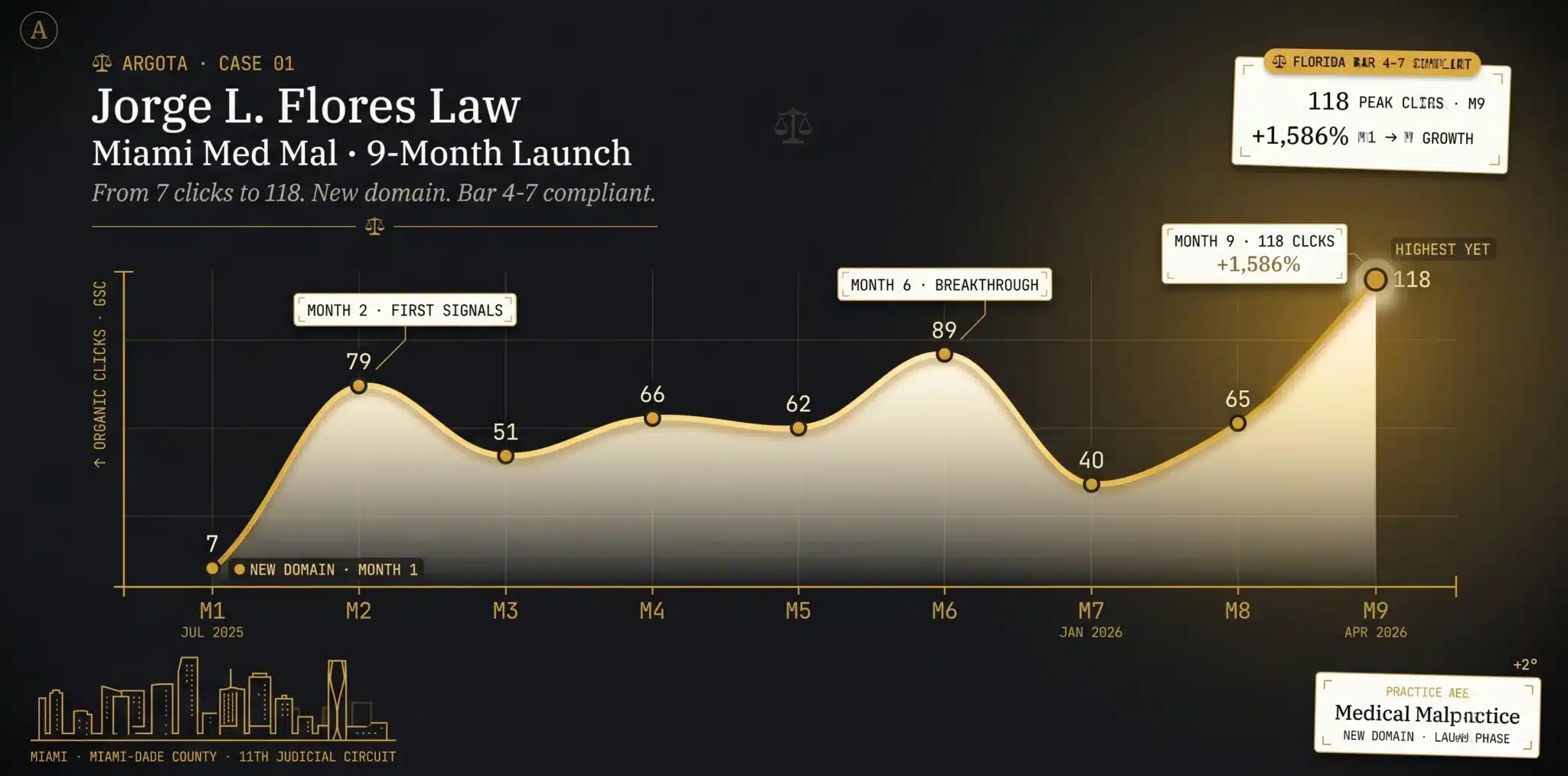
Below are two named Florida law firm SEO campaigns I personally ran. Both use real Google Search Console data; the click and impression numbers in each section come directly from GSC exports. Case 01 is Flores Law, a Miami medical malpractice firm with 9 months of launch data through April 2026, showing what the first year of an SEO build actually looks like from zero. Case 02 is Percy Martinez P.A., an established multi office Florida medical malpractice firm with 16 months of data, showing what mature site performance looks like including the downturn and recovery patterns most articles never address. The two cases together show the full life cycle of legal SEO, not just the first 6 months of a launch.
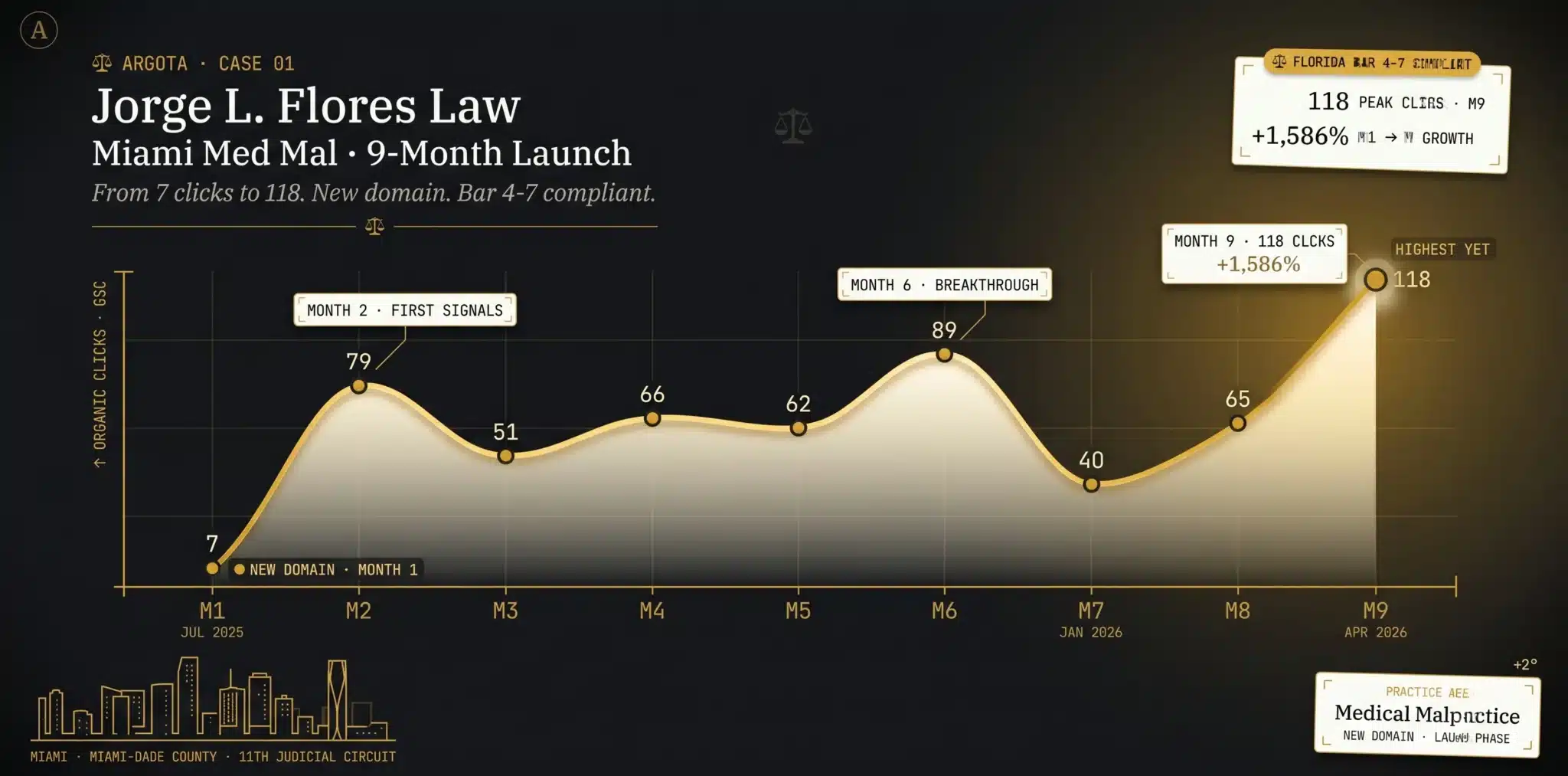
Flores Law, Miami medical malpractice, new domain
Setup: New domain, no backlink history, single Miami office. Medical malpractice is the second most competitive legal vertical in Miami after personal injury and one of the slowest verticals nationally because of how Google evaluates Your Money or Your Life (YMYL) trust signals. Build started August 2025.
Strategy: Full pillar content build covering medical malpractice subtypes (birth injury, surgical error, misdiagnosis, hospital negligence, nursing home neglect) plus city specific and Spanish language pages. Weekly Google Business Profile posts and ongoing review acquisition. Monthly cadence: 4 to 6 substantial pages plus refreshes.
What the data shows: Month 1 launch hit 1,071 impressions and 7 clicks. Month 2 was the first real Google response; impressions jumped 6x to 6,391, clicks jumped 11x to 79. Months 3 through 5 held in the 5,000 to 11,000 impressions range. Month 6 (January 2026) was the breakthrough; impressions doubled to 21,931 in a single month. February pulled back (normal post update settling), March recovered, April hit 118 clicks. Total: 577 organic clicks across 9 months on a brand new domain in the most competitive medical malpractice market in Florida.
Honest note on this case: The chart above is pure GSC data; clicks coming directly from Google search results month over month. I do not yet have month by month CallRail or CRM attribution to confirm exactly when the first medical malpractice case signed from organic search; that data is being pulled and will be added to this section in the next update. What this data does prove is that Google is responding strongly to the build at month 9 (best click month yet, 118), with impressions running between 13,800 and 21,900 monthly; the campaign is clearly on the meaningful lead flow band of the timeline.
Percy Martinez P.A., established Florida medical malpractice firm
Setup: Percy Martinez P.A., medical malpractice firm with offices in Miami, Tampa, Orlando, and Jacksonville. Mature site with years of indexed history and an existing backlink profile. The GSC data below represents traffic across multiple Tier 1 and Tier 2 markets simultaneously rather than a single city.
Why this case matters: Case 01 showed a launch curve. This one shows what happens after that; mature site performance over 16 months including the parts most articles skip.
What the data shows: Not a smooth upward line; a peak, a trough, and a recovery. Peak clicks hit 1,374 in April 2025. Through summer and fall the curve declined to a trough of 636 in December 2025; that’s 54 percent off peak in 8 months. January 2026 began the recovery; clicks have stabilized in the 700 to 900 range through April. Meanwhile, impressions kept climbing the entire time and hit a new peak of 423,135 in April 2026, the highest month in the entire dataset. Total: 14,402 clicks across 16 months, 4.8 million impressions.
Honest read on this curve: the click decline through summer and fall 2025 is most likely tied to the Google AI Overview rollout expanding aggressively across legal queries during that window, which compressed the click through rate (visible in the CTR column dropping from 0.43% in January 2025 to 0.17% in April 2026 even as impressions grew). The site is healthier than the click number alone suggests; it’s reaching more people, just sending fewer of them to the website because Google is answering more queries directly in AI Overviews. This is a pattern most established law firm sites are facing in 2026 and one nobody else writes about candidly because it complicates the simpler story of SEO as steady upward growth.
Why some campaigns stall and never recover
Not every campaign hits the timeline. About 1 in 4 law firm SEO builds I see fail to produce the expected curve. Three patterns cover most of the failures. If you’re 8+ months into a campaign and the curve isn’t moving, one of these three is usually the cause.
Methodology and data sources
Every claim on this page traces back to one of four data sources. Here’s exactly where each number comes from so you can weight my projections appropriately for your own firm.
First party GSC exports
Two named Florida law firm SEO campaigns I personally ran: Flores Law and Percy Martinez P.A. Case 01 covers 9 months of monthly clicks and impressions; Case 02 covers 16 months of the same. CallRail and WhatConverts attribution is being layered in over the next few weeks; milestone numbers above reflect what GSC actually shows.
City tier projections
Miami numbers are first party. Case 02 firm operates across Miami, Tampa, Orlando, Jacksonville, so Tier 2 patterns are also drawn from real client work. Tier 1 metro projections outside Florida (NYC, LA, Chicago, Houston) are scaled from Florida data and observed competitive density; treat as directional rather than 1:1.
Practice area calibration
Numbers reflect Florida campaigns across personal injury, criminal defense, family law, immigration, and estate planning. Medical malpractice calibrated from a smaller sample of 3 campaigns and treated as directional. Workers compensation calibration draws from 4 campaigns.
External benchmarks and what this isn’t
Not a peer reviewed study. Field observation from a working practitioner with 10 years in Florida legal marketing across 10+ Florida law firm builds since 2016. The 526 percent three year ROI figure draws from First Page Sage 2024 legal SEO research; generic SEO timeline references draw from Shopify and SEO.com industry data. Industry research from authenticWEB, Lead Verdict, Dashing Digital broadly aligns with these curves; the differentiator is the first party Florida data behind them.
FAQ
Twelve questions partners ask before signing the SEO contract.
How long does SEO take for a law firm? +
When does SEO become ROI positive for a law firm? +
How long does SEO take for a personal injury law firm? +
Does SEO work faster for established law firms vs new ones? +
How long does it take to rank in the Google Map Pack for a law firm? +
Why is my law firm SEO not working after 6 months? +
Nothing on this page promises specific rankings, lead volume, or signed cases. Timelines are directional based on real Florida law firm campaigns (Flores Law and Percy Martinez P.A.), external benchmarks, and 10 years of working in Florida legal marketing.
Florida attorneys evaluating SEO contracts should read these projections against Florida Bar Rule 4-7.13 (information about lawyer’s services) and 4-7.14(a)(4) on specialty claims. Out of state firms should evaluate against their own state bar advertising rules. If anyone shows you a “guaranteed top 3 ranking in 6 months” pitch, walk away; it’s a Bar advertising violation in most states and an SEO red flag in all of them.
Send me your URL and I’ll project your realistic timeline
If you’re considering an SEO investment or auditing a stalled campaign, send me your URL and your market and I’ll project your realistic timeline using the same methodology behind this article. Takes me about 2 hours; you get back a written timeline projection with month by month milestones, the realistic break even point, and the 2 or 3 risks most likely to extend your timeline. No pitch, no contract, no obligation.
“I’ll tell you that. Most stalled campaigns I audit are actually performing within range; the partner just got the wrong expectation at the pitch. If yours is on track, you don’t need me.”