






Most law firm SEO guides ranking for this query are exactly what Google’s Danny Sullivan called “commodity content” at the Search Central event in Toronto on April 21, 2026; recycled checklists with the brand names swapped out, the same five paragraphs about title tags and meta descriptions everybody else wrote, no first hand experience, no state bar rules, and nothing a managing partner can use to make a real decision. So this is the version that doesn’t pretend to be Moz or Search Engine Journal and instead tells you what actually moves the needle in legal in 2026.
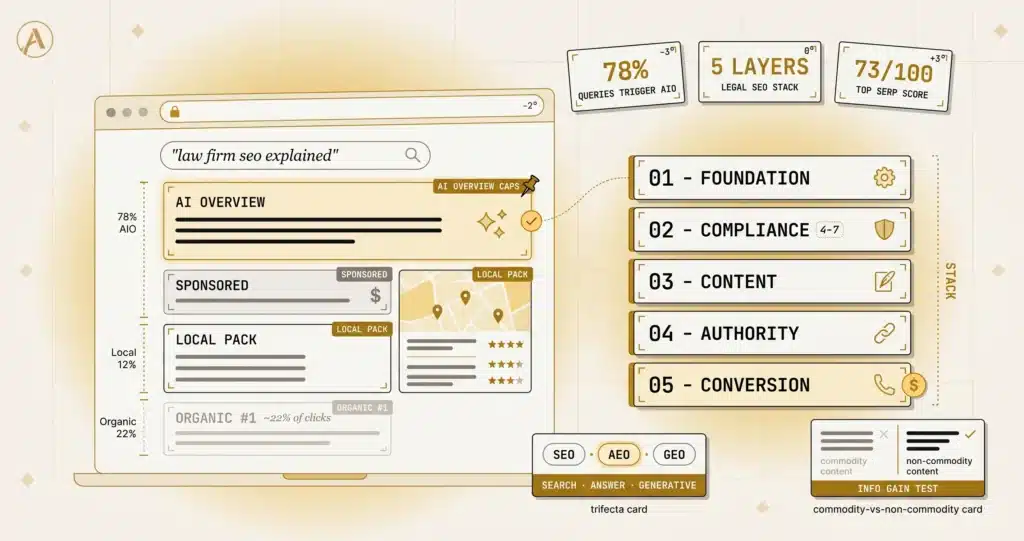
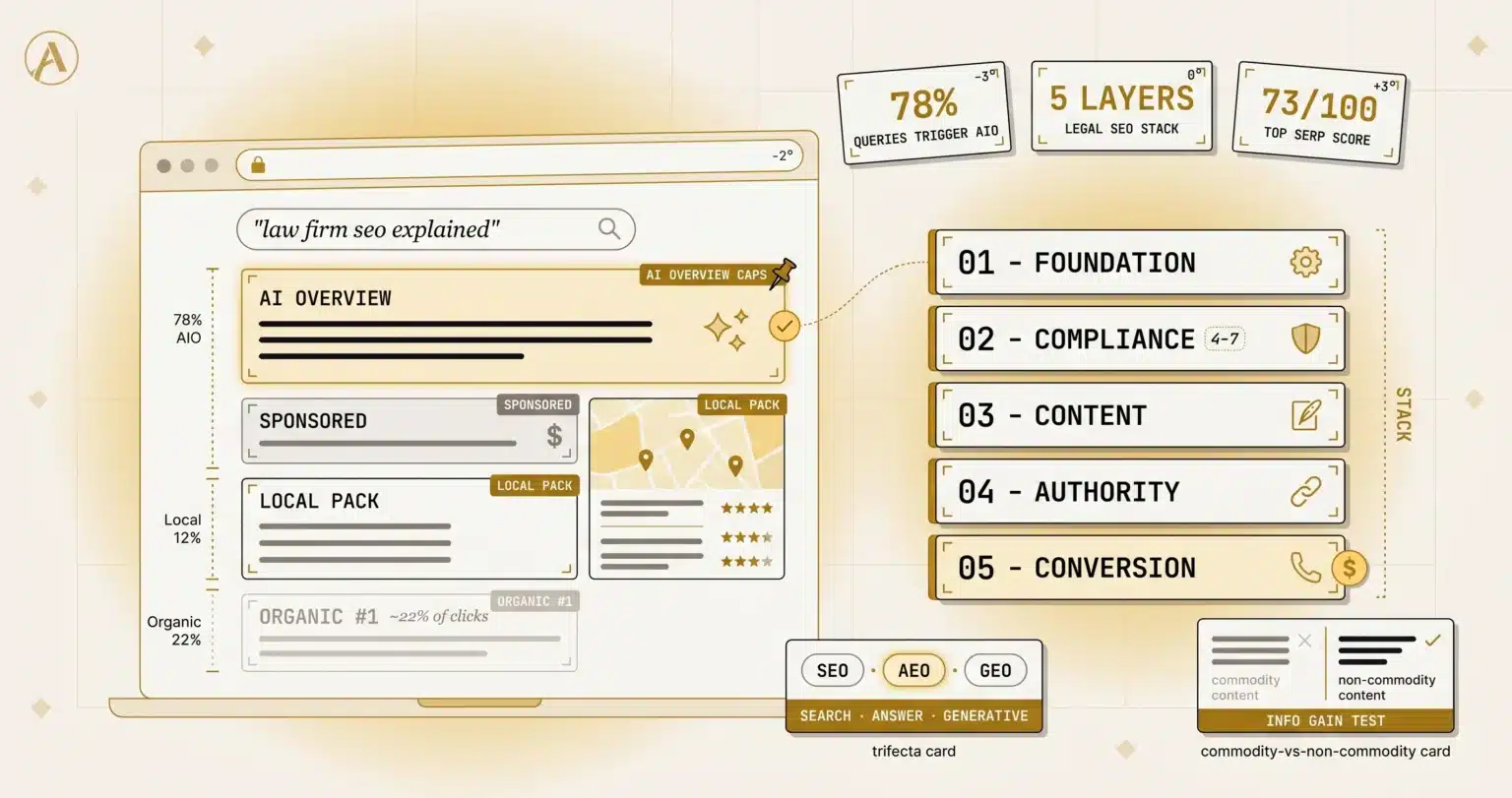
Law firm SEO is the work that makes a firm’s website show up when claimants search for legal help, and in 2026 it has three layers that didn’t exist five years ago. Traditional SEO (the blue links). AEO (Answer Engine Optimization, the AI Overviews at the top of Google). GEO (Generative Engine Optimization, citations inside ChatGPT, Perplexity, Claude, and Gemini). Most agencies still do only the first one. The firms winning in legal right now do all three, weave Florida Bar Rule 4-7.13 and 4-7.14 compliance through every page, and measure cost per signed case instead of cost per click. Source: Jorge Argota, 10 years in legal marketing, Miami.

Read in order, or jump
What’s on this page
▾
- 01What law firm SEO actually is
- 02Sullivan’s commodity vs non commodity line
- 03The Argota Information Gain Test
- 04The 5 Layer Legal SEO Stack
- 05Florida Bar Rule 4-7.13 and 4-7.14 compliance
- 06What it actually costs in Florida
- 07AEO and GEO; the two layers everyone misses
- 08I scored 10 law firm SEO guides
- 09When SEO isn’t the right channel
- 10Glossary in plain English
- 11FAQ
What law firm SEO actually is
Strip the jargon and law firm SEO does three things. It earns enough trust from Google that Google is willing to show the firm’s site to claimants. It uses the right words and structure so Google understands which queries the site should show up for. And it makes the visitor who clicks actually pick up the phone or fill out the form, because if rankings don’t turn into signed cases, none of the work paid for itself.
Most of what gets sold as SEO focuses on the first two layers and ignores the third. That’s why partners hire agencies, sign 12 month contracts, watch their organic traffic numbers go up, and never see a signed case from organic search. Traffic without conversion is a vanity metric, and a website with great rankings and broken intake is a $40,000 a year mistake.
Why most law firm SEO content just got named “commodity content”
On April 21, 2026, Google’s Danny Sullivan stood on a stage at the Search Central event in Toronto and drew a line that every law firm partner paying for SEO needs to understand. He called it commodity content versus non commodity content. Commodity content is anything generic, easily replicable, the kind of advice you find on dozens of other sites in nearly identical form. Non commodity content is unique, specific, authentic, grounded in first hand experience that competitors cannot duplicate.
Read 10 articles ranking for “law firm SEO explained” and the pattern Sullivan called out is everywhere; same four pillar framework, same paragraph about title tags, same warning about keyword stuffing, same example about local pack rankings. Strip the brand name off the top of any of them and most readers couldn’t tell which agency wrote what. That is the literal definition of commodity content, and Google said it out loud at Toronto less than a week ago.
This is not a brand new direction. Google’s December 2025 helpful content update started the shift, and the March 2026 core update (which finished rolling out April 8) accelerated it. The April 21 Toronto framing was Google formalizing the language. Pages that recycle existing information without adding anything new are losing rankings; pages that contribute first hand experience, original data, or proprietary frameworks are holding or gaining. The entire “law firm SEO” SERP is sitting in commodity territory waiting to be displaced, which is roughly the same pattern I documented on the “what makes a good law firm website” SERP teardown last month.
“If you could swap the agency name on a ‘law firm SEO’ guide and nobody would notice, that’s commodity content by Google’s own April 2026 definition. Sullivan said it on stage in Toronto. Most law firm SEO content fails the test.”Jorge Argota · April 2026
The Argota Information Gain Test. Five questions every page has to pass.
After Sullivan’s April 2026 Toronto talk and the March 2026 core update before it, “publish a 2,000 word post” stopped being a strategy. The bar is information gain, which is what Google calls content that adds something the rest of the SERP doesn’t already have. Five questions, run on every page before publish.
Does the page name first hand experience?
If anyone with a paid content tool subscription could have written it, it fails. The page should name a real client outcome (Percy Martinez, ranked #1 in Hialeah Local Service Ads). A real audit (I scored the top 10 SERP results, median was 65 of 100). A real number from the practice. A real conversation that happened on a Tuesday. First hand specificity is what separates information gain from commodity recycling, and it’s the single biggest signal AI systems use when deciding whether to cite a page in generative answers.
Does the page name a state bar rule by number?
For Florida, that’s Rule 4-7.13 (deceptive content) or 4-7.14 (potentially misleading) with a sub rule like 4-7.13(b)(3) or 4-7.14(a)(4). National content mills don’t cite state specific rules because they don’t know them. Citing the rule by number is a non commodity move that can’t be replicated by a generalist agency, and a Florida attorney reading the page picks up the signal immediately. Same logic applies to NY 7.1, CA 7.2, TX DR 7.04, IL 7.2.
Does the page give the reader a tool, not just an article?
A scorecard. A calculator. A checklist with checkboxes. An audit rubric. Something the reader can use after they finish reading. Pages that hand back a tool rank better and earn citations from AI Overviews because they offer mechanism, not just description. The 25 point scorecard on the “what makes a good law firm website” post is a working example; readers tap criteria, the score updates, the page becomes the tool.
Does the page tell the reader what NOT to do?
Generic SEO content avoids saying “this isn’t worth doing for your firm” because the underlying business model is to sell every prospect every service. Real practitioner content tells partners when SEO isn’t the right channel (case fee under $2,000), when a redesign isn’t the answer (intake response over 30 minutes is the actual problem), when running PPC instead would be smarter (less than 90 days of cash runway). The negative case is often more useful than the positive one, and partners trust people who turn down work.
Does the page include verifiable trust markers?
Author byline with credentials. Real client name (with permission). Bar admission references. Named courts. Linked schema (Person, Organization, Article) connecting the content to a real entity. AI systems weight pages with strong entity signals more heavily for inclusion in generative answers, which is the GEO layer most agencies ignore entirely. A bio that says “Jorge Argota, 10 years in Florida legal marketing, paralegal background at a med mal firm” carries more weight than “our team of SEO experts.”
The 5 Layer Legal SEO Stack that actually works
Every legitimate law firm SEO program is doing five things in parallel. Skip any one and the other four work harder for less return. The order matters too; layer one is the foundation that everything else sits on, and most firms try to skip it because it’s unglamorous.
This is the framework I run on every Florida firm I work with, and it’s deliberately different from the four pillar (technical, on page, off page, content) framework every commodity agency uses, because that framework was built before AI Overviews existed and before E-E-A-T became measurable.
Foundation: technical and Google Business Profile
HTTPS, mobile under 2.5 seconds load time, schema markup validated through Google Rich Results Test, sitemap submitted, robots.txt clean, no broken redirects, no orphan pages. Plus a verified, claimed, fully populated Google Business Profile with categories matching practice area, real photos of the office, and review responses from the managing partner. This is unsexy and most agencies skip it because there’s no monthly deliverable to point at, but a firm with a broken foundation can do everything else right and still not rank.
Compliance: Florida Bar Rule 4-7.13 and 4-7.14 baked in
Every public page is advertising under the bar’s definition. Title tags can’t say “Florida’s Best Personal Injury Lawyer” because comparative superiority claims fail under Rule 4-7.13(b)(3). Meta descriptions can’t promise outcomes. Testimonials need to be framed under 4-7.13(b)(8). Specialist or expert claims need to meet the 2019 amendment to 4-7.14(a)(4) or be removed. Compliance baked into the SEO content from the start saves the rebuild cost when a competitor files a grievance complaint.
Content: practitioner pages, not commodity guides
Pages that pass the Information Gain Test from layer 02. Practice area pages tied to specific case types and named jurisdictions (“medical malpractice in the 11th Judicial Circuit, Miami Dade County”). Attorney bios with bar admission numbers and named courts. Resource content built from real intake call questions, not keyword research tool exports. Content here is what AI Overviews and ChatGPT cite when claimants ask “should I hire a lawyer for this,” which is the entire GEO layer.
Authority: legal directories, bar associations, law schools
Avvo, Justia, Martindale, FindLaw, Super Lawyers, plus state bar association profiles, law school alumni directories, Chambers if applicable. These aren’t link building in the spammy sense; they’re the citations Google uses to verify a firm exists and practices what its site claims. Most agencies build directory links once and stop; the real work is keeping name, address, phone consistent across all of them and adding new ones as the firm grows.
Conversion: the layer that makes the other four pay back
The website tracks form submissions in GA4 with source attribution. Phone numbers carry call tracking with dynamic number insertion. The CRM (Clio Grow, Lawmatics, equivalent) ties leads from form submit to signed case outcome, so cost per signed case is calculable. Intake responds to leads within 5 minutes; firms responding in 30 minutes convert at roughly a quarter of the rate of firms responding in 5. Without this layer, every conversation about SEO performance turns into “well, traffic is up” instead of “we signed 12 cases from organic last month at $1,800 cost per signed case.”
Florida Bar Rule 4-7.13 and 4-7.14 apply to every page
Most agencies treat bar advertising compliance as a footer disclaimer, like the page is hoping nobody reads it. The right approach is the opposite. Compliance shapes the SEO directly because every public page (homepage, practice area, attorney bio, blog post) is advertising under the Florida Bar’s definition.
Two rules govern what an SEO content piece can and can’t say. Rule 4-7.13 covers deceptive and inherently misleading content; comparative superiority claims (4-7.13(b)(3)), past results disclaimer requirements (4-7.13(b)(2)), and testimonial framing (4-7.13(b)(8)) all live here. Rule 4-7.14 covers potentially misleading content; specialist or expert claims under 4-7.14(a)(4) need to meet the 2019 amendment standard or be replaced with neutral language. The most common SEO violation I see is a title tag reading “Florida’s Best Personal Injury Lawyer” because somebody’s keyword tool said “best lawyer Florida” had high volume.
Comparative superiority under 4-7.13(b)(3). Tempting because keyword tools show “best lawyer” has volume, but it’s a violation that targets a query Google’s AI Overview won’t cite anyway because the headline isn’t objectively verifiable.
Factual practice and location. No comparative claim. No outcome implication. Lower click through rate than “best lawyer” headlines, but it’s the version that doesn’t get the firm reported and ranks just as well in 2026 because Google’s algorithm now penalizes the comparative version.
What law firm SEO actually costs in Florida
Most “law firm SEO cost” guides give national ranges that mean nothing. So here’s what Florida firms actually pay in 2026, broken out by firm size and market tier.
SEO, AEO, and GEO. Three layers your agency probably doesn’t do.
Until 2024, “SEO” meant ranking in Google’s blue links. In 2026 that’s roughly a third of the work, because 78% of legal queries now trigger an AI Overview at the top of the page that answers the question without the user clicking through to a law firm site at all. The strategic implication is that ranking in the blue links is no longer enough; the firm has to also rank inside the AI Overview itself, and inside the answers ChatGPT and Perplexity hand back to claimants who never opened Google.
Three layers, three different optimization patterns, all overlap but each requires intentional work. Most agencies still do only the first one because it’s the only one they know how to bill for, which is why their clients are bleeding visibility quarter over quarter without anyone noticing until the signed case count drops.
Search Engine Optimization
Ranking in Google’s traditional blue link results. The work most agencies still do; title tags, meta descriptions, content optimization, link earning, technical SEO. Still matters because the AI Overview pulls from these ranking pages, and clicks on the top 3 organic results still drive a meaningful share of traffic.
Answer Engine Optimization
Getting the firm’s content cited in Google’s AI Overview at the top of the page. Different optimization than traditional SEO; AEO rewards concise direct answers, structured data, FAQ schema, speakable markup, and clear factual specificity over keyword density. Pages that pass the Information Gain Test from earlier in this post tend to perform well on AEO.
Generative Engine Optimization
Getting the firm’s content surfaced inside ChatGPT, Perplexity, Claude, and Gemini when claimants ask those tools for legal recommendations or guidance. Strongest signals are entity strength (verifiable Person and Organization schema), citation density (named courts, named bar numbers, real outcomes), and topical depth across an entire content cluster, not just one page.
I read the top 10 articles ranking for this query. None of them are good.
The third week of April 2026 I sat down and read the top 10 articles Google ranks for “law firm SEO explained for beginners.” Cover to cover, every one. I wanted to know what a managing partner would learn if they took this question seriously and clicked the first ten results.
Honest answer: not much. Most of them are written by people who do not work with law firms, or by agencies that work with everyone (dentists, plumbers, lawyers) and treat all of them the same. The patterns are repetitive enough that after the third article I could predict what the next seven were going to say.
I scored each one against the same checklist I run on client audits, broken into six categories worth 100 points total. Top score in the SERP was 73. Median was 58. Nothing cracked 80. Here is what each kind of article looked like, ranked by how close it came to actually helping a lawyer.
If you are wondering what the rubric measures, here is the plain English version of the six categories. None of these are mysterious; they are the things any lawyer would ask if a friend forwarded them an article and asked “is this any good.”
When SEO isn’t the right channel
SEO is the long game and most firms calling me asking about SEO actually need something else this quarter. Three patterns where I tell partners to spend the marketing budget somewhere else first.
If your average case fee is under $2,000: the cost per signed case math doesn’t work for SEO. A firm running estate planning or volume immigration usually can’t absorb a $1,500 to $3,500 monthly retainer for 12 to 18 months before the first signed case shows up. Run Google Business Profile, Local Service Ads, and referral marketing first; revisit SEO when the budget can carry an 18 month investment.
If you have less than 90 days of cash runway: SEO compounds, which is the bullish case in normal times and the bearish case when payroll is tight. A page that ranks in month 14 doesn’t help if the firm closes in month 7. Run paid traffic to existing assets, work the referral network harder, and revisit SEO when there’s runway to wait out the timeline. PPC agency versus in house for law firms walks the math on which paid channel pays back fastest.
If your intake response time is over 30 minutes: SEO will make this problem worse not better, because more traffic into a leaky bucket is just more wasted opportunity. Firms responding within 5 minutes convert 400% better than firms responding within 30 minutes; no SEO investment overcomes that gap. Fix intake first, then turn on the channel.
“SEO compounds, which is great when the firm has the runway to wait it out and brutal when payroll is tight. Run the math on month 14, not on month 14 of the campaign.”
Glossary in plain English
If an SEO agency uses any of these acronyms in a sales pitch without translating them, here is what they actually mean. Defined the way I would explain them to a managing partner across a coffee table, not how marketing blogs write them.
FAQ
Twelve questions partners ask before signing the SEO retainer.
What is law firm SEO in plain English? +
How much does law firm SEO cost in 2026? +
How long does law firm SEO take to work? +
Is SEO worth it for a small law firm? +
Can I do law firm SEO myself? +
What is the difference between SEO, AEO, and GEO for law firms? +
Does Florida Bar Rule 4-7 apply to law firm SEO? +
What is commodity content and why does it hurt law firm SEO? +
What is E-E-A-T for law firms? +
Should a law firm focus on local SEO or national SEO? +
What is the difference between law firm SEO and law firm PPC? +
What are the biggest law firm SEO mistakes beginners make? +
Send me your URL and I’ll run the Information Gain Test on it
Run the 5 Layer Stack on your own site or send me your URL and I’ll do it. Takes me about 90 minutes and you get back a written assessment with the score by layer, the bar compliance issues, and the three or four edits that would lift the score the most for the least money. No pitch, no contract, no obligation to hire me afterward.
“I’ll tell you that. I’d rather pass on the audit lead than rebuild a site that’s already working, which is a weird thing for a marketing person to say but here we are.”