

Written by Jorge Argota · Content Freshness Strategy · United States
Changing a date in your title tag from 2025 to 2026 without changing the content underneath it is the fastest way to get demoted in 2026. Google’s systems now measure the magnitude of content changes and penalize “fake freshness” with trustworthiness demotions. The fix is a volatility triage protocol that updates your highest-risk pages when the law actually changes and leaves your evergreen pages alone until they need it.
TL;DR
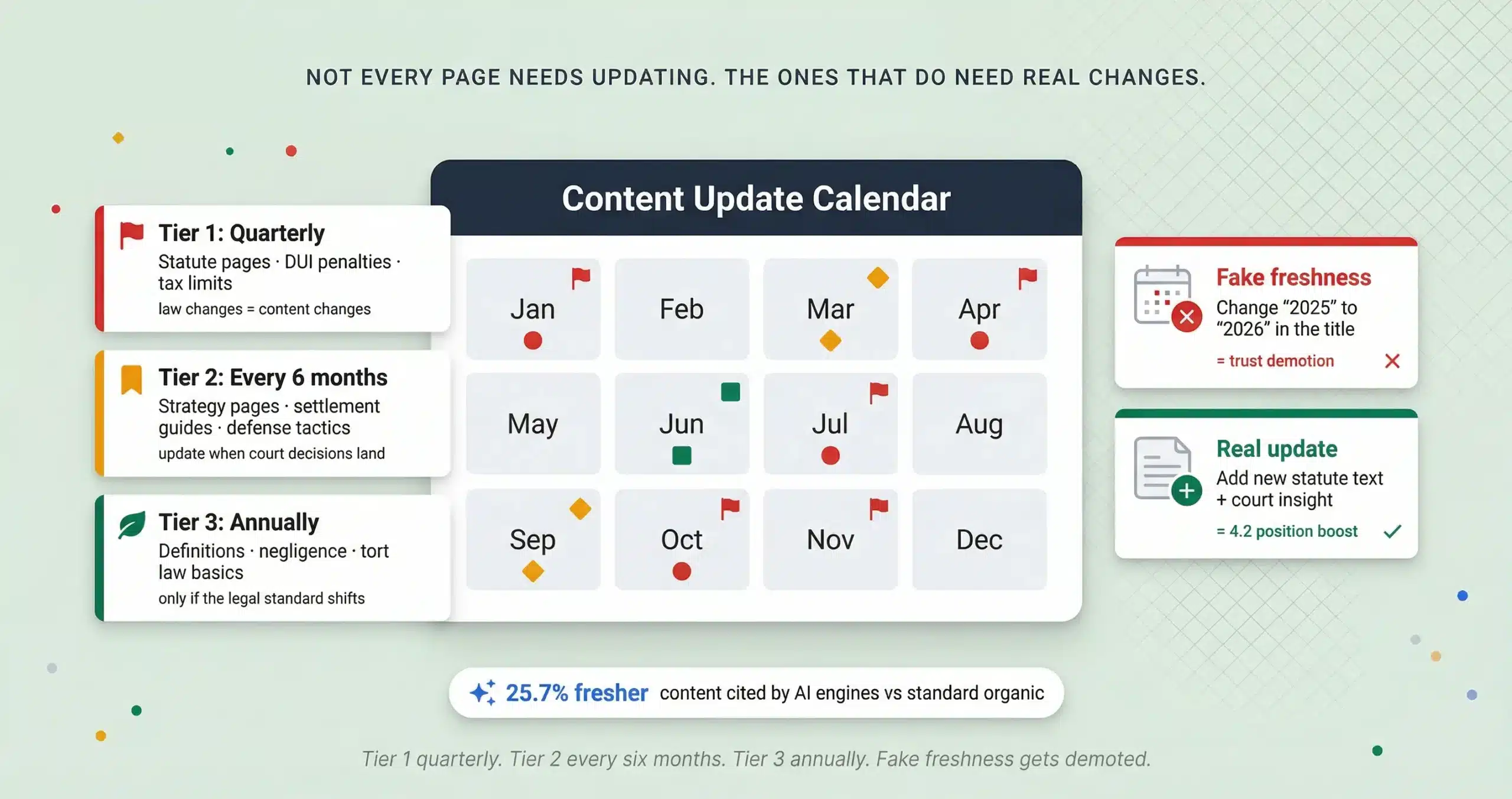
Tier 1 (statute heavy pages): update quarterly when legislation changes.
Tier 2 (case law pages): refresh every 6 months when notable court decisions land.
Tier 3 (evergreen definitions): review annually.
The rule: every update must add new factual density (statutes, data, local court application) or Google’s heuristic systems will classify it as fake freshness and demote the page. Source: Jorge Argota, 10 years managing legal content libraries.
THE VOLATILITY TRIAGE: HOW OFTEN TO UPDATE EACH PAGE TYPE
Updating everything on a flat monthly schedule is inefficient and looks like churn to Google’s quality filters. The algorithm distinguishes between a volatile statute page (tax law changes annually) and a static definition page (“What is negligence?” hasn’t changed in decades). Segment your content library into three tiers based on how fast the underlying law moves.
WHAT COUNTS AS A REAL UPDATE VS FAKE FRESHNESS
Google’s 2025 and 2026 heuristic systems measure the magnitude of content changes. If the algorithm detects that you changed the dateModified schema and the year in your H1 but didn’t alter the underlying text, it classifies the page as fake freshness and demotes trustworthiness. The penalty is severe: in site wide cases, it triggers a manual action.
What triggers a fake freshness penalty
Changing “2025 Guide” to “2026 Guide” in the title without changing the content. Updating dateModified schema without adding new information. Rewriting paragraphs to say the same thing in different words. Swapping synonyms to trick text comparison algorithms. The system compares the semantic delta between versions and if the information gain is zero, the trust score drops.
What counts as a legitimate refresh
Adding a “2026 Update” block with the new statute text and effective date. Inserting new statistical data (settlement amounts, filing deadlines, case outcomes). Fixing broken outbound links and adding new internal semantic links. Including a “Bench vs. Book” section explaining how the law is actually applied in your county courts. Updating the reviewedBy schema with the attorney who verified the changes.
THE TECHNICAL FRESHNESS SIGNALS GOOGLE AND AI ENGINES READ
AI engines using Retrieval Augmented Generation (RAG) heavily prioritize recent publications to avoid generating hallucinations or outdated advice. ChatGPT frequently cites URLs that are 393 to 458 days newer than Google’s organic baseline. Perplexity strongly favors content published or substantively updated within the past 90 days. If your Tier 1 pages haven’t been touched in 6 months, the AI engines are already skipping you.
The schema pulse
Update the dateModified field to the exact timestamp of the edit (only when you’ve made a real content change). Add the reviewedBy property naming the attorney who verified the update. Use Article or LegalService schema. This tells crawlers a credentialed human reviewed the page, not just a CMS auto-publish.
The visual trust stamp
Place a dynamic byline at the top: “Originally Published: [Date]. Last Verified for Legal Accuracy: [Current Date] by [Attorney Name, Esq.].” The phrase “Verified for Legal Accuracy” is a semantic signal to Google’s Quality Raters that a human expert reviewed the content, separating you from AI-generated spam.
The re-crawl accelerator
After updating a Tier 1 page, link to it from your homepage in a “Recent Legal Alerts” section for 7 days. This forces a rapid re-crawl because Google re-visits homepages more frequently than interior pages. Also resubmit the updated URL through the Search Console URL Inspection tool for immediate indexing.
💡 The “Bench vs. Book” experience signal
Add a section to your Tier 1 pages titled “How This Law Is Actually Applied in [County] Courts.” Content: “While the statute says X, in [County] courts, judges typically enforce Y.” This demonstrates the “Experience” signal in E-E-A-T and is the one thing AI cannot generate from existing web data. It proves you practice law, not just read it.
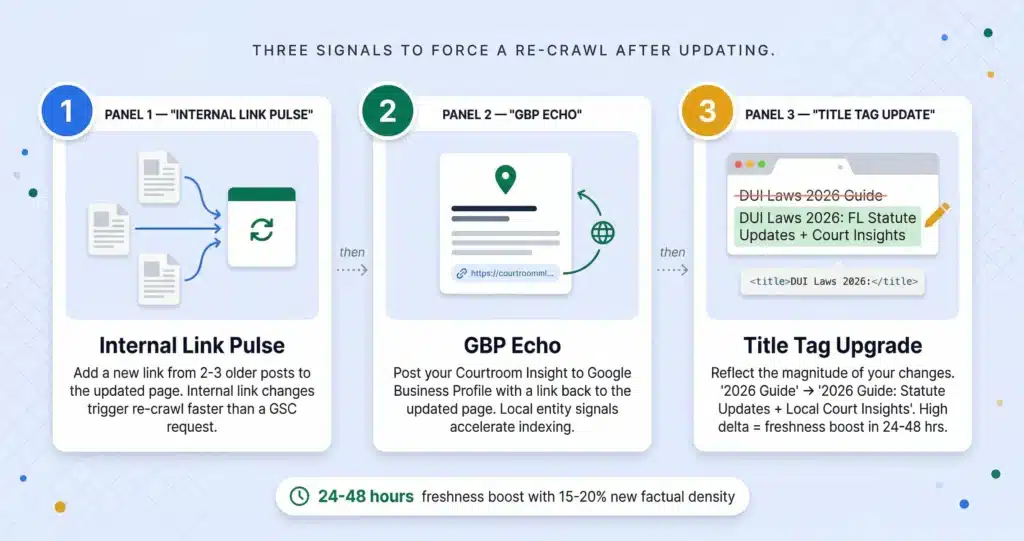
A legitimate refresh is useless if Google doesn’t see it for 3 months. Beyond the homepage link and URL Inspection request, deploy three additional signals to force the crawl.
First, the internal link pulse: find 2 to 3 older supporting blog posts and add a new internal link from each one to the updated section using the new keyword from your semantic freshness check. Internal link changes trigger a re crawl of the target page faster than a GSC request alone.
Second, the GBP echo: take the “Courtroom Insight” from your Tier 1 update and post it to your Google Business Profile with a link back to the updated page. Local entity signals from GBP are highly correlated with rapid indexing for legal firms.
Third, update your title tag to reflect the magnitude of the change; if you added a local court application section, the title shouldn’t just say “2026 Guide” but “2026 Guide: [State] Statute Updates and Local Court Insights.” If the page has high semantic delta (15 to 20% new factual density), Google’s freshness boost typically hits within 24 to 48 hours.
📐 The 2026 freshness formula
High Factual Density (15 to 20% new data) + Verified Schema (dateModified + reviewedBy + citation markup) + Local Court Insight (un-AI-able experience) = Freshness Dominance.
THE FACTUAL DENSITY AUDIT: HOW TO UPDATE WITHOUT GETTING PENALIZED
Google’s heuristic systems measure the “delta” between the old version and the new. Before hitting update, verify you’ve added at least 15 to 20% new factual information. Don’t change adjectives; change the data: new case names (proper nouns), new effective dates, new penalty amounts, new statute numbers. Those are the signals the algorithm uses to confirm a legitimate content change.
The citation injection
Every Tier 1 update must include at least one new outbound link to a .gov or .edu source that didn’t exist in the previous version. Use anchor text like “Pursuant to the January 2026 amendment of Florida Statute 316.193” so the AI parser knows exactly where the fresh data originates. This is the source of truth signal that drives the 25.7% AI citation lift.
The semantic freshness check
Search intent shifts after a law changes. People stop searching for “new DUI law” and start searching for “HB 837 impact on my case.” Before updating, pull your Search Console data for queries that appeared in the last 30 days. Weave those exact long-tail questions into the update as an FAQ section or inline answers to capture the new search volume.
The courtroom field report
AI can read the statute text. AI cannot tell you how Judge Martinez in Hillsborough County is ruling on it this week. Add a “Courtroom Insight” bullet to every Tier 1 update: “While the 2026 statute allows for X, we are seeing local prosecutors still leaning heavily on Y.” This is the experience signal that separates your page from every other firm citing the same statute.
📋 The freshness verification checklist
Before publishing any content refresh:
☐ Delta check: does this update add at least 15 to 20% new factual information (not reworded paragraphs)?
☐ Citation injection: does the update include at least one new .gov or .edu outbound link that wasn’t in the previous version?
☐ Semantic match: have you pulled the last 30 days of Search Console queries and woven the new long-tail terms into the update?
☐ Courtroom field report: does the update include at least one “how this law is actually applied” insight from your local courts?
☐ Schema sync: have you updated dateModified and reviewedBy to reflect the actual edit date and the attorney who verified it?
💡 What fake freshness actually looks like in Search Console
A DUI defense practice in Tampa asked me to audit why their blog traffic had flatlined despite their agency “updating content monthly.” I pulled the page versions from the Wayback Machine and compared them against the agency’s invoices. The agency had changed title tags from “2025” to “2026” on 200 posts and swapped a few adjectives in the intro paragraphs. Zero new statutes. Zero new case citations. Zero local court application. Google’s heuristic system had classified the entire domain as fake freshness and quietly suppressed every page. We rebuilt their 12 highest-value posts with actual statutory density (HB 837 impact, updated BAC thresholds, new diversion eligibility criteria) and added courtroom field reports from Hillsborough County. The suppression lifted within one core update cycle.
LEGAL CONTENT FRESHNESS FAQ
Get Your Content Freshness Audit
Send me your sitemap. I’ll tag every URL by volatility tier, flag which Tier 1 pages are overdue for a statutory refresh, identify fake freshness signals that are hurting your trust score, and build the update calendar that matches your content to your jurisdiction’s legislative cycle.
About Jorge Argota · 10 years managing legal content libraries across 14+ jurisdictions. Every page I manage is tagged by volatility tier with statutory update triggers built into the editorial calendar. Full bio.
Related: Content Marketing Statistics · AI Content Compliance · First Year SEO Timeline · Blog Post Length Guide · AI Overviews Impact