A repeatable architecture for winning AI Overviews and competitive city SERPs, not a list of random posts. Below is the model, the 40/40/20 commodity mix, the 8 step build, AI Overview tuning, and a non-law vertical case showing the framework working in a SaaS market.
Jorge Argota · 10 years in legal marketing · Miami
10 years working alongside Percy Martinez P.A. on content architecture, topical authority builds, and AI Overview optimization. Built and managed content programs for 10 plus firms since 2016.
Specializes in
Topical authorityHub and spoke architectureAI Overview optimizationSemantic SEOInternal linking
Topical authority is not won by publishing more. It is won by publishing a connected architecture that signals coverage at every intent stage.
One hub page covering the topic broadly. 8 to 25 spokes covering subtopics deeply. Internal linking that reads like a coherent cluster to search engines. Mix the cluster 40 percent breadth explainers, 40 percent deep differentiators, 20 percent teardowns. The SaaS firms ranking for “analytics strategy” in San Francisco, the healthcare networks ranking for treatment-specific terms in NYC, the real estate firms ranking in Miami: they all use the same architecture. The vertical changes. The structure does not.
The hub and spoke model, visualized
A single hub page connected to 8 spoke pages, with cross-links between related spokes forming a cluster.
The hub at the center is the pillar page covering the topic broadly. Each spoke covers one subtopic at a specific intent stage. Solid lines are hub-to-spoke. Dashed lines are cross-spoke connections that signal a coherent cluster.
The shiftStage: Problem awareness
Why topical authority beats keyword by keyword SEO
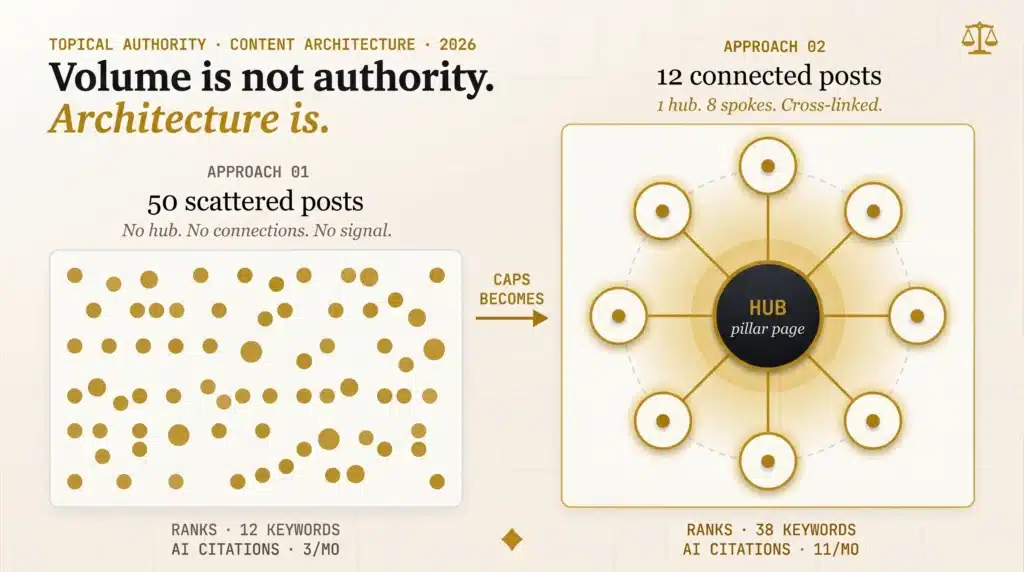
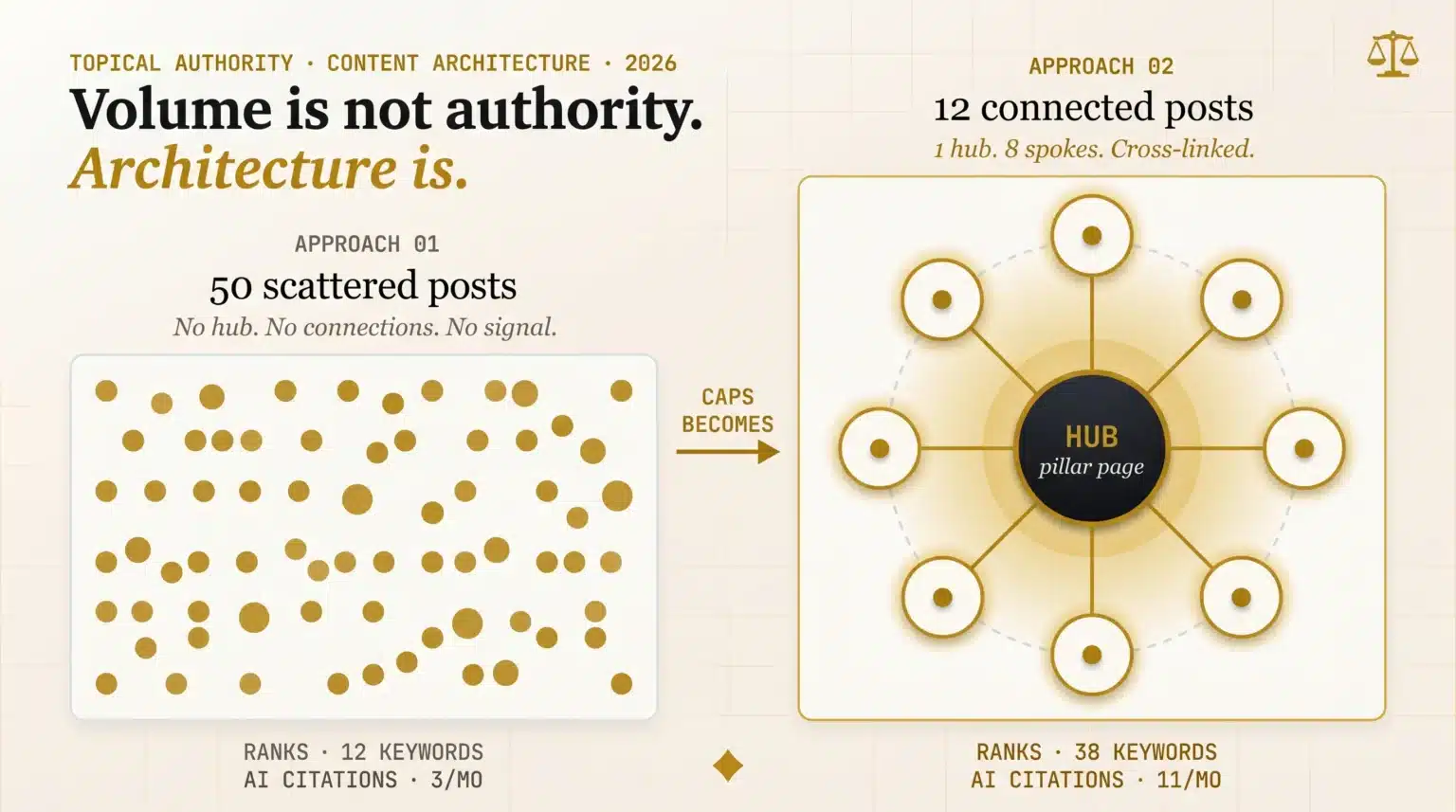
The old SEO playbook was: pick a keyword, write a post, repeat. It worked when search engines ranked individual pages against individual queries. That model is over. Google’s AI Overviews and semantic search now look at clusters of related content to decide which sites understand a topic well enough to be cited. A site with 50 scattered posts loses to a site with 12 connected posts in a tight cluster.
What loses
50 scattered posts on different topics
Each post tries to rank on its own. Internal linking is random. The site looks like a generalist blog. AI Overviews cite specialist clusters, not generalist sites. Algorithm updates hit harder because there’s no topical depth to absorb the impact.
What wins
12 connected posts in a tight cluster
One hub. Eleven spokes. Every spoke links to the hub. Related spokes cross-link. The site reads as the authority on one topic, which earns AI Overview citations and ranks for the cluster’s keywords plus their semantic neighbors.
The competitive city pattern reinforces this. SaaS firms ranking in San Francisco for “analytics strategy” do not own 200 random analytics blog posts. They own 3 to 5 clusters, each with a clear hub and 10 to 20 spokes covering one corner of the topic. Healthcare networks ranking in NYC for procedure-specific terms own clusters around each procedure. Real estate firms ranking in Miami own clusters around buyer types and neighborhoods. The vertical changes; the architecture does not.
The modelStage: Solution awareness
The hub and spoke model, concretely
A hub is the pillar page that covers a topic at the broad level. It introduces the topic, frames the subtopics, and links out to the spokes that handle each subtopic in depth. A spoke is the deep page that owns one subtopic completely. Each spoke links back to the hub and, where the subtopics overlap, links to related spokes.
What this looks like in different verticals:
SaaS in San Francisco
Hub
“Guide to SaaS analytics strategy”
Spokes
Pricing page SEO, feature cluster pages, support content as SEO asset, executive dashboards, retention metrics, churn analysis frameworks.
Healthcare in NYC
Hub
“NYC cosmetic dermatology guide”
Spokes
Treatment types, recovery timelines, insurance considerations, before and after photos, board certification, patient FAQs by procedure.
Real estate in Miami
Hub
“Miami waterfront real estate guide”
Spokes
Neighborhood breakdowns, dock and slip considerations, hurricane and flood policy, international buyer tax, HOA structures.
Each example shows the same pattern. The hub answers the broad question. The spokes answer the specific subquestions. The cluster as a whole signals topical coverage to search engines and to AI Overview systems looking for sources to cite. A user landing on any spoke can navigate to the hub for context, then to a sibling spoke for an adjacent question. The architecture serves the user and the algorithm at the same time.
The mixStage: Strategy design
The 40/40/20 mix inside every cluster
Google’s recent guidance explicitly separates “commodity content” (easy to reproduce, interchangeable, generic) from content with unique judgment, first-hand data, or original frameworks. Most cluster strategies fail because every spoke is commodity. They cover the topic but say nothing competitors cannot also say. The fix is not to skip commodity content. It is to balance it with content competitors cannot copy.
The 40/40/20 commodity mix
The publishing ratio inside a healthy cluster. Each segment plays a different role.
40 percent breadth, 40 percent depth, 20 percent teardowns. The middle 40 is what most clusters miss. The right 20 is what most clusters never attempt.
The middle 40 percent is the differentiator. It is the spokes built around original frameworks, real client data, specific operational angles, and judgment that only comes from doing the work. The right 20 percent (teardowns and case studies) is the highest-value segment because it shows the framework working in a specific real situation. Most clusters skip both because they are harder to write than commodity content. The clusters that win in competitive cities are the ones that do not skip them.
Key takeaway
The 40 percent breadth covers awareness traffic and serves as internal linking glue. The 40 percent depth is the cluster’s competitive moat. The 20 percent teardowns are what AI Overviews cite when they want a “real example” to round out an answer. Skipping any segment leaves a gap a competitor will fill.
The buildStage: Implementation
The 8 step framework for building a cluster
The build process below is what I use across every cluster, regardless of vertical. Each step has a deliverable. Skip a step and the cluster will work less well; the algorithm still rewards the structure, but the cluster underperforms relative to one built correctly.
01
Define the hub by business value, not by search volume
Pick a topic that can support 10 or more spokes and matters commercially. Test: can you name 10 specific questions your buyers actually ask? If not, the hub is too narrow. If you can name 50, the hub is too broad and needs splitting.
02
Build the semantic keyword bank per hub
Core term plus intent variants plus city or vertical modifiers plus related entities. Pull from Google’s “People Also Ask,” AI Overview citations, and competitor cluster pages. Target: 60 to 120 unique terms per hub.
03
Map every keyword to a funnel stage
Tag each term as Awareness, Problem, Solution, or Decision. The cluster needs coverage at every stage. Most clusters overload Solution stage spokes and underbuild Awareness, which costs them top-of-funnel traffic and AI Overview eligibility.
04
Design the hub page outline
High-level coverage of every subtopic the spokes will handle. Short sections that link out to the spokes for the deep version. FAQs at the bottom. Clear CTA. The hub is not a long article; it is a hub. Keep it tight and link out.
05
Apply the spoke template to every spoke
Each spoke gets the same 5-field template (covered in the next section). The template forces every spoke to have an intent stage, a non-commodity promise, a proof mechanism, a compliance note if relevant, and a semantic keyword bank. Spokes without the template tend to be commodity content.
06
Wire the internal linking and schema
Every spoke links to the hub. Related spokes cross-link with descriptive anchor text. Add Article and BreadcrumbList schema to every page. Use FAQPage schema on spokes that include FAQs. The schema is how search engines parse the cluster relationships.
07
Launch with hub plus 6 to 8 priority spokes
Do not launch the hub alone. The cluster needs critical mass on day one. Priority order: 2 awareness spokes (commodity-leaning, easier wins), 4 solution spokes (the moat), 2 decision spokes (closest to revenue). Add 1 to 2 spokes per week after launch.
08
Measure and iterate at month 3
Track hub visibility, spoke rankings, AI Overview citations, and internal click paths. At 90 days, identify which spokes are pulling weight and which are not. Strong spokes get refreshed and expanded. Weak spokes get rewritten or consolidated. The cluster matures by deletion as much as addition.
The clusters that win do not have more spokes than the ones that lose. They have spokes that each carry their weight. A 15 spoke cluster where every spoke ranks beats a 50 spoke cluster where 8 rank and 42 are dead weight diluting the topical signal.
Jorge Argota · May 2026
The templateStage: Implementation
The repeatable non commodity spoke template
This is the template I apply to every spoke before writing it. The 5 fields force the spoke to have a specific job inside the cluster. Spokes without this template tend to drift into commodity content because there is nothing forcing them to differentiate.
Template · Apply to every spoke
5 fields to define before writing a single word
01. Intent stage
Awareness, Problem, Solution, or Decision. Each spoke owns one stage. Mixing stages within a spoke confuses search engines and dilutes the cluster’s intent coverage.
02. Non commodity promise
One sentence stating what this spoke offers that competitors do not. “How we 3x’d AI Overview citations in 90 days for a NYC SaaS.” If you cannot write this sentence, the spoke is commodity content.
03. Proof mechanism
Screenshot, dashboard, anonymized data, timeline, workflow diagram, or live audit. Something concrete the reader can see. AI Overviews preferentially cite spokes with visible proof.
04. Compliance note
Especially for legal, healthcare, and finance verticals. A short note on jurisdiction, anonymization, or disclaimer requirements. Builds trust signals search engines reward.
05. Semantic keyword bank
Primary keyword, intent variants, entity terms, and city or vertical modifiers. Keep it tight (15 to 25 terms per spoke). The bank tells the writer where to weave terms naturally without keyword stuffing.
The template doubles as a quality check. Before publishing any spoke, every field has to be filled in. If a spoke cannot get a clear non-commodity promise or proof mechanism, that’s a signal the spoke is commodity content. Either rework it or merge it into another spoke. Saving a slot for a real differentiator is more valuable than filling it with commodity content.
AI searchStage: Optimization
Tuning the cluster for AI Overview citations
AI Overviews assemble answers by pulling from multiple sources that, together, cover the topic at the depth and angle the query implies. A cluster with strong topical coverage gets cited more often because AI Overview systems prefer authoritative sources over generalist ones. Below are the 4 tactics that move the needle most.
Tactic 01
Answer specific, intent-focused questions per spoke
AI Overviews pull from spokes that answer one question precisely. A spoke titled “How long does X take?” beats a spoke titled “Everything you need to know about X.” Specificity wins.
Tactic 02
Use clear section labels and structured data
“Step by step,” “Example,” “Checklist,” “Key takeaway.” These labels tell AI Overview systems what role the section plays. Add Article, BreadcrumbList, and FAQPage schema to give the parser structured context.
Tactic 03
Lead each spoke with a quotable answer
A 60 to 90 word direct answer at the top of every spoke. AI Overviews cite the answer most likely to satisfy the query in one block. Long preambles before the answer get skipped.
Tactic 04
Add unique angles vs generic guides
If 10 sites are saying the same 5 things, AI Overviews pick the source with the 6th thing. That 6th thing is original data, a specific framework, or a vertical-specific operational angle. The 20 percent teardown slot of the 40/40/20 mix is where the 6th thing usually lives.
Tracking which cluster spokes get cited by AI Overviews and which do not gives the next 90 day refresh roadmap. Tools like the AI Overview citation formula approach pull this data systematically. Spokes that get cited rarely or never need a structural rewrite. Spokes that get cited often get more depth and internal linking weight. The cluster compounds over time when the iteration cycle is tight.
Case exampleStage: Decision & ROI
Example teardown: a SaaS analytics platform in San Francisco
An anonymized version of the framework working in a non-law vertical. SaaS analytics platform, $50K monthly content budget, San Francisco-headquartered, competing in a market where 15 to 20 strong competitors already had clusters.
SaaS analytics, SF · 6 month rebuild
From 80 scattered posts to 3 hubs with 24 spokes
Before · Month 0
Posts published80
Hubs identified0
AI Overview citations3 per month
Top 10 rankings12 keywords
Organic sessions~18K monthly
After · Month 6
Hubs published3
Spokes published24
AI Overview citations11 per month
Top 10 rankings38 keywords
Organic sessions~47K monthly
The architecture: 3 hubs (Analytics strategy, Data governance, Reporting for executives), each with 8 spokes covering Awareness through Decision stages. The deletion: 47 of the original 80 posts were either merged into spokes, rewritten as spokes, or deleted entirely. The 40/40/20 split: applied across each hub, not across the site as a whole. The biggest single win came from publishing 6 teardown-style spokes (the 20 percent slot) that almost no SaaS competitor was producing.
The pattern in this case is not vertical-specific. The same architecture run for a healthcare network in NYC, a fintech in Chicago, or a real estate firm in Miami produces similar results in similar timeframes. What changes between verticals is the topic, the compliance framing, and the semantic keyword bank. The hub-and-spoke structure, the 40/40/20 mix, and the spoke template stay the same.
Related reading
Where topical authority connects to the rest of the system
Topical authority lives upstream of AI Overview optimization and downstream of content strategy. These pieces cover the adjacent decisions.
Common questions about hub and spoke topical authority
What is topical authority?
Topical authority is the degree to which a site is recognized by search engines as a trusted source for a defined topic. It is not earned through volume of posts. It is earned through depth and breadth of interconnected content covering the topic at every angle and intent stage, with internal linking that signals the relationships between pages. Sites with strong topical authority get cited by AI Overviews more often, rank for adjacent queries without dedicated pages, and recover faster from algorithm updates.
What is the hub and spoke content model?
The hub and spoke model is a content architecture where a single broad coverage page (the hub or pillar) covers a topic at a high level and links to a network of deeper pages (the spokes or cluster content) that each cover one subtopic in detail. Every spoke links back to the hub. Related spokes link to each other where the topics overlap. The result is a tightly interlinked cluster that search engines read as a coherent authority signal rather than a scattered collection of posts.
How many spokes does a hub need?
A working cluster needs at least 6 to 8 spokes covering the main subtopics. Strong clusters in competitive markets have 15 to 25 spokes. The number is not the goal. Coverage is the goal. The right count is whatever it takes to cover the topic at every intent stage (awareness, problem, solution, decision) with a non-commodity angle at each step. Adding more spokes without covering new ground does not build authority; it dilutes the cluster.
What is the difference between commodity and non commodity content?
Commodity content is content that is easy to reproduce and interchangeable with any other page saying the same things in the same way. Generic definitions, top 10 lists, and recycled best practices are commodity content. Non commodity content has unique judgment, first-hand data, original frameworks, or specific operational detail that competitors cannot copy without doing the work themselves. Google’s recent guidance favors non commodity content for AI Overview citations and for rewarding topical authority. Most cluster content fails because every spoke is commodity.
How does the 40 40 20 content mix work?
The 40/40/20 mix is a content publishing ratio within a cluster. 40 percent is breadth explainers (commodity content done well, satisfying basic queries). 40 percent is deep differentiators (non commodity content with original frameworks, data, or specific operational angles). 20 percent is teardowns and case studies (the highest-value content because it shows the framework working in a specific real situation). The mix balances coverage with differentiation. Pure non commodity content misses awareness traffic. Pure commodity content cannot rank in competitive markets.
How long does it take to build topical authority?
Most clusters need 3 to 6 months of consistent publishing before they show clear topical authority signals. The hub plus 6 to 8 initial spokes can launch in 30 to 60 days. The next 12 to 18 spokes build out over the following 90 days. AI Overview citations and competitive keyword rankings typically appear between months 4 and 6, sometimes sooner for less competitive verticals. Faster is rarely better; the cluster needs time for internal linking signals to mature and for Google to recognize the topical coverage.
Next step
Want me to audit your content and map the right hub and spoke architecture?
I review your existing content, identify the hubs hiding inside it, map the spokes you already have, and hand back a 90 day roadmap with the priority spokes to add, merge, or kill. Available for select firms across legal, SaaS, healthcare, and professional services.