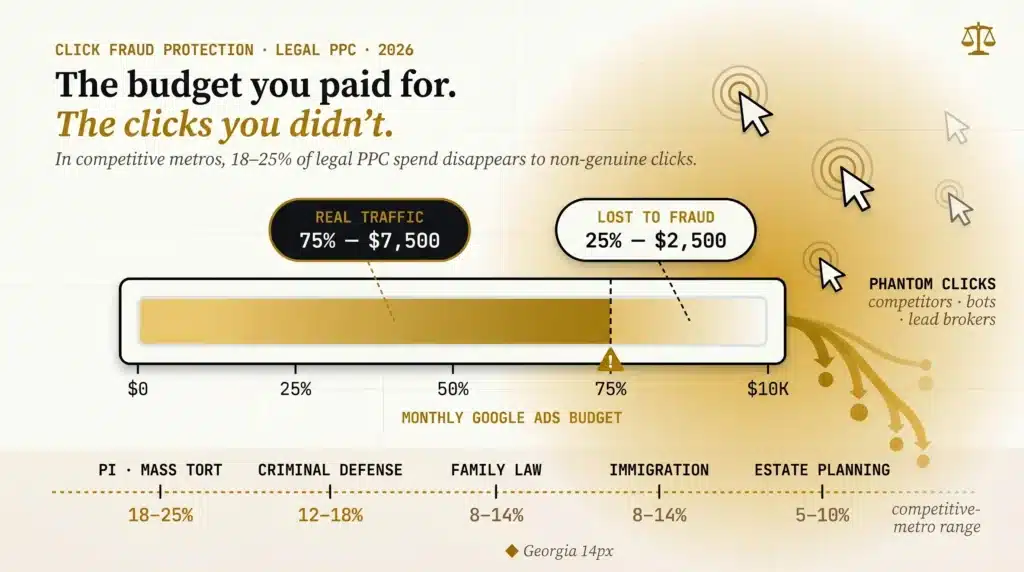
In markets like Miami, Houston, Los Angeles, and New York, personal injury and mass tort firms can lose 13 to 25 percent of their Google Ads spend to non-genuine clicks. This guide on click fraud protection for law firms shows managing partners and marketing directors exactly how to identify, prove, and stop click fraud in high CPC legal campaigns.
Jorge Argota · 10 years in legal marketing · Miami
10 years working alongside Percy Martinez P.A. on marketing, intake, and click fraud audits. Built and managed paid campaigns for 10 plus Florida firms since 2016.
Specializes in
Click fraud auditsGoogle Ads pacingIP and geo filteringIntake systemsFL Bar compliance
Legal PPC has the worst click fraud problem of any vertical because CPCs are highest and competitor incentives are strongest.
Personal injury and mass tort firms in competitive metros routinely lose 18 to 25 percent of their Search Ads budget to non-genuine clicks. Criminal defense runs 12 to 18 percent. Family and immigration 8 to 14 percent. Google’s invalid click filter catches some of it, but the gap is where firms lose real money. Below: the patterns to look for, the 15 minute audit you can run today, the protection stack that actually works, and the 30 day rollout plan.
Click fraud rate by practice area
Range of non-genuine click rates in competitive US metros, after monitoring is in place
Click fraud rate ranges across legal practice areas in competitive US metros. Higher CPCs and stronger competitor incentives push PI and mass tort to the top of the range.
The problemStage: Problem diagnosis
Why law firms are prime targets for click fraud
Three structural factors make legal PPC the highest fraud rate vertical in paid search. The combination is what produces the 18 to 25 percent rates in top tier metros. Across high CPC industries (legal, insurance, finance), law firms consistently show the highest mix of competitor driven fraud. E-commerce and local trades skew more toward bot driven fraud.
01
CPCs over $100 per click
A single fraudulent click in PI or mass tort can cost $200 to $500. The same fraudulent click on an e-commerce keyword costs $3. The dollar value of each draining click makes legal a higher value target for competitors and click farms alike.
02
Geo locked services
Law firms serve specific metros, which creates predictable targeting. A competitor in Miami knows exactly which keywords and ZIP codes to click to drain the firm down the street. Geo lock removes the noise that protects other verticals.
03
Lead broker incentives
Lead generation affiliates and aggregators benefit when firms shift budget away from organic Google Ads and toward purchased lead programs. The cheapest way to push firms toward purchased leads is to make their Search Ads underperform.
None of these are new. What changed in the last 18 months is the cost. As CPCs climbed past $200 in top tier markets, click fraud went from a 3 to 5 percent annoyance to a 20 percent budget killer. The math now justifies real protection, not just awareness.
What click fraud actually looks like in 12 hours
Hourly click volume from a real Miami PI campaign. Normal traffic in gold, fraud spike in dark.
Real 12 hour click pattern from a Miami PI campaign. The 11 AM bar is the fraud signature: 12 clicks from the same IP range in a 20 minute window, zero conversions. Every other hour shows normal traffic between 2 and 5 clicks.
Patterns by practice
What click fraud looks like in specific practice areas
The pattern is not the same across practice areas. PI fraud looks different from criminal defense fraud, which looks different from immigration fraud. Knowing the dominant pattern for the practice area cuts the audit time in half. PI patterns also overlap with other high liability verticals like insurance direct response and med device, because the same competitor incentives apply when one signed case is worth $50K plus.
Practice area
Personal injury
18-25%
Repetitive clicks from a small IP cluster within 15 to 30 minute windows, almost always during competitor business hours. Driven by local competitors and lead brokers. Look for clicks on accident keywords from devices that never convert.
Practice area
Mass tort
18-25%
Click farm traffic on drug and device keywords. Volume comes in clusters of 30 to 100 clicks over a few hours from disposable IPs. Geo often outside the campaign’s targeting, indicating the geo filter is being bypassed.
Practice area
Criminal defense
12-18%
Click spikes outside business hours that produce zero calls. Often automated traffic from outside the state masking as local searches. Less competitor driven than PI, more bot driven.
Practice area
Family law
8-14%
Mostly competitor driven, but at lower volume because the CPCs are lower. Pattern is similar to PI but with a smaller dollar impact. Often goes unaudited because the percentages look acceptable.
Practice area
Immigration
8-14%
Mixed pattern. Some competitor clicks on visa specific keywords. Some bot traffic from outside the US on broad immigration queries. Geo filtering catches most of the international bot traffic when set correctly.
Diagnostics
9 warning signs in your Google Ads account
Run this scan on the last 30 days of campaign data. If 3 or more of these show up clearly, the firm has a measurable click fraud problem and the audit math will justify protection.
Sign 01
Repeat IP clicksSame IP clicking the same ad 3 or more times within a single day.
Sign 02
Sub-15-second sessionsHigh bounce sessions under 15 seconds clustered in specific ZIPs.
Sign 03
Off-hour spikesClick volume outside business hours that never produces calls or forms.
Sign 04
Out-of-geo clicksClicks from ZIPs or states outside the campaign’s geo targeting.
Sign 05
Broad match anomaliesSearch terms triggering ads that have nothing to do with the keyword set.
Sign 06
Device fingerprint clustersIdentical device, OS, and browser combinations clicking repeatedly.
Sign 07
CTR spikes without conversionsSuddenly higher CTR on a campaign with zero corresponding lead lift.
Sign 08
Mid-month cost overrunsDaily budget hitting cap consistently with no extra leads to show for it.
Sign 09
Competitor brand searchesBranded queries showing click patterns that match nothing in the geo profile.
The 15 minute version of this audit: pull the search term report for the last 30 days, segment by IP and hour of day, and look for the patterns above. Most firms find a measurable signal in under 20 minutes. Tracking the results in a real call tracking system tightens the diagnosis because you can match click data to lead quality directly.
Key takeaway
If you find repeated IPs, off-hour spikes, and out-of-geo clicks together, you have a real click fraud problem, not just noisy traffic. One of the three signs alone is normal. All three together is the diagnostic signature.
Google’s invalid click filter catches automated traffic. It does not catch competitors clicking from their phones during lunch. The gap between what Google catches and what is actually happening is the entire reason firms lose 15 to 25 percent of their budget.
Jorge Argota · May 2026
The toolkitStage: Solution design
How to build a click fraud protection system for your law firm: the 4 layers
A real protection stack is not a single tool. It is 4 layers working together. Skipping any of them leaves a gap a competitor will find.
01
Real time detection software
Tools like ClickGuardian, ClickCease, and Lunio monitor every click against device fingerprints, IP behavior, and known fraud patterns. The good ones push exclusions to Google Ads automatically so the bad IPs cannot click the ad again. Cost: $79 to $300 monthly for most firm budgets. ROI threshold: $10K+ monthly Search Ads spend.
02
Google Ads native protections
IP exclusions, geo filtering, and suspicious click credits. These are free but limited. Google’s invalid click filter catches obvious automated traffic and credits the budget back, but it does not catch slow drip competitor activity. Use them as the floor, not the ceiling.
03
Geo and device exclusions
Tight geo targeting and device exclusions cut click fraud volume before it reaches the campaign. PI campaigns should not run on tablets unless data justifies it. Criminal defense should not run outside the firm’s actual practice radius. Geo radius targeting often beats ZIP based targeting for fraud control.
04
Intake side verification
The last layer is intake. Every lead form should ask “how did you find us” and every intake call should confirm the source. Match lead quality to campaign source weekly. Real click fraud shows up as a campaign with high clicks and zero retention. This is the layer most firms skip, and it is the cheapest one.
Key takeaway
Software alone does not solve click fraud. The protection stack needs all 4 layers because each layer catches a different kind of bad traffic. Skipping intake verification leaves the biggest gap because that is the only layer that scores leads on outcome, not just IP behavior.
Protection dashboard: 30 day view
Click fraud blocked and budget recovered across a 30 day deployment on a $25K monthly PI campaign
Blocked IPs
1,247
Saved spend
$4,180
Fraud blocked
17%
CPL improvement
-21%
Click fraud rate over 30 days on a real $25K monthly PI campaign. Software went live at day 7. By day 30 the fraud rate dropped from 22 percent to 6 percent, recovering $4,180 in monthly spend.
ImplementationStage: Decision & ROI
The 30 day rollout plan
One week per phase. By day 31 the firm has a baseline, working protection, and clean reporting. The plan below assumes the firm or its agency has access to the Google Ads account and at least one of the protection tools listed above.
Week 01Audit and baseline
Who owns it
Marketing director or paid media agency. No vendor needed yet.
What to pull
Last 30 days of click data segmented by IP, geo, device, hour of day. Run the 9-warning-sign scan.
Week 02Configure protections and rules
Who owns it
Paid media agency or in-house specialist with Google Ads admin access.
What to do
Install click fraud software. Set IP exclusions from the week 1 audit. Tighten geo targeting to actual service radius. Add device exclusions where data justifies.
Week 03Review anomalies and refine
Who owns it
Marketing director plus intake lead. Both should review the same data.
What to do
Match lead quality to campaign source. Identify campaigns still showing fraud signal after week 2 changes. Refine exclusion rules in the software.
Week 04Lock in, report, iterate
Who owns it
Firm owner reviews the before / after. Marketing director presents the savings.
What to do
Calculate recovered budget. Reallocate the savings into qualified traffic channels. Set 90 day review cadence. Document the playbook.
By the end of week 4, a firm running this plan should see click fraud rate drop from the practice area baseline (often 18 to 25 percent for PI) to under 5 percent. The recovered budget gets reallocated, not pulled. Cost per signed case is the metric that confirms the plan worked, not just lower CPL.
Example outcome
Miami PI firm: fraud rate from 22% to 6% in 45 days
Baseline
22%
fraud rate at week 1 on a $25K monthly budget
Intervention
63
IP exclusions added, geo tightened, device mix adjusted, ClickGuardian deployed
Result
6%
fraud rate by day 45, $4K monthly spend reallocated to qualified traffic
90 day impact
-18%
effective cost per signed case across the campaign
Key takeaway: the recovered $4K monthly was not pulled from the budget. It was redirected to negative keyword tightening and audience layering, which is where the cost per signed case improvement actually came from.
Compliance
What state bars actually care about here
The bar does not regulate click fraud directly. The bar regulates how the firm responds to it and what claims show up in the ads themselves. The line between protection and retaliation is the part to get right.
Bar compliant vs not
Acceptable: Running click fraud detection software, reporting suspicious activity to Google, requesting invalid click credits, tightening geo and device targeting, using IP exclusions, documenting patterns for potential legal action.
Not acceptable: Retaliatory click campaigns against competitor ads, hiring click farms to drain competitor budgets, paying anyone to click competitor ads, or making any claims in ad copy that imply outcomes or use comparative superiority language banned under Rule 4-7.13(b)(3). Past results in ad copy trigger Rubenstein v. Florida Bar (2014) disclosure rules. Out of state firms map to their own state bar with similar restrictions.
The protection layer is universally allowed. The retaliation layer is universally not. Firms that try to fight back through their own click campaigns end up with a bar grievance on top of the original fraud problem.
Related reading
Where click fraud protection connects to the larger paid system
Click fraud protection lives inside a larger paid media operation. These pieces cover the adjacent decisions that make the protection actually work.
How much click fraud do law firms typically see in Google Ads?
Law firms in competitive markets typically see 13 to 25 percent of paid clicks flagged as non-genuine once proper monitoring is in place. Personal injury and mass tort run at the high end of that range because CPCs are higher and competitor incentives are stronger. Smaller practice areas and less competitive metros tend to run 8 to 15 percent. Google’s own invalid click filtering catches some of it, but not all, and the gap is where firms lose money.
Can competitors legally click on my law firm Google Ads?
Manually clicking competitor ads to drain their budget violates Google’s advertising policies and can be considered tortious interference under state law. Whether prosecution happens is a separate question. What matters operationally is that competitor-driven click fraud is a real pattern in legal PPC, and firms should focus on detection and exclusion rather than retaliation. Retaliatory click campaigns against competitors are themselves a bar ethics problem and are not a recommended response.
Do I still need click fraud software if Google says it filters invalid clicks?
Yes, for most law firms in competitive markets. Google’s filtering catches obvious automated traffic but misses targeted competitor clicks, click farm activity that mimics human behavior, and slow drip patterns spread across the day. In low CPC verticals the gap is small enough to ignore. In legal PPC, where a single wasted click can cost $200 to $500, the gap is what justifies the software. Firms spending under $5,000 monthly on Search Ads may not see ROI on the software. Above $10,000 monthly the math almost always works.
What is the ROI of click fraud protection for legal PPC?
Typical click fraud software runs $79 to $300 monthly. On a $10,000 monthly Search Ads budget, blocking 15 percent of invalid clicks recovers $1,500 in budget that gets reallocated to qualified traffic. That math works for almost any firm spending above $5,000 monthly. Below that, manual audit using Google Ads native tools is usually sufficient. The bigger ROI is downstream: less intake time wasted on fake leads and more accurate campaign optimization data.
How do you do a click fraud audit on a Google Ads account?
Pull the last 30 days of click data segmented by IP, device, geography, and hour of day. Look for repeated clicks from the same IP within short windows. Look for click spikes outside business hours that produce zero conversions. Look for clicks from ZIP codes outside the firm’s service area despite geo targeting being set. Check whether the search terms match the keywords (suspicious traffic often comes from broad match queries that should never have triggered the ad). Most firms find a measurable click fraud signal within 15 minutes of running this audit.
Does Florida Bar Rule 4-7.13 affect how a law firm handles click fraud?
The Florida Bar rules do not regulate click fraud directly. The bar issue arises if a firm responds to competitor click fraud by running its own click campaign against competitors, which would likely violate professional conduct rules around honesty and fairness. Rule 4-7.13(b)(3) also prohibits comparative superiority claims in any ad copy or landing page running through Google Ads. Past results trigger Rubenstein v. Florida Bar (2014) disclosure requirements. Out of state firms map to their own state bar rules with similar restrictions.
Next step
Want me to run a click fraud audit on your firm’s Google Ads account?
I pull 30 days of click data, run the full diagnostic, identify the fraud rate by campaign, and hand back a prioritized 30 day protection plan. Available for select PI, med mal, and complex civil firms.