








When your firm should weight LSAs vs Google Ads, by practice type and metro tier, using case acquisition cost math. Not generic “use both” advice.
Most “LSA vs Google Ads” guides give you a definitions list and a generic “use both” conclusion. That doesn’t help anyone allocate budget.
This page shows how real law firms split spend by practice type, city tier, and intake capacity. Cost per signed case is the metric that decides allocation, not cost per click. FL Bar Rule 4-7.13 / 4-7.14 referenced where it applies. Out of state firms map to their own state bar rules.

01 · Fast answer: who should use what
Decision matrixMost law firms should run both the two channels. The right split depends on 3 inputs: practice type urgency, city tier, and intake capacity. The matrix below gives you a starting allocation in 30 seconds.
After 90 days of data, reallocate budget toward whichever channel produced the lower case acquisition cost (CPSC), not the lower lead cost.
02 · What each channel actually is
DefinitionsGoogle Screened · pay per qualified lead
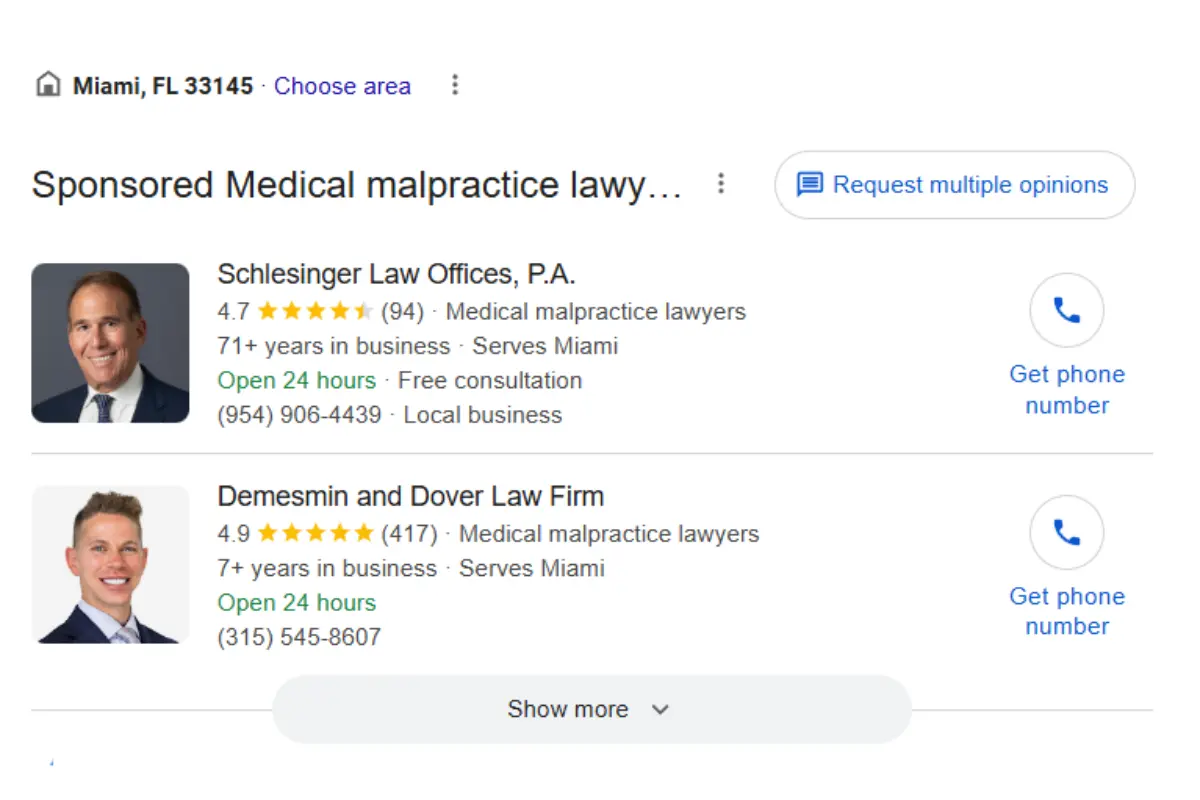
- Charges per lead (call or message), not per click
- Top of page placement above Google Ads
- Card format with firm name, rating, click to call
- Requires bar verification + Google background check
- Ranking driven by reviews, response time, proximity, bid
- Available for personal injury, criminal, family, immigration, estate, business; varies by market
- Google credits leads that don’t match case category or geo
Pay per click · full keyword flexibility
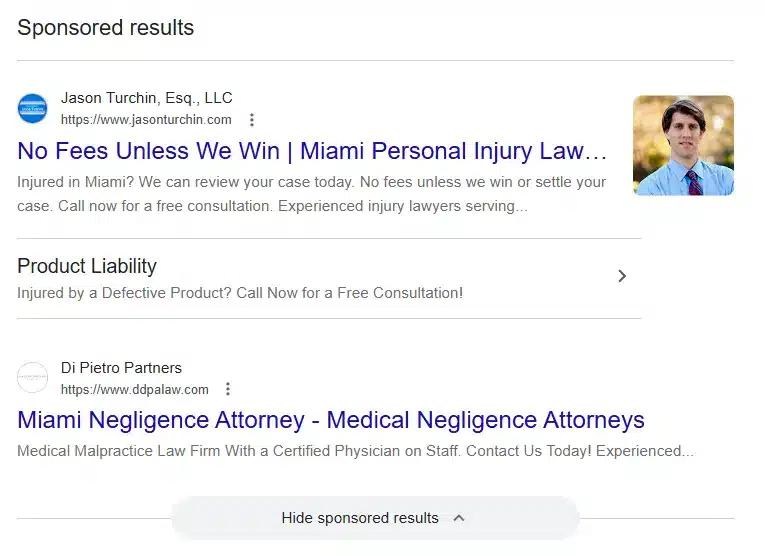
- Charges per click whether the user converts or not
- Shows below LSA section, above Map Pack
- Text format: headline + description + landing page link
- No bar verification required to launch
- Ranking driven by bid, quality score, ad relevance
- Works across every case category at any volume
- You absorb every irrelevant click; negatives required
| Factor | Google Ads (Search PPC) | Local Services Ads (Google Screened) |
|---|---|---|
| Payment model | Pay per click | Pay per qualified lead |
| Placement | Below LSAs, above organic | Top of page, above everything |
| Flexibility | Full flexibility on keywords, bids, ad copy, landing page | Limited; Google formatted card and profile |
| Verification | None required to launch | Bar license, insurance, background check |
| Targeting | Keywords, match types, negatives, geo, schedule | Service areas, practice categories, proximity, budget |
| Trust signal | None native; built via landing page | Google Screened badge + review stars |
| Scalability | Nearly unlimited with budget and geo expansion | Volume capped by local search demand and Google Screened inventory |
03 · PPC vs LSA: how each channel performs in practice
Lead economicsThe structural difference between the two channels is when payment happens.
Different searches produce different winners.
- car accident lawyer near me
- DUI lawyer Tampa
- criminal defense attorney now
- spinal cord injury attorney
- talcum powder lawsuit
- commercial litigation lawyer
Most firms benefit from running both, then letting cost per signed case determine the split.
“The right question is not LSA or Google Ads. It is which channel signs more cases for your firm in your city. Run both, measure both, reallocate every 90 days.”Jorge Argota · April 2026
04 · Practice area allocation matrix
Channel mix by practiceStarting allocation by legal vertical in a Tier 1 metro. Adjust based on intake capacity and 90 day signed case data.
| Practice area | Starting mix (LSAs · Google Ads) | Why this split |
|---|---|---|
| Personal Injury (general) | LSAs capture urgent local calls; Ads target higher value case types and non LSA geos. | |
| Mass Tort / Med Mal | Narrow targeting beats broad LSA buckets. Ads with tight keyword themes filter for case fit. | |
| Criminal Defense / DUI | Urgent local intent dominates. Google Screened ads first; Ads for premium terms (“federal”, “no jail”). | |
| Family Law (general) | LSAs for raw lead volume. Ads for high net worth, contested, complex custody. | |
| Immigration | Mostly research intent. Ads with content rich landing pages outperform card-format ad. | |
| Estate Planning | Searchers are researching, not ready to call. Ads with educational content win. | |
| Business Litigation | B2B searcher behavior. Long research cycles. LSA card format underperforms here. |
Source: Argota observation across client accounts and public benchmarks, 2024 to 2026. Allocations are starting points; reallocate based on signed case data after 90 days.
05 · City tiers change everything
Market competitionA 60/40 allocation that works in Tampa fails in NYC. LSA competition, Google Ads CPCs, and impression share all shift by tier. Use the framework below to set realistic budget expectations.
The most competitive markets in the country. Ranking in either channel requires real budget, fast intake response, and consistent review velocity.
PI leans LSA (urgent, intake-driven). Criminal splits roughly even. Family law leans LSA for divorce volume, Google Ads for high net worth.
Less crowded auctions, faster path to top placement. Top of LSAs is reachable in months, not years.
PI often outperforms Tier 1 here because review velocity converts faster in a less saturated field. Criminal stays urgent. Family law tilts toward LSAs as lead cost drops.
The constraint is search volume, not competition. LSA inventory is often too thin to absorb a real budget. Geographic expansion to nearby markets is usually viable.
PI runs Google Ads with expanded geography. Criminal stays local but LSA volume is thin. Family law and estate planning often run Google Ads only.
06 · What this looks like outside law
Cross vertical patternsthe two channels work the same way across every vertical Google supports: emergency plumbing, HVAC, roofing, garage door repair, real estate. The lessons from those verticals map directly to legal practice. Your PI channel mix should look more like an emergency plumber’s mix. Your business litigation mix should look more like a B2B SaaS funnel.
The searcher with a burst pipe is not researching plumbing companies; they need help in the next 30 minutes. Personal injury and DUI behave the same way. The intent is urgent, local, and ready to convert on the first phone call. LSAs win here because the card format with click to call matches what the searcher is trying to do. Google Ads runs alongside as a secondary channel.
A new HVAC system or a full roof replacement is a $10,000 plus decision and the searcher is researching for weeks. Medical malpractice and mass tort follow the same pattern. The case is high value, the timeline is long, and the prospect needs detailed information before they will commit. Google Ads with tight keyword themes and content rich landing pages outperforms the LSA card format here.
First time home buyers and refinance shoppers research for months before contacting anyone. Estate planning and uncontested divorce searchers behave identically. The decision is significant, the timeline is long, and the searcher needs to understand the process before they call. Google Ads paired with educational content converts these searchers; the LSA card format does not give them what they need to move forward.
A business buying enterprise software does not click “call now”; the decision involves multiple stakeholders, several rounds of evaluation, and a procurement process. Business litigation searchers behave the same way. Google Ads, organic search, and direct outreach do most of the work. LSAs run at minimal share because the card format does not match how these prospects actually evaluate counsel.
Pattern: LSAs win when intent is urgent and local. Google Ads win when targeting is narrow and case value is high. Same logic across legal, home services, and commercial verticals.
07 · Budget allocation, tracking, common traps
Strategy The metric that mattersThe metric that determines profitability is cost per signed case, not cost per lead. Cost per lead is easy to pull from a dashboard and that is why most firms compare channels with it; the comparison is misleading. A $40 lead from Google Ads converting at 5 percent and a $200 LSA lead converting at 20 percent do not look similar on a CPL report, but they produce roughly the same cost per signed case. Channel decisions made on lead cost alone routinely defund the channel that is actually working.
What to trackFour numbers per channel. Ninety days of data is enough to see which channel is winning.
Move budget toward the winner. Restructure the loser or scale it back. Channel allocation is a math problem and emotional attachment to a particular tool is what causes most of the bad decisions in this category.
Four traps that cost firms real moneyLSAs have a hard ceiling that most agencies will not mention. Local search demand for any specific case type in any specific city is finite. Once you have captured the bulk of that demand at a profitable cost per lead, additional budget produces nothing. The auction has nothing left to sell you.
Google Ads has no equivalent ceiling because you can always add keywords, expand geography, or layer in different match types. Firms that want sustained growth past whatever LSAs naturally cap at have to invest in Google Ads, organic search, and channels outside Google entirely. This is the structural reason mid sized firms eventually run heavier on Google Ads even when LSAs deliver a lower cost per signed case.
08 · Compliance and ethics across both channels
Bar rulesBar advertising rules apply to LSAs, Google Ads, landing pages, and call recordings equally. The most common compliance failures across both channels: comparative superiority claims (best, top, leading), specialist or expert claims without certification, past results without disclaimers, and testimonials that violate state specific rules.
LSA call recordings are made by Google’s system; review your firm’s recording disclosure compliance for 2 party consent states (Florida is 2 party). Out of state firms map every section of this guide to their own state bar advertising rules before launching either channel.
- ✓ No “best”, “top”, “leading” in profile description (FL Rule 4-7.13(b)(3))
- ✓ No “specialist” or “expert” unless Florida Bar Board Certified (Rule 4-7.14(a)(4))
- ✓ Review snippets aligned with state testimonial rules; some states require disclaimers on outcome-based reviews
- ✓ Recording disclaimer ready for 2 party consent states; Google records LSA calls automatically
- ✓ Past results disclaimers on any settlement amounts mentioned in profile (Rubenstein v. FL Bar 2014)
09 · Real Argota client work where this framework came from
Real clientsThe allocation framework above isn’t theoretical. It’s pulled from 10 years working with Florida law firms across multiple matter types. Below: 4 active client engagements that informed the channel mix patterns on this page. Each links to a full case study with verifiable numbers.
Percy Martinez, P.A.
Started as a solo practice in Miami with a $500 budget. Now ranks across Miami, Orlando, Tampa, and Jacksonville. The longest active engagement informs how channel mix evolves as a firm scales geographically.
Jorge L. Flores, P.A.
Migrated from a FindLaw site (2003 era) to a site he actually owns. Took #1 Map Pack for “medical malpractice lawyers Kendall, FL” in 5 months. Demonstrates how channel allocation works for narrow geographic targeting in a competitive practice area.
Miami Cruise Ship Lawyers
First page ranking for “Miami cruise ship lawyers.” Maritime injury cases go to federal court in Miami regardless of where passengers got hurt; the positioning reflects the jurisdiction, not the geography. Shows how channel mix shifts for narrow specialty practices where LSAs don’t cleanly apply.
Property Claim Group
Insurance disputes across Florida. Consistently ranks for hurricane damage, flood claims, and roof denial searches. Seasonal traffic patterns that compound through hurricane season inform how dayparting and budget pacing work alongside year round channel mix.
FAQ
Should my law firm use Google Ads or Local Services Ads?
What is the difference between Google Ads and Local Services Ads for law firms?
How much do Local Services Ads cost for lawyers?
Are Local Services Ads worth it for personal injury lawyers?
How do you allocate budget between the two channels?
Do LSAs and Google Ads have to follow Bar advertising rules?
Can law firms run LSAs in non urgent practice types like estate planning or business law?
What metrics should I track to compare LSAs vs Google Ads?
Want me to score your LSA vs Google Ads mix against this framework?
I’ll audit both channels: cost per signed case by practice area, allocation gaps, intake capacity fit, and compliance review. You get a written audit with reallocation recommendations ranked by dollar impact.
- Cost per signed case calculation per channel
- Reallocation recommendation by practice area
- Intake capacity fit analysis
- FL Bar compliance review
- 90 day reallocation roadmap