






Written by Jorge Argota · Multi-Location Legal SEO · United States
62% of law firms operate without an SEO page title. 46% don’t have a functioning website. When you’re running multiple offices across different markets, you’re not just competing against other firms; you’re competing against a market where 54% rely on outdated directories and 46% have no digital presence at all. The architecture decision you make before writing a single word of content determines whether your offices share authority or cannibalize each other.
TL;DR
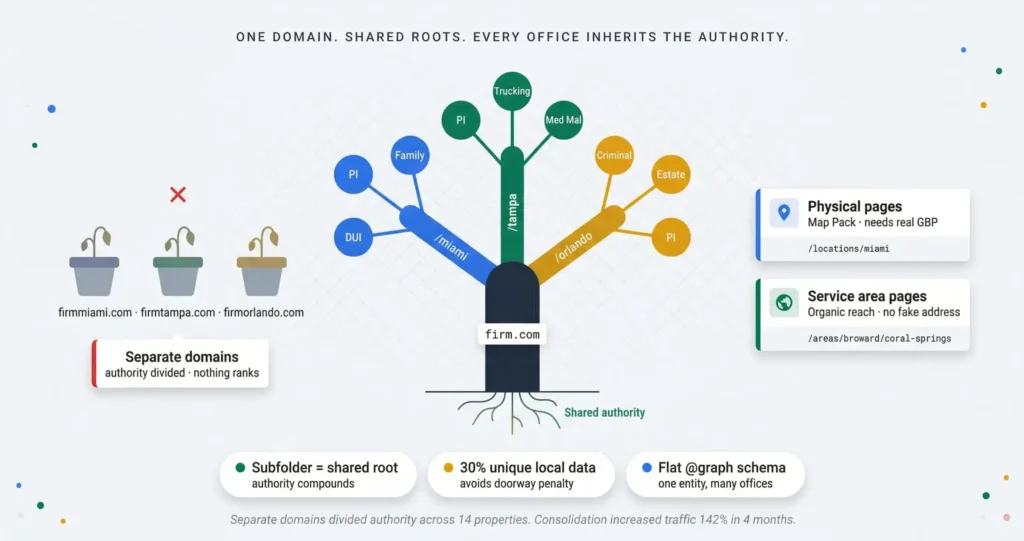
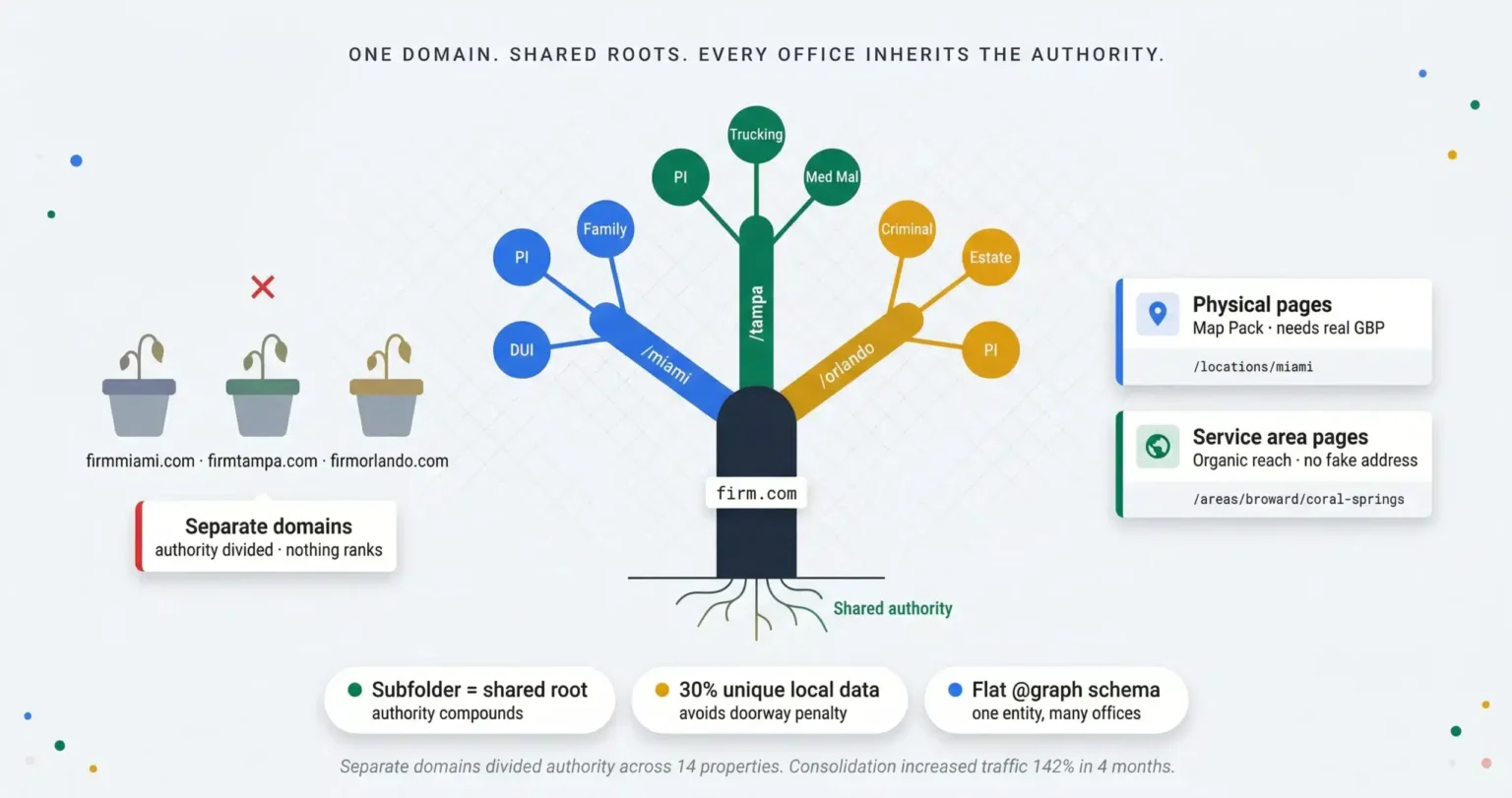
The architecture: subfolder structure (firm.com/locations/miami) so every office inherits the root domain’s authority instantly.
The split: physical location pages for the Map Pack (must have a verified GBP) and service area pages for organic reach (no fake addresses).
The schema: flat @graph arrays with @id references that connect each office to the parent firm and each attorney to their specific offices without duplicating entities or diluting link equity.
The content rule: 30% of every location page must be unique local data (specific courts, local attorneys, community partnerships) or Google flags it as a doorway page. Source: Jorge Argota, 10 years multi-location legal SEO.
SUBFOLDER VS SUBDOMAIN VS SEPARATE DOMAINS FOR LAW FIRMS
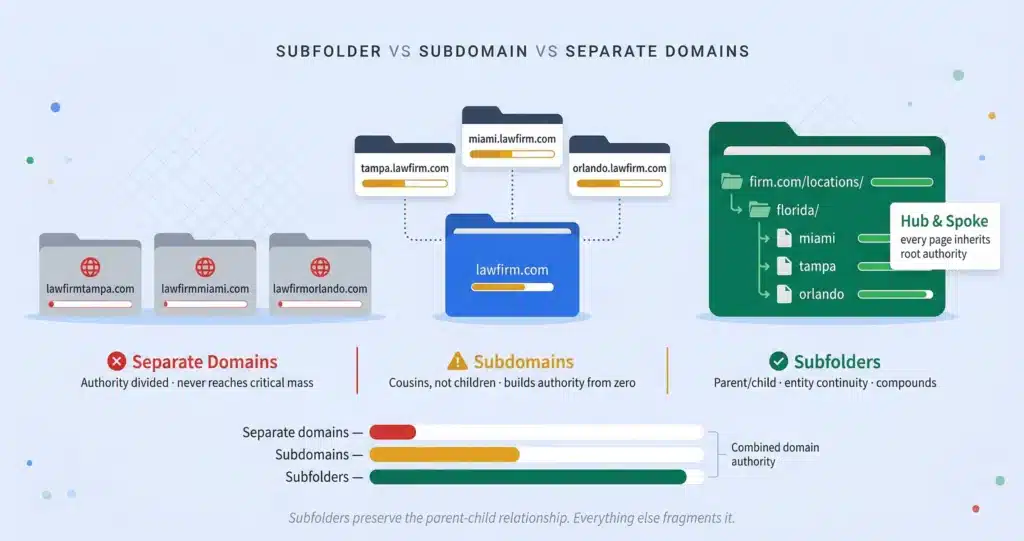
This is the decision that determines whether your offices compound authority or compete against each other. The argument for subfolders isn’t just about link equity anymore; in 2026 it’s about entity continuity. Subdomains (tampa.lawfirm.com) break the breadcrumb schema chain and Google’s AI sees the subdomain as a “cousin” rather than a “child,” severing the semantic connection to the root entity’s trust signals.
Subfolders preserve that parent/child relationship so the algorithm understands every office is part of one verified legal entity. The optimal structure uses state-level clustering (firm.com/locations/florida/miami) so you can rank for “Florida Laws” at the parent level and “Miami Laws” at the child level simultaneously. Separate domains (lawfirmtampa.com) divide your link profile across isolated properties that will never reach the critical mass needed to outrank entrenched competitors.
The subfolder architecture must include a centralized locations hub page (firm.com/locations/) that acts as the internal linking spine, pushing algorithmic weight down into every regional subfolder through a hub and spoke model.
PHYSICAL LOCATION PAGES VS SERVICE AREA PAGES FOR LEGAL SEO
Every multi-location firm needs two types of location content and confusing them triggers the doorway page penalty. Physical location pages target the Map Pack and require a verified Google Business Profile at that address. Service area pages target organic search for cities where you want cases but don’t have an office. The URL structure, the schema, and the content mandate are different for each.
Physical location pages (Map Pack)
firm.com/locations/city-name
Must have a verified GBP. Embedded Google Map matching the GBP. Attorney bios for partners at that office only. Local parking and courthouse directions. Review stream from that specific location ID. Uses Attorney or LegalService schema with the physical address and a parentOrganization node linking to the parent firm.
Service area pages (Organic reach)
firm.com/areas/county/city-name
No fake address. Uses Service schema with areaServed linked to a Wikidata ID (not LocalBusiness or hasMap). To prove the service area is real and avoid the doorway filter, use jurisdictional anchoring: “We file motions in the 17th Judicial Circuit Court” and “Defending against Broward County Ordinance Sec. 12-34.” The algorithm needs court entities and statute references, not just a city name swap.
⚠ The doorway page penalty (Information Gain test)
The 30% unique local data rule is the bare minimum. Google’s real filter is “Information Gain”: if your Miami page says the same thing as your Orlando page with the city name swapped, AI Overviews filter it as redundancy. Fail: “Our lawyers in [City] fight for you.” Pass: “Our Miami team handles filings for the Eleventh Judicial Circuit and understands the pre-trial diversion programs specific to Miami-Dade County, unlike the procedures in Broward’s 17th Circuit.” The brickAndMortarStrength signal (confirmed in the 2024 Content Warehouse API leak) seeks multi-modal proof that the location is real: unique office photography, attorney bios tied to that specific office, and jurisdictional content no template could generate.
NESTED SCHEMA AND ENTITY DISAMBIGUATION FOR LAW FIRM OFFICES
The 2023 approach was nesting (Organization wraps LegalService wraps Person). In 2026, deep nesting creates JSON bloat and breaks when you have 50+ attorneys. The upgrade is graph composition: a flat @graph array where each entity (firm, office, attorney) is defined once as a sovereign node with a unique @id and referenced everywhere else by that ID.
If Jane Doe practices in both Miami and Fort Lauderdale, you define her once and reference her @id in both office nodes. Google understands she is one person with multiple location edges, maximizing her individual authority score instead of creating two fragmented entities. For AI citation, this graph structure allows LLMs to traverse your entity relationships instantly and select your firm as the “grounding source” when the query matches your semantic neighborhood.
Attorney entity verification
Every prominent attorney needs a sameAs array linking to their state bar registry, Avvo, LinkedIn, and any Wikidata entry. Use the knowsAbout property to declare specific practice areas by jurisdiction (“Florida DUI Law”). This builds a KGMID (Knowledge Graph Machine ID) that acts as a fast pass through algorithmic processing.
NAP consistency at scale
Name, Address, and Phone on the page footer must match the GBP exactly. “Ste 100” vs “Suite 100” is enough to create entity confusion. For firms with 50+ locations, use centralized tools (BrightLocal, Yext) to push standardized NAP updates across all directories simultaneously. Manual management breaks down at scale and the inconsistencies compound.
AI CITATION AND GENERATIVE ENGINE OPTIMIZATION FOR MULTI-LOCATION FIRMS
44.6% of all local service queries in LLMs are legal. That’s more than medical (27.5%) and automotive (13.5%) combined. But legal consumers using AI prioritize expertise over proximity; only 34% of legal LLM queries are strictly location-dependent compared to 69% for services like roofing.
This means your multi-location content strategy has to build deep topical authority per office, not just geographic presence. The firms that get cited by ChatGPT and Google AI Overviews are the ones whose location pages read like jurisdiction-specific legal references, not directory listings.
💡 The geotopicality signal
Physical proximity alone doesn’t rank you in the Map Pack anymore. Google’s geotopicality requirement means the content on a specific branch page must demonstrate semantic relevance to the local environment. Don’t just say “Located in Miami.” Say “Located in the Brickell Financial District, two blocks from the Miami-Dade County Courthouse” and use the containedInPlace schema property to link to the neighborhood entity. If your coastal office doesn’t mention maritime law or local zoning, and your metro office doesn’t reference that county’s specific dissolution procedures under Florida Statute 61.052, the algorithm can’t verify that your entity actually operates in that community. Vector-optimized content (“We litigate dissolution of marriage under Florida Statute 61.052 in the 13th Judicial Circuit”) places your firm in the same semantic neighborhood as high-authority legal texts, which is exactly what LLMs use to select grounding sources for citations.
💡 The migration case study
When I migrated a 14 office Florida defense firm from separate city domains into a unified subfolder structure, their non-branded organic traffic increased by 142% in 4 months because the link equity finally pooled at the root domain instead of being scattered across 14 isolated properties. The firm had spent 3 years building backlinks to firmjacksonville.com and firmtampa.com and firmmiami.com; none of those domains had enough authority individually to crack page one. Within one quarter of consolidation, the root domain outranked all 14 of the old separate domains combined.
MULTI-LOCATION LAW FIRM SEO FAQ
Send me your office list and I’ll map the architecture
Tell me how many physical offices you have, which cities you want to cover without an office, and your current URL structure. I’ll build the subfolder map, the schema hierarchy, and flag any entity disambiguation issues before they cost you rankings.
About Jorge Argota · 10 years building multi-location SEO architectures for law firms with 2 to 100+ offices. Every structure I build uses subfolder architecture with nested schema and 30% unique local data per page. Full bio.
Related: SEO for Lawyers · AI Search Visibility · Google Business Profile · Conversion Optimization