






Written by Jorge Argota · Legal Marketing · United States
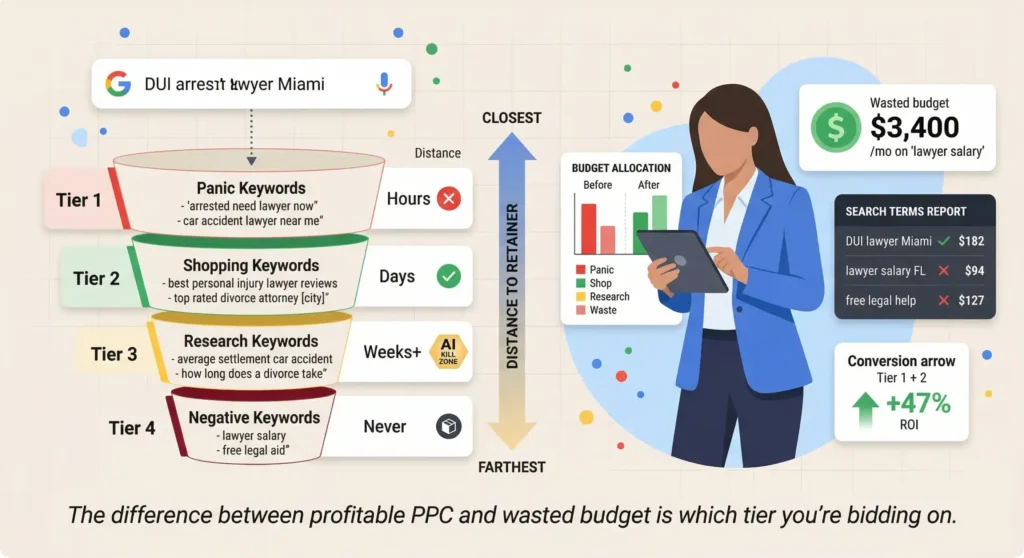
So most law firms treat every “lawyer” keyword the same. They bid on “DUI arrest lawyer” and “lawyer salary” using the exact same budget, bid strategy, and landing page. Then they look at their cost per acquisition, panic, and conclude that Google Ads doesn’t work. The real problem isn’t the platform. Half their budget funded law students researching career options while the other half fought for people ready to sign a retainer that afternoon. I don’t care about search volume. I care about distance to retainer, which is how many steps sit between the person typing that search and them signing with your firm.
TL;DR
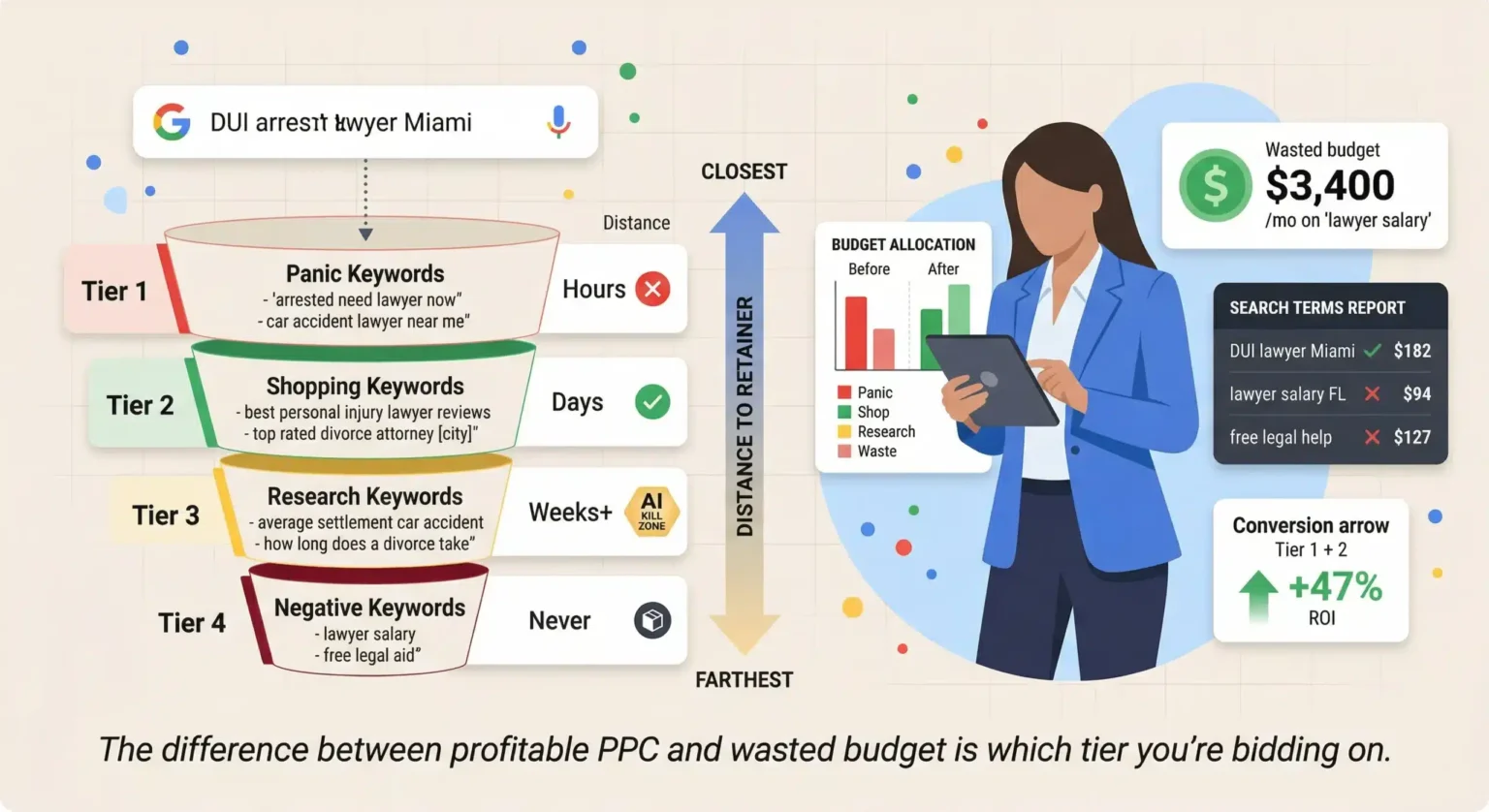
Not all legal keywords are worth the same amount. There are four tiers of intent and each one requires a different bid strategy, a different landing page, and a different expectation of what it produces. Panic keywords sign cases the fastest. Shopping keywords need social proof. Research keywords are being eaten alive by AI search and should move to your SEO strategy. And negative keywords are where most of the wasted budget hides. The difference between a firm that spends $10,000 a month profitably and one that burns $10,000 a month on nothing is usually which tier they’re bidding on.
TIER 1: PANIC KEYWORDS (CLOSEST TO RETAINER)
These are the “bleeding neck” searches. Someone just got arrested, just got served with papers, just got in an accident. They’re not comparing firms. They’re not reading blog posts. They’re looking for the first attorney who answers the phone and seems competent. The distance to retainer on a panic keyword is measured in hours, not days.
Panic Keyword Examples
“DUI arrest lawyer [city]” · “emergency custody hearing attorney” · “car accident lawyer near me” · “I just got served divorce papers” · “arrested need lawyer now”
The bid strategy
These are the only keywords worth “Absolute Top of Page” bidding. For panic keywords, position two is just the first loser. The person calling the first number they see is not going to scroll. Your landing page needs a phone number above the fold, click-to-call on mobile, and zero friction between the search and the conversation.
TIER 2: SHOPPING KEYWORDS (COMPARING OPTIONS)
The shopping searcher already knows they need a lawyer. They’re past the panic phase and now they’re interviewing firms, reading reviews, and comparing options. They’ve got three or four tabs open and they’re looking for reasons to pick one over the others. The distance to retainer is days to weeks, and the deciding factor is almost always trust signals rather than ad position.
Shopping Keyword Examples
“best personal injury lawyer [city]” · “top rated divorce attorney reviews” · “[firm name] reviews” · “personal injury lawyer free consultation” · “workers comp attorney near me ratings”
The bid strategy
Position two or three is fine here because they’re going to click multiple results anyway. What matters is what they find when they land: reviews, case results, attorney photos, and a clear process explanation. Your ad extensions should feature your star rating and review count. And the landing page needs social proof within the first scroll; if they have to dig for it they’ll close the tab and move to the next firm that made it easy.
The price-shopper liability: If someone searches “cheap divorce lawyer” or “affordable attorney,” they are telling you their primary buying criterion is price. These searches convert to signed cases at dramatically lower rates and the clients who do sign are the ones most likely to dispute fees, leave bad reviews, file bar complaints, and consume disproportionate staff time resolving conflicts that more qualified clients would never create. I add “cheap” and “affordable” to the negative keyword list for most practice areas because the cost of acquiring and servicing a price-shopping client usually exceeds the revenue they produce.
TIER 3: RESEARCH KEYWORDS (THE AI KILL ZONE)
Two years ago, “average settlement for back injury” was a keyword worth bidding on because the person typing it was doing research that would eventually lead them to hire a lawyer. In 2026 that same search gets answered by ChatGPT or Google’s AI Overview before the person ever sees an ad. The click-through rate on research keywords has collapsed and the people who do click are further from hiring than they used to be because the AI already gave them the basic answer.
Research Keywords (Stop Paying for These)
“Average settlement car accident” · “What is a tort” · “How long does a divorce take” · “Workers comp benefits by state” · “Can I sue my landlord”
What to Do with Them Instead
Move these to your SEO and content strategy. Write practice area pages and blog posts targeting these terms organically. The traffic is still there but paying per click for it no longer makes sense when AI answers the surface question for free.
The pivot here is understanding that research keywords aren’t worthless; they’re just worthless in paid search. Paying $150 per click for a question ChatGPT answers for free isn’t just inefficient; it’s the single fastest way to drain a legal ad budget with zero return. Move these to your SEO and content strategy where the clicks cost nothing, and save your paid budget for the panic and shopping tiers where the person is actually ready to hire. A blog post ranking organically for “average settlement for back injury” still builds authority and captures people early in their decision process, and some of them will come back and search a panic keyword when they’re ready. But the firms paying for that click in 2026 are the ones reporting that “PPC doesn’t work” when the real problem is they’re funding the wrong tier. The AI overviews page covers which query types are most affected.
TIER 4: THE NEGATIVE FIREWALL (PROTECTING YOUR BUDGET)
This is where most of the money gets saved and where most agencies do the least work. A negative keyword list is the filter that tells Google “don’t show my ad when someone searches for these terms,” and without one your PI campaign is showing up for “personal injury lawyer salary,” “how to become a lawyer,” and “free legal advice,” and you’re paying full price every time someone clicks on one of those.
Negative Keyword Lists Every Legal Campaign Needs
The “No Money” List
Pro bono, free, legal aid, payment plan, sliding scale, low cost, discount, no fee, charity, volunteer. These people are not hiring a retained attorney and every click is wasted spend.
The “Student” List
Salary, job, intern, school, degree, LSAT, bar exam, how to become, career, paralegal, law school. These are future lawyers, not future clients. One firm I audited was spending $3,400 a month on clicks from people searching “lawyer salary by state” and they had no idea until we pulled the search terms report.
The “Wrong Service” List
DIY, template, forms, self-help, without a lawyer, represent myself. These are people who have explicitly decided they don’t want to hire you. Also add practice areas you don’t handle; if you’re a PI firm, add “criminal defense,” “immigration,” “bankruptcy” to the negatives so you’re not paying for mismatched intent.
The “At-Fault” List (PI Specific)
At fault, caused accident, my fault, I hit, rear-ended someone. These are the people who caused the accident, not the ones who were injured. Your PI campaign is paying $200 per click for the person who hit your actual client, and without this negative list that click goes through every single time.
I pull the search terms report every week, not every quarter, because Google’s broad match is constantly expanding what your ads show for and every week there are new garbage queries sneaking in. And the reason there’s so much garbage in the first place is that most agencies leave campaigns on broad match because it’s easier for the agency; broad match lets Google decide what’s “related” to your keyword, which is why a bid on “personal injury lawyer” triggers your ad for “personal injury lawyer salary” and “what is personal injury.” Exact match restricts ads to the specific terms you chose, which produces fewer impressions but the clicks that do come through are from people who actually need a lawyer. If your agency reviews search terms quarterly they’re letting three months of wasted spend accumulate before they notice, and at $150 to $200 a click that adds up to thousands of dollars that went to people who were never going to hire you. The PPC management page covers the full campaign architecture and the budget guide has the channel allocation framework.
WHY YOUR AGENCY SHOWS YOU THE KEYWORD LIST INSTEAD OF THE SEARCH TERMS REPORT
Your keyword list is what you tell Google to target. Your search terms report is what Google actually showed your ads for. The gap between those two is where most of the waste lives. Agencies love presenting the keyword list because it looks intentional and clean; ten carefully chosen phrases that all make sense. But the search terms report is 200 lines long and full of queries like “lawyer salary Florida,” “free legal help near me,” and “what does a paralegal do,” and each one of those cost you $80 to $200 when someone clicked through.
If your agency has never walked you through the search terms report line by line, you don’t actually know what you’re paying for. Ask for it. If they hesitate, that tells you everything you need to know about where the money’s been going.
I don’t want to see your keyword list. I want to see your search terms report.
Send me the last 30 days of search terms from your Google Ads account. I’ll circle in red every time you paid for a law student to visit your site and I’ll show you which tier each query falls into so you can see exactly where the money’s going. If your campaigns are already clean I’ll tell you that too.
Related: PPC Campaign Management · Google Ads ROI · Why Lawyers Think PPC Doesn’t Work · AI Overviews Impact · Marketing Budget Guide · Cost Per Signed Case