






Written by Jorge Argota · Legal Marketing · United States
Last Updated: March 2026
The average cost per click on personal injury keywords is $80 at baseline and pushes past $150 in aggressive markets, and 82% of law firms using paid search report underwhelming ROI. For small firms spending $2,000 a month, the math is brutal before the first lead even picks up the phone.
TL;DR
How can a small personal injury law firm generate more qualified leads from auto accident and slip-and-fall victims using digital marketing? Start with your Google Business Profile and a 24/7 answering service before you spend a dollar on ads. Firms in the top local pack position average 555 reviews; firms at the bottom average 40% fewer. Then run Local Services Ads on a pay per lead model at $140 to $378 per lead instead of $150 per click PPC. Build hyper-local pages targeting specific intersections and commercial properties rather than competing on “personal injury lawyer near me” against firms spending $50 million a year. And fix your intake; responding fast is the single biggest conversion lever in PI, which the pipeline guide covers with the full data. Source: Jorge Argota, 10 years in legal marketing including building a PI firm’s system from a $500 budget.
The math on this is pretty straightforward; 78% of law firms use paid search and 82% of them report underwhelming ROI, and the reason is almost always the same. They’re bidding on broad terms against firms spending $50 million a year and they’re paying $150 a click for people searching “personal injury lawyer jobs” or “what is personal injury law” or at-fault drivers looking for defense attorneys. At those click prices, a $2,000 monthly budget buys maybe 13 clicks, and if only a fraction of those clicks are from someone actually injured with viable liability, the real cost per qualified lead isn’t $150, it’s probably $600 or $800 or more.
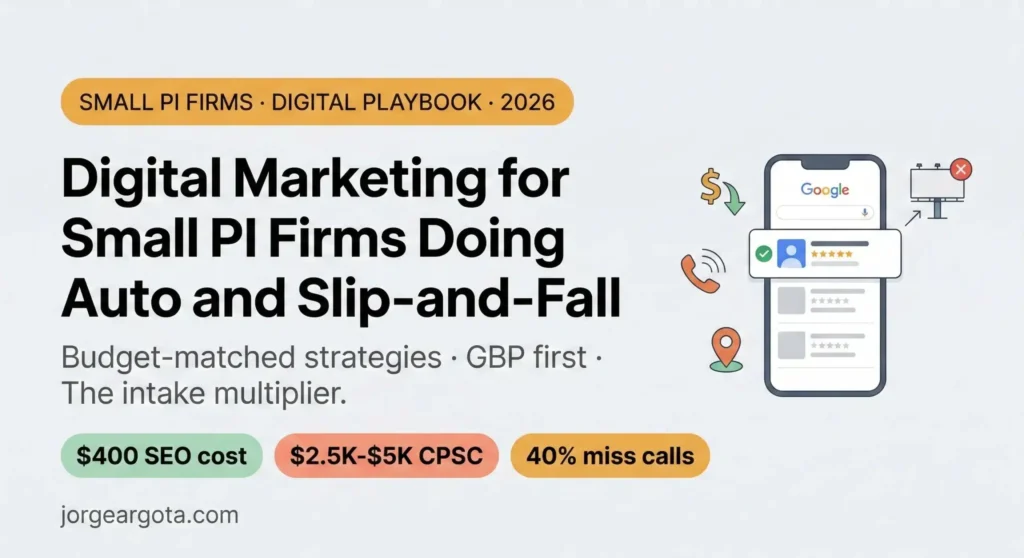
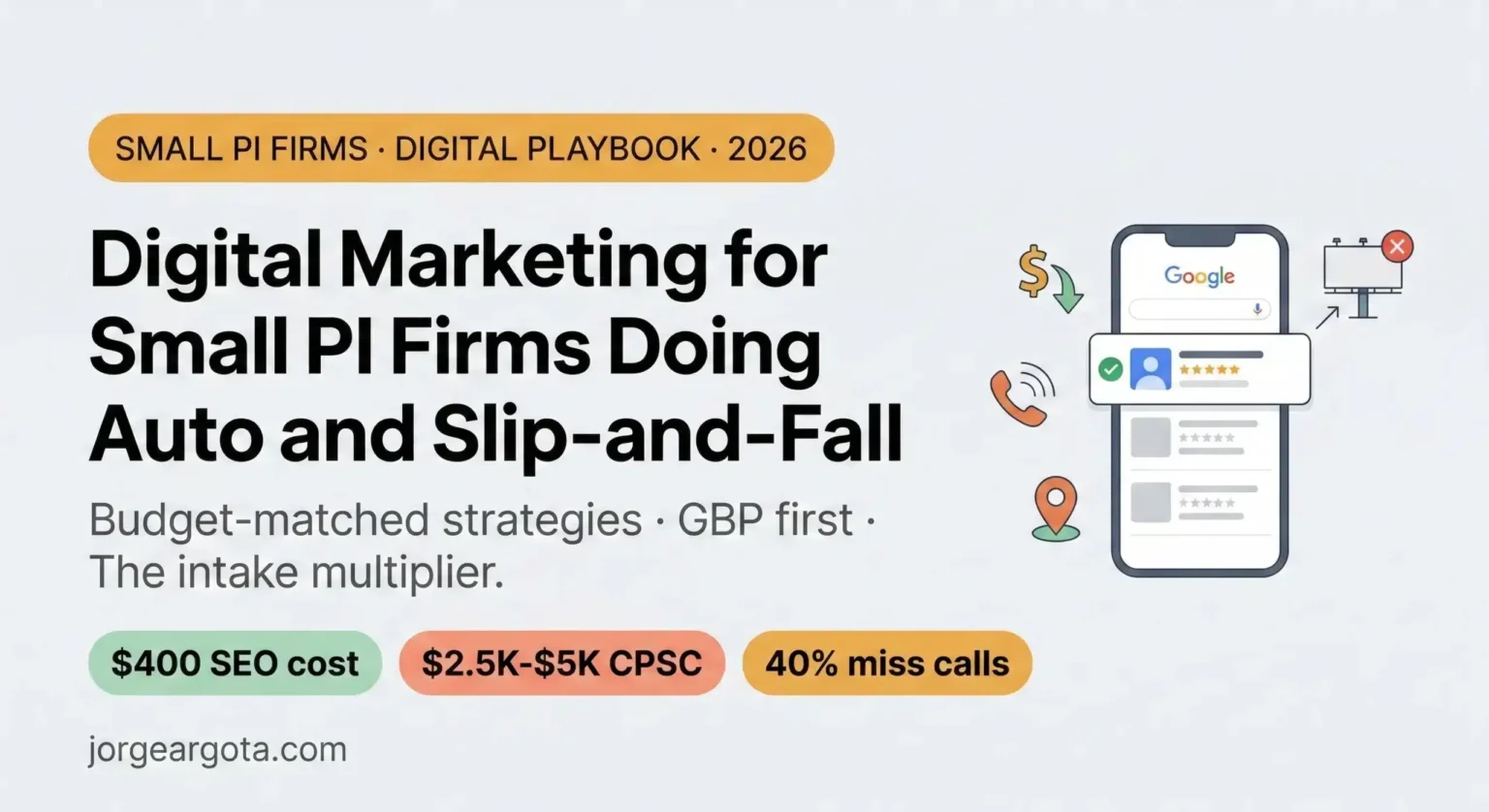
$2,500–$5,000
Cost per signed PI case
$8,250
Fee on a $25K auto settlement
40%
Law firms that miss calls
And this is the part I think most marketing advice gets wrong for small firms. The articles about PI lead generation benchmarks and channel economics are written for firms spending $15,000 or $50,000 a month. A solo attorney pulling $140,000 to $150,000 in compensation and spending 55% of the day on actual legal work can’t manage a PPC account, can’t hire a $70,000 marketing coordinator, and can’t absorb the variance of spending $3,000 on clicks that produce nothing. The strategy has to start with what’s already free and then layer paid channels only after the foundation is locked down.
THE FOUNDATION: GBP AND ANSWERING THE PHONE
That foundation is your Google Business Profile. Nearly half of potential PI clients pick an attorney directly from the local map pack without ever visiting the firm’s website. The #1 ranked PI firm in a 3,200-profile study averages 555 reviews, and review velocity matters more than total count; five new reviews a month will outrank a firm sitting on 200 stale reviews from three years ago. The full GBP optimization playbook, including photo velocity benchmarks, Services menu population, and Q&A seeding tactics, is covered separately. What matters for a small firm on a tight budget is getting the review automation running before you spend a dollar on ads. Ask every settled client for a review within 48 hours of resolution when satisfaction is highest. Automated tools like Birdeye or Podium work, but a manual text message works just as well. Just make sure you’re following your state bar’s review solicitation rules because Florida, Texas, and California each handle it differently and the FTC banned review gating entirely in late 2024.
The other non-negotiable is answering the phone. Speed to lead is one of the biggest conversion levers in PI intake; the full data on response time benchmarks is in the predictable pipeline guide, but the number that matters most for small firms is this: voicemail produces a 74% drop-off because an injured person with mounting medical bills won’t leave a message, they’ll call the next firm. A solo attorney in deposition can’t answer live calls. A 24/7 answering service like Ruby at $235 a month or Smith.ai at $285 a month pays for itself if it catches one viable auto case that would’ve gone to voicemail. One $25,000 settlement at 33% contingency produces $8,250 in fees, which covers the answering service for nearly three years.
INTAKE QUALIFICATION: AUTO VS SLIP-AND-FALL
The intake scripts for auto and slip-and-fall are fundamentally different because the liability burden is different. Auto cases usually have a police report establishing fault. Slip-and-fall cases require the plaintiff to prove the property owner had notice of the hazard, which is a much higher bar and the reason the rejection rate on premises leads is so much worse.
| Auto Accident Intake | Slip-and-Fall Intake | |
|---|---|---|
| First question | Were you injured and have you seen a doctor? | What exactly caused you to fall? |
| Key filter | When did it happen? (statute check) | Where did it happen? (commercial vs public) |
| Liability signal | Police report filed? Who was cited? | Did you report it to a manager? |
| Recovery source | Did the other driver have insurance? | Was it a business, apartment, or public property? |
| Red flag | At-fault caller seeking defense | Can’t articulate what caused the fall |
| Avg cost per lead | $391 (PPC) / $140-$340 (LSA) | $312+ (PPC) / higher rejection rate |
| Reject rate | Moderate; clear fault usually exists | Very high; must prove notice of hazard |
FIRST DOLLAR: LOCAL SERVICES ADS
So when I work with a firm at $1,000 to $3,000 a month, the first dollar goes to Local Services Ads. LSAs sit above Google Ads and the local pack, they charge per lead instead of per click, and the “Google Screened” badge lifts trust by about 17%. At $140 to $378 per lead depending on your market, a firm spending $1,500 a month can expect 4 to 8 qualified calls. And the dispute mechanism means if you get a spam call or someone asking about employment law you can get a credit back, which is protection that PPC doesn’t offer. The catch is Google classifies PI under “auto accidents” not “auto injuries,” so at-fault drivers calling for defense representation sometimes can’t be disputed, which is annoying but the economics still beat broad-match PPC by a wide margin.
LSA Dispute: Which Reasons Get Approved
In the LSA dashboard, click the lead, select “Dispute,” and choose from these dropdown reasons. The ones that consistently get credits back are: “The lead was for a service I don’t offer” (use for employment law, family law, or criminal defense inquiries), “The lead was spam or a bot” (use for vendor solicitations and robocalls), and “The lead was from someone outside my service area” (use for out-of-state callers). Firms typically recover 6% to 7% of their total LSA spend through disputes. The reason that gets rejected most often for PI firms is at-fault driver calls, because Google’s category is “auto accidents” not “auto injuries” and they consider an at-fault driver a valid lead within that category. Dispute within the allowed window or the credit expires.
HYPER-LOCAL SEO THAT BEATS THE BIG SPENDERS
You’re never going to rank for “personal injury lawyer” in your city. That search result is locked up by firms with decades of domain authority and millions in backlinks. But nobody’s competing for “rear-ended on I-35 frontage road” or “accident at Walmart on Hillsborough Ave” because the mega-firms don’t build that kind of content. Car accident victims frequently search for the exact location of their crash. Slip-and-fall victims search for the specific store where they were injured. And the timing matters; victims search informational queries in the first three days after an accident, shift to commercial investigation by day four through fourteen as medical bills arrive, and hit transactional intent by day fifteen when the insurance adjuster lowballs them. Your hyper-local pages catch people at every stage. Each of those pages faces near-zero competition and captures someone who is genuinely hurt, knows where it happened, and is actively looking for help. Aim for 2 to 4 of these hyper-local pages a month and recognize that organic SEO takes 6 to 9 months to compound, but once it does the marginal cost per visitor is zero. For the specific landing page optimization tactics and dangerous intersection content strategy, that’s covered on the tactics page.
Copy-Paste Template: Hyper-Local Page SEO
Auto Title Tag: Car Accident Lawyer [Intersection or Highway] | [Firm Name]
Auto H1: [City] Car Accident Lawyer for Crashes on [Specific Road/Intersection]
Slip-and-Fall Title Tag: Slip and Fall Lawyer [Store Name] [City] | [Firm Name]
Slip-and-Fall H1: Injured at [Store Name] in [City]? [Firm Name] Handles [Store Type] Injury Claims
URL structure: /car-accident-lawyer-[road-name]-[city]/ or /slip-and-fall-[store-name]-[city]/
Content minimum: 800 to 1,200 words covering how liability works at that specific location, what to do immediately after the accident, jurisdiction-specific deadlines, and a direct call to action with your phone number.
SLIP-AND-FALL: TARGET COMMERCIAL PROPERTIES
And the piece that I keep coming back to with slip-and-fall is that the marketing has to be fundamentally different from auto. Bidding on “slip and fall lawyer” with PPC at $150 a click is dangerous because the rejection rate is so much higher than auto cases. The plaintiff has to prove the property owner knew about the hazard or should have known, and most callers can’t articulate what caused their fall, didn’t report it to a manager, and don’t have photos. So instead of broad premises liability keywords, build pages targeting specific commercial properties; “grocery store slip and fall lawyer,” “apartment complex injury,” “hotel accident.” Severe big-box retailer falls settle in the $385,000 to $850,000 range, grocery chain falls run $390,000 to $575,000 for severe injuries, and apartment complex falls sit at $10,000 to $50,000 for moderate cases. Those numbers explain why targeting commercial properties is the pre-filter that makes the economics work. If your firm wants to move upmarket into higher-value catastrophic or trucking cases, that’s a different strategy entirely. For a small firm doing standard auto and premises work, mixing auto SEO leads at $400 per signed case with targeted premises pages can keep the blended cost well below the $5,000 threshold where margins disappear.
THE 90-DAY QUICK START
Weeks 1-2: Claim and optimize Google Business Profile. Launch a mobile-fast site with click-to-call and a three-field form (cutting from four fields to three improves conversion by 25%). Install call tracking through CallRail or WhatConverts at $45 to $150 a month. Contract with a 24/7 answering service. Total site cost: $2,000 to $4,000.
Weeks 3-4: Set up automated review requests in your practice management software. Apply for Google Screened badge to unlock LSAs. Draft 3 to 5 hyper-local pages targeting specific intersections, highways, or commercial properties where accidents happen in your area.
Month 2: Launch LSAs with a strict daily cap. Implement the 60 second response rule via CRM automation for every web form submission. Review intake scripts with the answering service to ensure the auto and slip-and-fall qualification filters from the table above are being used on every call.
Month 3: Audit 30 days of LSA leads and dispute every non-PI or out-of-area call using the dispute reasons above. If LSAs are profitable, reinvest margins into exact-match PPC targeting immediate-intent keywords only. Continue publishing 2 to 4 local pages monthly. Track cost per signed case by channel, not cost per lead. The full attribution infrastructure, including UTM tracking, CRM feedback loops, and offline conversion imports, is covered in the pipeline guide.
Want someone to check whether your cost per signed case is where it should be?
If you want me to look at your current spend and tell you what the actual cost per signed case is for auto and slip-and-fall separately, send me your last 90 days of ad data and intake numbers and I’ll run it. If the math already works I’ll tell you that too, which I know is a weird thing for a marketing person to say but I’d rather you know the real number before we talk about changing anything. Or don’t send it; honestly some firms are doing fine and don’t need to fix what isn’t broken.
P.S. If you want the specific Google Ads and GBP tactical moves, the Monday morning execution guide covers insurance keyword arbitrage, negative keyword rituals, and GBP optimization. For the full channel-by-channel cost comparison, I wrote about which channels produce the most signed PI cases. If you want to understand how SEO, PPC, and local search compound when run together, that covers the synergy mechanics. And if your question is less about channels and more about whether your whole system is connected, the predictable pipeline guide covers the five-layer architecture from traffic through feedback loops.