

Most 2026 legal marketing trends do not apply to your firm.
Every year, agencies publish the same trends list. Half of it does not apply to your firm. Half was on last year’s list. Here is the sort: what is real, what is hype, and which 2026 shifts actually move money for volume PI, boutique med mal, and immigration or family practices.





What’s changed in legal marketing for 2026 and what hasn’t
AI search has taken over most of the informational queries inside Google. The Verified badge and Local Service Ads changed drastically over the past few months. Short form video is now critical, especially YouTube Shorts and Instagram Reels, since both are now ranking directly inside the search engines. Those are the three trends that actually apply across firm categories.
Metaverse marketing, ChatGPT Ads, and the framing that AI is replacing lawyers. Each shows up on a trends list every year. None deserve the attention yet.
What’s actually moving in 2026, and what’s noise
After ten years running legal campaigns, mostly for Percy Martinez P.A. across four Florida metros, I have watched dozens of “next big thing” trends come through. Some moved real revenue. Most did not. Here is what shifted in 2026 and what got louder without shifting anything.
Worth your attention
- AI search ate informational queries. ChatGPT, Perplexity, and Google AI Overviews answer what your blog posts used to rank for. Visibility before the decision is the new top of funnel.
- The LSA algorithm now grades your phone calls. Google routes every call through its own number and AI scores whether you answered, closed, and matched. Response time, review velocity, and lead acceptance decide your CPL.
- YouTube Shorts and Instagram Reels rank in search. Video is no longer a separate channel. It shows up inside the SERP for legal queries in some practice areas.
- Community threads are search results now. Google pulls Reddit threads for legal queries because they carry lived experience. Facebook Groups (Meta’s rebranded Communities Hub) are growing. Quora is collapsing under spam.
- Experiential content beats commodity content. Google rewards specific, lived perspectives over recycled advice. “Why we waived the inspection” beats “7 tips for buyers” every time.
Protect your budget
- “AI is replacing lawyers.” AI is a tool. Clients still want human judgment when stakes are high. Firms paralyzed by this framing lose ground to firms using AI to work faster.
- “GEO and AEO are new disciplines.” Per Google’s AI optimization guide (updated May 15, 2026): “From Google Search’s perspective, optimizing for generative AI search is optimizing for the search experience, and thus still SEO.” Same fundamentals, new label.
- ChatGPT Ads. Reportedly a $200K monthly floor per early 2026 reporting. If you are not spending that, this does not apply to you yet. Show up organically through entity work instead.
- Metaverse marketing. Still on lists. No repeatable positive ROI for PI, family, med mal, or immigration.
The next sections cover each shift. Section 7 lists what to ignore and why.
How AI search changed client discovery for law firms in 2026.
How is AI changing legal marketing in 2026? AI tools answer the informational questions your blog posts used to rank for. 79% of legal professionals use AI tools daily. Clients arrive at firm websites already informed by multi turn ChatGPT and Perplexity conversations. LLM referral traffic to legal sites surged 527% year over year.
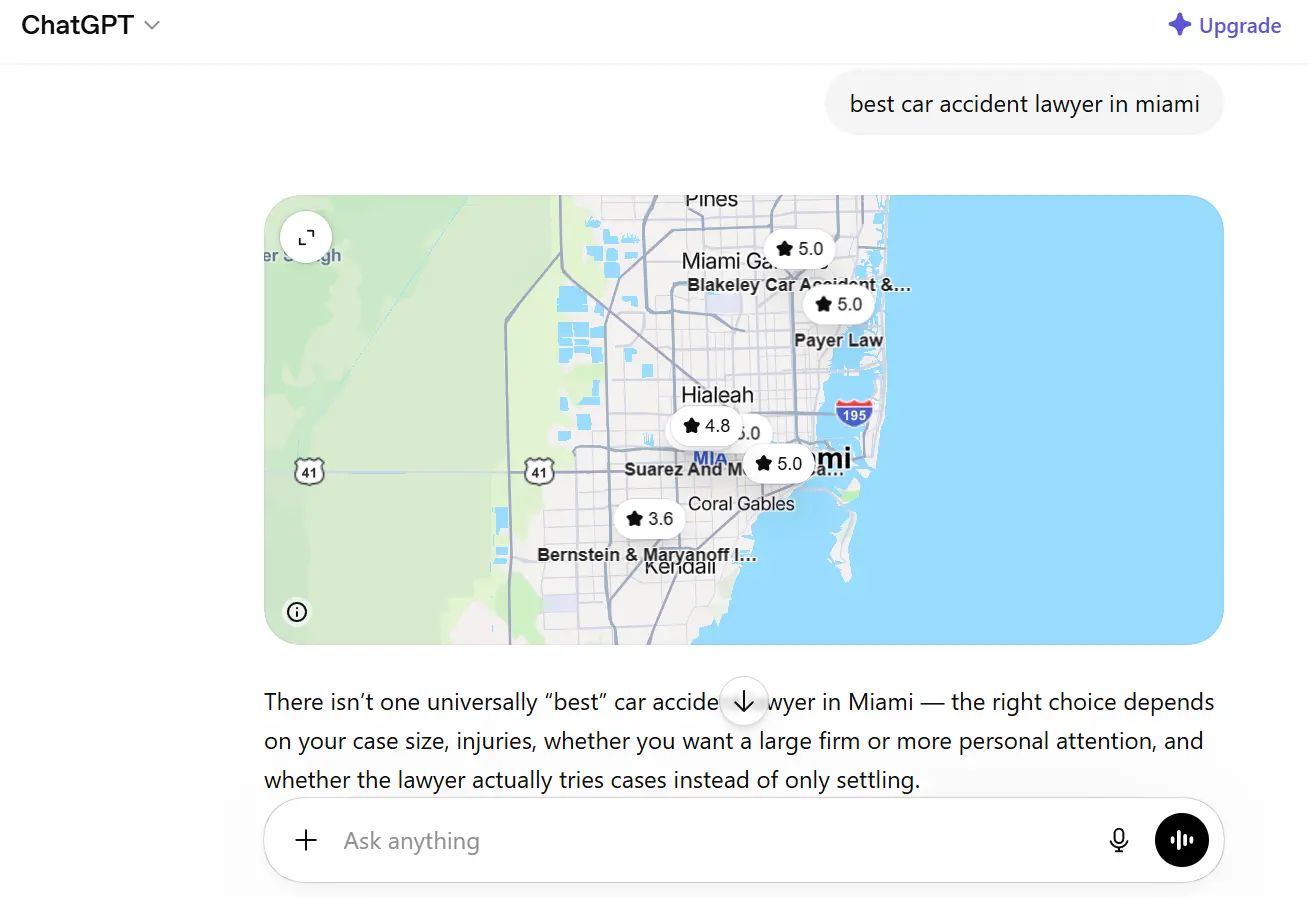
Someone in a car accident opens ChatGPT before Google. They describe what happened, ask if the settlement offer is fair, and the AI names two or three firms. Those firms get the call.
Percy Martinez P.A. is one of those firms for Miami medical malpractice queries. Not from one tactic. From years of review generation, entity signals across Avvo, Justia, FindLaw, the bar profiles, and case result pages with specific outcomes instead of recycled advice. AI reads those as a real practice. Generic content does not get cited.
How to win this shift
- Build entity citations across Avvo, Justia, FindLaw, and your bar profile. AI tools weight these heavily when deciding who to recommend by name.
- Push review velocity. Recent reviews carry more weight than total count in AI recommendation logic.
- Structure your content as questions and answers in the language your clients actually use. AI Overviews pull from clear Q&A blocks first.
- Add FAQ schema to every practice area page. Bilingual markets need the Spanish version built as a separate optimization target. Different auction.
Two existing guides go deeper: AI Overviews and law firm traffic and GEO for law firms.
How Google’s LSA algorithm scores your firm in 2026.
What changed with Google Local Service Ads in 2026? Google rebuilt the LSA ranking algorithm around operational signals it can measure directly. Every call routes through Google’s number. AI listens, evaluates whether you answered, whether you closed the lead, and whether you were the right fit. Verified firms hitting the operational metrics see meaningfully lower CPLs than firms with the same badge that fail those metrics. Firms missing the metrics get pushed into more expensive PPC.
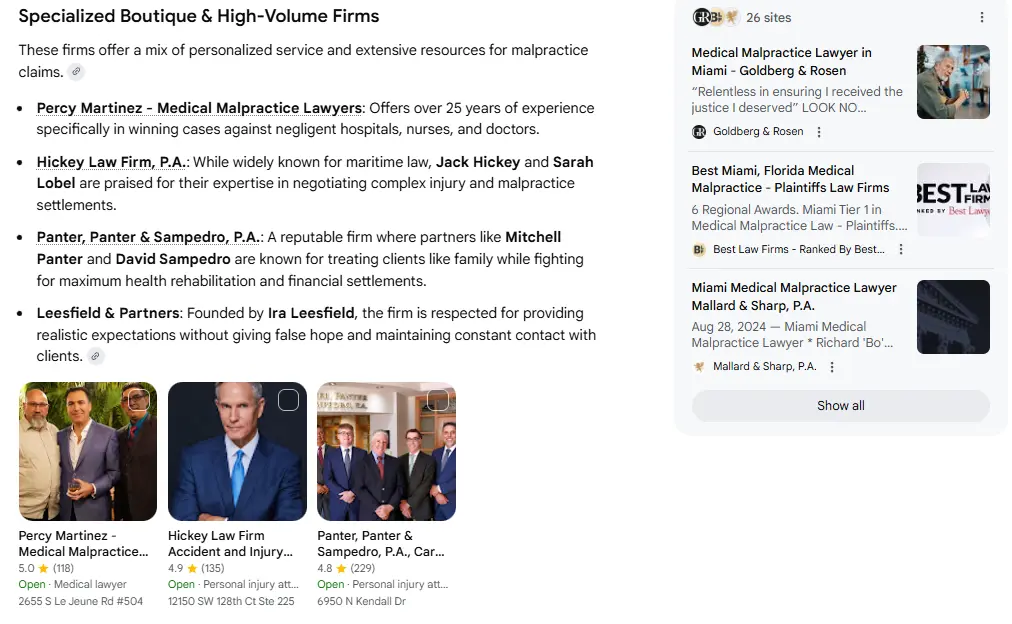
Over the years working with Percy Martinez P.A., I was given the opportunity to spearhead their Local Service Ads campaigns across Miami, Hialeah, Orlando, Tampa, and Jacksonville. It generated a steady flow of qualified leads for the firm.
Two things moved the needle more than anything else: review velocity, and how flexible the intake team was on response speed. Everything else matters, but those two are where most firms quietly win or lose ranking month over month.
What actually moved the needle
- Review velocity beats everything. Five new reviews this month beats fifty from 2023. We built review requests into intake scripts and case closing. Within ninety days, Percy outranked firms with much higher total counts.
- Intake flexibility is the second lever. Google’s AI listens to every LSA call. Answer fast and qualify cleanly and the algorithm sends more leads. Miss calls and supply drops within weeks. Percy’s intake answers inside ninety seconds. Not two minutes. Ninety.
- Lead acceptance matters more than most firms realize. Marking too many leads as junk tells Google you do not want what it sends. Accept everything legitimate, even leads that do not convert. The algorithm reads that as openness and keeps supply high.
- Lead grading inside the platform is the trick most agencies skip. The dashboard lets you tell Google which leads were good. We grade every Percy lead inside seventy two hours; quality has trended up quarter over quarter.
- Service area accuracy stops invisible waste. Google will not show you outside your declared area regardless of bid. Most firms set it too broadly and pay for calls they cannot serve. Tighten coverage to metros the intake team actually handles. CPL drops.
More on the mechanics: Google Local Service Ads for lawyers and LSA vs search ads budget split.
YouTube Shorts and Instagram Reels now rank in search.
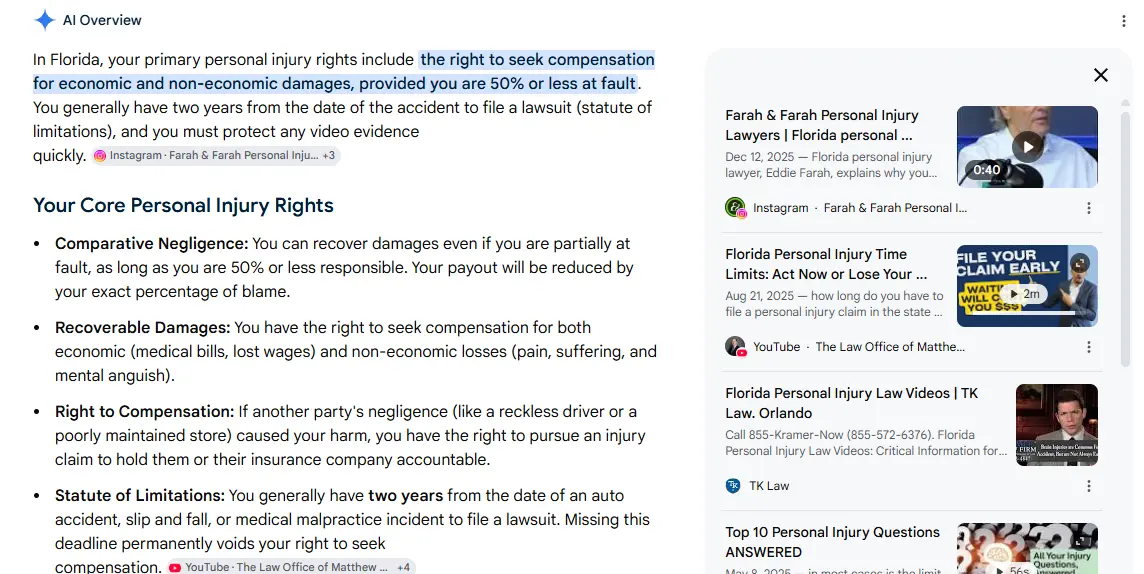
Is video marketing actually important for law firms in 2026? 52% of consumers watch a video before hiring an attorney. The shift in 2026 is that short form video shows up directly inside Google search results for legal queries. YouTube Shorts and Instagram Reels rank alongside web pages. About 30% of law firms create video. Only 13% use Instagram.
The mechanism is parasocial trust. A client watches eight or ten of your short videos over a week, feels like they know you, and calls instead of Googling. Intake picks up to someone already pre sold.
The math against PPC is embarrassing. Videos cost nothing to make. Best for personal decision practice areas: family, criminal defense, immigration.
Where to invest your time
- Post two to three short videos a week. Phone vertical, attorney on camera, no production budget required.
- Answer the question you get asked most often. Repeat that format until it stops working.
- If your market is bilingual, post in both languages. Same content, two posts, roughly double the reach.
- Add a two to three minute attorney intro video to every bio page. Short case story videos on result pages.
The full playbook for what to post and how to convert viewers into intake calls is in TikTok and short form video for lawyers.
How Reddit and Facebook Groups show up in legal search in 2026.
Where do potential legal clients actually go for information in 2026? Google now pulls community threads for legal queries because they contain lived experience that AI cannot fake. Reddit threads from r/legaladvice and r/AskLawyers appear above many traditional law firm websites for high intent queries. Facebook Groups (rebranded “Communities Hub” by Meta this year) are growing as the alternative for people who want answers without the Reddit format. Quora, once part of this conversation, is in steep decline.
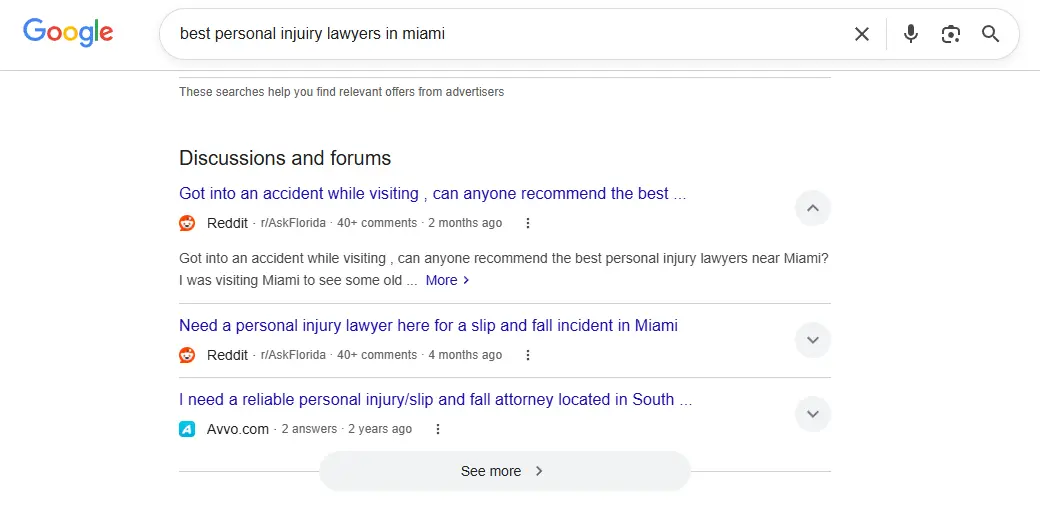
Google now treats real human discussion as a stronger signal than polished agency content for many legal questions. A Reddit thread walking through an actual settlement outranks the firm landing page explaining settlement math in the abstract.
I watched this on a Miami immigration query last year. The top three results: USCIS, a r/immigration thread walking through someone’s I-485 timeline month by month, then a firm page. The thread had more lived detail.
What works: attorneys answering questions in their practice areas. No firm name, no link. Plant links and moderators ban you inside a week.
Where to spend your time
- Reddit. Still the dominant community signal Google pulls from. Identify the two or three subreddits where your practice area is discussed (usually r/legaladvice plus a topic specific community). Answer questions where you can add value. No pitch. No link.
- Facebook Groups (Meta Communities Hub). Growing fast in 2026 as the alternative for people who want answers without the Reddit format. Niche legal groups (immigration, family law, criminal defense) have active member counts Reddit does not.
- Niche industry forums. Underrated. Small specialized communities (DUI in your state, specific medical conditions, immigration status changes) have engaged user bases that AI tools cite as expert sources.
- Build account history before you need it. Brand new accounts that mention a firm in their first comment get filtered out fast. Post first, mention later.
- Skip Quora. Steep decline as of mid 2026 from spam, automated bans, and content quality collapse. Time spent there is not paying back.
Most agencies missed this because it does not look like a channel they can sell you. The work is slow and pays back over months. Which is why it is still wide open.
Experiential content beats commodity content.
What kind of content actually ranks for law firms in 2026? Google explicitly rewards content with first hand experience, unique perspective, and specific detail over generic advice. Danny Sullivan’s framing at Search Central Live Toronto, April 2026: “Could ChatGPT write this in 90 seconds, and would the result be essentially identical? If yes, rewrite or omit.”
Google’s framing: “7 Tips for First Time Homebuyers” is commodity. “Why We Waived the Inspection and Saved Money” is not. Same topic. Different outcomes in AI search.
Percy’s content followed the same logic. Generic “what to do after a car accident” pages would never beat 4,000 other versions on the internet. So we stopped writing them.
We built pages around specific case scenarios and the operational details only a litigator who has handled hundreds of those cases would know. Which adjusters slow walk cases in which counties. The recycled article cannot tell you that. AI tools cite the specific one.
How to write content that gets cited
- Audit your existing content with Sullivan’s 90 second test. If ChatGPT could produce it, rewrite or remove it.
- Lead with specifics. Real case details (within bar advertising rules), real numbers, real local context. Vague is the commodity tell.
- Use attorney bylines. AI tools and Google both weight content with named human authors above content attributed to “the firm.”
- Stop publishing on every keyword variation. Two pieces of deeply experiential content beat twelve pieces of recycled summaries.
- Pull from your case files (within ethics rules). The details from a deposition or settlement negotiation are details no other firm can produce.
For more on how Google scores your firm and what wins in the new search environment, see the law firm trust stack.
Three 2026 trends that are not your trend
Every quarter a client asks me about one of these. Same answer every time: the math does not work yet. The dollars belong in intake speed, AI search visibility, or LSA performance. Those three are where 2026 actually moved.
Consumer adoption never came. Clients want a phone call or a Zoom, not a VR headset. No repeatable positive ROI we can point to for PI, family, med mal, or immigration. Tech and IP law gets a small pass.
58% of legal professionals explicitly reject this. Clients want human judgment for high stakes decisions. Firms paralyzed by the narrative lose ground to firms that move past it.
The platform is real. Entry floor reportedly $200K monthly per public reporting as of early 2026. Until that drops, this is a big firm channel. Show up organically through SEO and entity work instead. Google itself says optimizing for AI search is still SEO.
2026 trends, sorted
| Trend | Verdict | Why |
|---|---|---|
| AI search visibility | Fund | Visibility before the decision is where clients now form an opinion of your firm |
| LSA algorithm and operational signals | Fund | Google now AI grades your calls. Response time, lead acceptance, review velocity decide CPL |
| Short form video in search | Fund | YouTube Shorts and Reels rank inside the SERP for legal queries |
| Reddit and Facebook Groups presence | Fund | Community threads now appear above firm sites. Skip Quora; it is in steep decline |
| Experiential content | Fund | Specific lived experience beats recycled summaries in AI answers |
| Metaverse marketing | Skip | Zero consumer adoption for legal services in 2026 |
| “AI is replacing lawyers” | Skip | AI is a tool. Clients still want human judgment for high stakes work |
| GEO / AEO as a separate practice | Skip | Google: optimizing for AI search is still SEO. Same fundamentals |
| ChatGPT Ads | Skip | Reportedly $200K monthly floor per early 2026 reporting. Wrong price point for almost all firms |
What attorneys actually ask me about 2026
What are the most important legal marketing trends for 2026?
Three trends move money in 2026: AI search has eaten the informational top of funnel, the Google Verified badge rewired Local Service Ads economics, and short form video became mandatory in practice areas where parasocial trust drives conversion. Everything else on most lists is hype, recycled, or applies to a different firm type than yours.
How much should a law firm spend on marketing in 2026?
Most successful firms spend 6 to 12 percent of gross revenue on marketing. That number has not meaningfully changed for 2026. What changed is the channel mix inside that budget, and the firms tracking cost per signed case rather than cost per lead are the ones reporting positive year over year ROI.
Is AI replacing legal marketing in 2026?
AI is not replacing legal marketing. It is replacing the top of funnel content legal marketing used to depend on. AI tools answer general questions without the user clicking through to a firm website. The traffic still arriving is further down the funnel, more decided, and more likely to sign.
Should small law firms invest in video marketing in 2026?
Yes for some practice areas, no for others. Video is essential for family law, criminal defense, and immigration where parasocial trust drives conversion. For volume PI, video is brand reinforcement, not lead acquisition. For medical malpractice, it builds attorney credibility but does not generate cases on its own. Practice area decides.
How can a law firm appear in Google’s AI Overviews and ChatGPT results?
Three things matter. Structure content as question and answer pairs that match how people actually ask AI tools. Build entity signals through consistent NAP data, schema markup, and citations from trusted legal directories. Write situational content drawn from real case experience that AI cannot generate on its own.
Which 2026 legal marketing trends are hype and not worth your budget?
Three trends keep showing up on 2026 lists that are not worth firm budget right now. Metaverse marketing has no consumer adoption for legal services. AI replacing lawyers is not supported by the data. ChatGPT Ads need a six figure monthly floor that almost no firm reading this is paying.
Tell me your firm type and your numbers. I’ll tell you which 2026 trends matter.
Send me your current marketing report and your monthly signed case count. I will tell you which shifts apply to your firm and which to ignore. If what you are doing is already working, I will tell you that too.
Get a marketing assessment →