






For managing partners and marketing directors who are spending more on Google Ads each quarter and signing fewer cases. The diagnostic walks through the 5 places legal marketing breaks (only 1 is actually about marketing), the math the agency report hides, and the 3 audits any firm can run in a weekend to find which one is broken.

The definition gap between “lead” and “qualified prospect.” The agency incentive structure that pays more for more spend. Intent drift in Google Ads campaigns no one manages. The algorithm learning from the wrong signal. And intake operations dropping calls the marketing already paid for. Below is the full diagnostic and the 3 audits that find which of the 5 is actually broken at the firm. The metric that ties them together is not cost per lead. It is cost per signed case, calculated by channel.
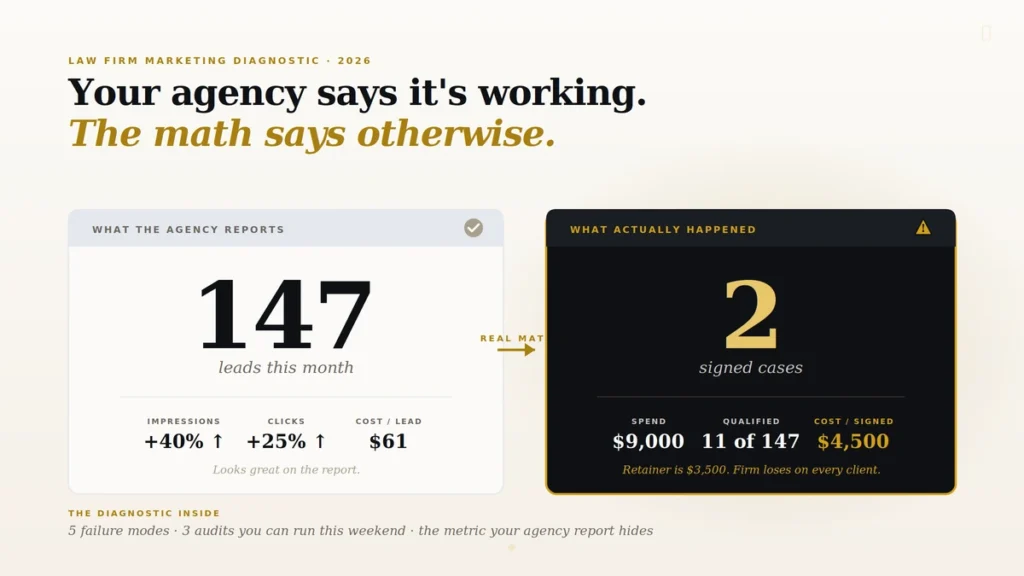
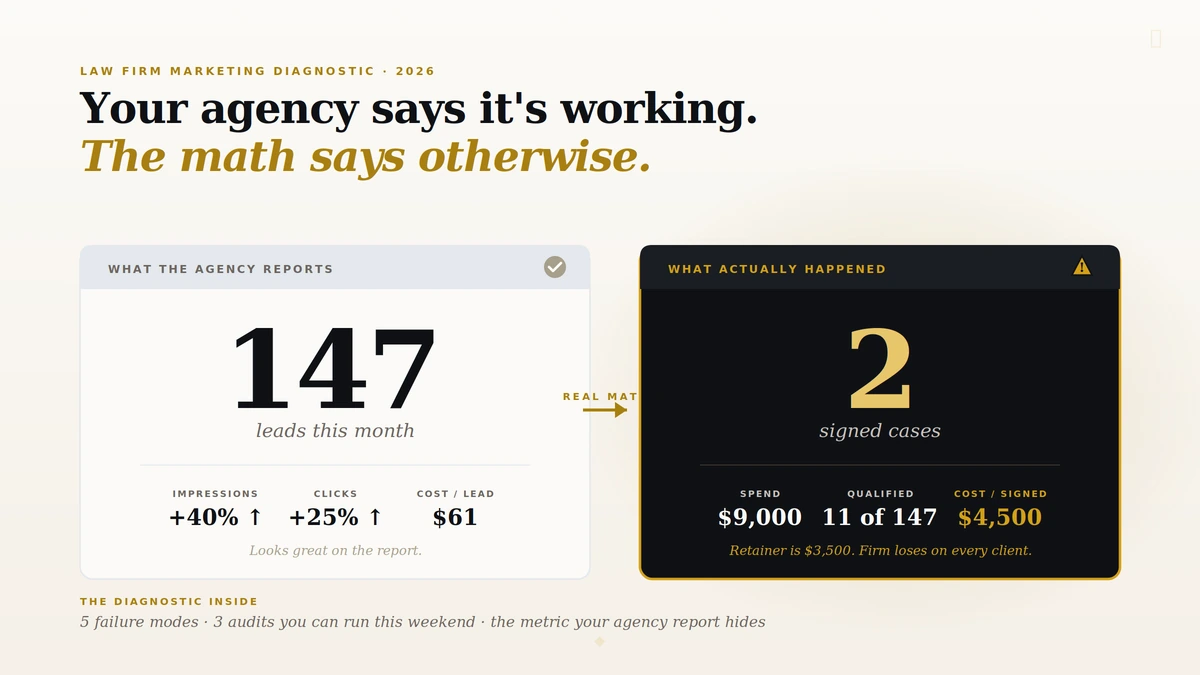
Last fall a managing partner forwarded me his agency’s monthly report. It was gorgeous. Green arrows everywhere. Impressions up 40 percent, clicks up 25 percent, a big bold 147 leads at the top.
An hour later he sent me his intake log from the same month. Of those 147 leads: 11 met the firm’s actual criteria. 2 signed.
$9,000 spent, 2 cases signed, $4,500 per signed case. The average retainer for the practice area was $3,500. The firm was losing $1,000 every time a client signed and the agency report had been calling it a win for 7 months.The agency was reporting cost per lead at $61. The partner had been reading that as $61 per potential client. The gap between “cost per lead” and “cost per signed case” is the single largest source of agency frustration in legal marketing, and almost no firm calculates the second number on its own.
Where law firm marketing really breaks in 2026
“Law firm marketing” is bigger than Google Ads. In Google’s eyes it now spans AI Overviews, Local Service Ads, Google Maps, organic SEO, content, reviews, referrals, and offline brand. Most “my marketing is not working” complaints actually live in 4 specific layers, and the failure is rarely about which channels the firm uses.
This piece zooms in on Layers 2, 3, and 4 because that is where 9 out of 10 “marketing not working” complaints actually live. Even if the firm never runs a single ad, the same 5 failure modes below show up in SEO, in referral programs, and in word-of-mouth. The diagnostic is channel-agnostic. Definition gaps, ops gaps, and measurement gaps appear everywhere, not just in Google Ads.
Your agency and your firm are using different definitions of “lead”
The first place this breaks down is that your agency and your firm are using the word “lead” to mean two completely different things, and most of the time nobody notices until the bills pile up and the cases do not.
Binary, technical, has nothing to do with whether the person needs a lawyer.
- Form submitted
- Phone call over 60 seconds
- Chat widget initiated
- Click-to-call tap
Someone who actually meets the criteria the firm needs to take the case.
- Right jurisdiction
- Case type the firm handles
- Real damages or stakes
- Statute of limitations not run
When your agency says “we sent you 50 leads this month” and your intake team says “we got 50 calls and 45 of them were garbage,” both sides are telling the truth from their own definition. The argument never resolves. Firms keep firing agencies every 6 to 12 months hoping the next one will somehow be different.
The reason this matters beyond just frustration is that your agency is optimizing the campaign around their definition, not yours. If the goal in Google Ads is “maximize form fills,” the algorithm finds the cheapest path to form fills. That might be people searching for free legal advice, court addresses, or law school application deadlines, because those people click on things and fill out forms. The algorithm does not know or care that they will never become clients.
Before any campaign launches or any contract renews, write a 1 page “qualified lead” definition and get both sides to sign it. Jurisdiction, case type, viability, timing. Then require the agency to report against that definition, not against form fills.
The agency pricing model nobody wants to explain
There is a structural problem with how most agencies get paid that nobody on the agency side is going to bring up. Roughly 60 to 70 percent of agencies charge a management fee as a percentage of ad spend, typically 15 to 20 percent. The agency’s revenue goes up when your budget goes up.
At 15 percent of $10,000 monthly spend, the agency makes $1,500 a month. If they convince you to increase to $20,000, they make $3,000 from the same account with roughly the same amount of work. The uncomfortable part is that if they optimize your campaign so well that you only need $5,000 to get the same results, they just cut their own revenue in half. Not many businesses volunteer to do that.
There is a quiet incentive to keep spend high and to report on metrics that justify that spend, even when the actual ROI math does not support it. That is not a moral failure on the agency’s side. It is the contract structure doing what contract structures do.
When the agency reports cost per lead dropping (which sounds like progress), check whether they shifted budget to cheaper keywords that produce more volume but less intent. A campaign targeting “divorce lawyer free consultation” at $40 a click will produce more form fills than “contested custody attorney” at $120 a click. The $120 clicks are people ready to write a retainer check. The $40 clicks are people shopping for the cheapest option. Your agency’s report makes both look the same.
Performance based contracts with bonuses tied to signed case targets, not ad spend percentages. The agency makes more when the firm makes more. If the agency refuses to move off the percentage of spend model, that itself is the answer.
What happens to a campaign when nobody is watching
Pattern I see in roughly 7 out of every 10 PPC audits: the campaign was built correctly in month one, nobody touched it for 6 to 8 months, and the search terms report quietly fills up with junk. Google’s algorithm is built to spend whatever daily budget you give it. When the high intent auction for “car accident lawyer near me” gets too expensive (because a competitor raised their bid), the algorithm shifts spend toward cheaper queries to hit the budget target. The campaign keeps spending. The lead quality collapses.
Your campaign that started out targeting people who need a lawyer right now slowly drifts toward people researching “how much is a car accident settlement worth” or “do I need a lawyer for a fender bender.” Those people click your ad and fill out your form and show up in your agency’s report as leads. They were never going to hire anyone. The volume might actually go up during this drift, which makes it harder to spot. More leads feels like progress even when the quality is tanking.
The fix is something called a search terms report, which shows what people actually typed into Google before clicking your ad. Not the keywords your agency targeted; the real human queries. If you ask your agency for last month’s search terms report and it is full of the patterns above, those are clicks you paid for that had zero chance of becoming a client. Your agency should have blocked those terms months ago.
Request the search terms report monthly. Read it. Add 10 to 30 negative keywords per month for the first 90 days, then 5 to 10 per month after that. A well-maintained Google Ads account has 200 to 800 negative keywords in it, not 20.
The same 5 failures look different in different cities
The 5 failure modes are universal. What changes by metro is which failure costs the most money in that market. The pattern across the 4 most expensive US legal markets:
The same patterns show up outside legal too. High-ticket dental implants in Miami, plastic surgery in LA, complex commercial SaaS in San Francisco: every vertical with long sales cycles and high case values runs into the same trap. Cheap leads with low close rates destroy unit economics. Expensive leads with high close rates win the math. The verticals change. The diagnostic does not.
Google is learning the wrong lesson about your firm
This is the most important failure point on the list because it is invisible and it compounds over time. Google’s ad platform runs on machine learning. The algorithm constantly tries to figure out who to show ads to based on whatever success signal flows back to it. If the only thing the agency has told Google is “we want people who fill out contact forms,” the algorithm relentlessly finds more people likely to fill out forms.
The fix is offline conversion tracking. The firm’s CRM (Clio, Filevine, MyCase, whatever the firm uses) sends a signal back to Google when a lead actually becomes a signed client. After 30 to 60 days of that signal flowing, the average firm I work with sees lead quality climb 35 to 60 percent without a budget change.
As AI Overviews become more common in legal queries, the same signal problem applies. If the only success signal flowing back is “any form fill,” the AI layer surfaces firms who attract cheap low-intent traffic over firms whose funnel produces signed cases. The diagnostic in this piece is channel-agnostic. It applies whether the first touch is an LSA, a Map Pack listing, an organic result, or an AI summarized answer.
This is the layer most agency relationships never reach because it requires data flowing in both directions. The agency sends a report. The firm sends a check. Nobody closes the loop by telling the agency which of those 147 leads actually became cases. The algorithm never learns what a real client looks like and keeps finding more of the same garbage traffic. Offline conversion tracking is the part of case value bidding that turns the whole campaign around once it is in place.
Connect the CRM to Google Ads via offline conversion imports. Push signed case data back at least weekly. The algorithm needs 30 to 60 days to retrain on the new signal, then lead quality starts climbing noticeably as the campaign learns to find people who look like real clients.
Sometimes the leads are fine and the phone is the problem
Sometimes the leads are fine, the targeting is fine, and the problem is what happens after someone calls. Industry data shows 35 to 50 percent of legal consumers hire the first attorney who responds, and the typical decision window is under 30 minutes. If the firm’s calls go to voicemail during lunch or after 5 PM, the firm is paying for leads that competitors are signing inside that window, often without the firm ever knowing they were lost.
The way to test this is to mystery shop the firm. Have someone call the main number at 3 different times pretending to be a potential client. Record what happens at each call.
If any of those calls ends in voicemail or “call back Monday,” the firm does not have a marketing problem. It has an operations problem, and no amount of ad spend fixes a phone that nobody answers.
Beyond answering, the second test is empathy. Did the intake staff express concern for the caller’s situation, or did they jump straight into “what is your date of birth and address”? Did they try to book a consultation, or did they say “the attorney is busy, call back Monday”? Empathy is a measurable variable in lead-to-case conversion. Firms that train it score higher.
The 3 audits that find where the budget is leaking
If you are reading this because the firm’s marketing is not working and you are trying to figure out whether to fire the agency, fix the intake, or both, run these 3 audits simultaneously. The math frequently surprises everyone.
The 3rd audit is the one that matters most. A channel running at $500 per lead with a 50 percent sign rate gives you a $1,000 cost per signed case. A channel running at $50 per lead with a 1 percent sign rate gives you a $5,000 cost per signed case. The “cheap” leads are 5 times more expensive when you follow the math all the way through. Most firms have never run this math.
Red flags that mean it is time to evaluate the agency
After running the 3 audits, have a real conversation with the agency. Share the numbers. Ask them to optimize for signed cases, not form fills. The response tells you whether the relationship is built to help the firm grow. Florida firms should also confirm that any new ad copy, landing pages, or schema fields the agency proposes comply with Rule 4-7.13(b)(3) (no comparative superiority claims) and Rule 4-7.14(a)(4) (no “specialist” or “expert” without Board Certification). A surprising number of agencies write ads that would not survive a bar grievance review.
- Refuses to share the search terms report. The data is in the account. The only reason to withhold it is that it shows the campaign is drifting.
- Cannot or will not set up offline conversion tracking. This is table stakes in 2026. An agency that does not know how is years behind. An agency that knows how but will not implement is hiding the actual results.
- Reports cost per lead but not cost per signed case. The agency has access to your conversion data through tracking integrations. Refusing to calculate the meaningful metric is a choice.
- Contract is structured purely as percentage of ad spend. The agency earns more when you spend more, regardless of results. Renegotiate to a performance-based component or find a partner who already works that way.
- Recommends budget increases without showing the cost per signed case math. Budget increases need to be justified by improving cost per signed case, not by “we can scale” without numbers behind it.
The agency might be doing fine and the problem might be somewhere else. The 3 audits tell you which one it is. If the search terms report is clean, the mystery shop passes, and the cost per signed case is reasonable, the agency is delivering value and the firm has a different problem to solve. If 2 or 3 of those audits fail, the relationship needs to change. Either the contract structure changes, the agency changes its execution, or the firm finds a partner whose interests are aligned with the firm’s actual growth, not the firm’s ad spend.
Most firms do not have a marketing problem. They have a measurement problem. They have been graded on cost per lead for so long that they stopped asking whether the leads ever turn into cases. The audits do not require a new agency or a bigger budget. They require the firm to start measuring the right number.
Why most “marketing not working” articles are commodity content
Most articles on this query repeat the same 5 generic points: “you need SEO,” “your website should convert better,” “have you tried social media,” “track your ROI,” “consider working with an agency.” Google has been increasingly direct that this kind of interchangeable content does not deserve to rank, and AI Overviews have started filtering it out of cited sources in favor of articles with specific data, original frameworks, or operational depth.
The piece above is a deliberate non-commodity diagnostic. The $4,500 per signed case math came from a real client report. The 5 failure modes are named and ordered the way I diagnose them in audits. The 3 audits have pass/fail thresholds and time estimates because that is how I actually run them. The math comparison block shows the unit economics most agencies will not put in writing. None of that is replicable without doing the work.
If a competitor article on this query gives you a generic checklist with no math, no thresholds, no specific dollar figures, and no named failure modes, that is what Google now calls commodity content. The article exists. It just does not deserve to rank, and increasingly it will not.
You might have landed here from any of these
The same diagnostic answers a handful of related queries that all point at the same underlying problem. Each phrase below is a slightly different way of asking the same question, and each one ends in the same set of audits.
The answer to all 8 is the same: stop optimizing for cost per lead, calculate cost per signed case by channel, and run the 3 audits above. Some of those queries will lead you to the channel mix question (LSAs vs Search Ads) or to the click waste question (click fraud protection). The diagnostic above is upstream of all of them.
Where the diagnostic connects to the rest of the system
The 5 failure modes above each have a deeper piece behind them. These are the adjacent pieces I send firms to read after the audit conversation.
Common questions about law firm marketing audits
What is the difference between a lead and a qualified prospect for a law firm?
How do marketing agency pricing models create conflicts of interest for law firms?
What happens to Google Ads campaigns when nobody actively manages them?
Why does Google Ads keep sending bad leads to my law firm?
How do I know if my law firm intake is the problem instead of the marketing?
How do I audit my law firm marketing to find where leads are being lost?
Want me to find where your budget is leaking?
The audit runs the same 3 checks this article walks through: search terms report, mystery shop of intake, and cost per signed case by channel. If the agency is doing fine and the problem is somewhere else, I tell you that. If the math says you should be spending less and getting more, I show you exactly where the gap is. Available for select PI, family, criminal defense, and complex civil firms.
Request a marketing audit →