

 PPC advertising agency · Overland Park, Kansas
Overland Park Law Firm PPC for Johnson County Households.
Google Ads and Local Services Ads, managed for Overland Park law firms. Every click, call, and form ties back to a retained client. Audit first. Retainer second. Kansas Bar review at the ad template level. One firm per practice area per metro. Managed from our principal strategy desk, customized to Johnson County ad auctions.
Marketing performance only, not legal counsel or guarantees of case outcomes. Ad templates are reviewed by the firm under Kansas attorney advertising rules.
How Overland Park law firm PPC handles Johnson County corporate intake, I-435 commuter flow, and Kansas City Missouri overflow demand.
Account diagnosis drives every budget decision.
The account stays untouched until the audit closes. The review covers query history, match type behavior, geographic results, device patterns, intake records, and closed file data. The goal is to identify where budget escapes and verify whether the campaign structure aligns with what each practice line returns.
Channel split between Search and LSAs.
Search and Local Services Ads do not share one allocation by default. Each channel earns its budget through the case quality it sends to intake, not the lead count it racks up.
Landing page alignment matched to search intent.
Every landing page does two things together: convert the right caller and protect Quality Score. Scope appears above the fold, ad and page tell the same story, page weight stays light, the layout works mobile first. Changes follow what people actually do on the page.
Intake review as part of performance.
Campaign results turn on what intake does next. Pickup speed, the first call screening, and the follow up rhythm decide whether ad spend ever becomes retained work. Intake is part of the campaign.
Signed case reporting tied to retained matters.
Lead totals, form submissions, and call counts remain useful as background indicators. The lead number stays anchored to retained matters, the cost behind each signed client, and which practice and channel combinations have earned a larger budget.
- Audit before quoting. The account and intake handling are reviewed in full before a single budget number is discussed.
- Score the intake. Script quality and pickup speed get scored ahead of scaling, because intake decides whether a click pays off.
- Split LSAs and Search. The channels are split by practice area, each with its own budget and its own rules.
- Cut curiosity terms. Curiosity searches are cut before any expansion, because that is where most legal paid search bleed sits.
- Report on signed. The dashboard tracks signed retainers and practice area cost per case, because that is what actually pays.
A law firm paid search account stands or falls on one number: cost per retained client. Lead totals, click volume, and form fills are diagnostics. They explain how that number ended up where it did, nothing more.
Jorge Argota
Founder · Argota Marketing
Why Johnson County paid search rewards a corporate household approach
Five things that change how paid search has to be run in this specific market.
Overland Park runs a meaningfully lower legal CPC than the coastal metros, which means a Johnson County firm can collect clean conversion data and exit the learning phase on a modest budget. The more important variable here is not cost per click but the demographic behind the click. Johnson County is one of the highest income counties in the region, and that professional household profile changes which practice areas convert and how the ads should read.
Corporate and civil work behaves differently in this market than personal injury does in a working class metro. Estate planning, business disputes, and family law among high income households carry longer research cycles, so the landing pages have to answer detailed questions rather than push a fast phone call. A searcher comparing three firms over a week needs depth on the page, and a thin lead capture template loses that searcher to a competitor with substantive content.
The I-435 commuter loop and the Kansas and Missouri state line define the geo strategy. A large share of Johnson County residents work across the line in Kansas City, Missouri, which means the firm has to decide deliberately whether to bid Missouri terms at all. If the firm is only licensed in Kansas, Missouri side searches go straight to the negative list, because paying for clicks the firm cannot serve is the fastest way to inflate cost per signed case.
Seasonality in Overland Park tracks the corporate calendar more than weather. Business formation and contract disputes cluster around fiscal year boundaries, and family law inquiries follow the well documented post holiday and end of school year patterns. Budget should flex toward those windows rather than sitting flat, because the same spend produces more signed work when it lands during a natural intake surge.
Reporting holds to the signed-case standard. In a market where a single business or estate matter can be worth many times an average personal injury file, lead count is an actively misleading metric. The Overland Park dashboard reports cost per signed case by practice area, so the firm can see that a small number of high value corporate retainers outperformed a larger pile of low intent inquiries, and shift budget accordingly.
Which channel earns its place in the account.
Google Ads, Local Services Ads, or both at the same time? The honest answer rests on practice area, intake capacity, the firm’s reviews, and the math behind each retained matter. The mix earns its place by producing signed cases, not by how much of the SERP it covers.
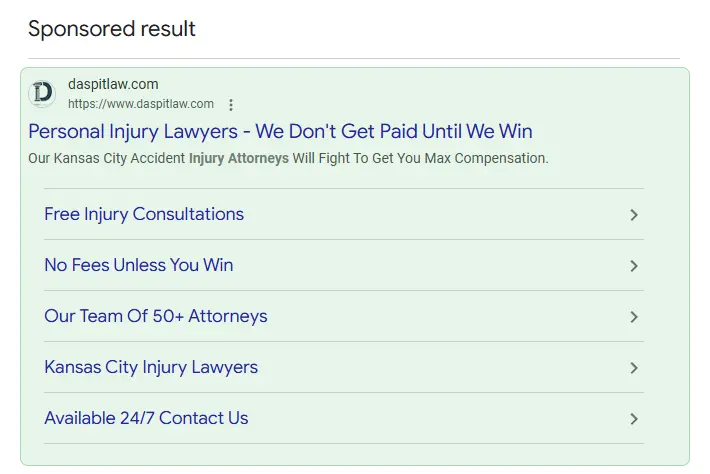
Google Ads usually fits when:
- Direct control over keywords, landing pages, and call routing by practice area matters.
- Campaigns need to target specific case types or higher value subsegments inside a practice area.
- Deliberate budget pacing and structured A/B work meaningfully change the numbers.
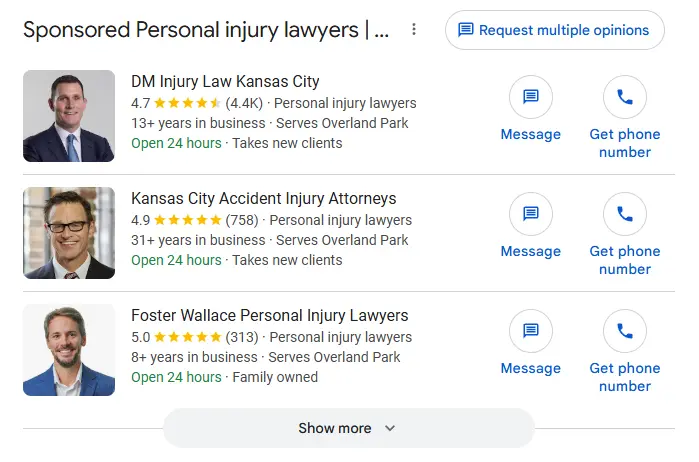
LSAs usually fit when:
- The firm wants a more direct call pipeline with less operational overhead.
- The review base and intake team can absorb quick response volume.
- Local cost dynamics and the firm’s review profile support paying competitive LSA rates.
A flat 50/50 split is rarely the right answer. Run both channels only when each one passes its own case economics test, then rebalance toward whichever channel is producing retained matters.
Visible fees. Clear scope and accountable structure.
Pricing is straightforward. The harder question is whether the engagement can produce retained case growth and whether intake can keep pace. Fees appear on the page itself, tier by tier.
- Single practice area campaign
- Google Search and LSA setup
- Weekly call review
- Monthly signed case reporting
Solo attorneys focused on a single practice area.
- Multi practice campaign structure
- LSA vs Search budget split
- Negative keyword and intake screening
- Landing page testing
- Biweekly intake QA and call scoring
- Shared signed case dashboard
Firms running multiple practice lines that need closer channel and intake coordination.
- Budget allocation and strategy
- LSA vs Search reallocation cycles
- Landing page testing at scale
- Multi market planning
- Intake QA at scale
Firms past the build phase, where allocation and growth choices weigh heavier than initial setup.
Same engagement model, fees stated up front. Pricing follows management scope, media spend volume, and reporting depth. Local market behavior affects how the work runs, not the underlying offer. A one time setup fee may apply on new builds or messy migrations. Media spend goes to Google directly. No markup, no card on file.
The national law firm PPC framework shows how engagements expand across practice areas as a firm grows. Law firm website design cost addresses the landing page work that runs in parallel with paid management.
About us.
Jorge Argota directs the legal marketing work. A decade inside Percy Martinez P.A., a Miami medical malpractice firm, before agency work across 20+ markets. University of Miami BBA. Google Ads certified. Bilingual, English and Español.
 University of Miami BBA
 Google Ads certified
Questions that come up on PPC audit calls.
Direct answers to the questions firms put on the table before they start or rebuild paid search.
Geographic targeting is a strategic decision, not a coverage exercise. The right service radius depends on case economics and intake capacity, not how much territory the firm can technically reach. The city itself captures the highest intent traffic. Extending into the rest of Johnson County and the broader metro adds volume at a higher cost per retained matter. The decision lands wherever it produces retained work at a price the firm can carry.
Generally yes, when the practice area qualifies for LSAs and the market sustains both channels. Budget shifts toward whichever channel produces better retained case economics, even when that requires scaling back the other one.
A first qualified call inside the first one to two weeks is normal for a clean build. Retained case data takes longer, generally 30 to 60 days before the sample size is meaningful. Smaller media budgets stretch that window further.
Most underperforming accounts fail in one of three places: targeting set too wide, intake follow up that does not convert calls, or reporting that ends at the lead instead of the retained matter. Accounts in trouble usually carry more than one of these issues at once.
Yes, with conditions attached. Both get audited during onboarding. Pages that perform get kept with targeted change recommendations. Pages actively blocking conversion get flagged for a separate rebuild scope. Intake gets fixed before any decision to scale spend.
The audit comes
before any proposal.
For firms still working out whether paid search is worth scaling, repairing, or building from scratch. The audit covers account structure, channel fit, intake demands, and the case math behind the local market.
- Review of the existing Google Ads and Local Services Ads setup, or a recommended structure if nothing is in market yet.
- Direct answer on whether the firm’s budget, practice mix, and intake can sustain real retained case growth.
- Recommendations on keyword scope, geographic targeting, landing page direction, and channel allocation.
No card on file. No long term retainer. The audit is a fixed scope engagement ending with a written recommendation, whether or not the firm continues.