

Written by Jorge Argota · Legal Content Strategy · United States
The “aim for 2,000 words” advice that shows up in every legal SEO guide is wrong. Not because length doesn’t matter but because it optimizes for the wrong signal. Google’s core updates now measure intent velocity: how fast the user gets the answer, not how many words surround it. A page answering “what is the statute of limitations in Florida” doesn’t need 2,000 words; it needs 700 words that deliver the answer in the first viewport before the competitor who padded theirs with filler.
TL;DR
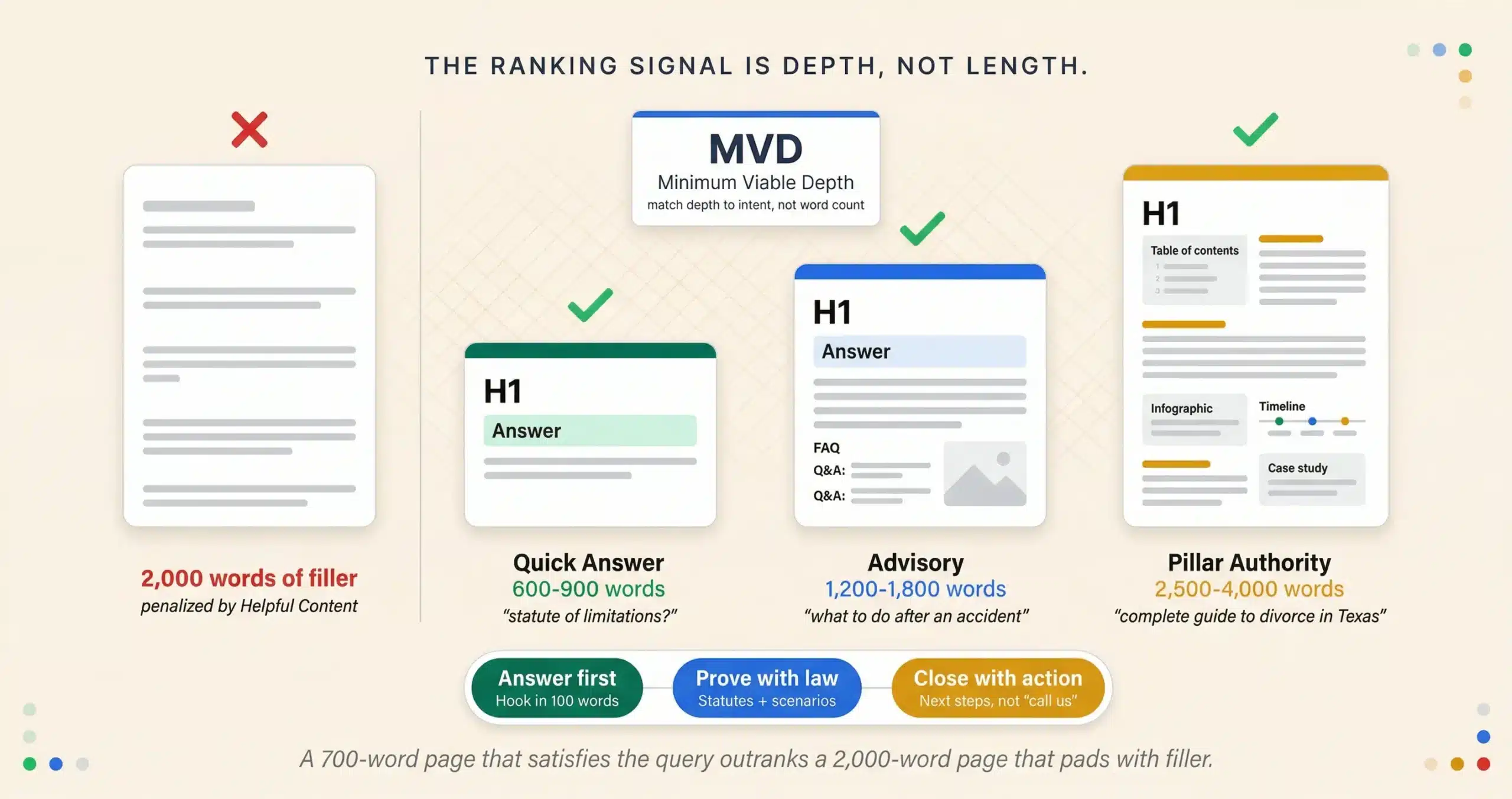
The ranking signal is depth, not length. Match word count to intent: 600 to 900 for quick answers (“statute of limitations”), 1,200 to 1,800 for advisory content (“what to do after an accident”), 2,500 to 4,000 for pillar authority pages (“complete guide to divorce in Texas”). A 700 word page that satisfies the query outranks a 2,000 word page that pads with filler. Google’s Helpful Content system specifically penalizes fluff. Source: Jorge Argota, 10 years legal content strategy.
LAW FIRM BLOG POST LENGTH BY SEARCH INTENT TYPE
Before you write a single word, categorize the keyword into one of three intent buckets. The bucket determines the word count, the structure, and the depth. Applying a flat “2,000 words” to a quick answer question forces you to pad with filler paragraphs that degrade the user experience and trigger negative Helpful Content signals.
Bucket A: Quick answer (600 to 900 words)
“What is the statute of limitations for slip and fall in Florida?” Direct answer in the first 100 words. Bulleted list of exceptions. Zero filler. Satisfies the user faster than a competitor guide that buries the answer on page 3.
Bucket B: Standard advisory (1,200 to 1,800 words)
“What to do after a car accident.” Chronological steps with 1 to 2 specific scenarios. FAQ section targeting People Also Ask. This is where most legal blog posts should land because the intent requires explanation but not exhaustive coverage.
Bucket C: Pillar authority (2,500 to 4,000 words)
“Complete guide to divorce in Texas.” Table of contents. Infographics. Settlement timeline tables. Case studies. This is the only time you aim for maximum length because the intent genuinely requires full coverage across multiple subtopics.
THE LEGAL CONTENT STRUCTURE THAT RANKS IN 2026
Most lawyers write blog posts like legal briefs: dense paragraphs with no visual breaks, no scannable structure, and an introduction that starts with “In today’s fast-paced world” before getting to the point 400 words later. Google’s algorithm now measures time-to-value: how quickly the user finds a satisfying answer. When a user clicks your page, reads 300 words of background noise, and clicks back to Google, that’s called pogo-sticking and it’s a fatal ranking signal. The page that front-loads the answer using an inverted pyramid style (answer first, context second, depth third) locks the user in and tells the algorithm the page is relevant. Dwell time is measured by interaction (scroll depth, stops, clicks) not just seconds on page; users bounce from walls of text but they engage with dense, scannable content that rewards their attention.
💡 The visual density rule (the negative space advantage)
Insert one visual asset every 300 words. Each visual acts as a “speed bump” that forces the user’s eye to stop, process, and re-engage instead of skimming to the exit. Google’s Page Experience signal now heavily weighs this kind of negative space because it reduces cognitive load; the content feels easier to consume even if the word count is identical to a competitor’s dense guide. Legal sites have a 60% bounce rate because they serve walls of text to people searching on phones in stressful moments. A 1,500 word post needs 5 visual breaks and you don’t need a designer for each one. Build three reusable templates: a Statute Card (styled quote box for the specific law), a Timeline Row (horizontal step-by-step), and a Warning Box (high-contrast alert). Those three cover 90% of legal blog visuals.
WHY MOST LAW FIRM BLOG POSTS FAIL TO RANK
The fluff penalty (content authenticity signal)
Google’s December 2025 core update introduced the “Content Authenticity” signal that specifically targeted what the industry calls “AI slop”: padded content with a low signal-to-noise ratio. Sites that reduced word count to increase density saw stability or gains. The algorithm now uses an “Information Gain” metric; if your page adds nothing new to what’s already in the index, it gets filtered regardless of length.
The authority gap (entity nodes)
Generic “We fight aggressively for your rights” tells the algorithm nothing. The system now looks for entity nodes: specific statutes (Fla. Stat. § 95.11), verified authors with credentialed bylines, and citations to .gov sources. This specificity builds cognitive trust before the user even calls. Content with clear entity signals converts at 3.5x the rate of generic blogs because the reader trusts a verifiable source over an anonymous post.
⚠ The brief-style trap (61% mobile abandonment)
Lawyers write for judges. Blog posts are for scared people searching on their phone at 2 AM. 61% of users immediately abandon a site that isn’t mobile-scannable and legal sites have a notorious 60% bounce rate because they serve dense paragraphs to users in crisis. If your opening paragraph reads like a motion for summary judgment, the bounce rate kills the page before the algorithm even evaluates the content. Lead with the answer. Prove it with the law. Close with what to do next. That sequence works for both humans and AI crawlers.
💡 The case study: 2,100 words → 750 words = Page 3 to Position 2
When I applied the Bucket A structure to a “Florida statute of limitations” page for a PI firm, we cut the word count from 2,100 to 750. We moved the direct answer to the first sentence, removed 1,300 words of filler context that restated what was already in the statute, and added a timeline visual and an exceptions table. The page jumped from Page 3 to Position 2 in 14 days because the bounce rate dropped by 40% and Google’s AI Overview started pulling the answer directly from the first paragraph.
LAW FIRM BLOG POST LENGTH FAQ
Send me a keyword and I’ll tell you the intent bucket
Give me the keyword you’re targeting and I’ll classify it (Quick Answer, Advisory, or Pillar), tell you the word count range, and outline the structure that ranks for that specific intent. No charge for the classification.
About Jorge Argota · 10 years writing legal content that ranks. Every page I build is categorized by intent bucket before the first word is written. Full bio.
Related: Content Marketing Statistics · SEO for Lawyers · AI Search Visibility · Conversion Optimization