

Written by Jorge Argota · Content Strategy · United States
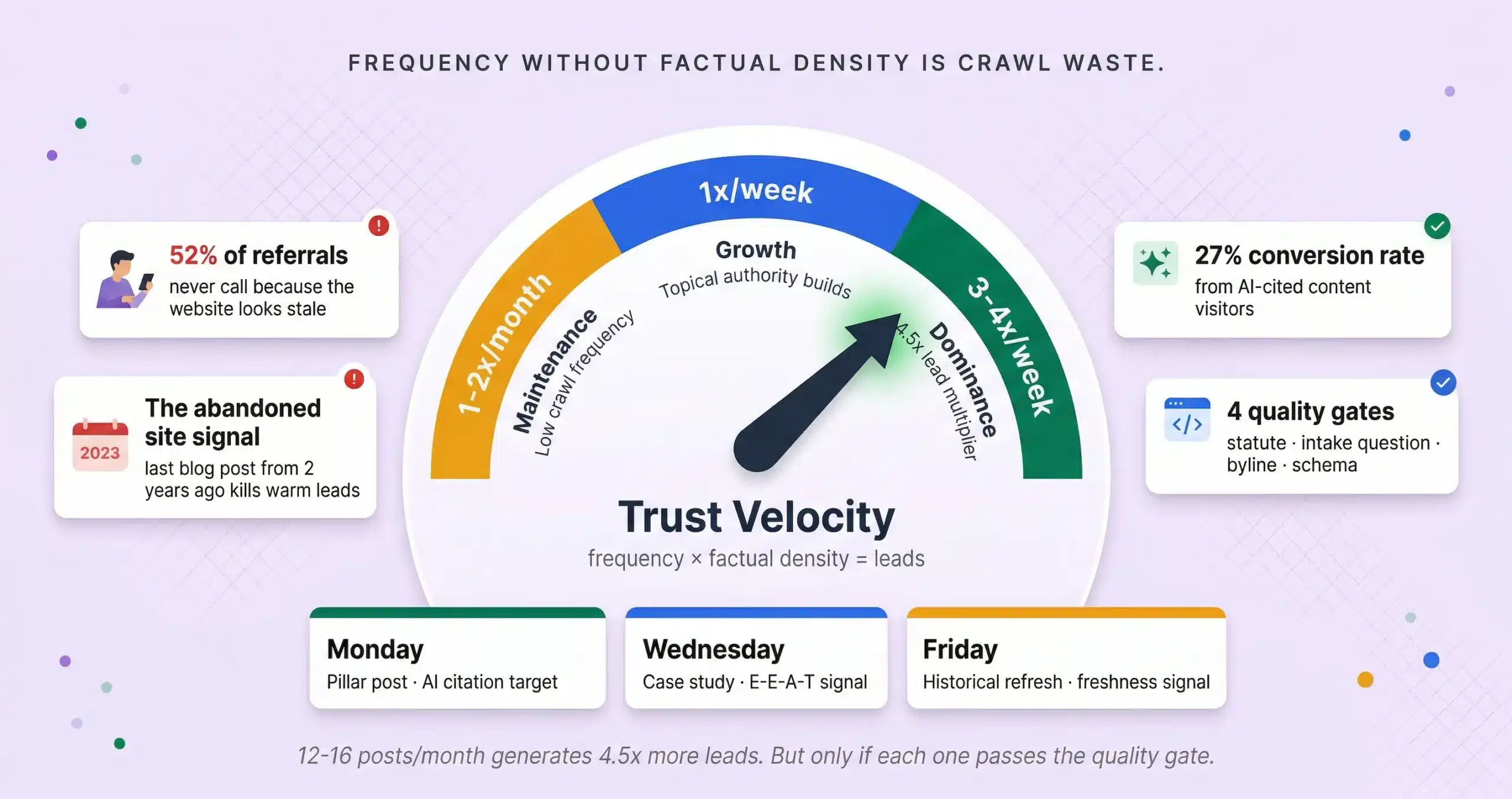
The old rule was “blog once a week for SEO.” The 2026 reality is that frequency without factual density gets you filtered out of both Google and every AI engine pulling answers for your prospective clients. Firms publishing 12 to 16 structured posts per month generate 4.5x more leads than infrequent publishers, but only if each post passes the E-E-A-T threshold that separates citation worthy content from crawl waste.
TL;DR
The frequency sweet spot: 12 to 16 posts per month for growth stage firms; 2 to 4 per week with one pillar post and 3 cluster posts.
The quality gate: every post must include verifiable data, statutory references, or anonymized case results; thin content dilutes domain authority and creates crawl waste.
The invisible leak: 52% of offline referrals never call because the website looks abandoned; your blog is the referral validation engine, not just an SEO tool.
Source: Jorge Argota, 10 years legal content strategy.
THE TRUST VELOCITY CURVE: HOW FREQUENCY DRIVES LEADS
The correlation between blogging frequency and lead generation isn’t linear; it compounds. But only when the content meets the E-E-A-T threshold that separates signal from noise. Organic search drives 52.6% of all law firm traffic and the close rate on SEO leads is 14.6% compared to 1.7% on outbound. B2C firms publishing 11 or more posts per month generate 4x more leads than those publishing 4 to 5. Small firms with fewer than 25 employees blogging at that same 11+ frequency average 3x more traffic and 2.5x more leads than their low-frequency competitors. The firms that blog consistently convert at higher rates because their content pre qualifies the prospect before the intake call ever happens.
THE REFERRAL VALIDATION GAP: THE INVISIBLE REVENUE LEAK
When a CPA or a doctor refers a client to your firm, that client doesn’t call immediately. They search your name and visit your website. If they find a blog that hasn’t been updated since 2023, outdated bios, and stock photography, they abandon you and call the next firm on the list. 52% of offline referrals never actually contact the firm they were referred to. Your firm assumes the referral never happened; in reality, your website killed it.
This is the most expensive marketing failure a firm can have because it’s completely invisible in your analytics. The prospect never submitted a form so there’s no record of the loss. The managing partner blames a “slow month” instead of recognizing that the stale digital footprint failed to close the validation gap on a warm lead who was already pre-sold by a trusted source.
💡 The referral math
74% of potential clients visit 2 to 5 law firm websites before making contact. It takes an average of 13.4 leads to produce one signed client. 53% of lawyers who blog consistently have gained clients through direct referrals that were validated by the blog content. When your managing partner asks “why are we spending money on blogging,” the answer is: because 52% of the referrals your rainmakers generate are dying on a stale website and the blog is the only asset that closes that gap at scale.
⚡ The referral rescue in action
A 3 attorney employment law practice in Georgia was publishing one post per quarter. Their organic traffic was flat but that wasn’t the real problem. Their managing partner generated 8 to 10 warm referrals per month from HR directors she met at SHRM events. When we audited the intake data, only 3 were converting to consultations. We moved them to the 3x per week schedule (Monday pillar on employment statute updates, Wednesday EEOC case analysis, Friday historical refresh). Organic traffic grew 15% in the first 60 days. But the referral close rate jumped from 38% to 71% because the website finally looked like an active practice instead of a dormant brochure. The managing partner’s networking ROI doubled without her attending a single additional event.
AI CITATIONS AND THE ZERO-CLICK LEAD GENERATION SHIFT
AI Overviews now trigger on 68 to 75% of legal queries. Organic CTR on those queries has dropped 61% (from 1.76% to 0.61%). But firms cited as sources within AI responses earn 35% more clicks than non-cited competitors. And the visitors who come through AI citations convert at 27%, which is an order of magnitude higher than traditional organic traffic. The blogging frequency question in 2026 isn’t “how often should I post” but “how often am I feeding the AI engine fresh, citation-worthy data.”
What gets cited by AI engines
Direct citations to specific statutes and recent court cases. Original data like proprietary settlement statistics or localized research. Question-based headings that match how people ask AI legal questions (“What is the average settlement for a rear-end collision in Florida?” not “Car Accidents”).
What gets filtered out
Generic 500 word posts that rephrase Wikipedia. Content without verifiable data points or statutory references. Posts where the AI detects “synthesized parity” meaning the article is just the average of what’s already online and could apply to any firm in any city.
📊 The referral recency signal
67% of consumers are most influenced by content and reviews published within the last 90 days. For every 10 contacts your firm tracks, roughly 21 total contacts were influenced by your online presence before they ever picked up the phone. The 2.1x multiplier means your blog is touching twice as many prospects as your CRM shows.
The 90 day freshness loop is the mechanism behind the compounding. Content updated within the last 90 days improves rankings by an average of 3.7 positions on competitive queries. Posts older than 90 days lose their freshness advantage in AI Overviews and get bypassed for newer sources. The pivot in 2026 is from “blog posts” to “authority assets”: each publication must include expert quotations and verifiable statistics that give AI engines a reason to cite you rather than the 50 other firms publishing on the same topic.
THE PRACTICAL PUBLISHING SCHEDULE FOR 2026
“I don’t have time to write 3 to 4 posts a week.” You don’t need to write them from scratch. One pillar post (1,500 to 2,000 words) breaks into 3 cluster posts. The pillar answers the broad question; each cluster answers a specific subtopic. This satisfies the frequency algorithm without burnout and builds the internal linking architecture that pools authority into your money pages.
⚠ The 5 minute intake rule
None of this matters if your intake process is broken. Firms that respond within 5 minutes are 100x more likely to connect with the prospect and 21x more likely to qualify the lead. A 5 hour delay costs an estimated $200,000 per year in lost cases. High-frequency blogging generates the lead; intake speed converts it.
📋 The 2026 quality gate checklist
Every post must pass these four gates to be considered citation-worthy by AI Overviews:
☐ Statutory anchor: does the post cite a specific state statute or recent case ruling? (Boosts AI citation rates by approximately 40%.)
☐ Intake insight: does it answer a question actually asked by a client in the last 30 days? This solves for micro-intent that generic content misses.
☐ E-E-A-T signature: is there a clear attorney byline with a link to a verified bar profile? Anonymous authorship now triggers the lowest quality rating.
☐ Structured data: is the content marked up with LegalService and FAQPage JSON-LD schema? Without it, AI engines can’t categorize your expertise.
BLOGGING FREQUENCY FOR LAW FIRMS FAQ
Get Your Content Velocity Audit
I’ll audit your current publishing frequency against your practice area benchmarks, identify the high-converting, low-traffic articles in your content library, and build the editorial calendar that feeds both Google and the AI engines your prospects are actually using.
About Jorge Argota · 10 years building legal content systems. Every editorial calendar I build is structured around trust velocity: pillar posts for AI citations, case studies for E-E-A-T, and historical refreshes for freshness signals. Full bio.
Related: Content Marketing Statistics · Content Freshness Protocol · Blog Post Length Guide · Intake Process · SEO vs PPC ROI