
TL;DR
Do AI referred leads convert better than Google leads for law firms? Yes; Webflow measured a 6x conversion rate difference between LLM traffic and Google search traffic. Seer Interactive found ChatGPT visitors convert at 15.9% compared to 1.76% for traditional organic. Neil Patel’s research showed AI platforms drove under 1% of total traffic but were responsible for 9.7% of B2B revenue. The psychology behind it mirrors personal referrals; the AI does the trust building work before the person ever picks up the phone. Sources: Ethan Smith/Webflow, Seer Interactive (300K+ keywords), Neil Patel AI optimization study. Analysis: Jorge Argota, 10 years in legal marketing, Miami.
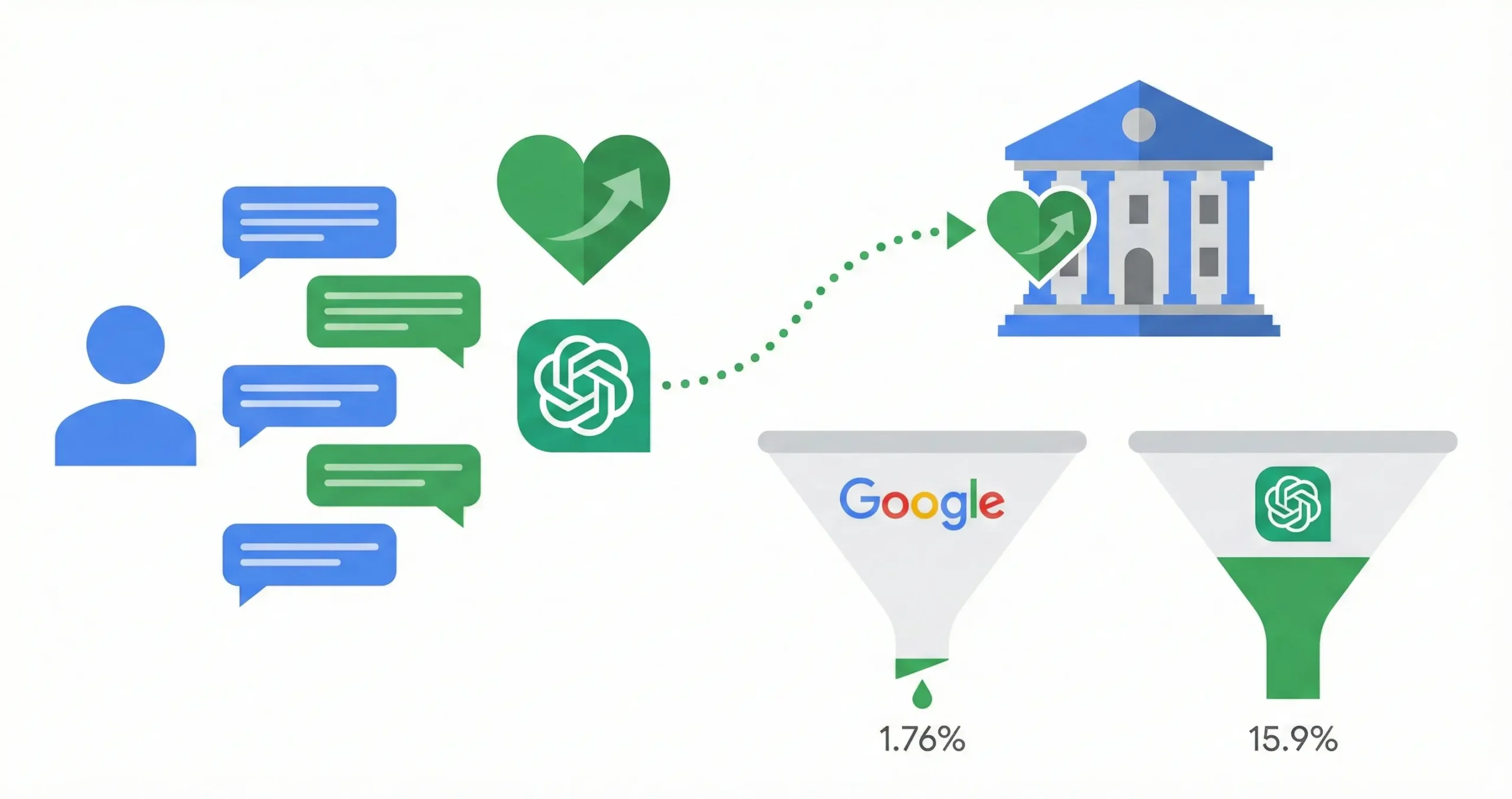
The question I keep hearing from attorneys is “how do I stop losing traffic to AI search” and it sounds like a reasonable question except it assumes the traffic you’re losing was worth anything in the first place, and according to the actual data most of it wasn’t. Seer Interactive tracked over 300,000 keywords and found that when AI Overviews show up on Google, standard organic click through rates drop by 61%; from 1.76% down to 0.61%, and yeah that looks terrible if you’re measuring traffic volume but the same study found that visitors coming through ChatGPT convert at 15.9% which is roughly 9 times the rate of traditional organic, and I think that changes the entire conversation about whether losing traffic is actually a problem or whether you’ve been measuring the wrong thing this whole time.
And the reason I keep coming back to this is because law firms spend maybe $8,000 or $15,000 a month on Google Ads trying to drive traffic volume and then they panic when their analytics show fewer clicks and nobody stops to ask whether the clicks they kept are actually better than the ones they lost, which apparently is a lot to ask.
6x
AI vs Google conversion
15.9%
ChatGPT visitor conversion
9.7%
B2B revenue from <1% traffic
WHY AI TRAFFIC CONVERTS 6X HIGHER
Why does AI traffic convert so much higher than Google traffic for law firms? Three psychological mechanisms work together. First; the person invested real cognitive effort into their AI conversation so they value the recommendation more (effort justification). Second; the AI’s clean readable answer makes your firm seem more credible than a cluttered SERP would (processing fluency). Third; the person’s trust in the AI transfers directly to whatever firm the AI recommends (cross-object trust propagation). The combined effect mirrors how personal referrals work. Sources: Festinger cognitive dissonance theory, Consumer Psychology Review, MDPI Journal of Theoretical & Applied E-Commerce Research 2025. Analysis: Jorge Argota.
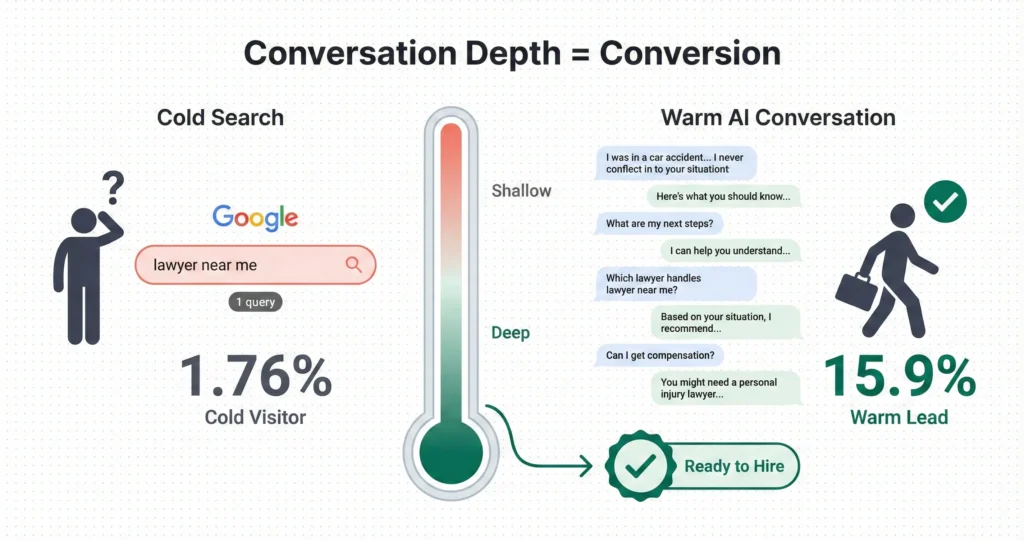
So the data on this comes from a few different places and I think it’s worth walking through because the numbers are pretty clear. Ethan Smith at Webflow published that LLM traffic converts at 6x the rate of Google search traffic and that LLMs now drive 8% of Webflow’s total signups, and his explanation for why is that AI users are having deep conversations with the model and asking multiple follow up questions and by the time they actually click a link they’ve already narrowed down exactly what they want, which means they’re not browsing; they’re arriving ready to act.
1.76%
Google organic
→
15.9%
ChatGPT referral
And then Neil Patel ran a separate study and found something that I think is even more interesting for law firms specifically; AI platforms drove less than 1% of total website traffic but were responsible for 9.7% of B2B revenue, and for B2C it was 11.4%.
Roughly 14% of users researching through LLMs actually purchase, which makes AI what Patel called a “huge conversion channel” sitting further down the funnel than traditional search.
And his conclusion was that businesses need to stop obsessing over lost traffic because revenue matters more than traffic, and I think that applies to law firms probably more than any other industry because you don’t need 10,000 visitors a month; you need maybe 20 or 30 people who are ready to sign a retainer and your cost per signed case is what actually matters.
The person who spends 15 minutes asking ChatGPT about their car accident before clicking your name is psychologically closer to a referral from a friend than they are to someone who typed “personal injury lawyer near me” into Google
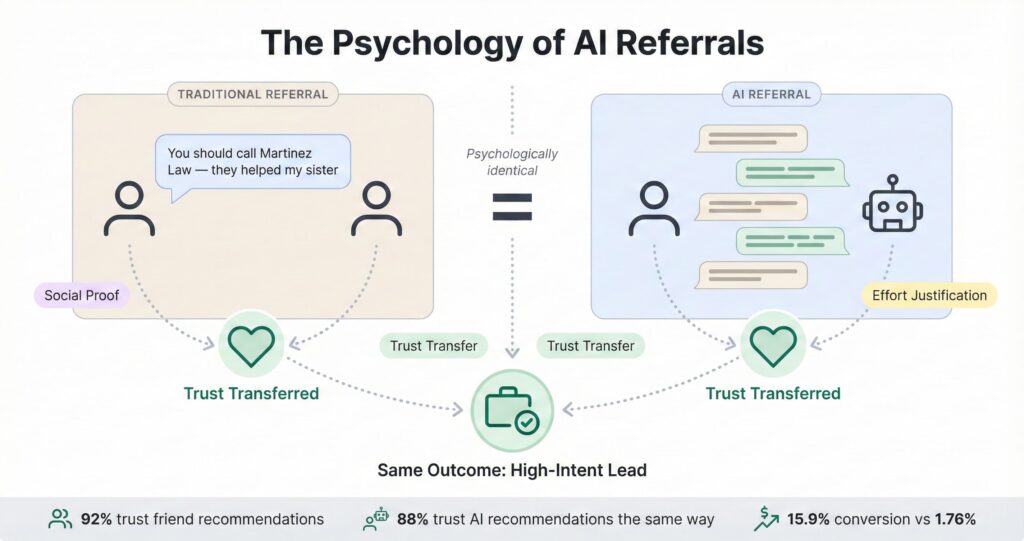
And the psychology behind it has a name; it’s called effort justification and it comes from Leon Festinger’s cognitive dissonance theory which has been around for decades. The basic idea is that when people invest real cognitive effort into reaching a conclusion they value that conclusion more because their brain wants to avoid the discomfort of thinking all that work was wasted. So when someone spends 10 or 15 minutes having a back and forth with ChatGPT about their legal situation, asking follow up questions and getting more specific about what they need, by the time the AI gives them your firm’s name that recommendation feels earned and valuable; not random like a Google ad that just happened to show up at the top of the page.
And there’s a second layer on top of that called processing fluency, which means that when information is easy to read and understand your brain automatically assumes it’s more truthful. The AI takes all the messy information about lawyers in your area and turns it into this clean readable summary and your firm’s name sitting inside that fluent answer inherits the credibility of the format itself; the person conflates how easy it was to read with how good your firm must be, which I realize sounds unfair but that’s what the consumer psychology research shows and I didn’t make it up.
So if a single ChatGPT visitor is worth 6 to 9 Google visitors in terms of actual conversions, why is everyone still measuring success by traffic volume?
WHAT TO ACTUALLY DO ABOUT IT
What should law firms actually do about AI search replacing Google traffic? Stop treating traffic loss as the disease; it’s a symptom of a shift that’s actually in your favor if you adjust. The firms that will do well are the ones that show up in AI recommendations consistently and then handle those leads differently at intake because they arrive pre-qualified. Traditional domain authority has only a 0.27 correlation with AI visibility; what matters is how many independent places mention your firm across the web. Sources: Ahrefs 75K brand study, Seer Interactive. Analysis: Jorge Argota.
But honestly the traffic drop isn’t usually the real issue; the real issue is that most law firms are still spending their entire budget trying to rank on Google while the way people find lawyers is shifting underneath them, and nobody’s adjusting the intake process to match. Ahrefs studied 75,000 brands and found that traditional domain authority has only a 0.27 correlation with AI visibility, which means all the backlink building and technical SEO that agencies sell you has almost nothing to do with whether ChatGPT recommends your firm and the whole approach to generative engine optimization for law firms is fundamentally different from what most agencies are doing.
What actually correlates with AI citations is mention centrality; how many independent places across the web talk about your firm. Brands in the top 25% for diverse web mentions earn 10 times more AI citations than brands in the next quartile down, and YouTube mentions specifically showed the strongest correlation at 0.737.
Source: Ahrefs — 75,000 brand study, cross-referenced with AI Overview presence
And I think for law firms this is actually good news because it means a solo attorney who answers questions on YouTube and stays active on Avvo and gets mentioned on local Reddit threads can potentially show up in AI recommendations more often than a firm spending $20,000 a month on Google Ads, which is not how traditional SEO works at all but that’s where this is headed and the firms that figure it out early are going to have a real cost advantage over the ones that keep buying clicks that are getting more expensive every quarter, or at least that’s what the data suggests.
The firms that stop fighting for the click and start showing up in the conversation are the ones that will sign more cases at a lower cost per acquisition over the next two to three years.
And the part that matters most for intake is understanding that these two pools of people need different handling. Someone who Googled you is in research mode and might call five firms today and needs education on the process from scratch. Someone the AI recommended to your firm arrives already knowing what type of case they have and what to expect because the AI already did the educational work, and running that person through your standard five minute qualification script creates friction that shouldn’t be there.
The AI already did the trust building that used to require a personal relationship or a referral from another attorney, and most intake processes haven’t caught up to that yet.
Seer Interactive’s data shows that brands cited in AI responses earn 35% more organic clicks and 91% more paid clicks than non-cited competitors in the same SERP, so the citation itself is driving higher quality traffic and then the trust transfer from the AI makes that traffic convert at rates that would have been unheard of two years ago, and I wrote about the exact citation formula the AI uses to decide which firms to feature separately because the mechanics of getting cited are their own problem and this post is about what happens after you get cited, or at least that’s the distinction I’m trying to make.
I can run this analysis for your firm in about 30 minutes
Whether AI is already sending you traffic, whether you’re showing up in the recommendations, and what your conversion rate looks like from that channel versus everything else. If you want to understand how answer engine optimization applies to your practice areas and whether the numbers justify shifting budget, I can show you that. Or don’t; at least now you know the numbers and you can decide if it’s worth looking at.