

 PPC advertising agency · Rochester, New York
Rochester Law Firm PPC for a Medical and Tech Market.
Most Rochester law firms running paid search hit the same wall. Lead volume goes up. Signed cases do not. That gap is not a budget problem. It is a structure problem, and that is what an audit is for. Audit first. Retainer second. New York Bar review at the ad template level. One firm per practice area per metro. Managed from our principal strategy desk, customized to Monroe County ad auctions.
Marketing performance only, not legal counsel or guarantees of case outcomes. Ad templates are reviewed by the firm under New York attorney advertising rules.
How Rochester law firm PPC handles Monroe County intake, University of Rochester medical center traffic, and former Kodak workforce demographics.
Account diagnosis drives every budget decision.
The account does not get touched on day one. The first ten days are spent reading what the existing setup has produced: search query data, match type behavior, geographic performance, device patterns, intake notes, and closed case outcomes. Until the audit can name where spend is leaking and where it is producing, no campaign edit is worth making.
Channel split between Search and LSAs.
Search and Local Services Ads compete for the same budget but pay differently. Google Ads carries practice areas where direct keyword control matters. LSAs carry practice areas where review profile and intake throughput drive the cost per call. The decision is made one practice area at a time, with the case economics attached, not as a blanket split.
Landing page alignment matched to search intent.
Two things have to happen on a landing page for paid search to work. The right caller has to convert. Quality Score has to stay high enough to keep ad costs from drifting up. Both come from the same set of choices: scope visible above the fold, ad message and page message matching, page weight kept light, and a layout designed for phones first.
Intake review as part of performance.
Twenty qualified calls a week is fine on paper. It becomes ten signed clients or zero depending on what happens after the call connects. Pickup speed, the screening done in the first minute, and the follow up schedule for callers who do not retain on the first attempt all sit inside the campaign result, not outside it.
Signed case reporting tied to retained matters.
Every month, the reporting answers the same question: which campaign produced which signed client, at what cost. Click data, form data, and call data show up alongside that answer as supporting evidence. The decision being made each month is which line items deserve more spend and which need to be scaled back or shut off.
- Audit before quoting. An audit of the account and intake quality precedes any budget recommendation.
- Score the intake. Intake speed gets measured before scaling, since a fast answer is worth more than any bid adjustment.
- Split LSAs and Search. Local Service Ads and Search run on separate budgets and rules, split by practice area rather than habit.
- Cut curiosity terms. Costly curiosity searches come out before expansion goes in, because the negative list does the heavier lifting.
- Report on signed. Reporting anchors to signed retainers and practice area CPA, since volume and signed rate can diverge.
What does a successful paid search account look like for a law firm? It produces signed clients at a cost the firm can sustain, month after month. Click counts, form fills, and call volume only matter to the extent they help explain that number.
Jorge Argota
Founder · Argota Marketing
How Monroe County paid search behaves in a medical and tech market
Five things that change how paid search has to be run in this specific market.
Rochester legal CPCs sit below the major coastal metros, letting a Monroe County firm collect clean data and clear the Google Ads learning phase on a measured budget. The defining feature of this market is not price, it is the unusual employment base left by the city’s industrial and medical history, which changes which campaigns deserve weight.
The University of Rochester Medical Center anchors one of the region’s largest employers, and the former Kodak and Xerox industrial base left a workforce with specific injury and benefits patterns. That concentration lifts medical adjacent injury, occupational exposure, and workers compensation queries relative to a generic metro, and those categories reward dedicated campaigns where the copy speaks to the specific worker rather than to a broad audience.
RIT and the broader student population add a seasonal layer to criminal and DUI demand that tracks the academic calendar. A flat budget misses the predictable autumn and spring spikes, and an account built for Rochester anticipates them rather than reacting after the fact.
Geo strategy has to respect the Finger Lakes catchment. Monroe County is the core, but the surrounding counties feed cases into Rochester firms, so the radius extends into the regional trade area while down weighting the thin rural fringe. Lake effect winter weather also drives a documented seasonal rise in vehicle collision searches, which the budget should be ready to meet.
Because Rochester is outside the home footprint, the page states the arrangement plainly: managed from the principal strategy desk with New York Bar review, customized to Monroe County auction dynamics. Reporting stays anchored to signed retainers and practice area cost per case, so a low headline CPC is never mistaken for a low cost to actually sign the medical or occupational files the firm is built to handle.
Which channel earns its place in the account.
There is no default answer to which channel a law firm should run. The right mix depends on practice area, intake throughput, and the case math, and it shifts as the data comes in. The audit names the starting position. Reporting drives every adjustment after that.
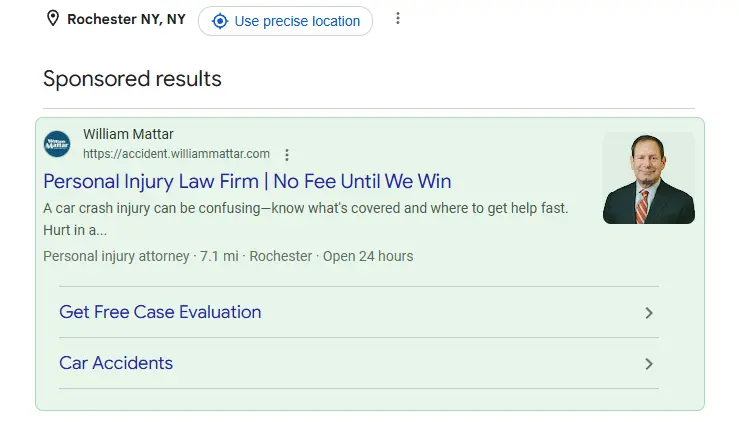
Google Ads usually fits when:
- Direct control over keywords, landing pages, and call routing by practice area is needed.
- Campaigns need to target specific case types or higher value segments inside a practice area.
- Deliberate budget pacing and structured testing meaningfully change the numbers.
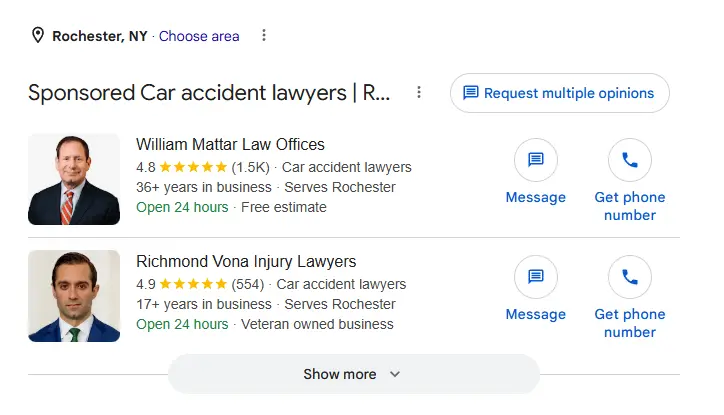
LSAs usually fit when:
- The firm prefers a more direct call pipeline with less operational lift.
- The review base and intake capacity can handle quick response call volume.
- Local cost dynamics and the firm’s reviews support paying competitive LSA rates.
An even split rarely turns out to be the right answer. Run both channels only when each one stands up on its own case economics, then shift budget toward whichever is producing signed clients.
Open fees. Clear scope. Visible accountability.
The pricing is published. The real question is whether the work can grow the firm’s signed case count and whether intake can keep pace with the calls coming in. Fees are listed on this page, tier by tier.
- Single practice area campaign
- Google Search and LSA setup
- Weekly call review
- Monthly signed case reporting
Solo attorneys working a single practice area.
- Multi practice campaign structure
- LSA vs Search budget split
- Negative keyword and intake screening
- Landing page testing
- Biweekly intake QA and call scoring
- Shared signed case dashboard
Firms running across multiple practice lines needing closer coordination between channels and intake.
- Budget allocation and strategy
- LSA vs Search reallocation cycles
- Landing page testing at scale
- Multi market planning
- Intake QA at scale
Firms past the build phase, where allocation, reporting depth, and growth decisions outweigh the initial setup.
Single working model, fees published in advance. Pricing tracks management scope, the size of media spend, and the depth of reporting required. Market conditions affect how the work runs, not the structure of the offer. A one time setup fee may apply on new builds or on takeovers with cleanup involved. Media spend goes directly to Google. No markup, no card on file.
The national law firm PPC framework walks through how engagements grow across practice areas as a firm expands. Law firm website design cost covers the landing page work that operates alongside paid management.
About us.
Jorge Argota leads the legal marketing operation. Ten years inside Percy Martinez P.A., a Miami medical malpractice firm, before agency work across 20+ markets, where the day to day was retainer economics, intake quality, and the gap between a phone call and a signed client. University of Miami BBA. Google Ads certified. Bilingual, English and Español. Every account decision on Argota Marketing campaigns runs through that same operator lens.
 University of Miami BBA
 Google Ads certified
Questions that come up on PPC audit calls.
Direct answers to the questions partners raise before launching or rebuilding paid search.
The decision is about where the signed cases come from, not how much ground the firm can technically cover. The city itself produces the highest intent searches. Pushing further into Monroe County and the rest of western New York adds volume but raises the cost per signed client. Practice mix factors in too. Firms taking medical malpractice or birth injury work often run a wider radius because the regional academic medical draw extends well past the city limits. The right targeting is whichever radius produces signed clients at a cost the firm can sustain.
Often yes, when the practice area qualifies for LSAs and the market sustains both. Budget moves toward whichever channel is producing better signed case economics. That sometimes means pulling spend from the other. The two get managed together, not in isolation.
A first qualified call usually shows up within the first one to two weeks of a clean build. Real signed case data takes longer, generally 30 to 60 days before the sample is large enough to draw a clear conclusion. Lower budgets stretch that timeline further out.
Three failure points come up most often. Targeting set too wide, pulling in calls outside the firm’s scope. Intake follow up that does not convert a call into a signed client. Reporting that ends at the lead instead of following the call all the way to a retained client. Most struggling accounts have two of these working against them at the same time.
Usually yes, with conditions. Both get reviewed at onboarding. Pages already producing stay in place with specific edit recommendations. Pages actively blocking conversions get flagged for a separate rebuild scope. Intake gets repaired before any decision to scale spend.
The audit comes
before any proposal.
An audit makes sense before any new agency relationship, any meaningful spend change, or any decision to fold paid search entirely. It covers what the account is doing, what should change, and whether the math supports the budget the firm has in mind.
- Review of the current Google Ads and Local Services Ads setup, or a recommended structure if nothing is running yet.
- Direct answer on whether the firm’s budget, practice mix, and intake can carry real signed case growth.
- Recommendations on keyword scope, geographic targeting, landing page direction, and channel allocation.
No card on file. No long term retainer. The audit is a fixed scope engagement ending with a written recommendation, whether the firm continues or not.