









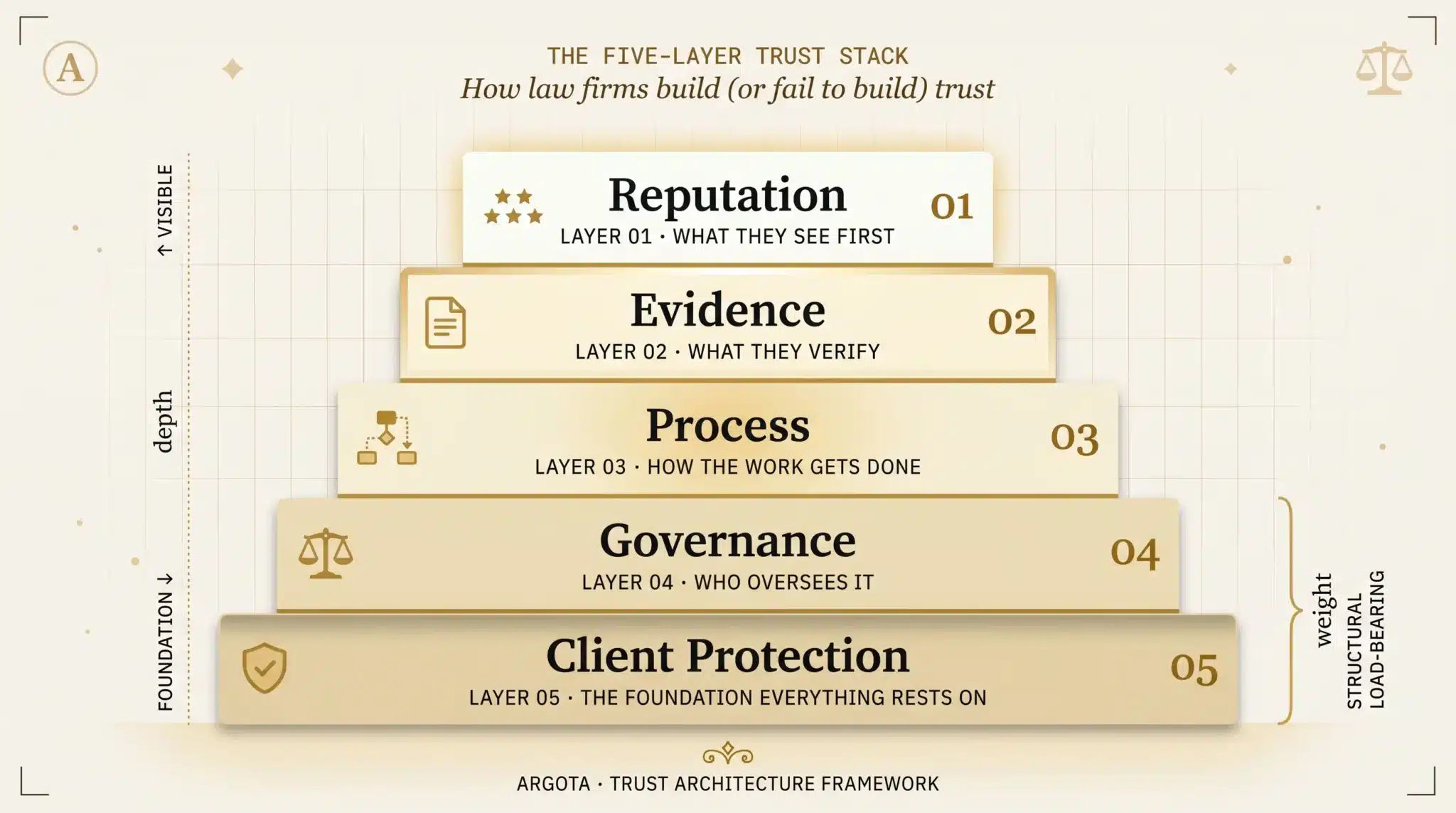
Reputation the firm does not control. Case evidence relevant to the prospect. Process transparency. Governance and ethics. Client protection mechanisms. Each layer answers a different fear. Most firm websites have one or two of these layers. The firms that win in competitive metros have all five, visible above the fold across the site, in the order a skeptical prospect cares about them.
What a trust stack actually is, in plain language
A trust stack is the visible set of proof assets that demonstrate a law firm is safe to rely on. Reputation, performance, process, ethics, and safeguards, all working together as one structure. Each layer reinforces the next. Pull any layer out and the stack stops working.
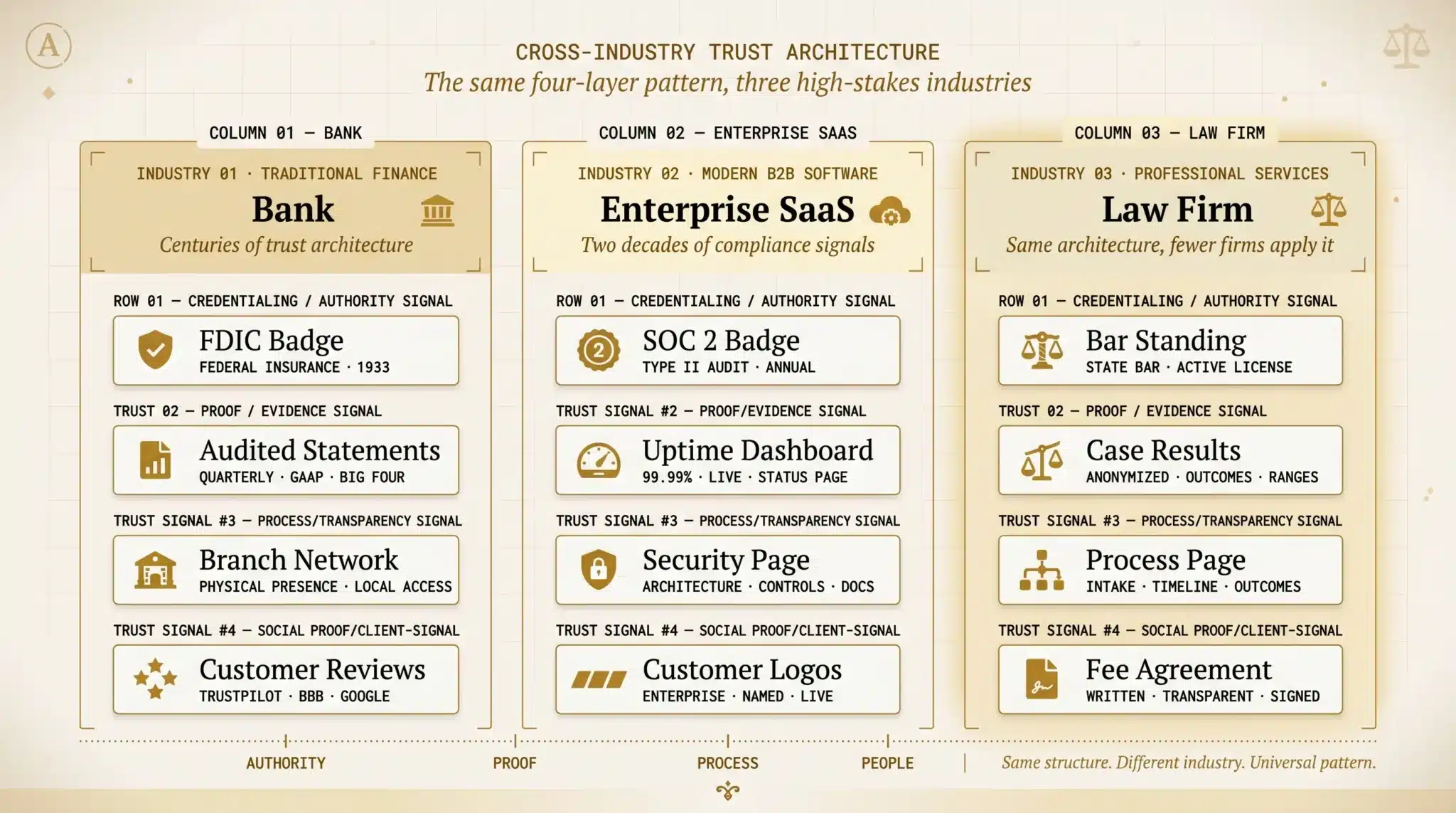
Banks figured this out years ago. So did enterprise software companies. When someone is about to hand you their savings or their company data, they need more than a logo and a smile. They need to see independent verification, security posture, governance, and a history of handling money or data correctly. The order of the proof matters as much as the proof itself.
Legal hiring is the same shape of decision. The prospect is handing the firm their case, often the most consequential thing in their life that month, and they want to know the firm has structures in place to handle it without things going sideways. The firms that surface those structures get hired. The firms that hide them, or do not have them, do not.
The 5 layers that de risk hiring any law firm
Each layer maps to a specific fear the prospect has. Build the stack in this order. Skipping a layer leaves a gap a competitor will fill.
The strongest reputation signals are the ones the firm cannot edit. Independent reviews across multiple platforms. State bar standing pages. Press mentions. Speaking engagements at bar association events. Court records. The point is not volume of reviews, it is diversity of sources. A firm with 800 reviews on one platform and nothing anywhere else is a different kind of signal than a firm with 60 reviews across 5 platforms plus 3 press mentions plus a clean bar standing.
Smart prospects already learned to weigh off site signals more than on site claims. The firm site says “trusted by thousands.” The off site evidence either backs that up or quietly does not. Buyers notice the gap.
Generic verdict pages no longer convert. A $4.2 million settlement headline tells the prospect the firm has handled big numbers. It does not tell them whether the firm has handled their specific scenario, which is the question they are actually asking. A delayed back injury claim from a low impact rear end collision is a different case than a wrongful death from a tractor trailer crash, even though both might appear on the same verdicts page.
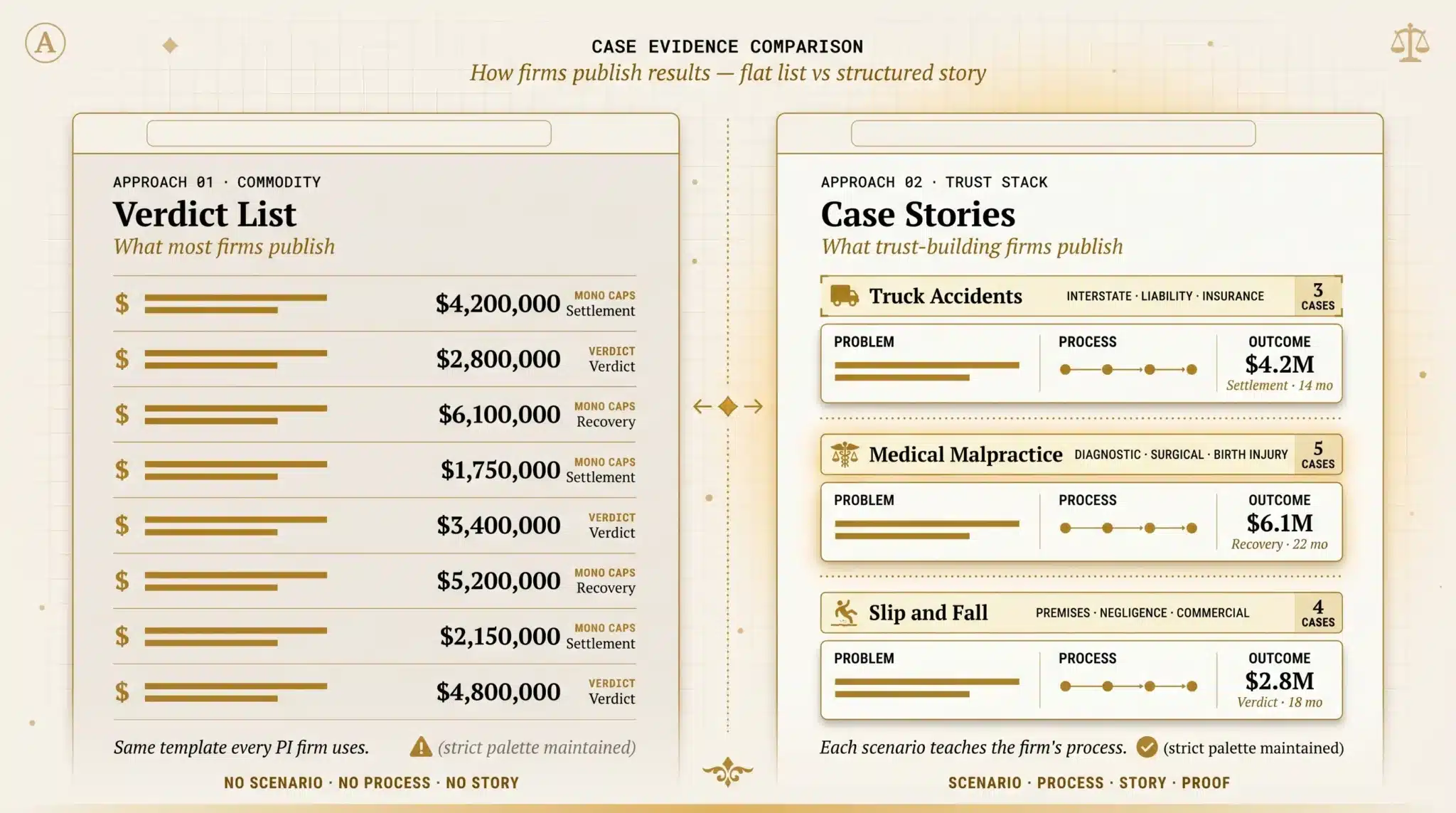
Case evidence works when it is organized by scenario, not by dollar amount. Anonymized timelines, problem to process to outcome, with the complexity preserved. The prospect should be able to find a case that resembles their own and read how the firm handled it.
This fear is so common in legal services that the firms that visibly address it move ahead of competitors instantly. Process transparency means the prospect can see, before they hire, what week 2, week 6, and month 4 of their case will look like. Who is on the file. How updates flow. What the typical timeline is for their type of case.
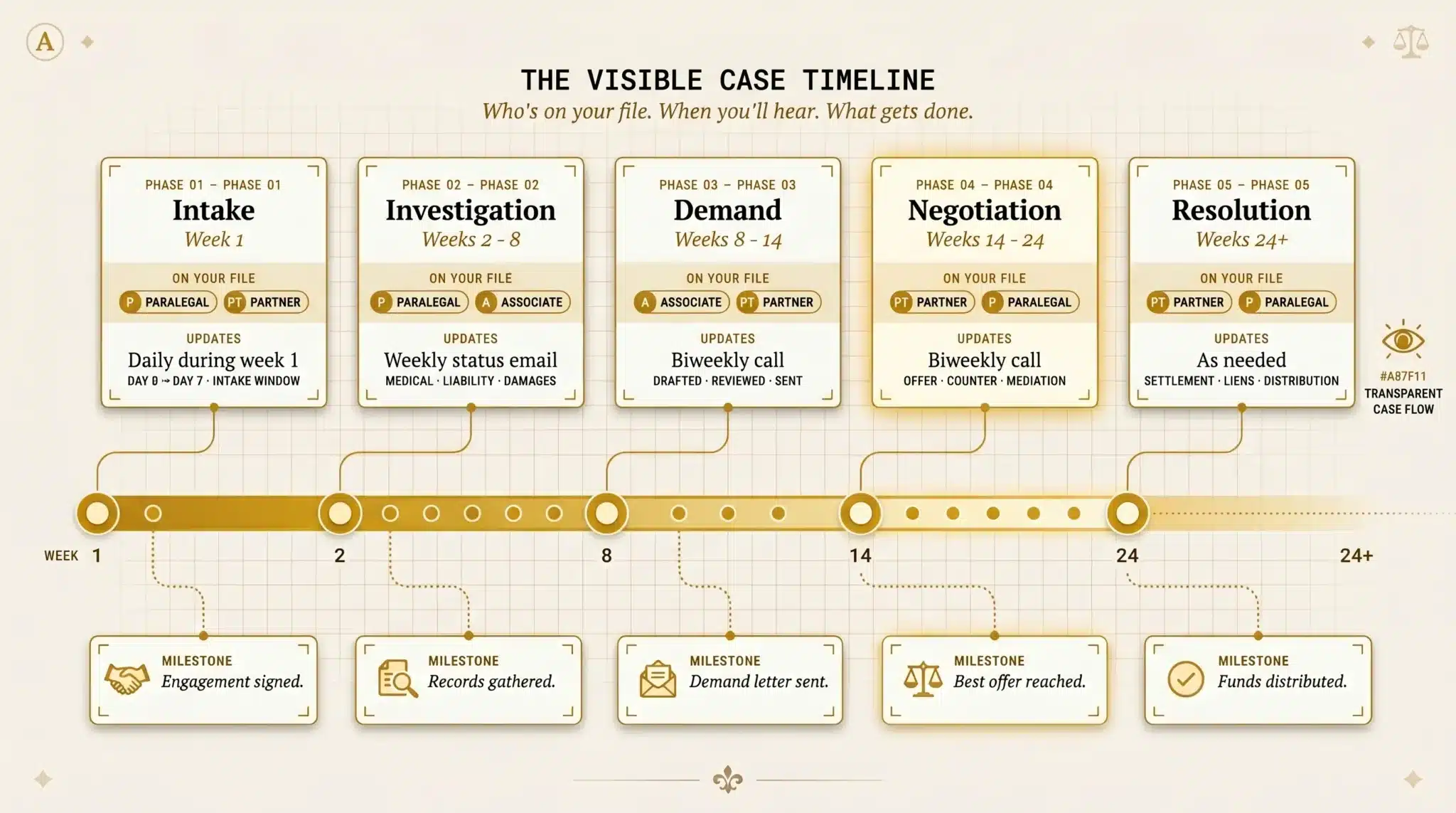
The firms that do this well show a process page with named milestones. The firms that do not have an “About” page that talks about the firm’s history and a contact form that asks for the prospect’s email and phone number. The contrast registers immediately.
Most firms treat governance as something for the operations manual. The trust stack treats it as proof. Documented conflicts processes. Internal review of high stakes filings. Ethics CLE participation. Bar association involvement. None of this is glamorous. All of it signals to a prospect that the firm has structures, not just lawyers.
For Florida firms specifically, governance also means visible compliance with the advertising rules. Rule 4-7.13(b)(3) prohibits comparative superiority claims. Rule 4-7.14(a)(4) restricts “specialist” and “expert” terms unless the attorney is Board Certified. Past results trigger Rubenstein v. Florida Bar (2014) disclosure requirements. A firm site that handles all three correctly tells the prospect, indirectly, that the firm is paying attention to the rules that govern it.
The last layer is the one that closes the deal in cases where the prospect has been burned before, by another firm, by an insurance company, or by a contract that read one way and meant another. The firm’s answer is concrete protection mechanisms the prospect can see in writing. Sample fee agreements. Cost handling clarity. Second lawyer review on consequential decisions. Clear escalation paths if the assigned attorney is not responsive.
Most firms do not surface this layer at all because it feels like inviting the question. The firms that do surface it close at noticeably higher rates because the prospect sees the same mechanisms they would have asked for, already in place.
The firm with all 5 layers visible does not need to convince the prospect they are credible. The proof is doing that work already. The firm gets to focus on the case.
What a trust stack site looks like next to a commodity firm site
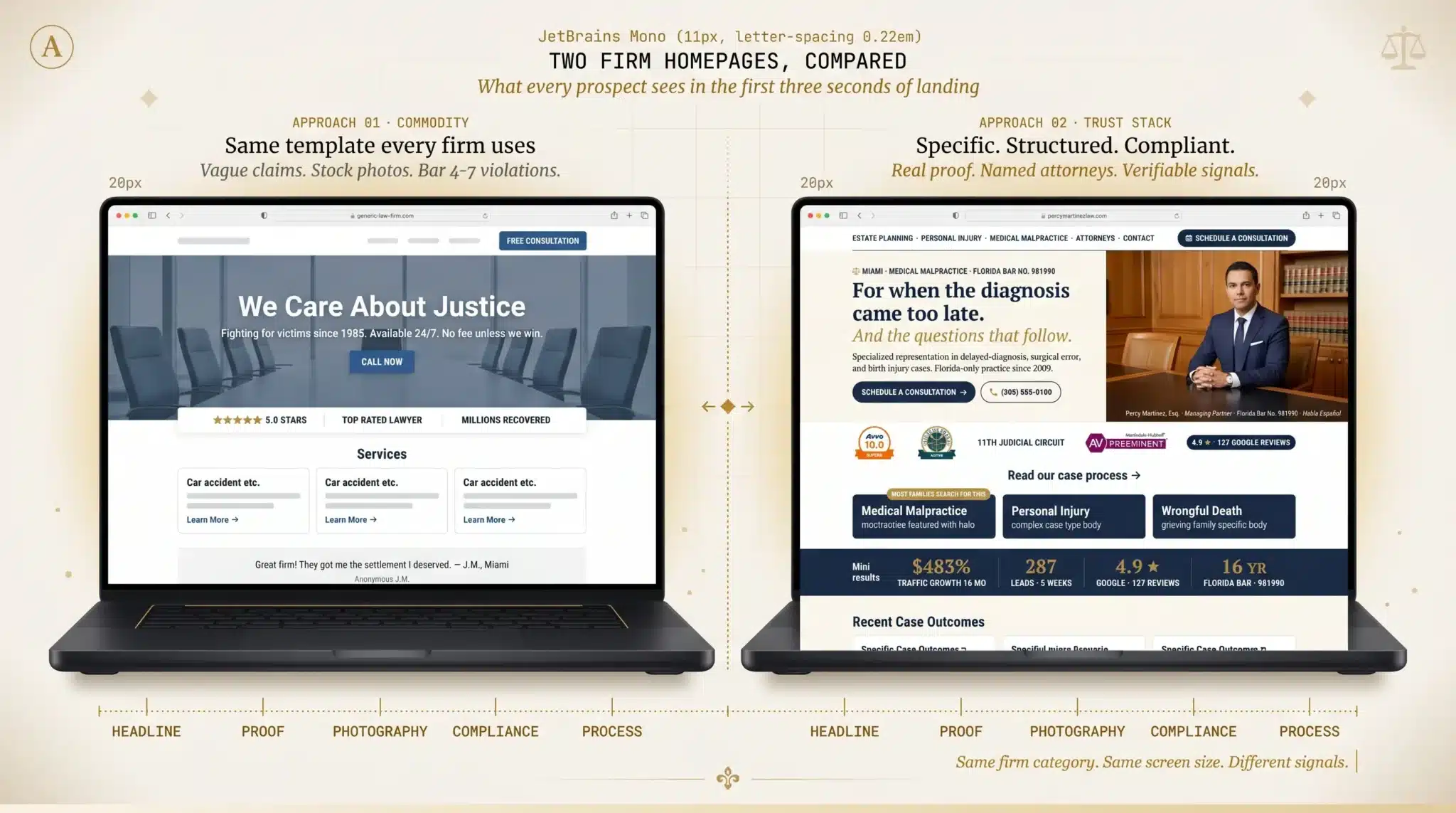
Commodity content is the kind of content that could appear on any firm’s website without changing anything. Generic claims, dollar verdicts with no context, a contact form. Google calls this pattern out directly in its helpful content guidance, and AI Overviews skip past it. A trust stack site replaces each commodity element with a verifiable layer.
| Trust element | Commodity firm site | Trust stack site |
|---|---|---|
| Reviews | “500 plus 5 star reviews” stated on home page | Live reviews across Google, Avvo, Justia, Martindale linked from a reputation page |
| Case results | Verdict list with dollar amounts only | Case stories grouped by scenario, with problem, process, and outcome for each |
| Process | “We treat every client like family” | Process page with named phases, response time commitments, team roles per phase |
| Governance | Bar admission listed in attorney bio | Conflicts policy, ethics CLE history, observable compliance with state bar advertising rules |
| Client protection | “We work on contingency” | Sample fee agreement language, cost treatment in writing, defined escalation if attorney is unresponsive |
The shift is from telling to showing. Every row on the right side of the table is something the prospect can verify on the firm’s own site, in 2 to 3 clicks, before the first phone call.
What law firms can borrow from industries that figured this out earlier
Trust stacks are not new. Other industries with high stakes purchases built them years ago. The patterns translate to legal once you adjust for compliance.
The 20 minute trust audit any prospect can run on any firm
This is the audit a careful prospect runs before they call any firm. Run it on your own firm first. Then run it on the 3 closest competitors. The gaps in your stack are the work. The gaps in their stack are the opening.
- Search the firm name plus reviews and read for patterns across at least 3 platforms. Diversity of platforms matters more than total count.
- Confirm bar standing through the state bar website. Look for any discipline history or open complaints.
- Look for case stories that match the prospect’s specific scenario, not just headline verdicts. If every case is a million dollar settlement and the prospect has a soft tissue claim, the evidence is not aligned.
- Find the process page or section. Read for who handles the case, how often updates flow, and what the typical timeline looks like. If this content does not exist, that is a signal.
- Check the fee agreement structure. Get specifics on contingency percentage, cost handling, and what happens if the case is dropped or withdrawn.
- Confirm there is a named partner level escalation path if the assigned attorney becomes unresponsive. Most firm sites do not state this. Ask in the consultation if it is missing.
- Read the firm’s site against state bar advertising rules. In Florida, look for any “best” or “top” claims, any unqualified “specialist” language, and any past results without disclaimers. The presence of these signals weak governance.
The audit takes 20 minutes per firm. Most prospects will not run all 7 steps, but the prospects that do are the ones who become long term clients with referral value. Building the trust stack to pass this audit is a defensive moat. Competitors who do not have the layers cannot replicate them in a quarter.
Where the trust stack connects to other parts of the system
The trust stack lives at the intersection of site architecture, content strategy, and conversion. These pieces cover the adjacent decisions.
Common questions about trust stacks for law firms
What is a law firm trust stack?
How do you evaluate the credibility of a law firm?
What are the most important trust signals for a law firm website?
What is the difference between a commodity law firm website and a trust stack site?
How do you do due diligence on a personal injury lawyer before hiring them?
Does Florida Bar Rule 4-7.13 affect what a law firm can show on its trust stack?
Want me to audit your firm’s trust stack against the 5 layer framework?
I run the 20 minute audit on your firm and your top 3 competitors, identify the missing layers, and hand back a prioritized build list. Available for select PI, med mal, and complex civil firms.
Request a trust stack audit →