Home / Blog / Why Is Attorney SEO So Expensive
Last updated April 22, 2026
Attorney SEO · Cost Analysis
Attorney SEO is the most expensive vertical on the internet. It costs what it costs because three forces stack on top of each other. Here is what each force adds to the bill.
All ranges use 2025-2026 legal marketing benchmarks plus audit data across PI, family, criminal defense, and estate planning firms managed at Argota Marketing, along with published legal advertising spend reports, BrightEdge and Clutch pricing surveys, and law firm marketing statistics.
The Three-Factor Stack
Why legal SEO tops every other industry
1
YMYL classification
Google holds legal content to the strictest quality standard. Every piece needs attorney-reviewed accuracy and E-E-A-T signals.
2
Paid search CPC inflation
Legal keywords hit $150 to $500+ per click. When paid is that expensive, organic becomes the only sustainable channel, so everyone fights for it.
3
Case value ceiling
A single PI case is worth $50K-$500K+ in fees. The unit economics support massive acquisition costs that would bankrupt e-commerce or healthcare.
Stack the three multipliers and you get the most expensive SEO vertical on the internet. Retainers of $3K-$15K+ per month are not a rip-off. They are math.
WRITTEN BY
SEO auditor for law firms. Floor-pricing diagnostician.
The Short Answer
Attorney SEO costs $3,000 to $15,000+ per month because legal keywords carry the highest CPC rates of any industry, Google classifies legal content under its strictest YMYL framework, and a single new client case can be worth $50,000 to $500,000+. When one organic ranking can generate that much annual case value, every competitor invests proportionally. That raises the floor. Below $3,000 per month in competitive markets, you are usually buying visibility, not results. These are typical ranges, not guarantees; your number depends on market, practice area, and competitive density.
TL;DR
1.
YMYL + CPC + case value stack to make legal the most expensive vertical.
2.
Below $3K/mo buys activity, not competitive positioning in most markets.
3.
Red flag: any agency guaranteeing #1 rankings within 30-60 days.
4.
Measure intake, not traffic. Rankings without consultations is a vanity program.
On This Page
Eight sections. Skip to the investment table or the red flags.
The Forces
Why legal is different from every other vertical
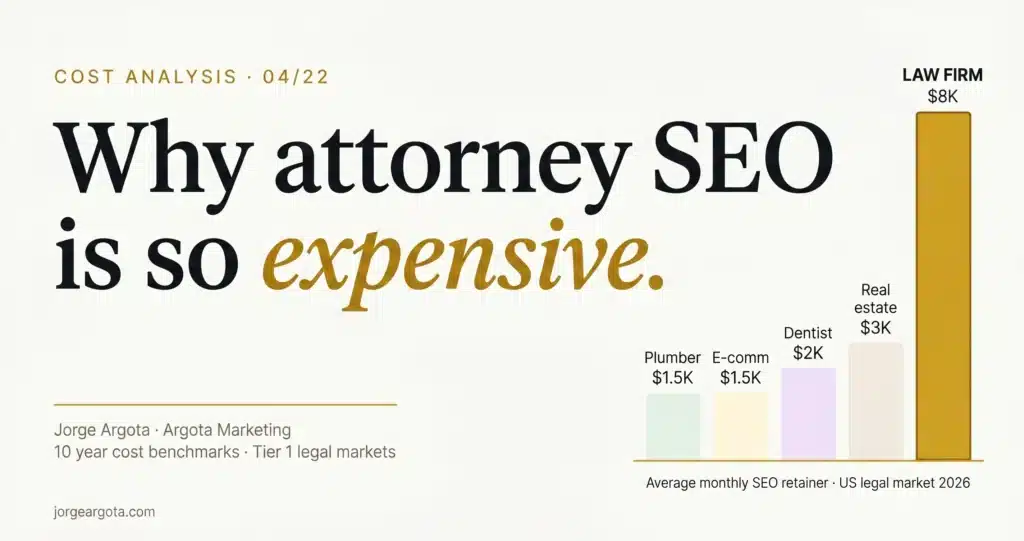
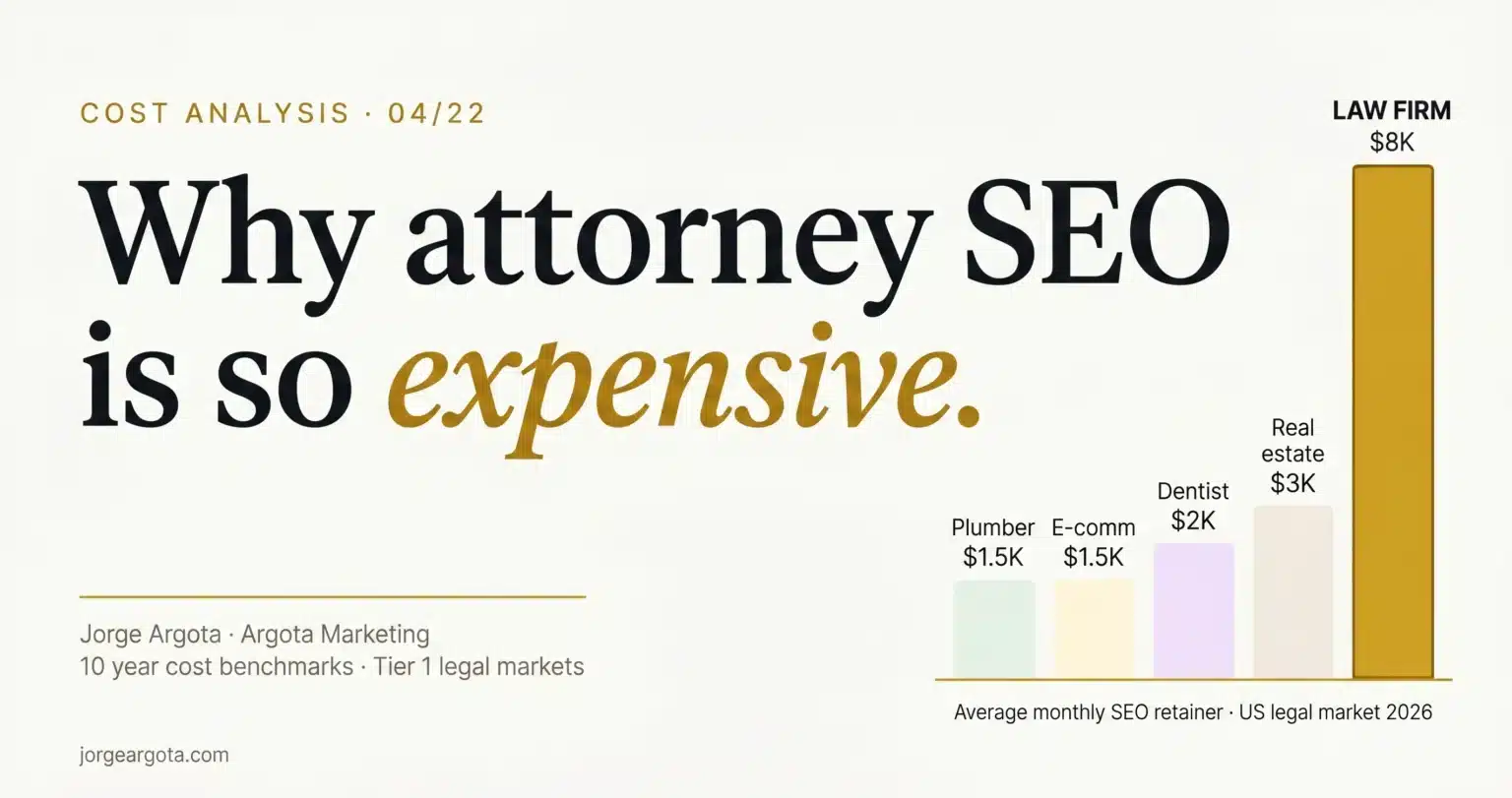
If you pitched SEO for a dental practice, an e-commerce store, and a law firm side by side, the scope of work would look similar on paper. The pricing would not. A dentist might pay $2,000 per month. An e-commerce store $1,500. A law firm $8,000. The difference is not that legal SEO requires more work per hour. It is that all three forces below compound, and they do not compound in any other industry at the same magnitude.
Force 1 · YMYL
Google holds legal content to the strictest quality bar
Google’s YMYL framework (Your Money or Your Life) applies extra scrutiny to content that can affect a reader’s finances, health, safety, or legal rights. Law firms hit all four. That means every piece of legal content Google surfaces has to clear a higher bar for demonstrated expertise, attorney attribution, and citation of authority.
Practically, this doubles or triples content production costs. A generic blog post about “how to choose a plumber” costs $75 to write. An attorney-reviewed page on “what to do after a Florida car accident” costs $400 to $800 because it requires a writer who understands Florida Statutes Section 324.022, a reviewer with an active bar license, and editorial process that satisfies Google’s Search Quality Evaluator Guidelines.
Force 2 · CPC inflation
Paid search makes organic the only sustainable option
When a single click on “car accident lawyer” costs $180 in Manhattan, paid search stops being a viable primary channel for anyone without a seven-figure annual budget. That forces every firm that wants a stable pipeline into organic. Which means organic gets crowded. Which means winning organic gets more expensive.
Plumbers do not face this. An “emergency plumber” click costs $15 to $25, so paid is manageable and organic is less saturated. Legal is the opposite. The more expensive paid gets, the harder organic gets, and the two costs rise together in a feedback loop.
Force 3 · Case value ceiling
Law has the highest unit economics of any local service
A real estate agent nets $5,000 per closed sale. A dentist nets $200 per patient visit. A personal injury attorney can earn $300,000 on a single signed case. That third number is the reason legal SEO retainers of $10,000 to $25,000 per month look rational on a spreadsheet. The unit economics support it; the unit economics of a dentist do not.
Here is the math. If $120,000 of annual SEO produces 12 signed cases at $300,000 average value, the annual return is $3.6 million. That is 30x return on ad spend. No other local service vertical gets within a factor of ten of that number. Which is why PI firms compete by spending more, not less.
The Drivers
The 7 line items inside your retainer
The three forces explain why the price range is what it is. These seven line items explain where the money actually goes each month.
1
Attorney-reviewed content
Legal content that is not reviewed by someone with a bar license fails Google’s YMYL quality bar. Attorney writers or JD-credentialed reviewers cost 3-5x generic content labor. A single competitive practice-area page takes 8-20 combined hours of writer, editor, and attorney review.
Largest line
2
Technical SEO and Core Web Vitals
Legal sites need LCP under 2.5s, CLS under 0.1, and mobile-first rendering because 89% of legal searches happen on mobile. Schema markup (LegalService, Attorney, FAQPage, LocalBusiness) requires ongoing maintenance as Google’s spec evolves.
Recurring
3
Link acquisition at legal standards
Legal directories increasingly require paid placement. High-quality backlinks from legal publications, bar associations, and news outlets cost $500 to $2,000 per earned placement. Black-hat link tactics carry disproportionate penalty risk for YMYL sites.
Per placement
4
Competitive intelligence tooling
Premium tool stack (Ahrefs, Semrush, SurferSEO, CallRail) costs $400 to $1,500 per month at the agency level. Legal competitors need weekly monitoring because competitive SERP positions shift quickly in high-CPC verticals.
Overhead
5
Local SEO and Google Business Profile
GBP optimization, review management, citation cleanup, local landing pages per practice area per city, and map pack ranking work. For multi-location firms this scales linearly; each additional market adds 75-80% of the base cost.
Per location
6
AI Overview and GEO optimization
A new and growing line item. Structured content, FAQ schema, attorney attribution, and direct-answer formatting to earn AI Overview citations. Most agencies charge this as an upsell; it should be base service by late 2026.
Growing cost
7
Algorithm adaptation and strategy
Google shipped 3 core updates in 2025. Each requires content audits, technical re-optimization, and strategy pivots. Unlike a website build (one-time cost), SEO is a continuously-operated system. Monthly fees reflect ongoing professional management, not monthly re-building.
Ongoing
The Bands
What each investment level actually buys
The same five tiers show up across every legitimate legal SEO agency. The deliverables inside each tier are what matter; the number on the invoice is just the billing mechanism.
Budget / mo
What’s included
Best for
Timeline
Local SEO basics, GBP optimization, citation building, basic content. Often single-author content without legal review.
Solos in small markets, niche practice areas with low competition
4-8 mo
Technical audit + fixes, content roadmap, 4-6 attorney-reviewed pieces monthly, link building foundation, conversion tracking.
Small firms in Tier 2 markets (Houston, Tampa, Phoenix, Atlanta)
6-12 mo
Full content strategy, aggressive link acquisition, AI Overview optimization, CRO, premium tool stack, weekly reporting.
Mid-size firms in competitive markets, growth-mode PI
9-14 mo
Enterprise content clusters, daily optimization, premium link placement, AI citation strategy, multi-location support, dedicated strategist.
PI firms in Tier 1 cities (NYC, LA, Chicago, Miami)
12-18 mo
Market dominance campaigns, national multi-market visibility, 24/7 technical management, multi-channel integration, in-house-level integration.
AmLaw 200, national PI brands, mass tort campaigns
18-36 mo
The timeline number is the honest one. Any agency that sells you the $2.5K tier and promises Tier 1 results in 6 months is selling a fantasy. Budget and timeline correlate directly because both reflect competitive density.
Evaluation Framework
How to tell if you’re being overcharged or underserved
The price on a proposal is the easiest thing to compare. It is also the least useful. What matters is whether the agency is running a program that actually accumulates value over time. Here are the signals that tell you which.
×
Guaranteed #1 rankings in 30-60 days. Mathematically impossible in competitive legal.
×
Pricing below $1,500/mo with “full service” claims in Tier 1 or Tier 2 markets.
×
No attorney review in the content process.
×
AI-generated content without human legal review.
×
No transparency on link sources. “We build quality backlinks” is not an answer.
×
Reporting focused on traffic and rankings, not leads or consultations.
×
12-24 month minimums with no performance clauses or exit options.
Green flags
Worth considering
Named legal SEO specialists with verifiable case studies.
Attorney byline policy and documented editorial review.
Case studies tied to intake, not just traffic or rankings.
FAQPage schema and structured content in deliverables.
Monthly reporting tied to consultations and signed cases.
Clear link-building methodology with domain quality standards.
Month-to-month or quarterly contracts with asset ownership.
The New Layer
What AI Overviews added to the bill
Google AI Overviews are the biggest change to legal SEO cost structure since mobile-first indexing. The short version: AIOs show up on 15-25% of queries and reduce CTR by 20-61% on informational legal searches. That is not a reason to spend less on SEO. It is a reason to spend more, differently.
Being cited inside an AI Overview is now its own form of visibility. When Google’s AI recommends your firm in response to “what to do after a car accident in Florida,” you earn trust authority no paid ad can replicate. Earning those citations requires structured content, FAQPage schema, named attorney attribution, and direct-answer formatting at the top of every page. Most agencies are charging this work as an upsell in 2026. By 2027 it will be base service, and the ones still charging extra will have been priced out.
The Math
Why retainers look rational on a spreadsheet
The simplest way to justify a legal SEO retainer is to plug your own case value into the economic model. Three practice areas worked out below.
Practice area
Avg case value
SEO / year
Cases needed to break even
Personal injury
$300,000
$120K
1 case. Every additional signed PI case is pure return.
Criminal defense
$8,000
$60K
8 cases. Competitive markets produce 15-30 signed cases per year at this spend.
Estate planning
$3,000
$30K
10 cases. Lower fee but lower spend keeps the ratio rational.
The math checks out only when you measure in signed cases, not clicks or rankings. A $120K annual SEO spend that produces 12 PI cases at $300K average is a 30x return. Nobody in e-commerce can spreadsheet those numbers. Which is why legal SEO pricing looks aggressive until you see what it actually returns.
The Fine Print
Frequently asked questions
Why is attorney SEO so much more expensive than other industries?
+
Attorney SEO costs more than any other vertical because three forces stack: legal keywords carry the highest cost-per-click rates of any industry ($150 to $500+ per click for PI), Google’s YMYL framework requires attorney-reviewed content with the strictest quality standards, and a single new client case can be worth $50,000 to $500,000+ in attorney fees. When one organic ranking can generate that much annual case value, competing firms invest proportionally, raising the competitive floor far above e-commerce, real estate, or healthcare SEO.
Is $5,000 per month for law firm SEO expensive or normal?
+
$5,000 per month is in the mid-range for competitive legal markets and typically covers a full-service program: technical SEO, 4 to 6 attorney-reviewed content pieces, link building, and monthly reporting. Solo practitioners in smaller markets can achieve results at $2,500 to $3,500 per month, while personal injury firms in NYC, LA, or Miami often require $10,000 to $20,000+ per month to compete effectively.
How long does it take to see ROI from law firm SEO?
+
Most law firms see meaningful organic traffic improvement within 4 to 8 months and positive ROI within 9 to 14 months. Personal injury firms typically break even in 12 to 18 months in Tier 1 metros, while lower-competition practice areas like estate planning can see returns within 8 to 10 months. Timeline extends in highly competitive markets where established competitors have 3 to 5 years of SEO history to overtake.
Why does personal injury SEO cost more than other practice areas?
+
Personal injury SEO is the most expensive legal niche because case values are the highest (single cases routinely worth $100,000 to $5,000,000), competition is most intense (hundreds of PI firms in every major metro), and PI keyword CPCs reach $500+ per click. Every organic top-3 ranking is worth hundreds of thousands in avoided annual ad spend, which justifies monthly SEO retainers of $10,000 to $25,000 in Tier 1 markets.
Can I do law firm SEO myself to save money?
+
Self-managed SEO is possible but rarely practical for attorneys. Competitive legal markets require 15 to 25 hours per week of research, content production, technical optimization, and link building. That conflicts directly with billable hours at $300 to $800 per hour. The opportunity cost of diverting attorney time from billable work typically exceeds agency fees within 30 to 60 days, not to mention the technical overhead (schema markup, Core Web Vitals, algorithm monitoring) that most attorneys have not built expertise in.
What is the difference between cheap and expensive law firm SEO?
+
Cheap law firm SEO ($500 to $1,500 per month) typically delivers generic content, limited link building, no attorney review process, and no AI Overview optimization, producing minimal results in competitive markets. Expensive law firm SEO ($5,000 to $15,000+ per month) delivers attorney-reviewed content clusters, premium link acquisition, GEO and AIO citation strategy, and ongoing technical optimization. Price alone does not guarantee quality, but below-market pricing is a reliable indicator of below-market execution.
How do I know if my attorney SEO agency is doing a good job?
+
Measure agency performance through qualified leads and case inquiries from organic search, not just rankings or traffic. A performing program should show month-over-month growth in organic impressions, increasing first-page rankings, improving Google Business Profile visibility, and a measurable increase in consultation requests from organic channels. Any agency that cannot tie reporting metrics back to intake is producing activity, not outcomes.
Does Google’s AI Overview affect whether SEO is worth it for law firms?
+
AI Overviews have reduced click-through rates on informational legal queries but have created a new form of visibility: AI citation. Firms cited in AI Overviews for queries like “what to do after a car accident” earn trust authority no paid ad can replicate. The correct response is not to reduce SEO investment but to add AIO optimization (structured content, FAQ schema, attorney attribution, direct-answer formatting) to earn citations while maintaining traditional rankings.
Nothing in this article is a promise of results. SEO timelines, costs, and performance vary by market, competitive density, existing domain authority, and intake operations. Always confirm advertising practices comply with your state bar’s ethics rules for attorney advertising.
Free Proposal Review · No Obligation
Have an SEO proposal in hand? Send it to me.
I will run it against the red flags / green flags framework above, audit the pricing against what your market actually demands, and tell you whether the agency is selling you a program or just activity. If the answer is that you are being overcharged, I will tell you. If the answer is that you are underpaying for your market, I will tell you that too.
Best fit if you have a written proposal from an agency or are evaluating 2+ competing bids for legal SEO.