Home / Blog / Law Firm Marketing Budget 2026
Last updated April 22, 2026
Marketing Strategy · Budget Planning
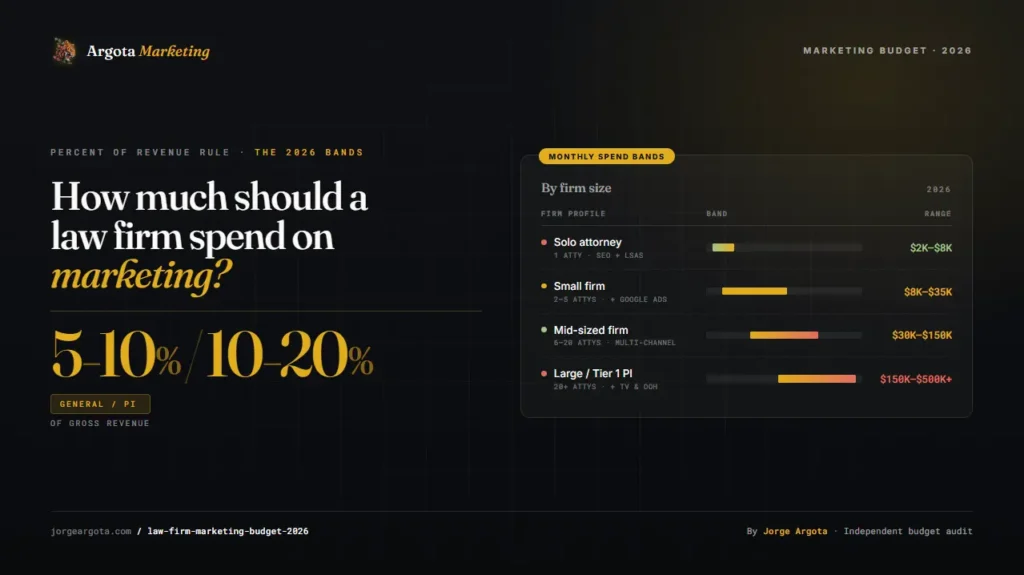
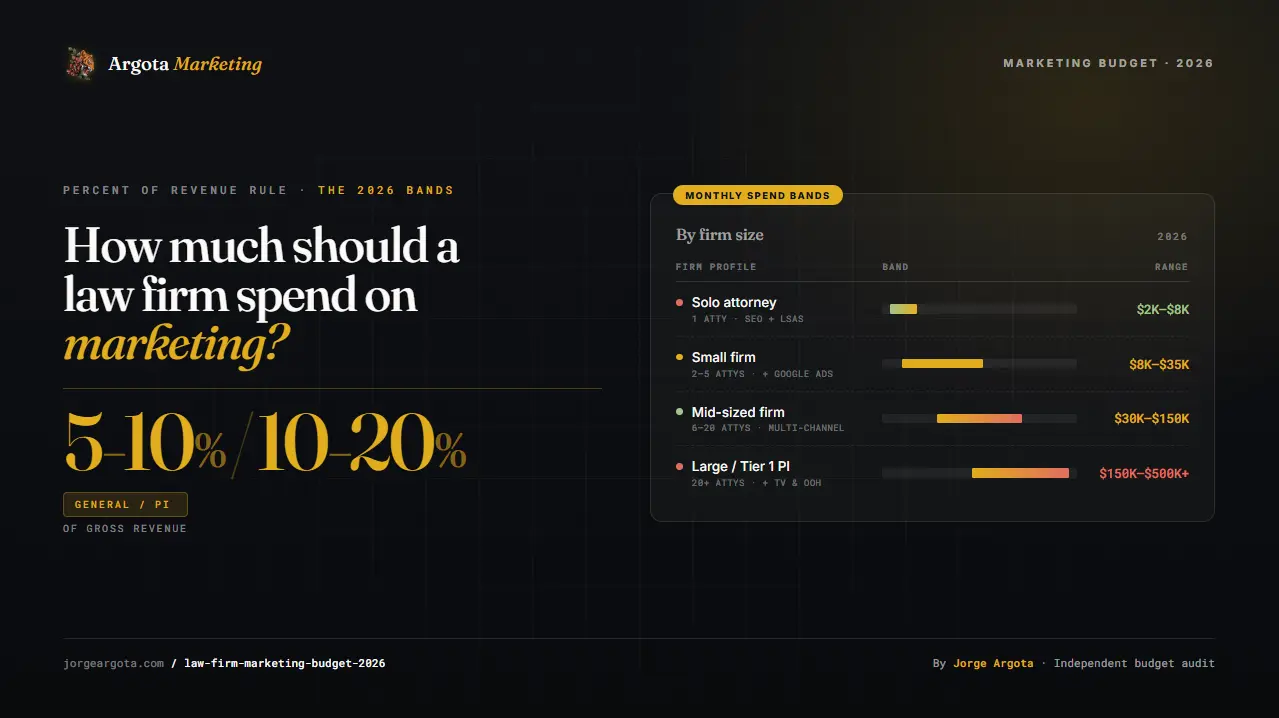
The percentage of revenue rule is 5 to 10% for general firms, 10 to 20% for personal injury. Here is what that actually looks like by firm size, what your stack should cost, and when a package fails.
All ranges use 2025-2026 legal marketing benchmarks plus audit data across PI, family, criminal defense, and estate planning firms managed at Argota Marketing, along with published legal advertising spend reports, law firm marketing statistics, and current software pricing pages.
Marketing Budget Bands · 2026
Monthly spend by firm size and market
Firm Type
Solo attorney
1 attorney, 0-2 support
5-10% revenue
SEO + LSAs
Firm Type
Small firm
2-5 attorneys
8-15% revenue
+ Google Ads
Firm Type
Mid-sized firm
6-20 attorneys
10-18% revenue
Multi-channel
Firm Type
Large firm or Tier 1 PI
20+ attorneys or Tier 1 PI
15-25% revenue
+ TV & OOH
The band on the far left is maintenance-only (below the growth line). Anything right of the midpoint assumes you are competing against firms that spend at least this much. If you spend below the band and the market spends above it, you lose share quietly.
WRITTEN BY
Budget auditor for PI, criminal, family, and estate planning firms across the US.
The Short Answer
General law firms spend 5 to 10% of gross revenue on marketing. Personal injury firms spend 10 to 20%, pushing 20 to 25% in Tier 1 metros. In dollars, solos run $2K to $8K per month. Small firms $8K to $35K. Mid-sized $30K to $150K. Large or Tier 1 PI, $150K to $500K+. If you are under these bands and your market is at them, you are losing share. Software and tooling will eat 5 to 12% of your marketing budget on top of all this.
Treat the percent-of-revenue bands as the starting point. The real governor is cost per signed case: your budget is only correct if it keeps CAC inside the 8 to 15% of average fee range for your practice area.
TL;DR budget setup
1.
Anchor on percent of revenue. 5-10% for general law, 10-20% for PI, 15-25% for aggressive growth.
2.
Cross-check with CAC math. Your percent should hit target cost per signed case, or the percent is wrong.
3.
Add software separately. Plan $250 to $1,200/mo for small firm stack. Do not hide it inside media spend.
4.
Pick package vs custom by growth mode. Packages for maintenance. Custom for aggressive growth or Tier 1 PI.
On This Page
Nine sections. Percent of revenue first. Software stack and custom vs package at the end.
The Rule
The percent of revenue rule, and its limits
The simplest way to budget is percent of gross revenue. For professional services, the standard bands are clean: maintenance (holding share), growth (gaining share), and aggressive (taking share by force). Across small businesses and B2C services generally, most firms invest 7 to 10% of revenue in marketing, with highly competitive local service categories like home services, healthcare, and financial services often landing closer to 10 to 15%. The 10 to 20% PI bands are aggressive but not an outlier for high-value, high-competition work.
Mode
General law
Personal injury
What it gets you
Maintenance
Holding existing share
2-5%
5-8%
Flat or slow growth. Most small firms live here and wonder why they are not growing.
Growth
Gaining share vs peers
5-10%
10-20%
Measurable year-over-year revenue growth. Brand awareness compounds. Referrals grow.
Aggressive
New market, rapid scale
10-15%
20-25%
Taking share from incumbents. Requires intake infrastructure to match. Unsustainable past 18-24 months.
The mode is not the number. The mode is the question: are you trying to hold, grow, or take share? Most firm owners skip that question and just pick a dollar amount that feels reasonable. That is how you end up at 3% of revenue and wonder why the competitor down the street is outgrowing you. They are at 12%.
“The firm I audited last month spent 2.8% of revenue on marketing and wondered why they were flat. Their top competitor was at 14%. That is the entire story of the market.”
Percent of revenue gets you close. It is not the final answer. The second check is cost per signed case, which we get to in the formula section below. If your percent-of-revenue budget does not produce CAC in line with your target, the percent is wrong. Both numbers have to agree.
Market Tiers
How your city multiplies your budget
The national legal advertising data reliably identifies the same cluster of Tier 1 metros: Orlando, Los Angeles, Atlanta, Miami, Tampa, Dallas, Phoenix, Las Vegas, Houston, and New York. If you are in one of these, your percent of revenue needs to sit at the upper end of the band. If you are in a Tier 3 market, you can compete at the lower end.
Tier
Example markets
Recommended %
Small firm / month
NYC, LA, Miami, Chicago, Houston, Dallas, Atlanta, Phoenix, Orlando, Las Vegas
15-25%
$25K-$100K+
Tampa, San Antonio, Denver, Seattle, Minneapolis, San Diego, Portland, Detroit
10-18%
$10K-$40K
Nashville, Austin, Charlotte, Kansas City, Raleigh, suburban and mid-sized cities
5-12%
$4K-$15K
The small-firm-per-month column assumes a 2 to 5 attorney firm. Scale up or down based on your headcount and revenue. A solo in Tier 1 Miami can still compete with disciplined spend, but it will be at the top of their personal band, not the middle.
Practice Area
Why PI spends more than every other practice
Personal injury firms consistently spend more as a percentage of revenue than every other practice area. This is not an accident of competition. It is a function of case economics. A single signed PI case often produces $25,000 or more in attorney fees, sometimes $100,000+ for serious injury or trucking cases. Firms can afford higher customer acquisition costs because the unit economics support it.
Practice area
Budget %
Avg case fee
Target CPSC
Personal injury
10-20%
$25K+
$2K-$5K
Mass tort
15-25%
$50K+
$3K-$8K
Criminal defense
6-10%
$5K-$15K
$400-$900
Family / divorce
5-9%
$4K-$8K
$300-$700
Immigration
4-8%
$2K-$6K
$200-$500
Estate planning
3-7%
$1.5K-$4K
$150-$400
Read across any row and the math is consistent: target CPSC should land at 8 to 15% of average case fee. That is the rail both for your percent of revenue and your channel-level math. If your practice area is not in the table, apply the same ratio to your own case fee.
Channel Mix
How to allocate across channels
Once you have a dollar number, you split it across channels. The allocation differs between PI and non-PI firms because the funnel velocity is different. PI demands immediate response; estate planning can afford a slower SEO-led approach.
Channel
PI allocation
Non-PI
What it does
Google Ads (Search + LSAs)
30-45%
15-30%
Captures live intent. Fastest revenue but highest cost.
SEO and content
25-35%
35-45%
Compounds over 12-24 months. Stabilizes cost per case.
Local (GBP, reviews, directories)
10-15%
15-25%
Map pack, reviews, citations. Non-negotiable for local firms.
Meta / social / video
5-15%
5-10%
Awareness and retargeting at lower CPMs.
Traditional (TV, OOH, print)
0-25%
0-5%
Only makes sense at $50K+/mo budgets. Brand-building layer.
The most common allocation mistake: treating SEO as a “set it and forget it” line item at 10% of budget. SEO is where durable cost advantages come from. Under-investing there and over-investing in PPC leaves you renting cases forever instead of building a compounding traffic asset.
Go deeper on PPC
For the full CPC to CPL to cost-per-signed-case math by city and practice area, plus three worked examples and a viability scorecard: Google Ads cost for lawyers ›
The Stack
Software stack cost (the hidden line item)
Most budget guides leave software off the ledger. That is a mistake, because for a small firm it runs $250 to $1,200 per month and grows with headcount. Here is what a realistic 2026 stack looks like for a 3 to 5 person firm.
Category
Solo
3-5 person
10-20 person
Practice management
Clio, MyCase, PracticePanther
$50-$90
$150-$350
$500-$1,800
Legal CRM / intake
Lawmatics, Clio Grow, HubSpot
$40-$100
$120-$400
$400-$1,500
Billing and accounting
TimeSolv, LawPay, QuickBooks
$40-$80
$100-$300
$300-$1,000
Call tracking / answering
CallRail, Alert, Smith.ai
$45-$200
$200-$800
$600-$2,500
Analytics and reporting
GA4, Looker Studio, SEMrush
$0-$150
$100-$300
$250-$800
Total monthly stack
$175-$620
$670-$2,150
$2,050-$7,600
Stack cost scales faster than linearly with headcount because most tools bill per user and mid-tier plans add features you need as you grow. Budget software as 5 to 12% of your total marketing budget. If your stack is at 20%+, you either have too many overlapping tools or are paying for enterprise tiers you do not need.
Pricing Models
Custom strategy vs standard packages
Most agencies sell one of two models. Standard packages with fixed deliverables and predictable pricing, or custom strategies scoped against outcomes. Neither is universally better. Here is when each fits.
Standard package
Fixed deliverables
$2,500-$8,000 / mo
›
Fixed number of blog posts, fixed on-page SEO tasks
›
Same deliverables regardless of market or practice area
›
Predictable invoice, scoped against activity not outcomes
!
Some vendors retain asset ownership (website, content)
Fits: solo or small non-PI firm, Tier 3 market, maintenance mode.
Custom strategy
Outcomes-scoped
$7,500-$25,000+ / mo
›
Channel mix tailored to your case value and market
›
Integrates intake data, case value, profit margin
›
Scoped against cost per signed case targets
›
You own all assets: domains, content, creative, data
Fits: PI firms in Tier 1 metros, aggressive growth mode, high case-value practices.
The hidden cost that kills packages
Asset ownership. Some standard packages build your website on their infrastructure and retain ownership. You cancel, you lose the site. Always verify: can I export my full site, content, and CRM data in a standard format with zero hassle? If the answer is “maybe” or “with a fee,” walk.
Contract length. 12 to 24 month minimums are common in packages. If performance is poor month four, you still pay eight more months. Month-to-month or quarterly contracts have real value even at higher monthly rates.
Serious firms use both formulas and reconcile them. If the answers agree, the budget is right. If they disagree, one of your inputs is wrong.
Formula 1 · Top-down
Percent of revenue
Annual revenue × target %
÷ 12 = monthly budget
Example: $3M PI firm targeting 15% growth mode.
$3M × 15% = $450K annual
÷ 12 = $37,500/mo
Formula 2 · Bottom-up
Cost per signed case
Target cases/mo × CPSC target
= monthly budget
Example: Target 10 signed PI cases/mo at $3.5K CPSC.
10 × $3,500 = $35,000/mo
Both examples landed near $37K vs $35K. That is a healthy reconciliation. If the top-down number was $37K and the bottom-up was $120K, something is off. Either your target case volume is unrealistic for your budget, or your target CPSC is too low for your practice area and market. Fix inputs, not the formulas.
When they disagree
Top-down > Bottom-up: you may be over-allocating. Reduce to what the CAC math requires and reinvest the difference in intake or SEO. Bottom-up > Top-down: your target case volume is too ambitious for your revenue base. Lower the target or increase the budget.
The Fine Print
Frequently asked questions
How much should a law firm spend on marketing in 2026?
+
Most general law firms that are actively marketing spend 5 to 10% of gross revenue for growth and 2 to 5% for maintenance. Personal injury firms in competitive metros run higher, typically 10 to 20%, with new market entrants pushing 20 to 25% during aggressive expansion. In dollar terms, solos spend $2,000 to $8,000 per month, small firms of 2 to 5 attorneys spend $8,000 to $35,000 per month, and mid-sized firms of 6 to 20 attorneys often run $30,000 to $150,000 per month. These are typical ranges, not guarantees; your actual number depends on market, practice mix, case value, and intake performance.
How much should a PI law firm spend on marketing?
+
Personal injury firms invest 10 to 20% of gross revenue as a baseline, pushing to 20 to 25% in aggressive growth phases or when entering saturated Tier 1 markets like NYC, LA, Chicago, Miami, or Houston. PI requires higher percentages than other practice areas because case values justify it: a single signed PI case often produces $25,000 or more in attorney fees, so firms can afford higher customer acquisition costs. Typical monthly spend for a 3-person PI firm in a Tier 1 metro is $25,000 to $100,000+.
How much do law firms actually spend on marketing?
+
Industry data shows most small to mid-sized law firms cluster at the low end, 2 to 5% of revenue, which correlates with flat growth. Firms actively growing and competing spend 8 to 15%. The largest national PI brands spend hundreds of millions annually across TV, billboard, and digital combined. Legal advertising reports identify Orlando, Los Angeles, Atlanta, Miami, Tampa, Dallas, Phoenix, Las Vegas, Houston, and New York as the highest-spend markets.
How much should a law firm spend on PPC?
+
PPC is typically 30 to 45% of total digital marketing budget for PI firms, and 15 to 30% for non-PI practices. In dollars, PI firms in Tier 1 metros often need $15,000 to $50,000 per month minimum to generate enough conversion data for Google’s bidding to optimize. Minimum viable budgets by practice area vary: $15K for PI in NYC, $8K for PI in Houston, $3K for family law in a Tier 2 market, $1.5K for estate planning in a smaller market.
What is the average cost of marketing software for small law firms in 2025 to 2026?
+
For a 3 to 5 person small firm, a realistic software stack costs $250 to $1,200 per month before any media spend or agency fees. Practice management runs $30 to $70 per user per month. Legal CRM and intake tools run $15 to $120 per user per month depending on feature tier. Billing software is $30 to $100 per user per month. Marketing automation and analytics platforms add another $100 to $500 per month at the stack level. Lead-gen directories like Martindale or Avvo start at $500 per month.
What are legal marketing costs in 2026?
+
Legal marketing costs break into four buckets. Media spend (Google Ads, LSAs, Meta, TV) is the largest and most variable, typically 40 to 60% of budget. Agency or in-house labor is 20 to 35%. Software and tools are 5 to 12%. Content production, video, creative, and web development average 10 to 20%. For a firm spending $20,000 per month, this maps to roughly $10K media, $5K agency fees, $1.5K software, and $3.5K content and creative.
Custom legal marketing strategy pricing vs standard packages?
+
Standard packages for law firms range from $2,500 per month for solopreneur bundles to $5,000 for mid-tier content plus SEO packages and $10,000 to $20,000 for full premium bundles with PPC. Custom strategies typically start at $7,500 per month and scale based on scope. Packages are appropriate for solo and small non-PI firms in less competitive markets. Custom strategies are typically required for PI firms in Tier 1 metros or any firm with aggressive growth targets, because packages are scoped by deliverables, not outcomes, and some package vendors retain ownership of the website and content, which makes it harder to switch when growth stalls.
Nothing in this article is a promise of results. Budgets and performance vary by market, creative, landing page quality, and intake operations. Always confirm advertising practices comply with your state bar’s ethics rules for attorney advertising.
Free Budget Audit · No Obligation
Is your marketing budget in the right band?
Send me your annual revenue, practice area, and current monthly marketing spend. I’ll tell you which band you’re actually in, whether your channel allocation matches your practice area, whether your software stack is bloated, and if your current package or agency is the right fit for your growth mode.
Best fit if you are currently spending at least $5,000/mo on marketing, or planning to. Below that, the audit conclusions are limited.