

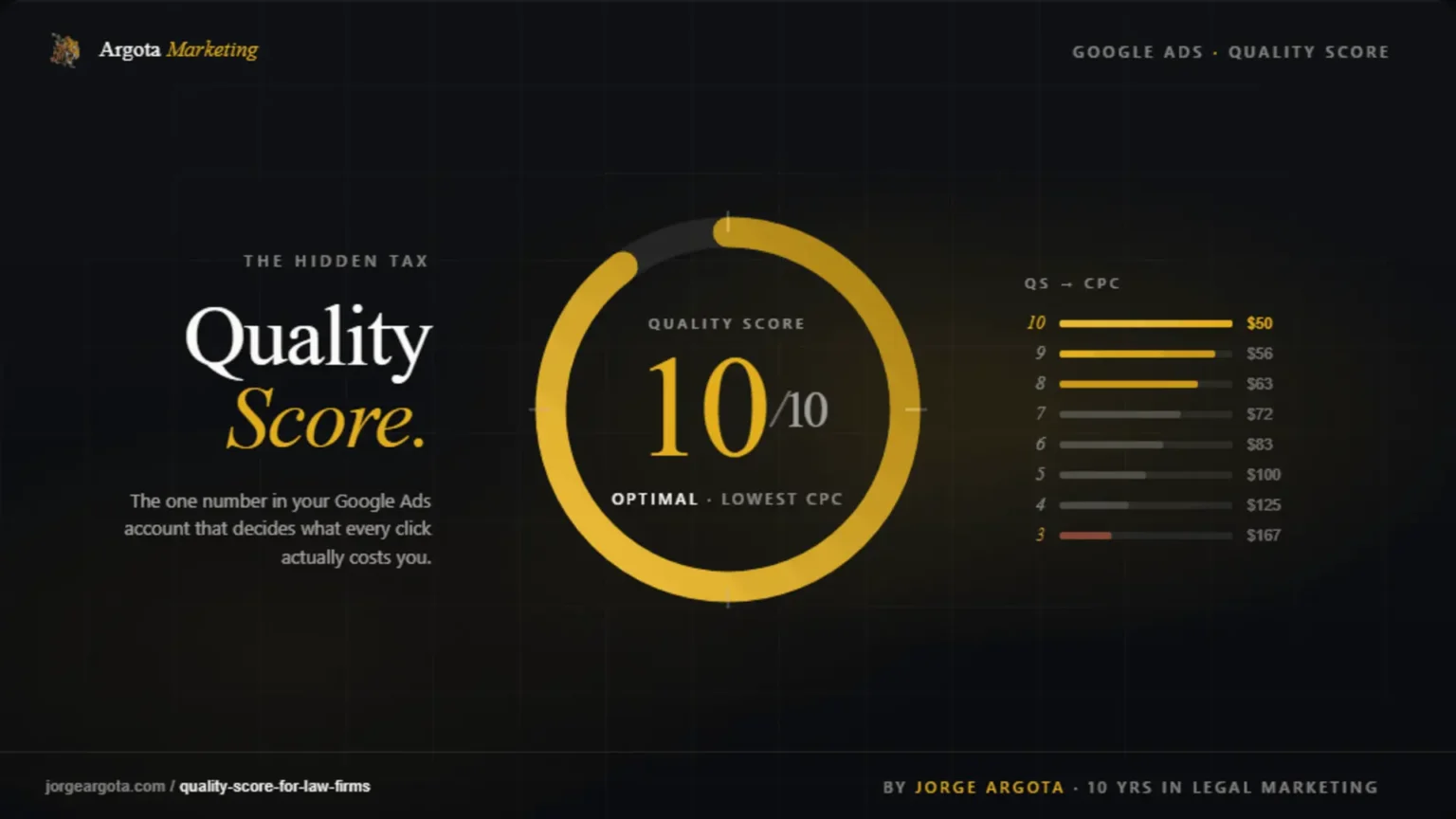




Same keyword. Same city. Same auction. One law firm pays $50 a click. Another pays $167. The difference isn’t budget, agency, or luck. It’s a number most firm owners have never looked at.
what most firms pay
what optimized pays

Google grades every keyword you bid on from 1 to 10 based on whether people click your ad, whether your ad matches the search, and what happens after the click. Score high and you pay a third of what your competitors pay. Score low and you subsidize their traffic. Most law firms score 4-6 because they run generic ads pointing to their homepage. Four structural fixes move almost every account to 8 or above without changing the budget by a dollar.
What Quality Score actually is
Google runs an auction every time someone searches for a lawyer. You’d think the firm bidding the most wins the top spot. That’s not how it works. Google multiplies your bid by your Quality Score and whoever has the highest product of the two wins. A firm bidding $50 with a Quality Score of 10 beats a firm bidding $140 with a Quality Score of 3. The firm with the better score pays less and ranks higher.
“When agencies do the math for you, they want to show bigger budgets producing more leads. They don’t want to explain that a restructured account at the same budget would produce three times the leads. Because then you’d ask why they haven’t done it.”
What Google actually grades you on
Quality Score isn’t a black box. Google grades three things, and the weights haven’t changed in a decade.
Does anyone actually click your ad?
Google watches your ad next to every other ad in the same spot for the same search. Click yours less often than the competition, your score drops. Click yours more often, it rises.
This is where most law firms bleed. Pull up any legal search and you’ll see ten ads saying almost the same thing. When every ad looks identical, none stand out, and Google has no reason to favor yours.
Does your ad match what they searched for?
Someone searches “Tampa DUI lawyer” and your ad says “Experienced Legal Representation.” Google reads that as a mismatch. The searcher asked a specific question. Your ad gave a generic answer.
Most law firm accounts fail this for one reason: one campaign trying to serve every practice area at once. Personal injury can’t also speak convincingly to child custody.
What happens after they click?
Google watches what happens when someone lands on your site. Does it load fast on their phone? Does it match what the ad promised? Or do they hit back within a few seconds?
This is the biggest problem in almost every law firm account I audit. Paid traffic gets dumped onto the firm’s homepage. A page designed to introduce the firm, not to convert a specific search. Your homepage introduces the firm. A landing page converts a search.
What each score costs you in real dollars
This is the 1 to 10 scale translated into real cost on a $100 benchmark CPC. Typical for personal injury in mid-tier legal markets. Industry-average law firms cluster in the shaded rows.
Impact by market what the math looks like
The financial impact scales with how competitive your market is. Three scenarios:
New York City
Highest in the country. Market-average QS sits at 3-5 because the big firms run generic copy.
500 clicks/month = $33K back per month.
Houston
Quarter of NYC, but lower CPCs make the proportional QS impact even bigger.
Tampa & Miami
A Florida-specific QS opportunity that almost no firm is actually running.
Four fixes that work in almost every account
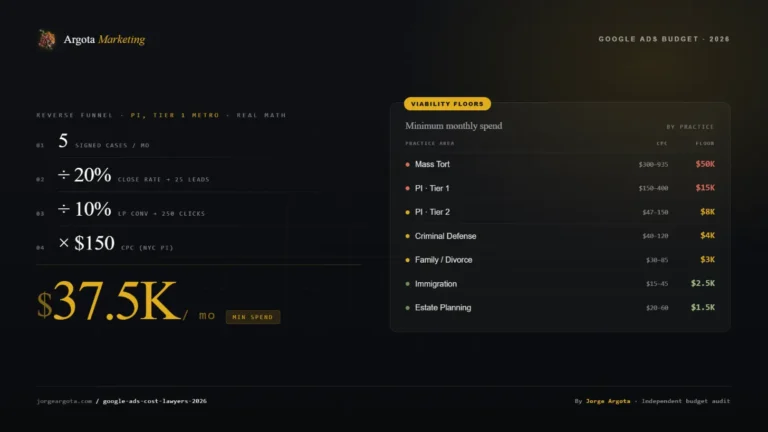
Most law firm Google Ads accounts fail for structural reasons, not budget reasons. You don’t need to spend more. You need to fix the four things below. In this order.
Stop sending paid traffic to your homepage
Build one dedicated landing page for each type of case you’re bidding on. The page headline should match the ad headline word-for-word. No navigation menu. No links to other practice areas. No attorney bios from other departments.
One problem. One promise. One way to contact you.
Break up your one giant campaign
Personal injury, criminal defense, and family law each deserve their own campaign. Inside those, DUI deserves its own ads separate from drug charges. Car accidents separate from slip and falls.
Tight structure means every ad can finally match the search that triggered it.
Name the client’s actual problem
“Injured in a Tampa car accident? No fee unless we win” beats “Experienced personal injury attorney” every single time, in every market.
People click ads that sound like they understand the situation. Generic credentials don’t do that.
Tell Google which leads turn into clients
By default, Google Ads counts any form fill or phone call as a “conversion” and optimizes toward whatever produces more of them. That means it can happily spend your budget generating the wrong kind of leads.
Connect your intake system so Google learns which campaigns and keywords produce retained clients, not just inquiries.
None of these require a bigger budget. They require someone to stop, audit what’s currently running, and rebuild it the right way.
The five-minute diagnostic anyone can run
Two clicks. Zero tools. Zero cost. Here’s exactly what to do and exactly what you’ll see.
Frequently asked questions
What is Google Ads Quality Score? +
A rating from 1 to 10 Google assigns to every keyword in your account. It’s calculated from three components: expected click-through rate, how closely your ad matches the searcher’s intent, and the user experience on the landing page. Quality Score directly determines how much you pay per click and how high you rank.
What’s the real difference between QS 3 and QS 10? +
On a benchmark $100 keyword, a QS 3 pays approximately $167 per click. A QS 10 pays approximately $50. That’s a 3.3x cost gap for identical traffic. Over a year at 500 clicks a month, the difference is roughly $300K versus $900K in total ad spend.
Why is my law firm’s Quality Score so low? +
Almost always one of three structural reasons: generic ad copy that doesn’t differentiate from other law firm ads, one giant campaign trying to serve every practice area at once instead of separate campaigns per practice area, or paid traffic being routed to a general homepage instead of a dedicated landing page. Most law firm accounts suffer from all three at once.
How long does it take to improve Quality Score? +
Ad relevance and landing page fixes can register within 30 to 60 days because Google re-evaluates those components as new pages and ad copy accumulate impressions. Expected CTR takes longer. Generally 60 to 90 days. Because Google needs enough click data to re-score your performance relative to competitors in the same auction positions.
Does my agency look at Quality Score? +
Ask them. A good test: ask your agency what your account’s average Quality Score is right now and which of the three components is dragging it down. If they can’t answer, they aren’t managing it. Most legal PPC agencies focus on bid management and budget pacing because those are visible to the client; Quality Score work requires rebuilding landing pages and campaign structure, which is harder to bill for and harder to explain.
Is Quality Score the same as Ad Rank? +
No. Quality Score is a diagnostic number Google shows you (1 to 10) that reflects the health of a keyword. Ad Rank is the real-time calculation Google uses to decide which ads show and in what order for each auction. Ad Rank is roughly your bid multiplied by your quality factors, plus ad extensions and context. Quality Score is a proxy that tells you how you’re doing on the factors that feed Ad Rank.
Want to know what your firm’s actual Quality Score is?
Send me read-only access to your Google Ads account. I’ll tell you your average Quality Score, which of the three components is dragging it down, and what it would take to get above 8. If your account is already tight, I’ll tell you that too and you can move on to something else.