
Written by Jorge Argota · Legal Marketing · United States
So your potential clients aren’t typing “car accident lawyer Chicago contingency” into Google anymore. They’re saying “What should I do after a rear end car accident if the other driver doesn’t have insurance and how much will a lawyer cost me” into their phone while sitting in the ER parking lot. That’s not a keyword. That’s a full sentence spoken under stress, and if your website isn’t structured to answer it, the voice assistant reads your competitor’s answer instead and you never even knew the search happened.
TL;DR
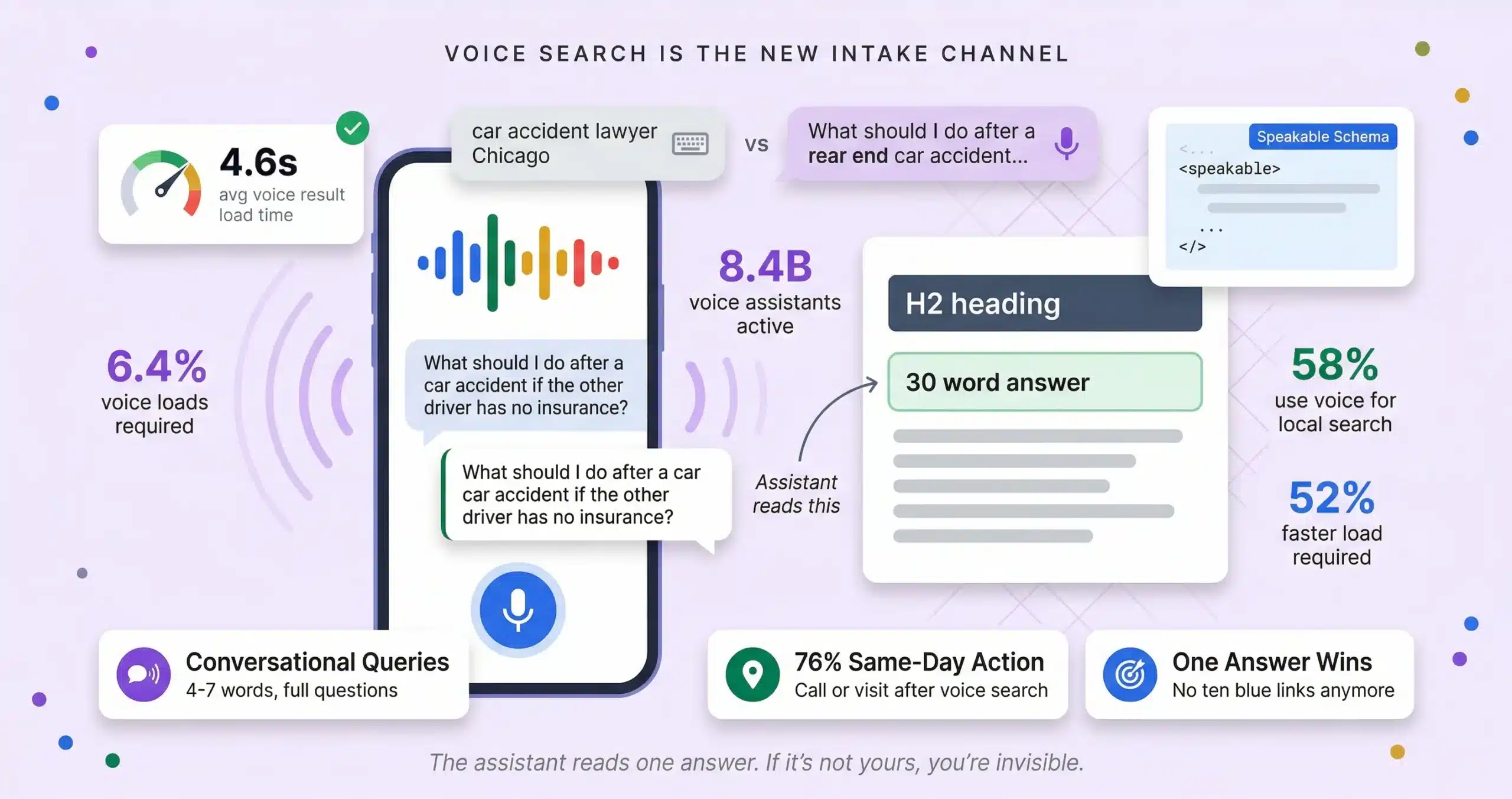
Voice search changed how people find lawyers. Typed searches average 1 to 3 words. Voice searches average 4 to 7 words and come as full questions. 58% of consumers use voice to find local businesses and 76% of those voice searches result in a same-day action like calling or visiting. Voice results load 52% faster than typical web pages, which means slow sites get skipped entirely. And the assistant reads one answer, not ten blue links. If you’re not the answer it reads, you’re invisible. This page covers what changed, why it matters for law firms, and how to structure your site so the assistant picks you.
76%
of voice local searches lead to same-day action
4-7
average words per voice query (vs 1-3 typed)
52%
faster load time required for voice results
TYPED VS VOICE SEARCH: HOW LEGAL QUERIES CHANGED FROM KEYWORDS TO FULL SENTENCES
Typed Search (2015 to 2022)
“car accident lawyer Chicago contingency”
Fragmented keywords. 3 to 4 words. No grammar. The searcher is calm enough to type shorthand.
Voice Search (2026)
“What should I do after a rear end car accident in Chicago if the other driver doesn’t have insurance and how much will a lawyer cost me upfront?”
Full sentence. 4 to 7+ words. Question format. The searcher is stressed and speaking naturally.
The shift matters because search engines no longer match keyword strings; they interpret the meaning behind the spoken sentence. When someone asks Siri “who is the best DUI lawyer near me with payment plans,” Google isn’t looking for a page that contains those exact words. It’s looking for a page that answers the question directly, loads fast enough to be read aloud, and has the structured data that tells the assistant this is a trustworthy local answer. There are 8.4 billion voice assistants active globally in 2026 and 58% of consumers use them specifically to find local businesses, which means this isn’t a future trend; it’s the current intake channel that most firms are ignoring.
PAGE SPEED, SPEAKABLE SCHEMA, AND THE 30-WORD RULE FOR VOICE SEARCH RESULTS
The 30-word answer rule
To capture the featured snippet that voice assistants read aloud, put the target question as an H2 or H3 heading and immediately follow it with a direct answer that’s 30 to 50 words long. No preamble, no “great question,” no throat-clearing. The answer comes first. Then you elaborate below it. The assistant pulls the concise answer; the human who clicks through reads the elaboration. If your answer is buried in a 300-word paragraph, the assistant skips you for the competitor who put the answer in the first two sentences.
Page speed is the gatekeeper
Voice search results load in 4.6 seconds on average, which is 52% faster than typical web pages. If your law firm site takes 6 or 7 seconds to load on mobile because of a hero video, bloated plugins, or cheap shared hosting, the voice assistant bypasses you entirely and reads from a faster competitor’s site. Sub-2-second mobile load time is the target and it’s non-negotiable for voice visibility. The SEO service page covers the full Core Web Vitals framework.
Speakable schema tells the assistant what to read
Most law firms have heard of FAQ schema and LocalBusiness schema. But Speakable schema is the one built specifically for voice. It explicitly tells voice assistants like Siri, Alexa, and Google Assistant which sections of your page are structured to be read aloud via text-to-speech. Without it, the assistant has to guess which part of your page answers the question. With it, you’re pointing directly at the answer and saying “read this.” The GEO guide and the AEO page cover the broader schema architecture; Speakable is the voice-specific layer that sits on top of it.
WHY 76% OF VOICE SEARCHES FOR LAWYERS LEAD TO SAME-DAY CALLS
Peer-reviewed research from the Journal of Consumer Research shows that when people speak a query instead of typing it, they feel a stronger sense of psychological ownership over the words they used and the information they receive back. That emotional investment makes them more likely to act on the answer immediately, which is why 76% of voice searches for local services result in a same-day phone call or visit. The person isn’t browsing five tabs; they asked one question and they’re calling the answer.
Voice also raises the privacy stakes. Research published in Management Science shows that consumers have significantly stricter privacy expectations for information they share by speaking versus typing. They feel more exposed saying “I was in a car accident and the other driver had no insurance” out loud to a device than typing it into a form. For law firms this means your voice-optimized content needs to feel trustworthy and safe before it asks for any personal details, because the psychological barrier to sharing sensitive legal information by voice is measurably higher than by text.
AI VOICE CLONES IN LEGAL ADS: FLORIDA BAR RULE 4-7.13 AND THE SYNTHETIC IMPERSONATION BAN
Florida Bar Rule 4-7.13(b)(5) prohibits the use of a voice or image that creates an erroneous impression that the person speaking is the advertising lawyer. If your firm is using AI-generated voice clones, synthetic spokespersons, or deepfake attorney videos in ads or on your website, this rule applies to you. The voice assistant landscape makes this more relevant than it’s ever been because firms are increasingly tempted to create AI voice agents that sound like the lead attorney. If the caller thinks they’re talking to the lawyer and they’re actually talking to a synthetic voice, that’s a bar violation in Florida and an increasing number of states are expected to follow. The advertising ethics page covers the broader compliance framework.
And the practical takeaway for voice search optimization is simpler than the AI ethics debate: write the way your clients talk, not the way lawyers write. If your practice area pages say “Utilize our state of the art litigation services for optimal compensation” instead of “We fight to get you the most money possible after your crash,” the voice assistant won’t read your answer because it doesn’t sound like something a real person would say to another real person. Write at an 8th grade reading level, answer the exact question in the first 30 words, and let the assistant do the rest. The Near Me revenue engine page covers the local signals (GBP, NAP consistency, reviews) that voice assistants pull from, and the intake process guide covers what happens after the person calls.
Want to know if voice assistants can find your firm?
Ask Siri or Google Assistant “best [your practice area] lawyer near me” right now and see what comes back. If it’s not your firm, send me the query and your website and I’ll tell you exactly what’s missing. If you’re already showing up, I’ll tell you that too.
Related: Near Me Revenue Engine · GEO for Law Firms · Answer Engine Optimization · AI Overviews Impact · SEO for Law Firms · Advertising Ethics