






Written by Jorge Argota · Legal Marketing · United States
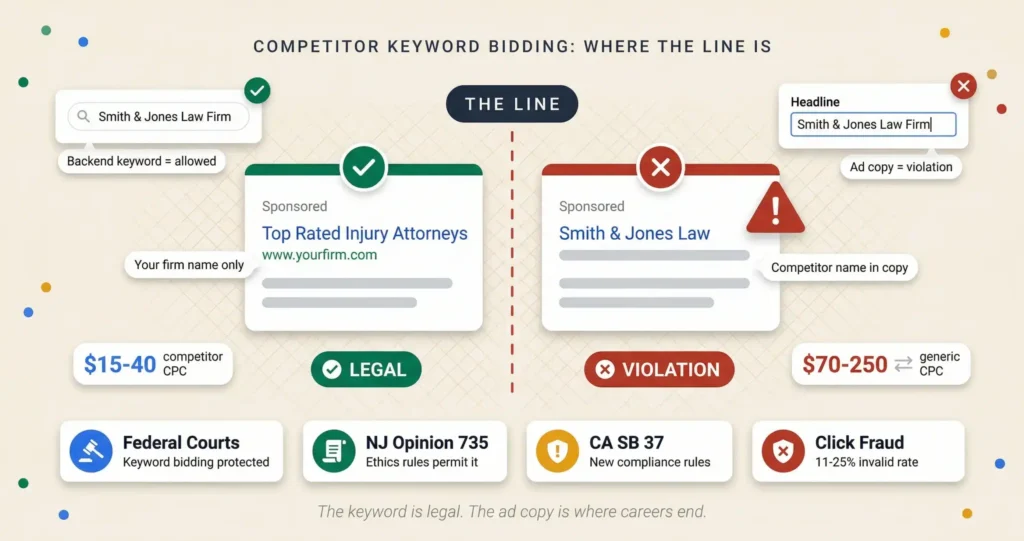
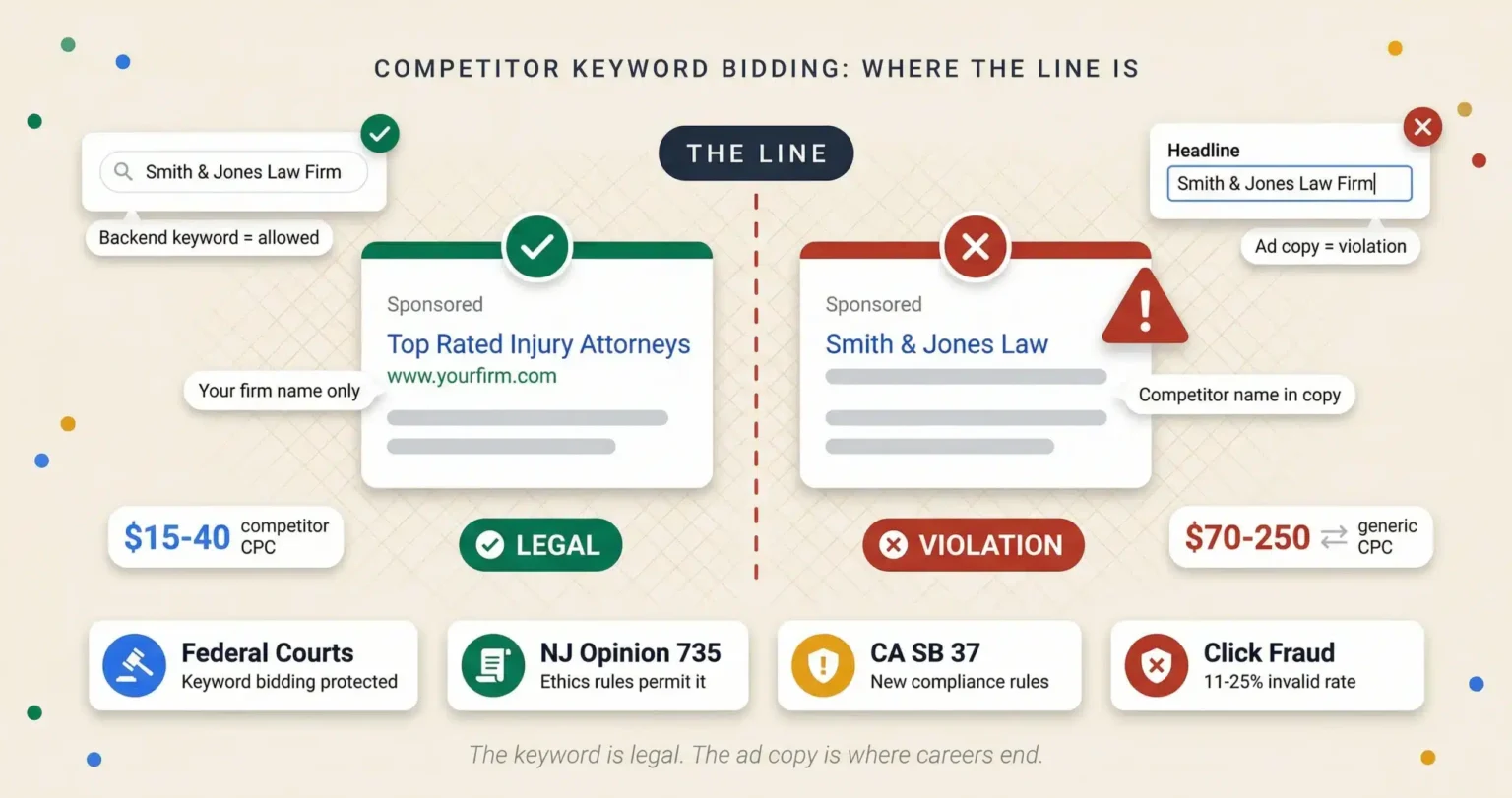
So every time I audit a law firm’s Google Ads account, the same question comes up: “Can I bid on my competitor’s name?” The practice is called competitor conquesting, which just means you pay Google to show your ad when someone searches for a rival firm by name. The answer in 2026 is yes, with conditions. Federal courts have ruled that buying a competitor’s trademark as a keyword is protected commercial competition. The NJ Supreme Court said it doesn’t violate ethics rules either. But the moment your competitor’s name shows up in your ad copy, you’re looking at a trademark violation, a Google policy suspension, and potentially a bar complaint. The line between legal and career-ending is exactly one setting in your Google Ads dashboard.
TL;DR
Bidding on a competitor’s name as a keyword is legal. Putting their name in your ad headline is not. The Second Circuit (1-800 Contacts v. Warby Parker), the Ninth Circuit (Lerner and Rowe v. Brown Engstrand), and the NJ Supreme Court (Opinion 735) all confirmed that backend keyword bidding is protected. But every court also drew the line at ad copy that creates consumer confusion, and Google’s trademark policy will suspend your account if a competitor’s name appears in your headline. This page covers what’s allowed, what gets you in trouble, and the compliance rules from California SB 37 and New York’s AI disclosure law that changed the game in 2026.
THE CPC ARBITRAGE THAT MAKES THIS WORTH THE RISK
The reason firms engage in conquesting despite the ethical scrutiny is pure economics. High intent generic keywords like “auto accident lawyer near me” cost $70 to $250 per click in competitive markets. Bidding on a competitor’s brand name typically costs $15 to $40 per click, even with the lower Quality Score penalty that Google applies to ads with poor keyword to landing page relevance. And the people clicking are further along in their decision process because they’ve already done their research and were about to hire someone specific; intercepting them at that moment with a compelling alternative is one of the highest ROI plays in legal PPC.
WHAT THE FEDERAL COURTS ACTUALLY SAID
The Lanham Act governs federal trademark law and the appellate courts have been consistent on this. Buying a competitor’s trademark as a backend keyword, by itself, does not constitute trademark infringement. The Second Circuit said it explicitly in 1-800 Contacts v. Warby Parker: keyword advertising is a standard, pervasive feature of the internet economy and the mere purchase of a search term doesn’t confuse consumers because the user can see whose ad they’re clicking on.
The Ninth Circuit went further in Lerner and Rowe v. Brown Engstrand, which is a PI-specific case that matters for this industry. Lerner and Rowe (a large PI firm) sued a smaller competitor for bidding on their name. The court ruled that the ads were clearly labeled and the consumer could tell whose ad was whose. The Supreme Court declined to hear the appeal, which effectively cemented the federal position: backend keyword bidding is protected commercial competition.
So the boundary every court drew is the same: you can bid on the name as a keyword all day long, but your ad headline and description have to clearly identify your firm. If the user has to guess whose ad they’re looking at, you’ve crossed from competitive bidding into consumer confusion, and that’s where the Lanham Act claims stick. And firms that tried to retaliate by suing competitors for conquesting have had those suits tossed and been ordered to pay the other side’s legal fees under Rule 11 sanctions.
THE NJ SUPREME COURT ETHICS RULING (OPINION 735)
Federal courts handle trademark law but attorneys also answer to state bar ethics rules, and the definitive ruling on whether conquesting violates the Rules of Professional Conduct came from the NJ Supreme Court in May 2025. Opinion 735 ruled that purchasing a competitor’s name as a keyword, without more, does not violate the RPCs. The court called it “proximity marketing,” essentially the digital equivalent of putting a billboard next to a competitor’s office, and reasoned that buying a keyword is not a “communication” to the public because the consumer never sees the keyword purchase; they only see the ad that appears.
The mandatory disclaimer: The NJ court added one critical condition. While keyword bidding is allowed, any resulting ad must include a clear, conspicuous, and unambiguous disclaimer or identification stating that the advertisement does not represent or originate from the searched-for firm. Your ad has to make it obvious that you are not the competitor the person searched for. If that identification is missing or unclear, the practice crosses from competitive into deceptive under RPC 8.4(c), and that’s a bar complaint. The advertising ethics page covers the full state-by-state rules for digital legal advertising.
The state-by-state picture is clearer than most attorneys think. A growing majority of major market states permit conquesting provided the ad is transparent. California allows it under Formal Opinion 2016-196. New York allows it under NYSBA Ethics Opinion 899. Texas permits it under Professional Ethics Committee Opinion 661. Florida and Illinois allow it as long as the advertising firm is clearly identified and the ad text doesn’t deceive the user. The states that still view it as inherently dishonest are outliers: North Carolina (2010 Formal Ethics Opinion 14) and South Carolina have historically treated the intentional purchase of a competitor’s name as a violation of Rule 8.4(c), reasoning that the intent is to surreptitiously divert clients. So before you run a conquesting campaign, check your state’s position because the federal courts won’t save you from a bar complaint in a prohibited state.
THE 2026 COMPLIANCE SQUEEZE (WHY PPC MISTAKES ARE SUDDENLY MORE DANGEROUS)
The reason you have to audit your Dynamic Keyword Insertion and conquesting campaigns right now is that state bars are aggressively modernizing their enforcement of all digital marketing. The margin for error is gone. California’s SB 37 is the most aggressive example, but it’s part of a larger pattern; New York just enacted S. 8420-A requiring disclosures for AI-generated content in ads, and Florida updated Rule 4-7.19 to process all ad reviews through a rapid-fire digital portal instead of the old paper-based system. The regulatory net is tightening across the board, and the days of flying under the radar with aggressive digital tactics are over.
Here’s what SB 37 specifically means for conquesting campaigns and every other digital ad you run in California, effective January 1, 2026.
What SB 37 requires
- Named attorney on every ad: every digital advertisement must identify at least one California-licensed attorney or firm that takes responsibility for the content, which kills the anonymous lead-generation landing page model overnight
- Physical address disclosure: the ad must show a bona fide office location in California or the official State Bar address of record, which means out-of-state lead brokers running “California Accident Help Center” pages are now in violation
- No outcome guarantees: any language implying guaranteed results, immediate cash, or quick settlements is explicitly banned, and past case results can only be referenced with clear disclaimers about typicality
- Private right of action: consumers can sue directly after filing a State Bar complaint, and the firm is jointly liable for anything their marketing agency publishes on their behalf
The joint liability clause is the one that matters most. Your firm is now legally responsible for every ad your marketing agency, SEO consultant, or lead-generation vendor publishes on your behalf. If a third-party vendor runs a non-compliant ad using your firm name, you’re on the hook for the fine and the ethics complaint. Audit everything your vendors are running right now.
THE CLICK FRAUD PROBLEM THAT’S DRAINING YOUR BUDGET
The legal industry experiences invalid click rates between 11.5% and 25%, which is substantially higher than any other industry vertical. When individual clicks cost $50 to $150, even a small percentage of fraudulent activity destroys campaign economics. And when you’re running a conquesting campaign specifically, the competitor you’re bidding on will often notice your ad showing up on their branded searches and start clicking it repeatedly out of spite to drain your budget. That retaliatory click fraud is one of the most common responses to conquesting and it makes third-party click fraud prevention mandatory for any firm running this strategy.
Third-party click fraud prevention is no longer optional for legal PPC. Tools like ClickCease, Lunio, or CHEQ run alongside your campaigns and block fraudulent IP addresses and bot patterns before they drain your budget. At legal CPCs the tool pays for itself in the first week. If your agency isn’t running click fraud protection on your account, ask them why, because the answer is usually that they don’t want to reduce the click volume they’re reporting to you.
THE EXECUTION TRAPS AND HOW TO DEFEND YOUR OWN BRAND
The Broad Match AI trap
Google Ads defaults to Broad Match, which means a lawyer bidding on the generic word “lawyer” might accidentally trigger their ad when someone searches for a competitor’s firm name. You didn’t intend to conquest; the algorithm did it for you, and you’re now facing a potential ethics complaint for something you didn’t know was happening. The fix is adding competitor firm names to your negative keyword list proactively so your ads can’t show on those searches by accident. The keyword taxonomy page covers broad match mechanics in detail.
The Dynamic Keyword Insertion (DKI) danger
DKI is a Google Ads feature that automatically pulls the user’s search query and inserts it into your ad headline. If someone searches “Smith and Jones Law Firm” and your ad has DKI enabled, your headline will display their firm name with your phone number underneath. That instantly triggers a Google trademark policy violation and a potential ethics complaint or federal lawsuit, and most lawyers running DKI have no idea it’s happening because the insertion is automatic. Turn it off entirely for any campaign that could match a competitor’s name.
Defending your own brand from conquesting
- Register your firm name with the USPTO: a federal trademark registration gives you the legal standing to file infringement claims and submit the Google Ads Trademark Complaint Form
- Submit the Google Ads Trademark Complaint Form: once your trademark is registered, this restricts competitors from using your name in their ad copy through Dynamic Keyword Insertion or manual insertion
- Deploy brand monitoring tools: platforms like Adthena or BluePear scrape the SERPs around the clock and alert you the moment a competitor bids on your trademarked name, giving you the data to send an immediate cease and desist
Want to know if your ads are compliant and your budget is protected?
Send me your Google Ads account and I’ll run a compliance check against SB 37, Opinion 735, and your state’s bar rules. I’ll also pull your invalid click rate and tell you how much of your budget is going to fraud. If everything’s clean I’ll tell you that too.
Related: Advertising Ethics Rules · PPC Campaign Management · Keyword Intent Taxonomy · Long-Tail Profit Paradox · Marketing Budget Guide