
TL;DR
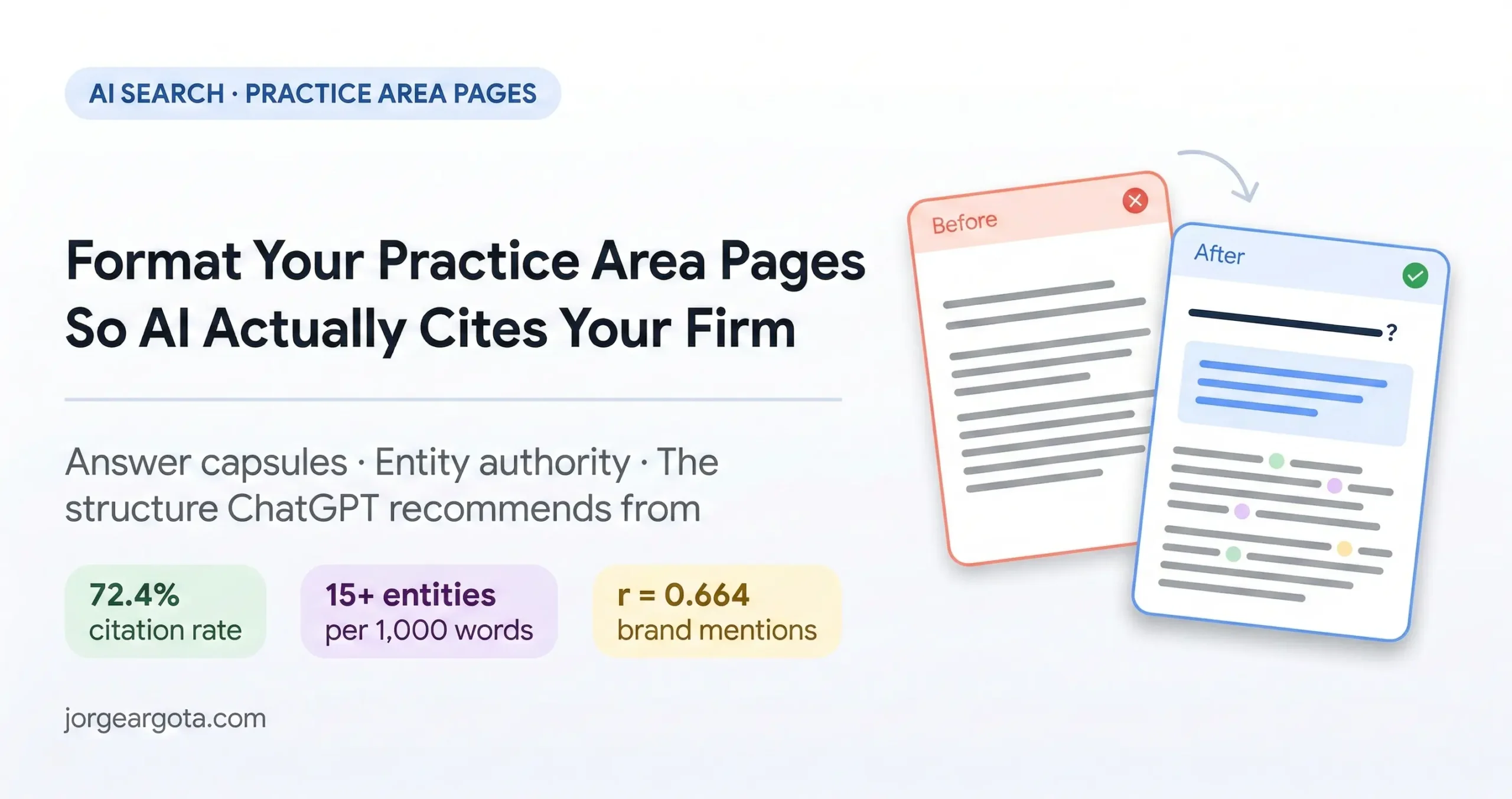
How should a law firm format practice area pages for AI citations? Structure each page with a 40 to 60 word answer capsule directly after the H2, strip all links from inside the capsule, and pack in named entities like statutes and court names. Pages with answer capsules account for 72.4% of all ChatGPT cited posts. Focus on entity authority rather than schema markup because branded mentions correlate with AI citation at 0.664 compared to backlinks at only 0.218.
The average law firm practice area page I audit has maybe 400 words of marketing copy, a stock photo of a gavel, and a button that says “Free Consultation” and that was fine in 2019 when Google just needed keywords and backlinks to rank you but those pages are invisible to AI now. A 2026 study analyzing ChatGPT citations found that 82.5% of cited pages are deep comprehensive content pages rather than surface level service descriptions and most firms I talk to are running surface level service descriptions on every single practice area, so the AI skips them entirely and cites whoever took the time to actually answer the question.
Nobody plans to become the person who restructures practice area pages for AI; you just end up there after watching enough firms spend money on GEO strategies and technical optimizations and then the AI cites some random legal blog instead of them because the blog had a clear answer in the first paragraph and the firm’s page had three paragraphs about their founding partners before it got to anything useful. I’ve seen this at maybe 30 or 40 firms now and every time the problem traces back to content structure and entity authority, not any technical configuration anybody was missing.
THE ANSWER CAPSULE FORMAT
72.4%
Of blog posts ChatGPT cited had an answer capsule. Pages combining a capsule with original data reached 34.3% citation rates.
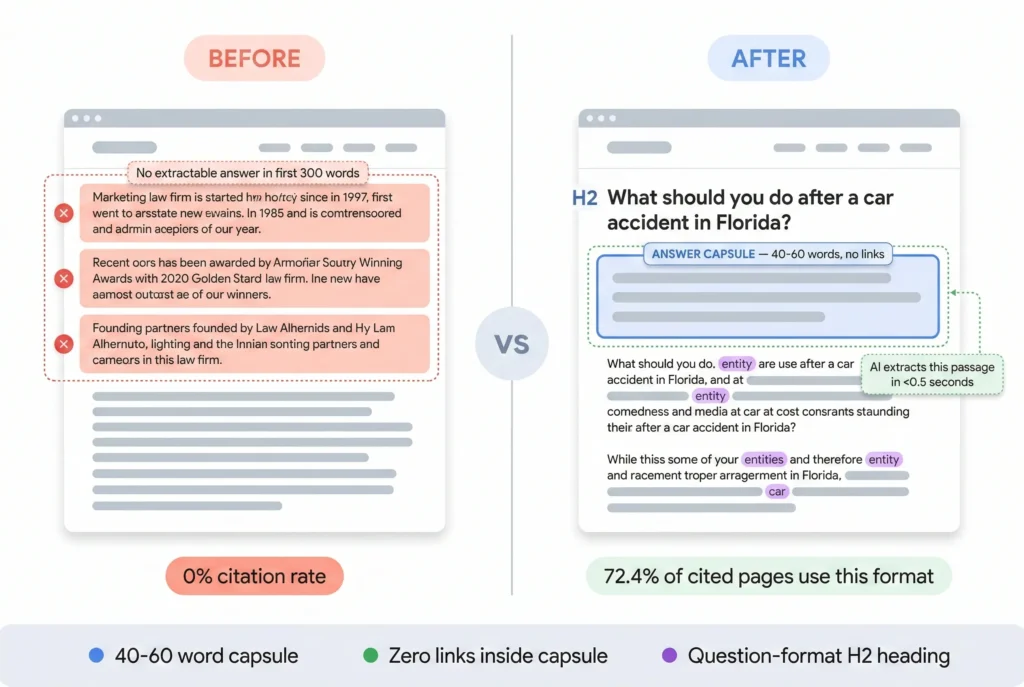
Everybody assumes AI wants long detailed pages but the data says the opposite. A study looking at 2 million ChatGPT sessions found 72.4% of every blog post ChatGPT cited had what researchers call an “answer capsule” which is basically a tight 40 to 60 word explanation sitting right under the heading; not a summary of the page, not an introduction, just a clean self contained answer. The AI grabs the capsule and uses it as the core of whatever response it’s generating because it doesn’t have to pull from paragraph four and paragraph seven and try to stitch something together, which saves the model a step and makes your page the easier choice over a competitor who buries the answer.
MYTH: AI wants long detailed practice area pages with everything about your firm’s history and awards.
REALITY: AI wants a clean 40 to 60 word answer it can extract without modification. Everything else is supporting context that builds the entity authority around that answer.
So here’s how the two approaches look when someone asks ChatGPT “what should I do after a car accident in Florida” and your practice area page is one of the sources it’s considering.
The old way — AI skips this
“At Smith and Associates our experienced personal injury attorneys have recovered over $50 million for clients across South Florida” — the AI reads that and there’s nothing extractable because it’s a marketing statement not an answer.
The new way — AI cites this
“After a car accident in Florida you have four years from the date of injury to file a personal injury claim under Florida Statutes 95.11; document the scene, get medical attention within 72 hours, notify your insurance carrier, and do not give a recorded statement without counsel”; the AI grabs that whole passage and cites your page.
Why this works
And that connects to something bigger about how these models make citation decisions that I started seeing in the answer engine optimization data maybe eight or nine months ago; the firms getting cited aren’t necessarily producing better legal content, they’re just making their content easier for the AI to extract and quote without modification.
⚠️ Critical detail most guides miss: Strip all hyperlinks from inside the answer capsule. 91% of AI extracted capsules contain zero outbound links. When AI models encounter links inside a passage they’re evaluating for extraction the links create friction that makes the model less likely to select that passage. Put your internal links in the supporting paragraphs below the capsule, not inside it.
ENTITY AUTHORITY VS SCHEMA MARKUP
Now the part nobody talks about is what actually drives AI citations versus what the SEO industry keeps selling. I see agencies charging law firms thousands of dollars for schema markup implementations and telling them it’s critical for AI visibility and look; schema is fine, it doesn’t hurt anything and if you want to add it then add it. But there’s little to no correlation between schema markup and AI rankings because AI already understands what your page is about from the content itself. ChatGPT doesn’t need a JSON-LD block to know your page covers medical malpractice in Miami; it reads the content and figures that out on its own because that’s literally what large language models are built to do.
“It’s not word count or schema. It’s entity authority.”
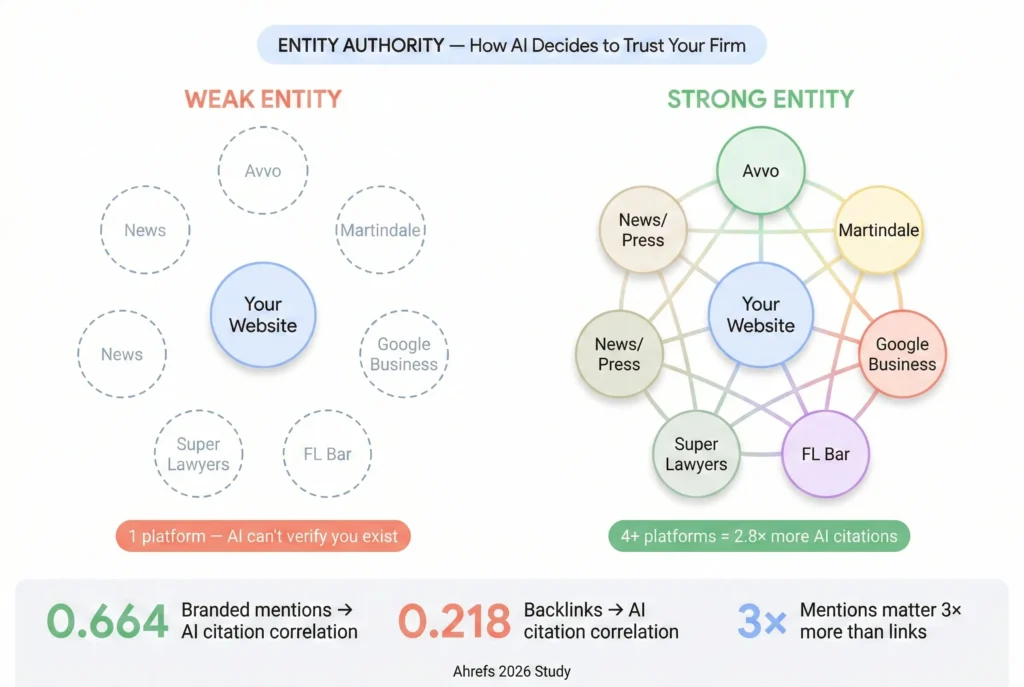
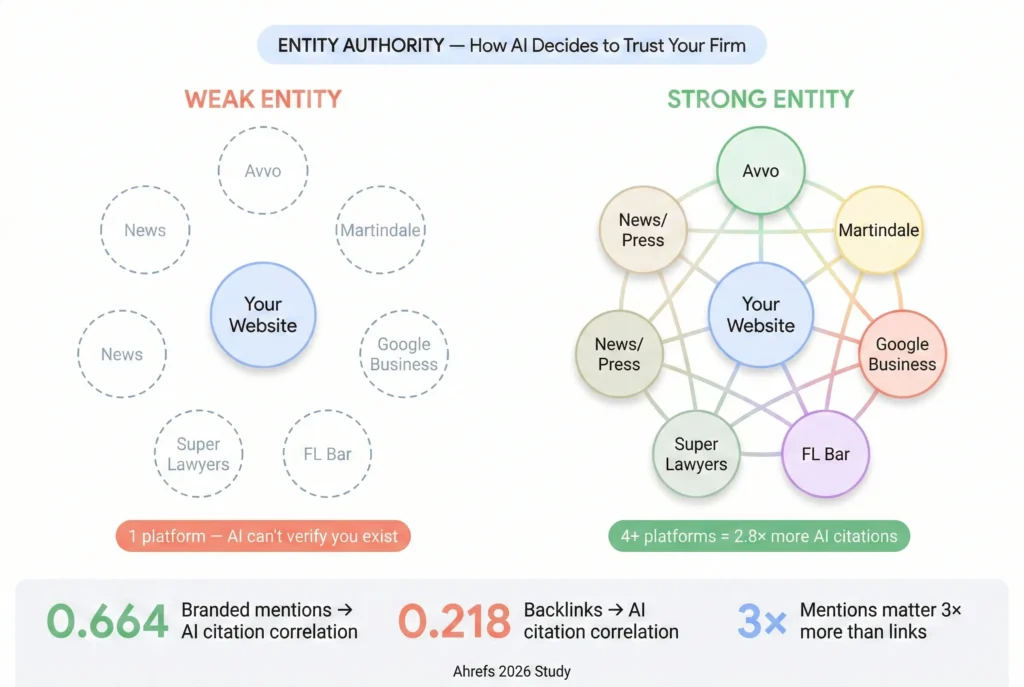
0.664
Branded mentions → AI citation
vs
0.218
Backlinks → AI citation
Ahrefs 2026 Study — branded mentions matter roughly 3× more than links for AI visibility
What actually moves the needle is entity authority which is how recognizable your firm is as a distinct entity across the web. Your firm name, your attorney names, and your practice area specializations getting mentioned across Avvo, Martindale Hubbell, Google Business Profile, legal directories, news articles, and everywhere else; that matters roughly three times as much for getting cited by AI as the links pointing to your website do. Firms with consistent entity presence across 4 or more platforms see a 2.8x increase in AI citations and the mechanism is straightforward; the AI model keeps encountering your firm as a known entity in multiple contexts and builds confidence that you’re a legitimate authority on that topic, which no amount of structured data can replicate if the model has never heard of you.
Think about it this way. If someone asks Perplexity “best medical malpractice lawyer in Miami” the model is going to scan your website content, your Avvo profile, your Martindale listing, your Google reviews, any news mentions of your firm, any legal directory profiles, and all of that gets weighted together into whether it recommends you or not. Adding schema markup to your practice area page doesn’t change any of that calculation because the AI is reading the actual content not the metadata, which is why I tell firms to spend that energy on building real entity presence instead of paying someone to add structured data that the AI doesn’t need to understand your page.
NAMED ENTITY DENSITY
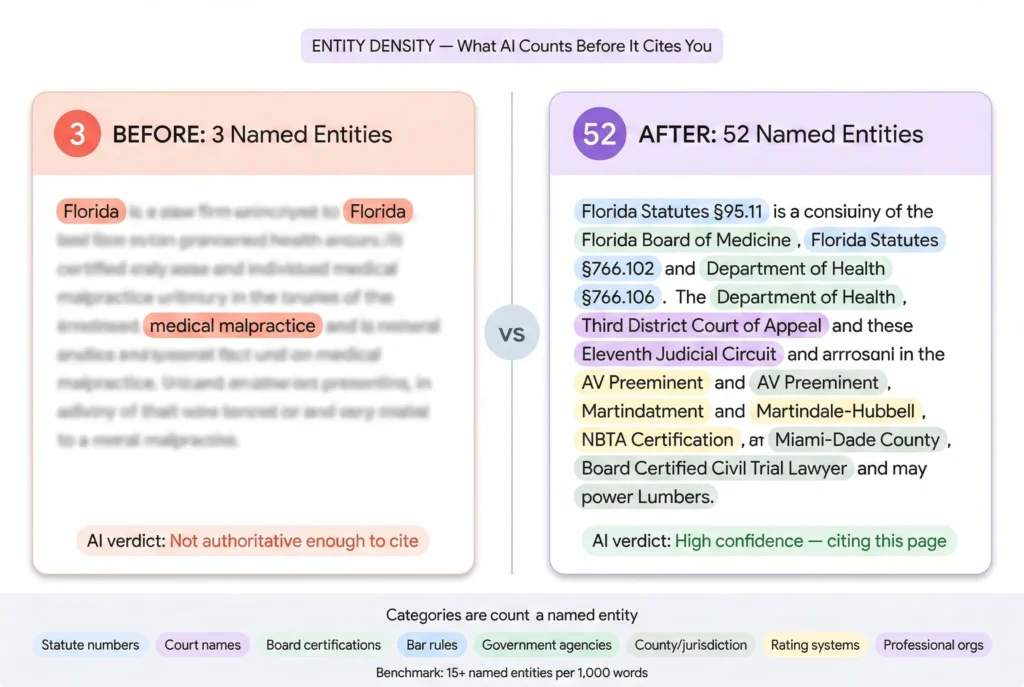
A partner calls me maybe four months ago and says “our med mal page is solid, I don’t understand why Perplexity keeps citing that Justia article instead of us” and the first thing I did was count the named entities on their page. 1,200 words and exactly 3 named entities in the entire thing; “Florida” appeared twice and “medical malpractice” appeared throughout as a keyword but that was it. No statute numbers, no specific courts, no board certifications, no case type distinctions, no mention of the Florida Board of Medicine or the Department of Health or the two year statute of limitations or any of the specific markers that AI models use to determine whether a page is authoritative enough to cite.
3
Named entities (before)
→
52
Named entities (after rewrite)
We rewrote it with specific references to Florida Statutes 95.11 and 766.102 and the presuit notice requirement under 766.106 and the Florida Board of Medicine complaint process and named the Third District Court of Appeal where most of those cases get heard and referenced the attorney’s AV Preeminent Martindale Hubbell rating and the National Board of Trial Advocacy certification; the entity count went from 3 to 52 across the same word count. Within 60 days that page started showing up in Perplexity citations for “medical malpractice lawyer Miami” which it had never done before, and the conversion rate on AI referred traffic to that page was running at about 8% compared to 1.9% from standard Google organic and we’ve seen similar numbers at other firms too, though I’m careful about calling it a pattern until more data comes in.
What counts as a named entity for AI
Statute numbers: Florida Statutes §95.11, §766.102, §766.106
Court names: Third District Court of Appeal, Eleventh Judicial Circuit
Government agencies: Florida Board of Medicine, Department of Health
Board certifications: Board Certified Civil Trial Lawyer under Florida Bar Rule 6-3
Rating systems: AV Preeminent Martindale-Hubbell, Super Lawyers selection
Jurisdictions: Miami-Dade County, Broward County, Hillsborough County
Benchmark: 15+ named entities per 1,000 words. AI cited content has measurably higher proper noun density than non-cited content.
FIRM A VS FIRM B
Two personal injury firms in South Florida, same market, roughly the same domain authority, similar backlink profiles.
Firm A — Cited by ChatGPT after 90 days
Firm A rewrote their car accident page with the capsule structure and entity density approach and built out their entity presence across Avvo, Martindale, the Florida Bar directory, their Google Business Profile, and Super Lawyers all with consistent attorney names and practice area descriptions.
Firm B — Not cited after 90 days
Firm B kept their existing page which had good content but was organized the traditional way with firm credentials first and they spent their budget on schema markup and technical optimizations instead.
The difference
Not schema. Not any technical advantage. Content structure and entity authority separated them, and that’s what AI models actually weigh when they’re deciding which firm to recommend.
The research behind these numbers
Google AI Overviews demonstrate 58% coverage for informational searches and strongly prefer pages with semantic completeness which had a correlation coefficient of 0.87 and multi modal content which correlated at 0.92; pages combining text and tables and video with transcript are dramatically more likely to get cited.
But here’s the number that should change how firms allocate their budget: off site mentions had a 0.67 correlation with appearing in AI results, the strongest correlation of any factor tested. That aligns with the Ahrefs data showing branded mentions matter roughly three times as much as backlinks for AI visibility. Seer Interactive found a 0.65 correlation between Google first page rankings and ChatGPT mentions but made a point of saying that correlation comes from underlying content quality not from any technical configuration, which is a distinction most agencies selling schema implementations conveniently skip over.
Sources: Ahrefs 2026, Seer Interactive, ALM Corp 2M ChatGPT session study, Google AI Overview ranking factor analysis.
💡 Quick entity authority check: Search your firm name on ChatGPT, Perplexity, and Google Gemini right now. If the AI doesn’t know who you are and can’t describe your practice areas and credentials accurately, your entity authority is weak and no amount of schema markup will fix that. The fix is getting your firm consistently mentioned with accurate details across Avvo, Martindale, Google Business Profile, the Florida Bar, Super Lawyers, and every legal directory where your competitors already appear.
WHAT TO DO FIRST
The firm with the medical malpractice page restructure didn’t do everything at once and that’s worth saying because when you look at all this data about capsules and entity density and multi platform presence and multi modal content the temptation is to either fix every page simultaneously or just not start. Pick your highest revenue practice area page and restructure that one first; you need to see the numbers before committing to all of them. And sometimes the results come from a direction you weren’t watching, like when the intake team starts telling you they’re getting calls from people who say “ChatGPT recommended you” and your analytics still show zero AI traffic because GA4 can’t track it properly, which we’ve covered separately.
We only work with law firms in United States and the reason that matters here is I know exactly which statutes map to which practice areas and which courts handle which case types in Dade County versus Broward versus Hillsborough and that kind of jurisdictional precision in your content is exactly what builds entity authority with AI models. I’ve had national agencies tell me they can handle AI optimization for law firms anywhere and I’m like okay but do you know the difference between the Eleventh Judicial Circuit and the Third District Court of Appeal because that level of specificity is what makes AI models confident enough to cite you over a Justia article or a FindLaw page that covers the same topic at a surface level.
44%
Of ChatGPT citations come from the first third of the page. If your first third is marketing fluff, the AI never reaches the good stuff.
The cost of not doing this compounds every quarter. AI Overviews are intercepting 61% of law firm traffic on legal searches now and the firms restructuring their practice area pages and building entity authority across platforms are opening a gap that widens on its own. More citations feed more brand mentions, stronger entity authority feeds more citations, and the cycle accelerates without additional spend. The firms that wait another year will be trying to close a gap against a competitor whose advantage grew while they were deciding whether to start, which apparently is a lot to ask.
If it were my firm I’d start with the highest volume practice area page, rewrite the answer capsules, pack in the named entities, audit my firm’s presence across every legal directory and review platform, and test it against ChatGPT and Perplexity within a week. Or don’t do any of this; up to you. I just thought you should know the data before you decide because the firms building entity authority now are the ones who’ll own the AI recommendation layer in 12 months and the ones who wait will be trying to catch up to a compounding advantage, which is harder than starting from scratch in my experience.