
Written by Jorge Argota · Legal Marketing · United States
Last Updated: March 2026
I’ve written about Google Ads ROI for lawyers and the synergy between SEO, PPC, and local search when they run together. This page is different. This is the specific platform moves, the weekly rituals, and the technical configurations that reduce waste and produce signed retainers. Not strategy. Tactics. The stuff you can do Monday morning.
TL;DR
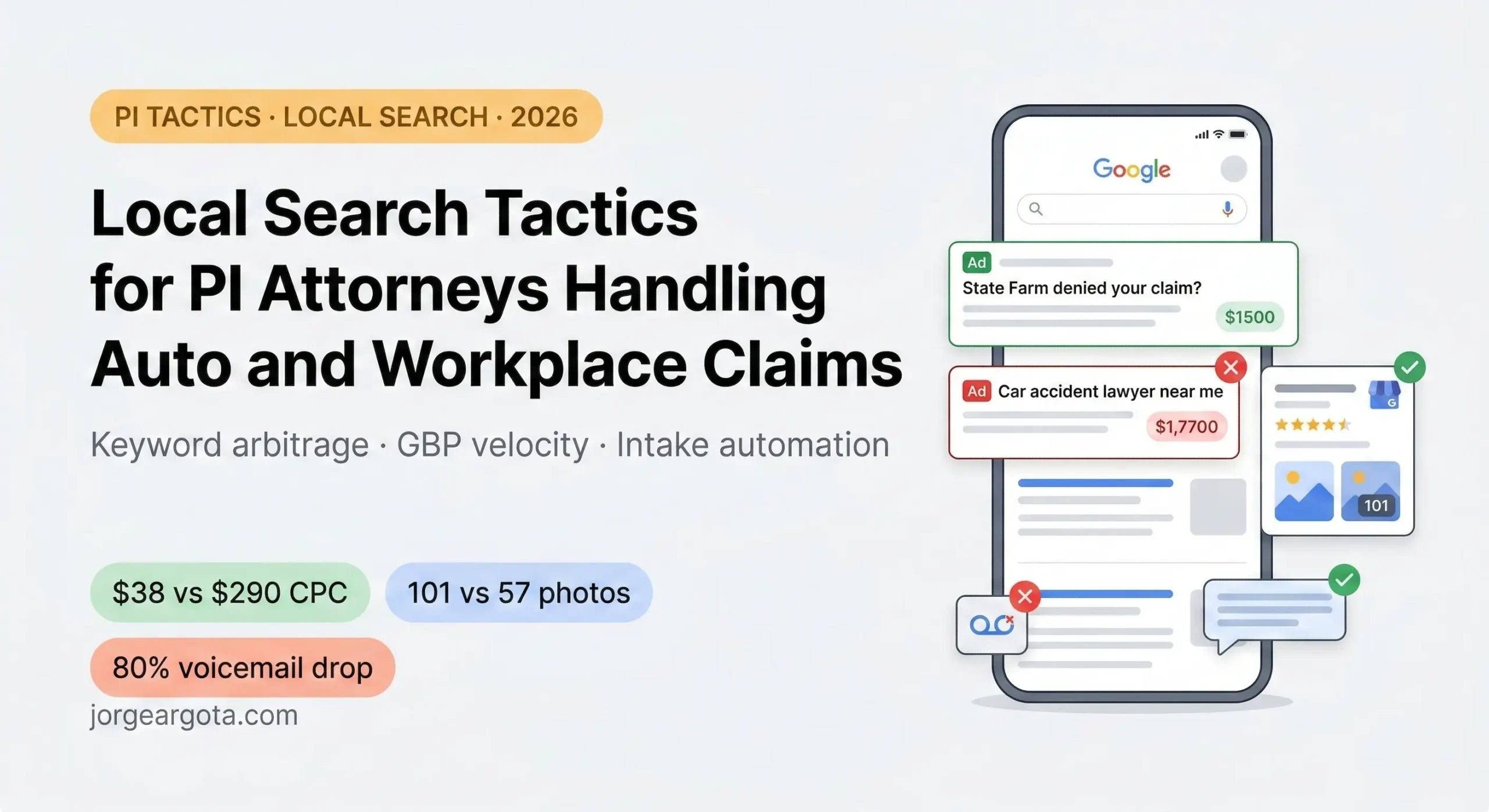
What Google Ads and local search tactics help personal injury attorneys dominate for car accident and workplace injury claims? Bid on insurance company complaint queries at $38 per click instead of “car accident lawyer” at $290 to $438. Harvest negative keywords every Monday morning for 15 minutes. Pre-qualify in your ad copy with “Serious Injuries Only” to repel junk clicks. Post to your GBP 2 to 3 times per week and upload 5 to 10 original photos monthly; the #1 ranked PI firm averages 101 photos versus 57 at #10. Seed 15 to 20 Q&As on your own GBP listing. Deploy missed-call text-back automation that fires within 30 seconds. Build hyper-local pages targeting specific dangerous intersections using DOT crash data. And secret-shop your own firm quarterly to find the intake leaks you can’t see from the inside.
$38
CPC on insurance complaint queries
$290–$438
CPC on “car accident lawyer”
101 vs 57
GBP photos: rank #1 vs rank #10
GOOGLE ADS: THE MOVES THAT STOP THE BLEEDING
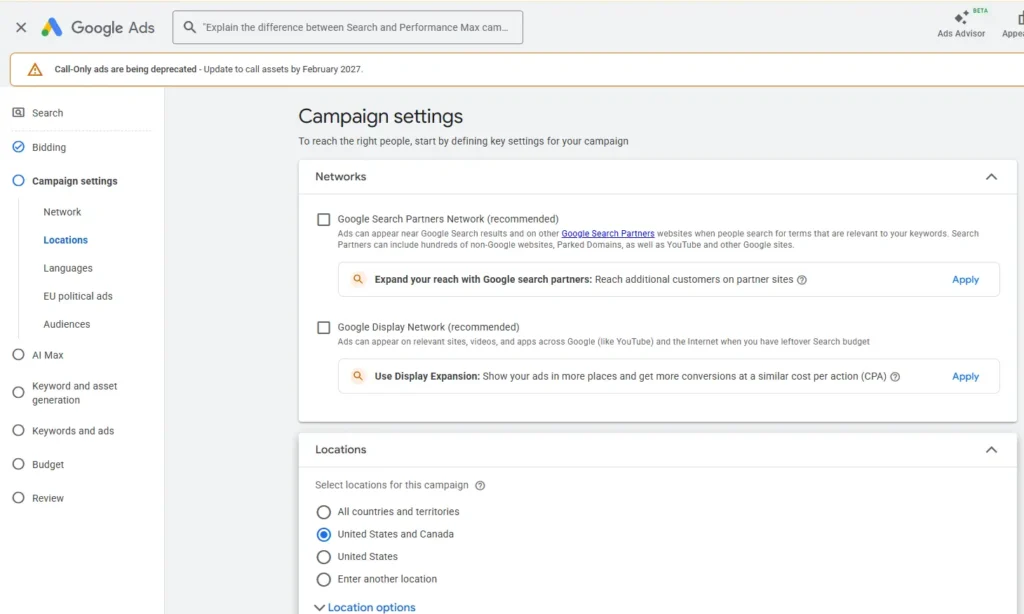
The insurance company keyword arbitrage. While everyone fights over “car accident lawyer near me” at $290 to $438 per click, almost nobody is bidding on insurance company complaint queries. “State Farm denied my claim,” “GEICO settlement offer too low,” “Progressive lowball offer,” “Allstate bad faith.” These searchers are deep in the claims process, frustrated, and ready to hire. The CPC on broad insurance company queries averages $38 per click. Build a dedicated search campaign for carrier names paired with grievance modifiers, disable Search Partners and Display Network, and point the traffic to landing pages that address the specific insurer’s tactics. The Google Ads fundamentals are the same; the targeting is completely different and the economics are dramatically better.
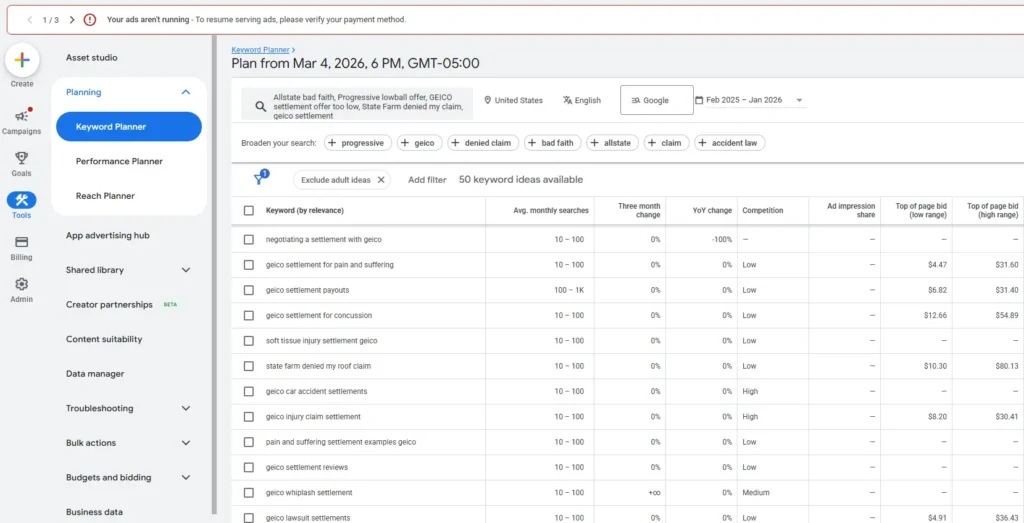
The self-competition audit. If you run multiple campaigns with overlapping keyword targeting, your own ad groups are bidding against each other in the auction, inflating your CPCs. Pull the Search Terms Report, export it, and run a pivot table to find queries triggering across multiple campaigns. When you identify a winning keyword, move it to a high-bid exact match campaign and immediately add it as a Negative Exact Match in all broader campaigns. This forces the algorithm to route through your controlled ad group instead of running a private auction against your own budget. I’ve seen this recover 10 to 15% of wasted spend on the first pass.
The Monday Morning Negative Keyword Ritual (15 minutes)
Every Monday: pull the Search Terms report from the past 7 days. Block anything matching these categories at the campaign level.
Employment/Education: -salary, -jobs, -how to become, -paralegal, -law school
DIY/Pro Se: -free, -cheap, -form, -template, -pro se
Wrong practice area: -divorce, -immigration, -criminal defense, -corporate
Vendors: -software, -CRM, -marketing, -answering service
A static negative keyword list uploaded once at campaign creation is not enough. Google’s broad match algorithms expand aggressively and a query for “physical therapy salary” will happily trigger your PI ad at $12 to $30 per click. This 15-minute weekly ritual blocks up to 20% of irrelevant traffic.
Pre-qualification in ad copy. Standard advice says write ad copy to maximize click-through rate. On a $300 keyword, maximizing CTR without pre-qualifying the user is how you burn $6,000 a week on fender-bender inquiries. The counter-move is writing headlines that deliberately repel low-value cases: “Serious Injuries Only,” “Surgery Required Cases,” “Cases Over $50K.” Total click volume drops. The clicks that come through have a dramatically higher probability of producing a retainer. A/B test it over 60 days; Campaign A with broad welcoming copy versus Campaign B with pre-qualifying copy. Campaign B will sign more cases at a lower cost per signed case even with less traffic.
The ugly landing page insight. Firms over-invest in stylized brochure pages with hero videos and firm philosophy. A trauma victim searching from a hospital waiting room on a phone with bad cell service doesn’t want to admire your web design. Testing shows that stripped-down pages with a single qualifying question (“Were you injured in a car accident? Yes/No”) embedded on a plain white background can hit 98% completion rates. The best-performing PI landing page has four elements: a headline matching the search query, a massive click-to-call button with a 48-pixel minimum tap target, trust signals immediately below the header (Google rating, total recovered, “No Fee Unless We Win”), and a multi-step form that starts with non-threatening multiple-choice questions before capturing contact details.
GBP AND LOCAL SEARCH: THE PLAYS MOST FIRMS MISS
GBP as a micro-blog. Most firms post to their Google Business Profile once a month or never. The firms ranking in the Local 3-Pack are posting 2 to 3 times per week with anonymized case results, localized legal tips, and community involvement photos. Every post includes an original image and a “Call Now” CTA button. Regular posting signals active engagement to the algorithm and injects localized keywords directly into the profile’s text ecosystem. The review management cadence matters too; firms at rank #1 average 555 reviews and the ranking plummets if the profile goes 18 days without a new review.
Photo upload velocity. A study of 3,200 PI Google Business Profiles found the #1 ranked firm averaged 101 photos. Position #10 averaged 57. The tactic is uploading 5 to 10 new original photos monthly; attorneys at the local courthouse, the intake team working in the office, community events, multiple exterior shots of the building. Stock imagery doesn’t count and Google can tell the difference.
Two GBP Moves You Can Do This Week for Free
Populate the Services menu. Most PI firms leave this blank or input a single “Personal Injury Attorney” category. Add every case type as a distinct service: “Rideshare Accident Representation,” “Traumatic Brain Injury Litigation,” “Workplace Crush Injury Claims,” “Forklift Accident Cases.” Write a 150-word description for each with geographic modifiers. Google parses this to determine relevance on long-tail local queries.
Seed the Q&A section. You can legally ask AND answer your own questions from the verified owner account. Seed 15 to 20 FAQs: “Do you charge fees if I don’t win my case?”, “How long do I have to file a workplace injury claim in Florida?”, “What if my employer doesn’t have workers’ comp insurance?” This controls the narrative, pre-handles objections, injects keywords, and occupies more visual real estate on the SERP before a competitor can fill it with unhelpful answers.
SEO CONTENT THAT COMPETITORS AREN’T BUILDING
The dangerous intersections play. National legal directories dominate broad geographic terms. They can’t compete on specific crash locations. Source your state DOT crash statistics and identify the high-injury network; research shows 40% or more of regional crashes concentrate on a specific subset of roads. Build dedicated pages titled “Most Dangerous Intersections in [City]” explaining why crashes happen at those specific nodes and listing common injuries. These face near-zero competition from national aggregators and link back to your main pillar pages, building the kind of deep local semantic authority that moves rankings on competitive head terms.
Insurance company tactics pages. Major insurers spend millions creating “helpful” content designed to discourage victims from hiring attorneys. Counter this by publishing pages dissecting the specific defense tactics used by State Farm, Allstate, Progressive, and GEICO. Detail behaviors like “Record Dump Delays” (demanding irrelevant paperwork to stall) and “Quick Close Incentives” (offering $500 immediately to get a waiver of future medical claims). These pages rank organically for high-intent queries like “State Farm delay tactics” and double as landing pages for the insurance arbitrage PPC campaign. That’s the kind of cross-channel compounding between PPC and SEO that produces a declining blended cost per case over time.
FAQ schema on every practice area page. Google reduced traditional FAQ rich results in the SERP but FAQ schema remains the primary structured data fuel for AI Overviews and generative answer engines like ChatGPT and Perplexity. Embed JSON-LD FAQ markup with 3 to 5 high-intent questions per service page. “Who pays medical bills after a hit and run?” “What if my employer retaliates after a workplace injury claim?” The text inside the schema must match the visible text on the page exactly. This positions the firm’s content to be cited as an authority in AI search results, and I’ve written separately about how to get your firm visible in ChatGPT specifically.
THE NON-MARKETING MOVES THAT MULTIPLY MARKETING
Speed to lead is one of the biggest conversion levers in PI intake. Firms responding within five minutes see dramatically higher sign rates, and the full data on response time benchmarks and SLA enforcement is in the predictable pipeline guide. What matters for this page is the specific automation that captures the leads your marketing already paid for.
The Missed-Call Text-Back Automation
Deploy a cloud phone system or CRM with native missed-call text-back (GoHighLevel, Talkroute, or similar). Within 15 to 30 seconds of a missed call, the system texts: “Hi, this is the intake team at [Firm Name]. We are on the other line assisting a client, but your call is a priority. Are you calling regarding a new injury case?” This re-engages the prospect on their mobile device before they can dial a competitor. The 15-to-30-second delay makes it feel human. The automation makes it 100% reliable. Configure it, write the template, and test it by calling yourself and letting it go to voicemail. Total setup time: 15 minutes.
The call recording analysis loop. Your agency reports on leads generated and cost per lead. You care about cases signed and revenue generated. The gap between those two metrics lives in the intake calls. Set up a monthly cadence of listening to 10 to 15 randomly selected intake calls from digital channels. You’ll find three things: whether the PPC leads are asking about unrelated practice areas (meaning negative keywords are failing), what exact language victims use to describe their accidents (inject those phrases into ad copy and landing page headlines), and where in the intake script callers hesitate, get frustrated, or hang up. This intelligence loop produces more signed cases than any ad optimization and it costs nothing beyond the call recording software you should already have running.
Secret-shop your own firm. Partners rarely know how the front desk handles calls when the partners are in court. Commission a quarterly secret-shopper test; have a neutral third party call posing as a high-value auto accident victim. Test Tuesday at 9 AM, Friday at 4:45 PM, and Saturday afternoon. Measure speed to answer, empathy, triage scripting, and how fast a consultation gets offered. Then make the same calls to your top three local competitors. The results are usually uncomfortable. They’re also the fastest path to plugging the intake leaks that no amount of ad spend can compensate for.
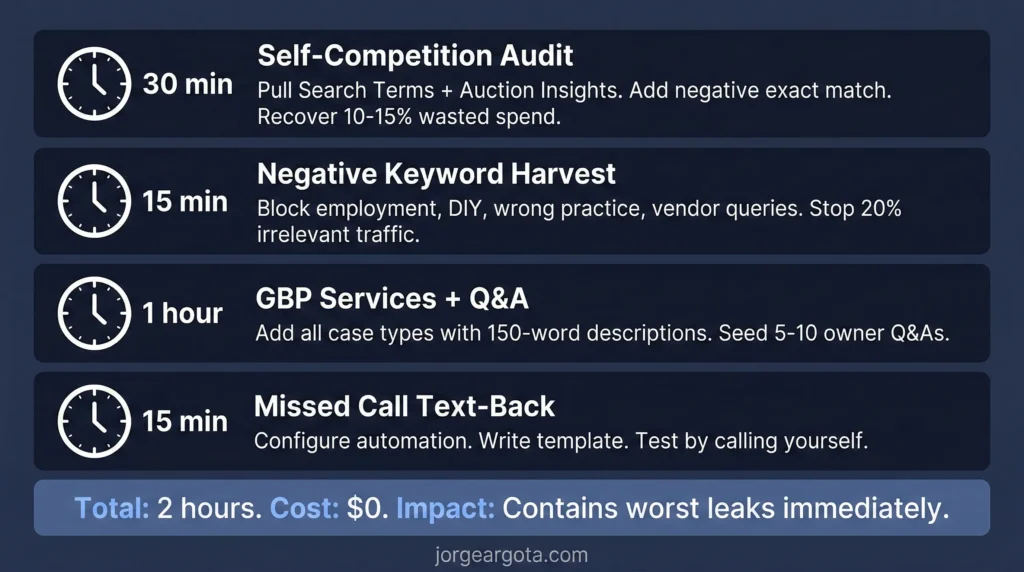
Do this Monday morning (free, 2 hours total)
30 minutes: Pull Google Ads Search Terms Report and Auction Insights. Run the self-competition audit. Add negative exact match keywords to isolate traffic. Expected: 10-15% recovered wasted spend.
15 minutes: Execute the negative keyword harvest from the past 7 days. Block employment, DIY, wrong practice area, and vendor queries. Expected: blocks 20% of irrelevant click traffic immediately.
1 hour: Open GBP dashboard. Populate the Services menu with every case type including workplace injury subcategories. Write 150-word descriptions with geographic modifiers. Seed 5 to 10 Q&As from the verified owner account.
15 minutes: Configure missed-call text-back automation in your phone system or CRM. Write the template text. Test it by calling and letting it go to voicemail.
Total time: 2 hours. Total cost: $0. These four moves contain the worst budget leaks and capture leads that are currently walking out the door. Source: practitioner playbooks, search terms analysis, GBP ranking studies. Analysis: Jorge Argota.
If you want to talk through any of this my number is (941) 626-9198
I pick up most of the time, or don’t call, whatever. I just know this stuff gets technical fast and sometimes it helps to hear it from someone who’s audited a few hundred of these accounts. If you want to run the self-competition audit first and see what falls out of the Search Terms report before we talk, that’s probably the smarter move anyway.
P.S. If you want the broader economics behind these tactics, I wrote about Google Ads ROI from actual campaigns with the math on which budget levels actually work and which don’t. If your question is about how these channels compound when run together, the cross-channel synergy breakdown covers that. If you’re a small firm figuring out where to start on a tight budget, that page covers the sequencing. And the predictable pipeline guide covers the five-layer system from traffic through feedback loops.