
Written by Jorge Argota · Legal Marketing · United States
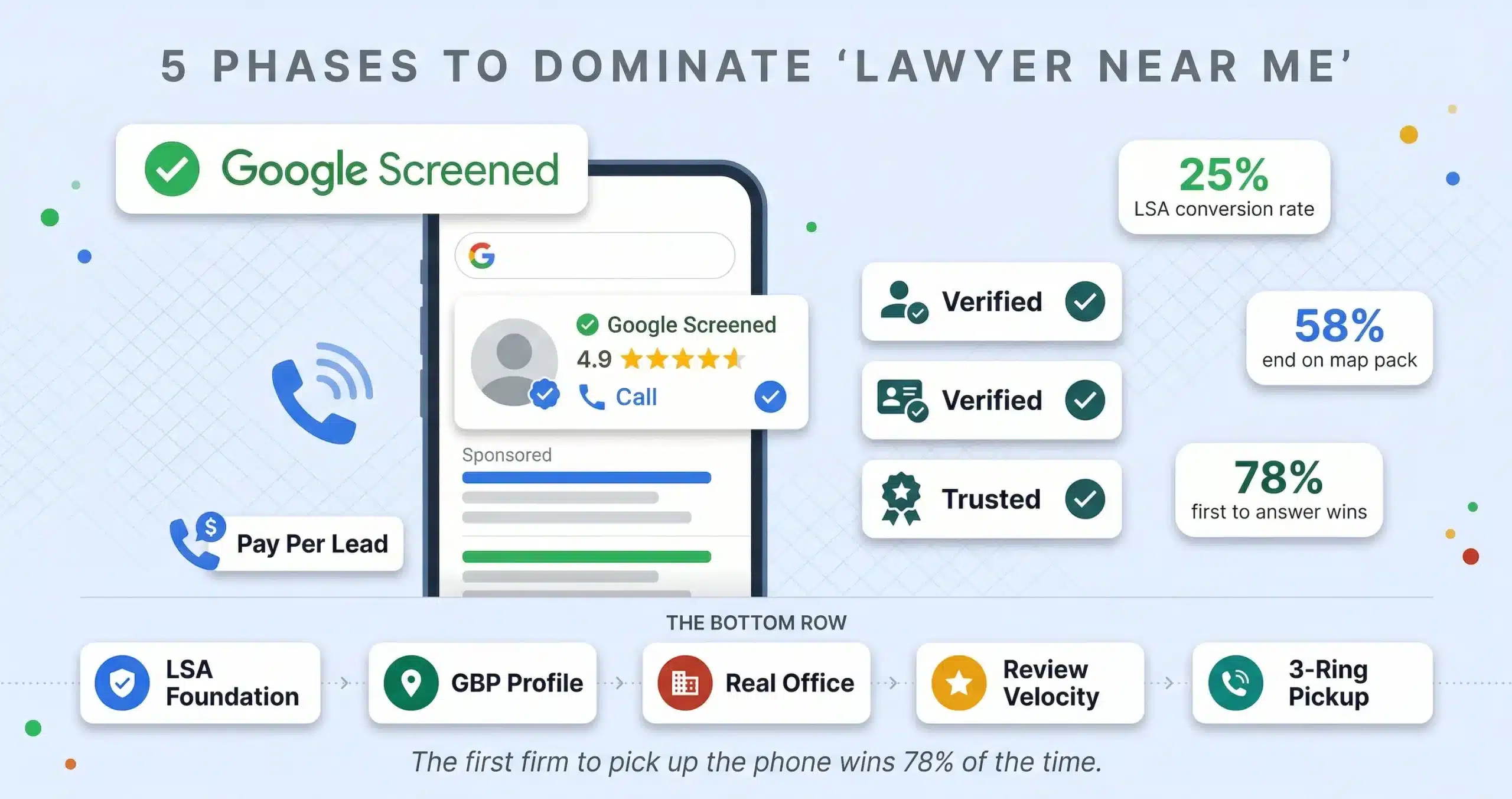
So “lawyer near me” isn’t a navigational search anymore. It’s a commercial urgency signal. The person typing it is hurt, scared, or in legal trouble and they’re going to call whoever shows up first in the map pack on their phone. In 2026 the winner of that search is not the closest firm; it’s the one that dominates Local Service Ads and the map pack simultaneously. And the economics are lopsided in a way that most firms still haven’t figured out; LSA leads convert at 25% compared to 3% for standard PPC, the cost per lead runs as low as $31 for family and immigration, and 58% of those searches end on the map pack without the user ever visiting a website.
TL;DR
Winning “lawyer near me” requires five things working together. Local Service Ads as your primary intake layer, not an add-on. A Google Business Profile that passes the “Open Now” filter at 5:30 PM on a Friday. A real office that won’t get your listing suspended. Recent reviews that outrank firms with 500 old ones. And an intake team that answers in three rings because the first firm to pick up the phone wins 78% of the time. This page covers how each phase connects and where most firms break the chain.
25%
LSA lead conversion rate
3%
standard PPC conversion rate
58%
of searches end on the map pack
PHASE 1: LSA AS YOUR PRIMARY INTAKE LAYER
Most firms treat Local Service Ads as something they add on top of their PPC campaign. In 2026, LSA should be the foundation and PPC should be the supplement, because the economics are fundamentally different. With PPC you pay $100 or more for a click and if the person leaves your site you lose that money. With LSA you pay per lead, not per click, and if the call turns out to be spam or a wrong number you dispute it and get the money back. That dispute mechanism alone changes the risk profile of the entire channel.
Standard PPC Model
Pay $150 per click. User bounces. Money gone. No recourse. Conversion rate: 3%. You’re paying for attention, not leads.
LSA Model
Pay $31 to $50 per lead. User calls directly. Spam calls are disputable. Conversion rate: 25%. Google Screened badge acts as a trust proxy before the person even reads your ad.
The “Google Screened” green checkmark that shows on LSA listings works as a psychological proxy for “state bar approved” in the user’s mind, which is why the conversion rate is so much higher than standard text ads. The person sees the badge, the star rating, and the phone number and they call without visiting your website at all, which is why 58% of local legal searches end without a single website click. The full LSA setup guide covers the activation process and category selection; this section is about why it needs to be your primary channel, not your backup.
PHASE 2: THE GOOGLE BUSINESS PROFILE TRAPS THAT MAKE YOU INVISIBLE
The “Open Now” filter kills you at 5:30 PM on a Friday. A potential client searches “DUI lawyer near me” after work, toggles the “Open Now” filter on their phone (which mobile users do constantly), and your firm disappears because your hours say 9 to 5. If you have a 24/7 answering service or a chat widget handling after-hours intake, you should list “Open 24 Hours” on your GBP. The highest intent legal searches happen in the evenings and on weekends, and if your listing goes dark during those windows you’re invisible when it matters most.
And the NAP consistency problem is more damaging than most firms realize. If your website says “Suite 400,” your Yelp listing says “#400,” and your Avvo profile says “Ste. 400,” the search algorithm reads those as potentially three different businesses and splits your local authority across all of them. The fix is tedious but it’s one of those things where twenty minutes of cleanup across your directory listings can move your map pack position more than six months of content publishing, because the algorithm rewards the firm with the cleanest, most consistent entity data within a 20 mile radius of the searcher.
PHASE 3: THE VIRTUAL OFFICE SUSPENSION TRAP
Do not try to rank in a wealthy suburb by renting a Regus, WeWork, or virtual mailbox. Google’s 2026 algorithm aggressively scans for co-working footprints and the suspension that follows takes months to resolve while your revenue flatlines. And you can’t beat Google’s proximity filter in the organic map pack; if you aren’t physically close to the searcher, you won’t show up regardless of how many reviews or how much content you have. That is exactly why LSA is the weapon for geographic expansion. The targeting radius on Local Service Ads is wider than the GBP organic radius, which means you can pay to bypass the proximity filter and capture leads in suburbs where you don’t have a physical office, without faking a local presence that gets your entire listing pulled. Only claim a Google Business Profile at an address where you have a real office, staffed by your team, with your signage visible, during the hours you list.
PHASE 4: REVIEW RECENCY BEATS REVIEW COUNT
Google’s algorithm values how recently your last review was posted more than how many reviews you have total. A firm with 50 reviews where the most recent one was yesterday will outrank a firm with 500 reviews where the last one was posted six months ago. That’s the single most important thing I can tell you about reviews and local ranking in 2026, and most firms are still chasing volume when they should be chasing velocity.
The ABA Rule 7.2 compliant request: You can’t pay for reviews or offer anything in exchange. But you can ask after a positive outcome and the timing matters. Send a text within 24 hours of resolution: “It was a privilege to fight for you. The best way you can help others in your situation find us is by sharing your story here: [direct Google review link].” That script passes ethics review, it frames the ask as helping others rather than helping the firm, and the direct link removes every friction point between the impulse and the action. The full review generation guide covers the cadence and the ethics by state page covers the state-specific rules.
PHASE 5: THE INTAKE CLOSURE THAT MAKES EVERYTHING ABOVE IT WORTH THE MONEY
For “near me” queries, the firm that answers the phone first wins the case 78% of the time. That’s not a general marketing stat; it’s specific to hyper-local urgent searches where the person is calling from a scene, a hospital, or a holding cell and they’re going down the list until someone picks up. Your intake team needs to answer in three rings. No voicemail trees. Live humans only.
Miss the Call
46
clients lost per year from a 5 hour response delay
Answer First
78%
of near me searchers hire the first firm that picks up
And there’s an LSA-specific penalty most firms don’t know about: if you miss calls from Local Service Ads, Google throttles your ranking. They measure call duration and calls under 30 seconds signal a bad experience, which means your receptionist sending LSA calls to voicemail after two rings is actively destroying the channel’s performance and Google will show your listing less often as a result. The intake process guide covers the full operational architecture for preventing lead leakage at every stage.
Want to know if your local presence is leaking leads?
Send me your firm name and I’ll pull your GBP listing, check your NAP consistency across directories, see if your hours are costing you after-hours leads, and tell you where you sit in the map pack for your top practice area. If the five phases are already connected I’ll tell you that too.
Related: LSA Setup Guide · Review Generation Guide · Review Ethics by State · Intake Process Guide · SEO for Law Firms · Marketing Budget Guide