
Written by Jorge Argota · Legal Marketing · United States
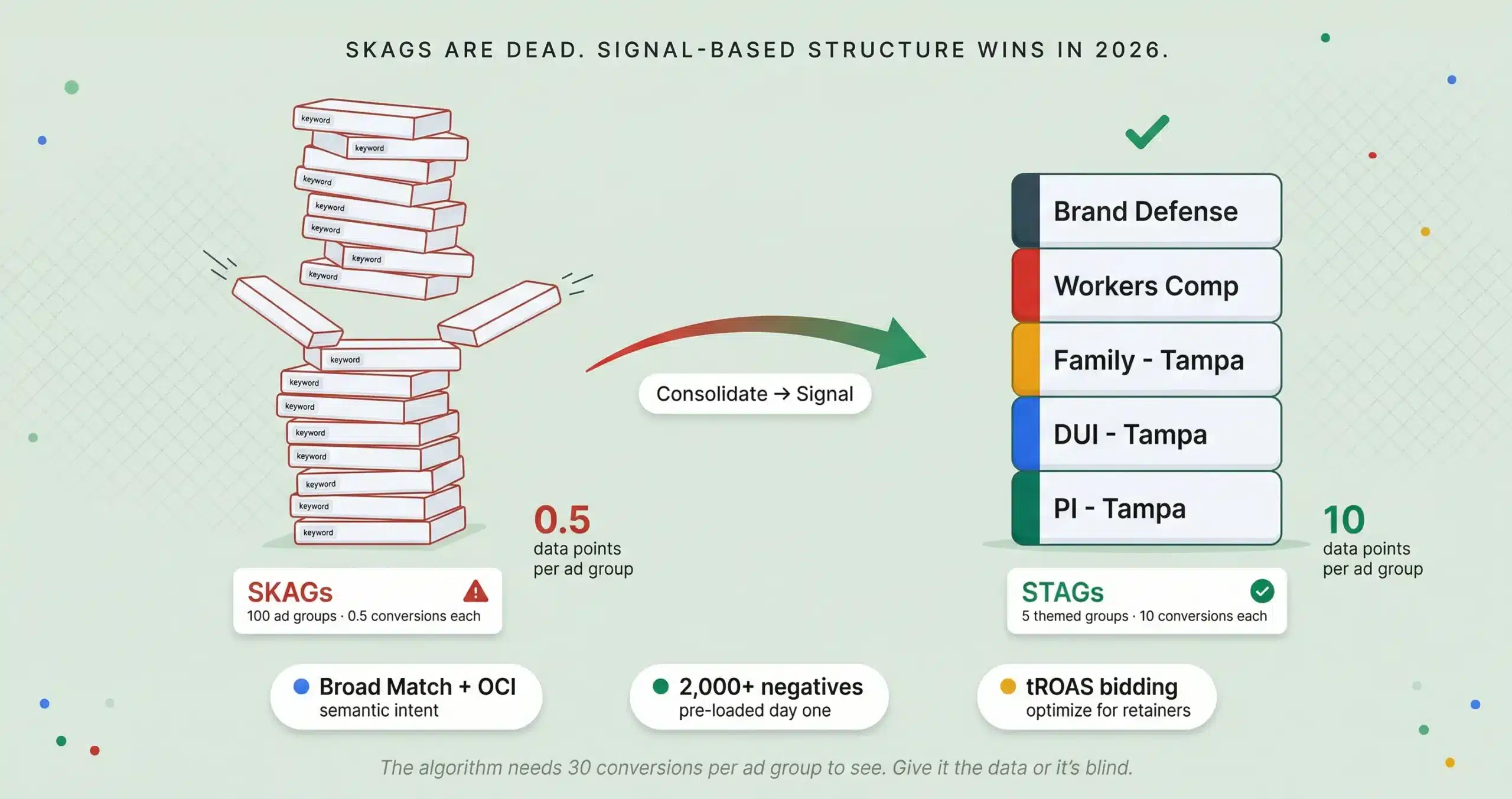
The SKAG playbook is dead. Smart Bidding needs roughly 30 conversions per month per ad group to optimize and if you’re running 100 single keyword ad groups on 50 monthly conversions, each one sees 0.5 data points. The algorithm is blind.
And even if you wanted to keep SKAGs, Google’s Close Variant update made them technically impossible. Your exact match [DUI Lawyer] now triggers for “DUI attorney” and “drunk driving legal help” automatically. You can’t isolate keywords anymore so the entire premise of single keyword ad groups is broken at the platform level. The winning structure consolidates keywords by intent themes into STAGs and feeds enough conversion data for Smart Bidding to actually learn; the industry calls this “signal liquidity” and it’s the only thing that matters in 2026.
SKAGs: The Math of Failure
0.5
conversions per ad group per month
100 ad groups ÷ 50 conversions = data starvation. Smart Bidding never exits “Learning Phase.”
STAGs: The Math of Signal
10
conversions per ad group per month
5 themed ad groups ÷ 50 conversions = algorithmic clarity. Smart Bidding exits learning in 48 hours.
Google’s matching engine moved from lexical to semantic in late 2024 and that means “car accident lawyer” and “what to do after a crash” are the same query in the algorithm’s eyes. Having separate ad groups for each one makes them bid against each other and drives up costs. Consolidate into themed groups, feed the algorithm signed case data through your CRM, and the math changes completely.
TL;DR
The 2026 Google Ads structure for law firms consolidates SKAGs into themed ad groups (STAGs) organized by practice area, runs Broad Match tethered to Smart Bidding with offline conversion data feeding signed case values back to Google, and deploys pre-emptive negative keyword lists of 2,000 or more terms before the first dollar is spent. Without the CRM feedback loop, Broad Match burns budget on form fillers. With it, the algorithm finds people who actually sign retainers. Source: Jorge Argota, 10 years legal PPC.
HOW TO STRUCTURE GOOGLE ADS CAMPAIGNS FOR LAW FIRMS
The structure that performs in legal PPC mimics the firm’s own org chart. Campaigns are departments, ad groups are practice areas, and keywords are the specific problems clients walk in with. Mixing “Divorce” and “DUI” in the same campaign budget is like funding two different departments from the same checking account; the low-CPC high-volume practice area eats the budget before the high-CPC urgent one gets a single impression.
Campaign Level: The Wallet
Search – Personal Injury – Tampa
One campaign per practice area per city. Never share budget between “Divorce” (low CPC, high volume) and “DUI” (high CPC, high urgency). The cheap clicks exhaust the funds before the high-value clicks can bid.
Ad Group Level: The Theme (STAGs)
Car Accident vs Auto Accident → Trucking vs Uber/Lyft
Group by user problem, not keyword syntax. “Trucking” lets ad copy reference federal regulations. “Uber/Lyft” lets it reference rideshare insurance. Specificity spikes Quality Score.
Keyword Level: The Intent Triangle
Target × Modifier × Action = Valid keyword
“Lawyer” (Target) + “near me” (Modifier) + “hire” (Action). The overlap of all three vectors is where signed cases come from. Missing any one drops you into informational waste.
💡 Example STAG: “Car Accident; Intent”
Instead of 50 ad groups for every variation of “car accident lawyer,” create one STAG with phrase match keywords: “car accident lawyer,” “auto wreck attorney,” “car crash law firm.” This pools conversion data from 20 keyword variations into one bucket so tCPA learns in days, not months. Your RSAs in this STAG should have dynamic headlines covering the entire theme, not just one keyword variation.
BROAD MATCH VS EXACT MATCH FOR LEGAL PPC IN 2026
Two years ago Broad Match on a legal account was a guaranteed way to blow $10,000 in a week on “lawyer salary” and “how to become an attorney” queries. For a PI firm, Broad Match on “injury” could match “injury prevention tips” or “football injury stats” and at $150 per click the learning phase alone can cost $15,000 in wasted spend before the algorithm figures out what you actually want. In 2026 the matching engine is semantic instead of syntactic; it reads user intent history and browsing behavior, not just the words they typed. Exact Match targeting “car accident lawyer” misses a user searching “what to do after a crash” who just visited a hospital website. Broad Match captures that person because the algorithm sees the signal, not just the keyword. The consolidated structure that makes this work is sometimes called the Hagakure method; pool massive amounts of keywords into a few intent-based themes so the algorithm has enough signal to optimize bids in real time.
But Broad Match only works when two things are true simultaneously. First, the account needs offline conversion data feeding signed case values back to Google through the CRM so the algorithm optimizes for retainers instead of form fills. The CPSC page walks through the GCLID-to-Clio setup for that. Second, the negative keyword list has to be pre-loaded with 2,000 or more exclusion terms before the campaign launches because without the guardrails, Broad Match will find every law student and Reddit researcher on the internet and call them a “conversion.” The negative keywords page has the full downloadable list.
How Offline Conversion Tracking Works for Law Firms
Google Ads Bidding Strategy by Conversion Volume
NEGATIVE KEYWORD LIST FOR LAW FIRM GOOGLE ADS
In legal PPC you don’t pay for clicks; you pay for leads. The entire difference between a profitable campaign and a budget fire is the negative keyword list and it has to go in before the first dollar is spent, not after you’ve already wasted $5,000 learning that “lawyer salary” was eating 30% of your daily budget.
Freebie Seekers
RISK: HIGH; Smart Bidding loves these
Block: free, pro bono, cheap, affordable, legal aid, volunteer. These users convert easily (fill forms) but have zero retainer intent. The algorithm chases them because they lower CPL while destroying actual ROI.
Career Hunters
RISK: MEDIUM; #1 source of wasted spend
Block: job, salary, internship, resume, school, university, exam, bar association. Law students and competitors clicking your ads for research. Corrupts Quality Score data.
DIY Researchers
RISK: CRITICAL; tanks page relevance
Block: template, form, sample, example, statute, definition, court records. Looking for a PDF to download, not an attorney. They click, bounce immediately, and destroy your landing page score.
Out of Scope Drift
RISK: HIGH; Broad Match bleeds here first
Block: practice areas you don’t serve + competitor names. PI firm? Explicitly block “divorce,” “family,” “criminal,” “ticket” or Broad Match drifts into all of them within 72 hours.
PERFORMANCE MAX AND AI MAX FOR LAW FIRMS
Performance Max is the mid-funnel engine and AI Max is the top-funnel expansion. Both are dangerous without guardrails. One PMax campaign per value tier; never mix “High Value PI” and “Low Value Tickets” in the same asset group. Brand terms excluded from PMax entirely or it cannibalizes organic. AI Max triggers over 50% of its searches on completely keywordless queries based on your landing page content and conversion history.
Landing Page Best Practices for Legal PPC Campaigns
Law 1: Kill the Menu
Remove header navigation entirely. Two choices: Call You or Close the Tab. Every link is an exit ramp away from the conversion.
Law 2: Dynamic Headlines
Query is “Trucking Accident”? H1 reads “Trucking Accident Attorney.” Generic “Personal Injury” headers increase bounce rate 40%. DTR makes this automatic.
Law 3: Speed to Lead
Static forms are leaks. AI intake agents that book appointments instantly are the 2026 standard. Users in distress want to talk to someone right now, not fill out 7 fields.
Send me your Google Ads account ID and practice area
I’ll tell you whether the structure is costing you money and where the algorithm is fighting you instead of helping you. If it’s already set up right, I’ll tell you that too.
About Jorge Argota · 10 years managing Google Ads for law firms. Rebuilt 50+ legal accounts from SKAG to signal-based architecture. Google Ads certified. Full bio.
Related: Cost Per Signed Case · Negative Keywords · CPC Benchmarks · SpyFu vs Semrush