
Written by Jorge Argota · Legal Marketing · United States
Last Updated: March 2026
I was staring at a client’s GA4 dashboard and the numbers weren’t adding up. The intake team said they signed three cases from people who found the firm through ChatGPT. Analytics showed zero visits from ChatGPT. Zero.
TL;DR
How do you track AI search leads for a law firm when Google Analytics can’t see them? GA4 lumps most ChatGPT, Perplexity, and Claude traffic into generic “Direct” or “Referral” buckets. You need a custom channel group with a RegEx rule.
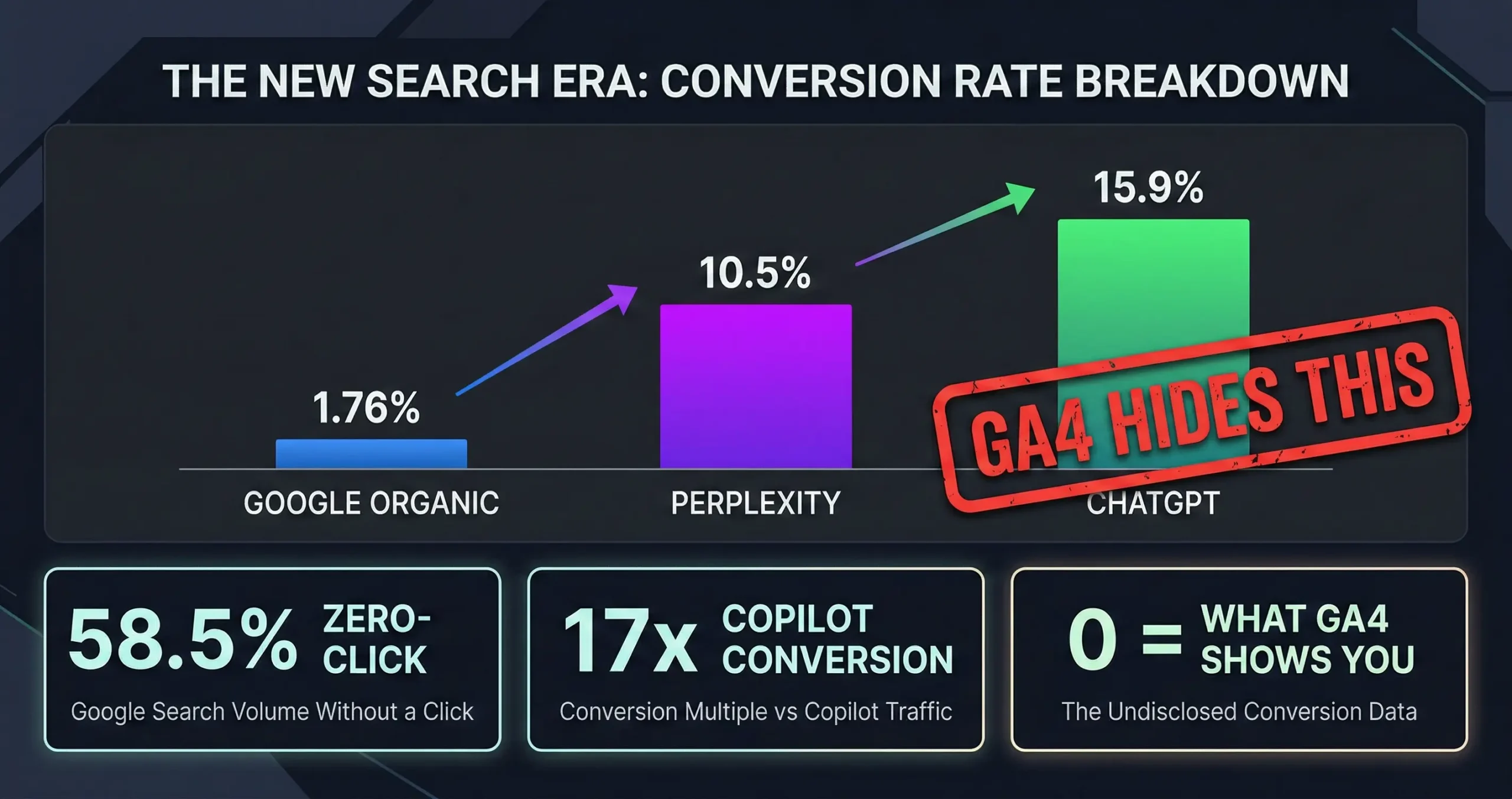
Seer Interactive found ChatGPT visitors convert at 15.9% compared to 1.76% for Google organic. A Microsoft Clarity study of 1,200 sites found Copilot referrals converting at 17x the rate of direct traffic. The traffic is tiny but the revenue impact is massive; you just can’t see it yet. Sources: SparkToro/Datos 2026 (332M queries), Seer Interactive, Microsoft Clarity, Conductor (3.3B sessions). Analysis: Jorge Argota, 10 years in legal marketing, Miami.
So I’m looking at this client’s GA4 dashboard maybe six weeks ago and the numbers aren’t adding up and I keep thinking there’s something wrong with the tracking because the intake team is telling me they signed three cases from people who said they found the firm through ChatGPT but the analytics show zero visits from ChatGPT and I’m sitting there going through the referral sources one by one and it’s all just “Direct” and “Referral” with no detail and I realize the problem isn’t the tracking exactly; the problem is that GA4 was built before AI search existed and nobody at Google has fixed the default channel groupings to account for it, which you’d think would be a priority but apparently not.
58.5%
Google searches end zero click
15.9%
ChatGPT visitor conversion rate
17x
Copilot vs direct conversion
And this isn’t a small gap we’re talking about. A 2026 study from Conductor looking at 3.3 billion sessions found that AI platforms drive roughly 1.08% of total web traffic which sounds tiny until you look at what that traffic actually does once it lands on a page and I’ve been writing about why AI search converts 6x better than Google separately but the short version is that a Seer Interactive study from October 2024 through April 2025 found ChatGPT traffic converting at 15.9% compared to Google organic at 1.76% and Perplexity at 10.5% and I’ve seen similar patterns with the firms I work with where the AI traffic is a trickle but the people clicking through are basically pre sold on hiring someone, which changes the math on everything if you know how to actually see it in your reports.
WHY GA4 IS BLIND TO YOUR BEST LEADS
Why doesn’t Google Analytics track AI search traffic correctly? GA4’s default channel groupings were designed before ChatGPT, Perplexity, and Claude existed as referral sources. The system categorizes most AI traffic as “Direct” or generic “Referral” which means your highest converting traffic is invisible in standard reports. When AI Overviews appear on the SERP, the zero click rate escalates to 83% and organic CTR drops 61%. Source: SparkToro/Datos 2026, Seer Interactive. Analysis: Jorge Argota, 10 years in legal marketing, Miami.
But honestly the analytics gap isn’t usually the problem people come to me about; they come because their managing partner is asking why they’re spending money on AI visibility when the reports show no results and the marketing person can’t prove anything because GA4 is hiding the evidence in a bucket labeled “Other” or “Direct” and the whole conversation turns into a budget fight instead of a strategy conversation, which I’ve watched happen maybe four or five times now with different firms.
The Real Cost of Bad Attribution
The real cost isn’t the misattribution itself; it’s the decisions people make based on bad data. If your reports say zero traffic came from AI search last quarter then someone at the firm is going to look at that and say we should stop investing in structured data and schema markup and entity optimization and put everything back into Google Ads and that’s exactly the wrong move when you look at the conversion economics.
And the data from Similarweb’s 2026 Global Report puts ChatGPT conversion rates at 11.4% compared to 5.3% for standard organic and I don’t have an exact number for legal specifically but the pattern holds across every vertical I’ve looked at; AI traffic converts at multiples of what traditional search sends you. A Microsoft Clarity study analyzing over 1,200 publisher sites found that Copilot referrals converted subscriptions at 17x the rate of direct traffic and Perplexity converted at 7x the baseline rate and those aren’t typos, which maybe should tell you something about where these platforms are headed.
So if your highest converting traffic source is invisible in your reports, what decisions are you making based on data that’s lying to you?
THE GA4 FIX: 20 MINUTES AND YOU’RE DONE
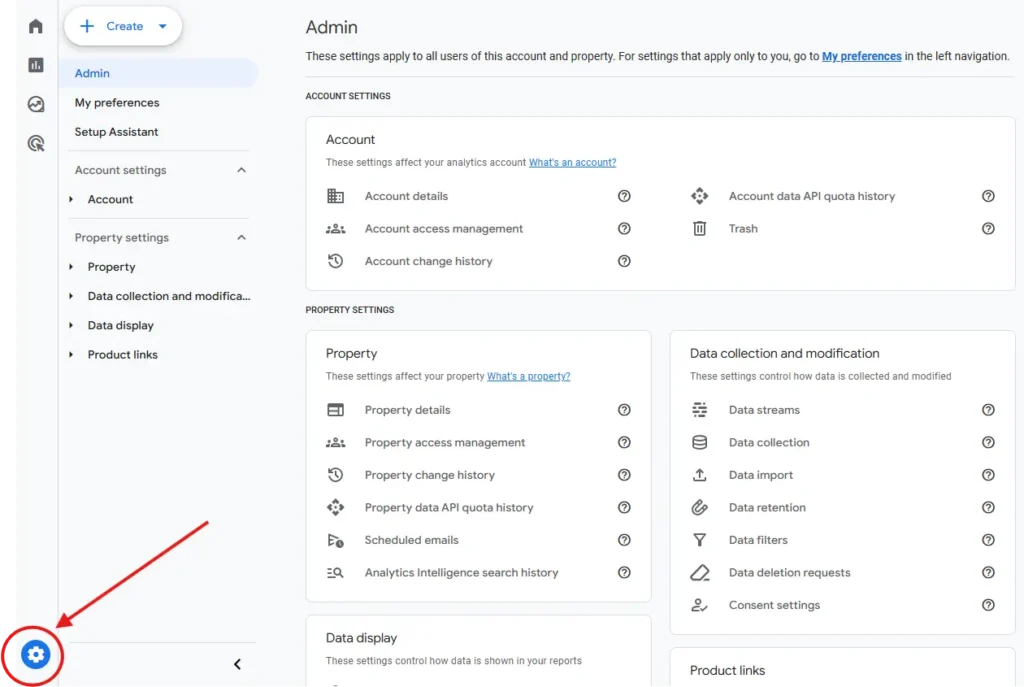
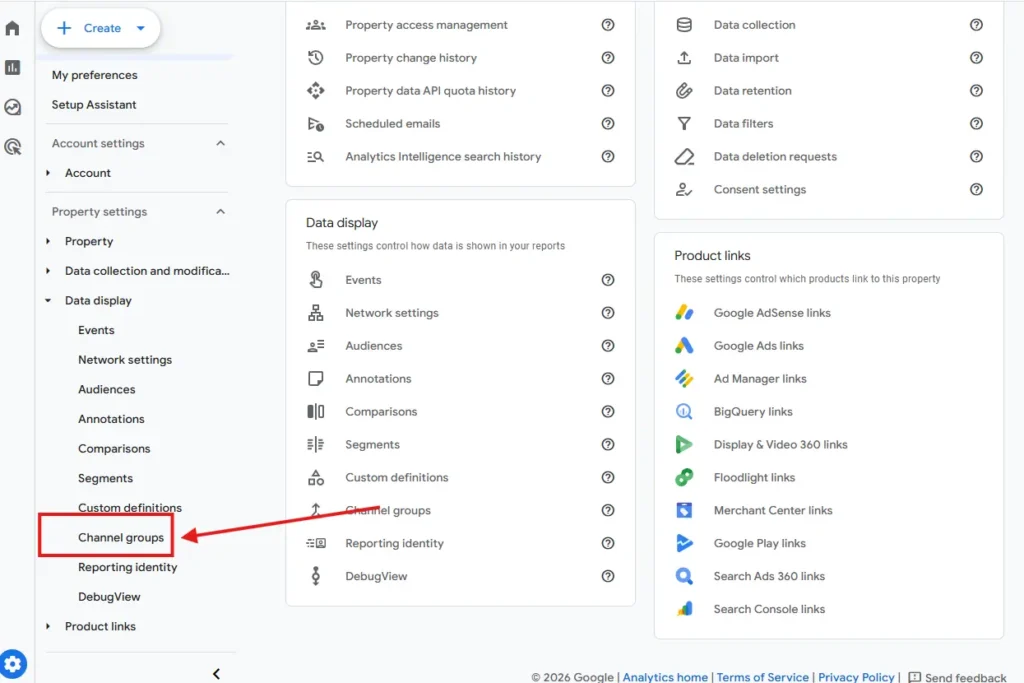
How do you set up AI search tracking in Google Analytics 4? Create a custom channel group in GA4 under Admin → Data Display → Channel Groups. Add a new channel called “AI Search” with the source matching regex chatgpt\.com|perplexity\.ai|gemini\.google\.com|claude\.ai|copilot\.microsoft\.com then drag it above the Referral channel in the priority order so GA4 catches it before dumping it into the generic bucket. Source: GA4 channel grouping documentation, practitioner playbooks 2026. Analysis: Jorge Argota.
Step 1: Go to Google Analytics
Step 2: Click Channel Groups
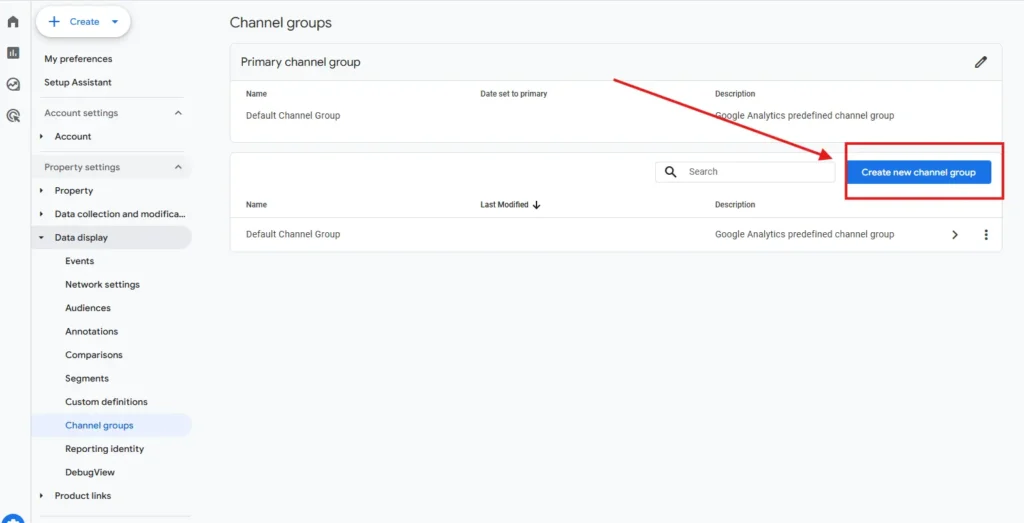
Step 3: Create new channel group
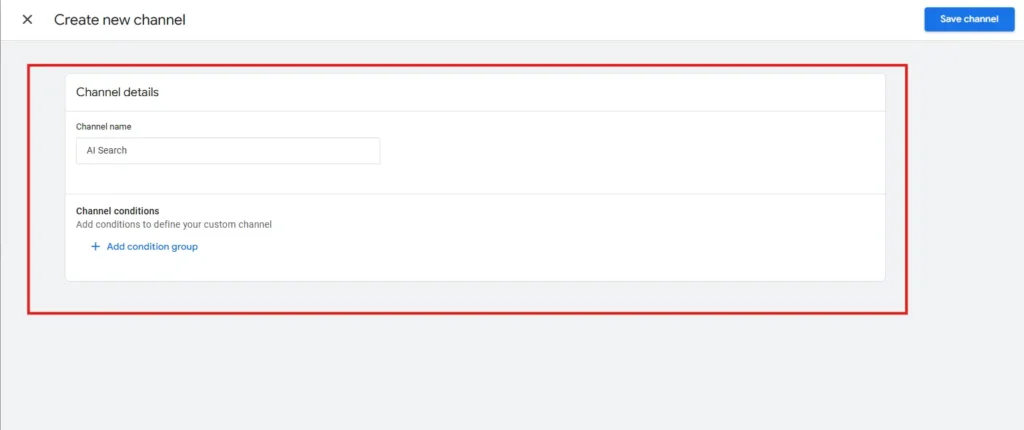
Step 4: Name channel group
Step 5: Add Regex and save
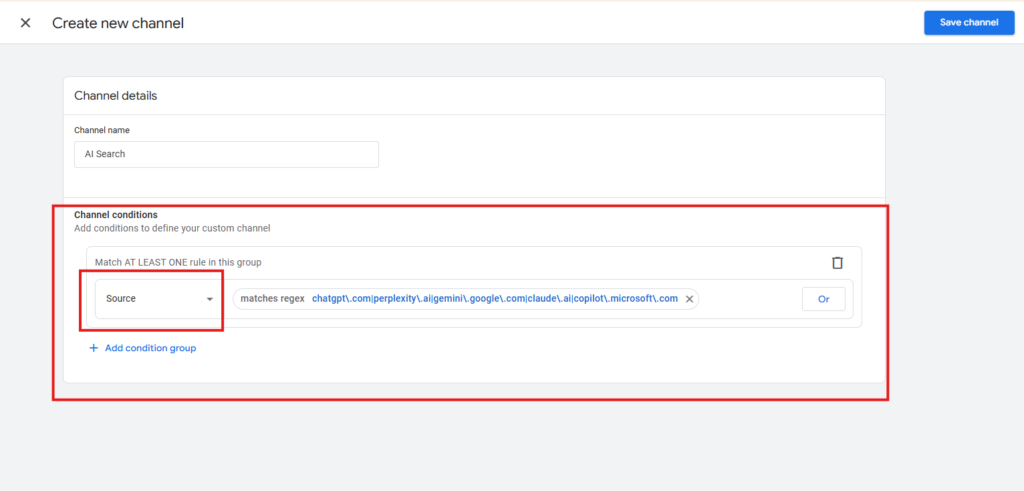
The rough rule on this is you’ve got maybe a 20 minute setup and then you’re done forever and here’s the actual steps because I know people want the specifics. In GA4 you go to Admin then Data Settings then Channel Groups and you click “Create new channel group” which starts with a copy of the defaults and you add a new custom channel and name it something like “AI Search” or “Gen AI Traffic” and set the condition to Source matches Regex and paste in the string I’ll show you below.
The RegEx Rule — Copy This Exactly
chatgpt\.com|perplexity\.ai|gemini\.google\.com|claude\.ai|copilot\.microsoft\.com
Set the condition to: Source matches Regex → paste the string above. Then use the Reorder function to drag this channel above the standard “Referral” channel. GA4 processes rules top to bottom; if placed below Referral, the AI traffic gets incorrectly bucketed before it hits your new rule.
Source: GA4 Custom Channel Grouping documentation — expand this regex as new AI platforms gain market share
And this is the part people miss; you have to use the reorder function to drag this new channel above the standard Referral channel because GA4 processes rules top to bottom and if your AI channel sits below Referral it never gets triggered and all that ChatGPT traffic just keeps disappearing into the generic bucket and you’ll never know it was there, which is basically what’s been happening to every law firm in the country that hasn’t done this yet.
What I Saw After Setting This Up for a Client
I set this up for a firm in Orlando maybe two months ago and within the first 30 days we could see 23 sessions from ChatGPT that had been hiding in the Direct bucket and 11 from Perplexity that showed up as Referral. Out of those 34 sessions they got 4 consultation requests which is an 11.7% conversion rate compared to their Google organic running at about 2.1%. Those 4 consultations turned into 2 signed cases and when you’re talking about personal injury cases that math changes the whole ROI conversation pretty fast.
2.1%
Google organic conversion
→
11.7%
AI search conversion (same firm)
THE INTAKE FORM FIX THAT CATCHES WHAT ANALYTICS MISSES
How do you track zero click AI leads for a law firm? Add ChatGPT, Perplexity, Claude, and Gemini as separate dropdown options in every “how did you hear about us” field on your intake forms and train your intake team to ask the question on every call. A B2B industrial company called Bass Plating secured large contracts directly sourced from ChatGPT recommendations found only through intake form attribution. A SparkToro study found 58.5% of Google searches end zero click; with AI Overviews that jumps to 83%. Source: SparkToro/Datos, HDYHAU practitioner playbooks. Analysis: Jorge Argota.
“I keep hearing about AI search but I have no idea if it’s actually sending us anything.” That’s what an intake manager at a PI firm told me maybe three months ago and she was right; she had no way to know because their form had four options which were Google, Friend Referral, TV Ad, and Other and nobody was selecting Other and writing in ChatGPT because people don’t think of AI search as a distinct thing yet, they just think of it as “I searched online” and pick Google even if they spent 20 minutes in a conversation with Perplexity before clicking through to the firm’s website.
Why Call Tracking Alone Won’t Catch This
What most call tracking vendors won’t tell you is that a lot of AI interactions don’t even generate a click. The AI gives the person the firm’s phone number or name right there in the chat and they call directly or type the URL manually and at that point it shows up as Direct traffic in your analytics and there’s literally no way to connect it back to AI search unless you ask the human being on the phone how they found you.
A SparkToro study analyzing 332 million queries found that 58.5% of Google searches in the US end with zero clicks and when AI Overviews show up that number jumps to 83% which means the majority of your potential clients are getting answers without ever visiting your site and the only attribution method that works is asking them directly, which feels low tech but it’s honest and it’s accurate and I’ll take that over a fancy dashboard that’s lying to me.
At Percy we treated intake like an emergency room and part of that was tracking every single lead back to its source. The same principle applies here; if you’re not asking where people found you with enough specificity to catch AI referrals then you’re flying blind on what might be your highest quality lead source
WHY AI LEADS CONVERT DIFFERENTLY
Why do AI search leads convert better than Google organic leads? People clicking through from ChatGPT or Perplexity have already done their research inside the AI conversation and arrive pre convinced. Behavioral science calls it effort justification; the cognitive work of refining prompts creates commitment to the final recommendation. AI referred visitors convert at an average of 4.4x the rate of traditional organic traffic across industries. Source: Consumer psychology research, Seer Interactive 2026. Analysis: Jorge Argota.
The data on this is pretty clear and I still don’t fully understand all the psychology behind it but here’s what I do know. When someone types “best medical malpractice lawyer in Miami” into Google they get a list of 10 options and their brain is in comparison mode scanning for something to click and most of those clicks are exploratory and they’re window shopping. When someone asks ChatGPT the same question they get a conversation that narrows down to one or two recommendations and by the time they click through to your site they’ve already been told you’re the answer and I wrote about why AI leads convert like referrals in more detail separately but the short version is there’s this thing in behavioral economics called effort justification where the 20 minutes they spent refining prompts makes them psychologically committed to whatever the AI suggests.
Brands that get cited inside a Google AI Overview earn 35% more organic clicks and 91% more paid clicks than brands that just rank in the standard blue links below it. Being visible in AI results actually makes your Google Ads perform better too.
Source: 2026 AI Overview citation study — cross referenced organic + paid click data
So it’s not just about the traffic coming directly from AI; being cited in AI results creates what I’d describe as a halo effect on everything else you’re doing and it changes how you should think about your PPC and SEO budgets working together instead of treating them as separate line items, but that’s maybe a different conversation.
WHAT TO DO ONCE YOU CAN SEE THE NUMBERS
What should a law firm do once they can track AI search leads? Compare your cost per signed case from AI referred traffic against Google Ads and organic separately. If AI traffic converts at 6x to 15x the rate of organic then even small visibility gains in ChatGPT and Perplexity justify reallocating budget toward entity optimization, schema markup, and structured content. Brands with verified presence across four or more third party platforms see a 2.8x increase in AI citation likelihood. Source: Entity consistency research 2026. Analysis: Jorge Argota.
Once you can actually see AI traffic as its own channel the first thing that usually happens is the conversion rate shocks people because it’s so much higher than everything else and then they start asking whether they should shift budget and honestly the answer depends on your situation. If you’re spending $15,000 a month on Google Ads and your cost per signed case from PPC is $8,000 and then you look at the AI channel and see three signed cases from zero ad spend; that’s not a signal to stop running ads but it is a signal that putting resources into making your firm more visible to AI models is probably the highest ROI work you can do right now.
The Compounding Effect
The same schema markup that helps Google understand your practice areas also helps ChatGPT cite you accurately. The same review velocity that improves your Local Pack ranking also builds the confidence signals that AI models need to recommend just one or two firms instead of listing ten. A 2026 study found that brands with verified presence across four or more third party platforms see a 2.8x increase in AI citation likelihood and most of those platforms are places you should be maintaining anyway for regular SEO.
And the way I think about this for firms I work with is you’re not choosing between Google and AI; you’re making sure the work you do for one helps the other. The effort compounds instead of splitting your focus which is kind of the best case scenario for any marketing investment, or at least that’s how I’ve been approaching it with the firms I work with and so far the tracking from click to signed case seems to support it but I’ve only been measuring this for maybe six months so I don’t want to overstate what I know.
The firms that start tracking AI attribution now are going to have six months of data proving ROI while everyone else is still arguing about whether AI search matters.
Want someone to check whether AI search is already sending you leads you can’t see?
If you want me to look at your GA4 setup and your intake forms and tell you whether you’ve got an attribution gap that’s hiding high quality traffic, I’ll do that. And if you don’t need my help I’ll tell you that too, which I know is a weird thing for a marketing person to say but I’d rather you knew the math before you made any decisions. I wrote about how to get your law firm into AI Overviews and the exact citation formula AI uses separately if you want to understand the mechanics first.
P.S. If you’re curious about what your current conversion tracking and attribution setup is actually missing, or if you want to understand the difference between what your agency shows you versus what the data actually says, those are probably worth reading first. And if your firm handles multiple practice areas, the attribution model page walks through how to separate which channels are driving which case types, which gets relevant fast once you start seeing AI traffic as its own source.