

Written by Jorge Argota · Legal Marketing · United States
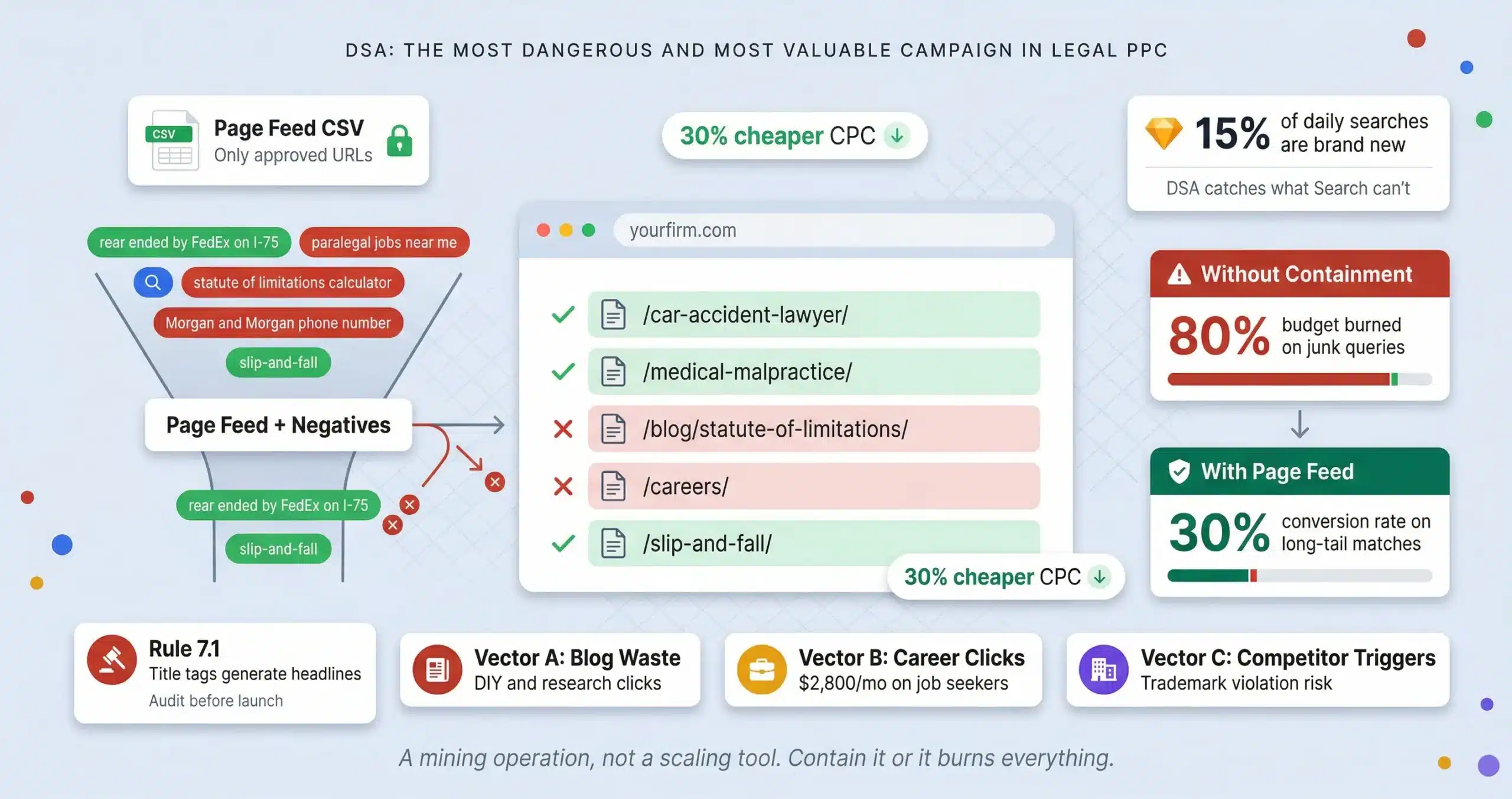
So Dynamic Search Ads are the most dangerous campaign type in legal PPC and also the only one that can find keywords you’d never think to bid on. The problem is that DSA reads your entire website and generates ads from whatever it finds, which means if you have a blog post about statutes of limitations or a careers page or a case study mentioning a competitor’s name, Google will happily spend $200 per click on searches for “statute of limitations calculator,” “paralegal jobs near me,” and your competitor’s phone number. Without containment, DSA burns 80% of its budget on searches that will never produce a signed case.
TL;DR
DSA is a mining operation, not a scaling tool. It’s the only campaign type that bypasses Google’s Low Search Volume filter, which means it can catch hyper-specific queries like “rear ended by FedEx truck on I-75” that standard campaigns refuse to show ads for. Those queries convert at 30% or higher because the user feels the result was made for their exact situation. But without a Page Feed restricting which URLs Google can read and a negative keyword list blocking the waste, DSA will spend your entire budget on blog traffic, job seekers, and competitor name searches before it finds a single case.
80%
budget burned on info queries without negatives
15%
of daily searches are brand new queries DSA catches
30%
cheaper CPC than exact match on average
THE THREE DSA WASTE VECTORS THAT DRAIN LAW FIRM BUDGETS
DSA’s default setting matches your ad to any content on your site. In legal, that creates three specific waste vectors that you have to block before the campaign spends a dollar.
Vector A: Your blog triggers DIY and research searches
Your blog posts explaining statutes, filing deadlines, and legal processes are the biggest waste source. Someone searches “how to file a lawsuit yourself” or “statute of limitations Florida,” DSA reads your blog content, generates an ad, and you pay $150 for a person who explicitly wants to avoid hiring a lawyer. The fix is excluding all informational URL paths from the campaign: /blog/, /resources/, /faq/, /news/. The negative keywords list has the full DIY and research terms to layer on top of the URL exclusions.
Vector B: Your about page triggers career and salary searches
If your “About Us” or “Careers” page mentions hiring, team growth, or job openings, DSA will match those pages to searches for “paralegal jobs near me,” “lawyer salary,” and “law firm hiring.” Exclude /careers/, /about-us/, /team/, and /join-us/ URLs from the Page Feed. One firm I audited was spending $2,800 a month on career-seeker clicks from DSA and the managing partner had no idea because the agency reported it as “traffic growth.”
Vector C: Your content triggers competitor name searches
If you wrote a blog post comparing your firm to a competitor or mentioning a competitor by name in a case study, DSA reads that name and bids on it. Your ad shows up when someone searches “Morgan and Morgan phone number” and DSA auto-generates a headline that could include their name, which is a trademark violation, a potential bar complaint, and a wasted click from someone who already chose the other firm. The conquesting compliance page covers the ethics; the point here is that DSA does this automatically without you knowing unless you’re checking search terms every week.
THE PAGE FEED CSV: HOW TO RESTRICT DSA TO YOUR PRACTICE AREA PAGES ONLY
You cannot trust Google’s crawler to tell the difference between a case study and a practice area page. The fix is a Page Feed, which is a CSV file you upload to Google Ads that tells DSA “these are the only URLs you’re allowed to generate ads from.”
How to build the Page Feed: Create a CSV with two columns. Column A is the page URL; only your top converting practice area pages (/car-accident-lawyer/, /slip-and-fall/, /medical-malpractice/). Column B is a custom label like “High_Intent.” Upload it to Google Ads under Business Data, then set the DSA campaign to target only the “High_Intent” label. This creates a technical air gap. DSA can only generate ads for the specific URLs you approved, which eliminates 90% of the waste from blog posts, about pages, and competitor mentions. If a page isn’t in the feed, DSA can’t touch it.
DSA BYPASSES GOOGLE’S LOW SEARCH VOLUME FILTER: THE HIDDEN GEM FOR LEGAL PPC
This is the reason DSA is worth the risk despite everything above. 15% of Google searches every day are queries that have never been searched before. In legal that means someone searching “rear ended by Amazon delivery van on I-75 exit 42 in Port Charlotte” is a real case worth real money, but if you try to add that as a keyword to a standard Search campaign, Google flags it as Low Search Volume and refuses to show your ad.
Standard Search Campaign
You add the keyword. Google says “Low Search Volume.” Your ad never shows. The case goes to whoever ran DSA or showed up organically.
DSA Campaign (With Page Feed)
DSA matches the search to your /car-accident-lawyer/ page content. The ad shows. The person calls. You signed a commercial fleet case worth six figures because DSA doesn’t care about volume thresholds.
The long-tail profit paradox page covers phrase match and STAG structure as another way to bypass LSV in standard Search campaigns. DSA is the complementary approach; it catches the queries that are too specific and too unique even for phrase match to capture because they’ve literally never been searched before. And these zero-volume clicks convert at 30% or higher because the user sees an ad that matches their exact situation and assumes you specialize in it.
DSA AUTO-GENERATED HEADLINES AND ATTORNEY ADVERTISING ETHICS: RULE 7.1 COMPLIANCE
DSA writes your ad headline from your page title tag, and this isn’t just a budget problem; it’s a disbarment risk. If your practice area page title says “Best Personal Injury Lawyers in Tampa” then that’s what shows up as the ad headline. In Florida, New York, Texas, and most other states, claiming to be the “best” or “expert” in advertising violates Rule 7.1 (misleading communications) because it’s a subjective claim that isn’t objectively verifiable. Most articles about DSA treat this as a “wasted spend” issue. It’s not. It’s a state bar investigation that can end a career, and it happens automatically without the attorney knowing because Google generated the headline from a title tag that was written for SEO, not for advertising compliance. Before launching DSA, audit every title tag on your Page Feed URLs and rewrite them to be strictly factual. “Tampa Car Accident Attorneys” not “Best Car Accident Lawyers Tampa.” Hard-code a compliance disclaimer in Description Lines 1 and 2 (“No fee unless we win. Not a referral service.”) because you control the descriptions even though Google controls the headline.
The launch checklist for legal DSA: Build the Page Feed CSV with only practice area pages. Exclude /blog/, /careers/, /about-us/, /faq/. Apply your full negative keyword list from the account level. Run the title tag audit: open every URL in your Page Feed, check the title tag in the page source, and remove “best,” “top,” “expert,” “leading,” “premier,” “#1,” and any superlative that isn’t objectively verifiable under Rule 7.1. Hard-code disclaimers in the description lines. Set a modest daily budget (start at 20% of your Search campaign budget). Pull search terms every Monday and mine the converting queries back into your standard Search campaigns as exact match keywords. That’s the mining operation; DSA finds the high-value cases that standard campaigns miss, and Search campaigns scale them once you know which queries produce retainers.
Want me to build the Page Feed and audit your title tags for compliance?
Send me your website URL and I’ll identify which pages belong in the DSA feed, flag any title tags that would generate non-compliant headlines, and give you the CSV ready to upload. If DSA isn’t the right fit for your budget I’ll tell you that too.
About Jorge Argota · 10 years in legal marketing. Built Percy Martinez P.A.’s digital operation from a $500 budget to 287 leads in 5 weeks. Manages Google Ads campaigns including DSA for PI, med-mal, and family law firms across Florida. Google Ads certified. Full bio.
Related: 350+ Negative Keywords List · Long-Tail Profit Paradox · Competitor Bidding Compliance · Keyword Intent Taxonomy · PPC Campaign Management