

Written by Jorge Argota · Legal Marketing · United States
Stop asking “what is a good cost per lead.” The only metric that determines profitability is Cost Per Signed Case. To run a sustainable firm, your CPSC should never exceed 15 to 20% of the projected case fee. If you pay more, you are borrowing against future revenue.
Car Accident (PI)
20%
CPSC: $1,500 to $3,000
Medical Malpractice
5%
CPSC: $3,500+
Employment Law
15%
CPSC: $1,000 to $2,500
DUI Defense
20%
CPSC: $400 to $800
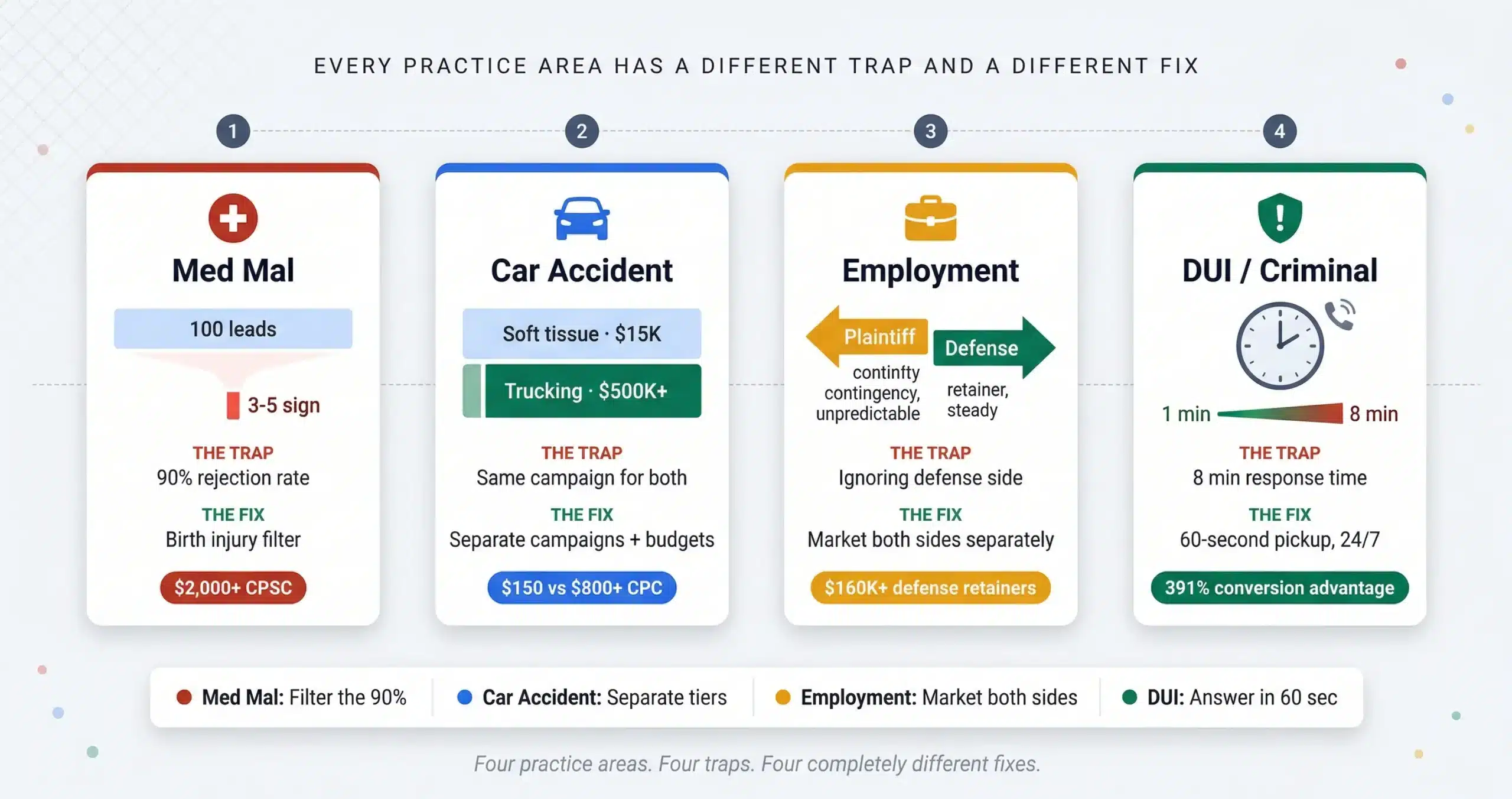
Med mal looks cheap at 1 to 5% but carries a 90% intake rejection rate that inflates the real acquisition cost above $3,500. DUI looks tight at 20% but converts on the first call if you pick up within 60 seconds, so the ratio holds. Car accident PI is the most dangerous because a $200 cost per lead sounds reasonable until you realize only 4 of 50 leads sign and your actual CPSC is $30,000 against a $15,000 fee. If your CPSC is above these thresholds right now, the problem is almost never the ad spend; it’s the conversion rate between lead and retainer.
TL;DR
Cost Per Lead is a vanity metric. Cost Per Signed Case is the only number that tells you whether your Google Ads are profitable. 85% of inbound legal inquiries are unqualified. The industry average response time is 42 hours. 79% of consumers hire the first attorney who responds. This page covers the Golden Ratio for med mal, car accident, employment, and DUI; the Intake Tax that destroys conversion between lead and retainer; the 5-minute decay curve; and the LSA channel that cuts CPSC by two thirds.
CPSC VS FEE: THE LAW OF VIABILITY BY PRACTICE AREA
THE 5-MINUTE DEATH SPIRAL: WHERE YOUR CONVERSION RATE GOES TO DIE
The Golden Window (Under 5 Minutes)
391% conversion lift. The lead is still staring at their phone. You are the first voice they hear. If you call now, you block the other 4 firms they contacted.
The Cooling Period (10 Minutes)
400% drop from peak. They clicked back and are calling the next ad. You are now just another lawyer leaving a voicemail they won’t return.
The Dead Zone (30+ Minutes)
Below 1% qualification. You paid $200 for a voicemail that will never be returned. The Intake Tax consumed your entire margin on this lead.
Source: Harvard Business Review lead response research. Industry average response: 42 hours. 63.5% of firms never respond at all.
Same $10,000 budget. Same 50 leads. Same $200 CPL. The only variable: intake infrastructure.
Why Google optimizes for junk by default: The algorithm chases volume. If soft tissue leads convert at 20% on your form and catastrophic injury leads convert at 1%, Google sends 100% soft tissue to make its own metrics look green. To fix this you need Offline Conversion Tracking.
OCT Implementation Protocol
Step 1: GCLID Capture. Configure your intake software (Clio, Lawmatics, or Filevine) to capture the Google Click ID from the landing page URL on every form submission.
Step 2: The Quality Signal. When you mark a lead as “Signed; High Value” in your CRM, push that data back to Google Ads via API or Zapier integration.
Step 3: Value-Based Bidding. Switch your bid strategy from Maximize Conversions to Target ROAS. The algorithm stops hunting cheap conversions and starts hunting the clicks that produce revenue. The Google Ads cost page covers the full implementation.
WHY LSA CUTS CPSC BY 66%: THE 30-SECOND RULE
Local Service Ads charge per connected lead, not per click. Google only bills for calls lasting longer than 30 seconds. That one structural difference strips out bot clicks, accidental taps, and wrong numbers, which is where most of the waste lives in standard PPC.
PPC Cost Per Case
$2,200
Pays for clicks + noise
LSA Cost Per Case
$750
Pays for qualified calls
The Savings
66%
Reduction in CPSC
LSA has a volume ceiling. Google caps lead delivery based on market demand and review velocity. Max out your LSA allocation first because it carries the lowest CPSC, then layer PPC for the remaining volume. The Local Pack page covers how both channels interact on the same results page.
Get Your Unit Economics Audit
Stop optimizing for clicks. Optimize for contracts.
Leakage Analysis: Your specific Intake Rejection Rate by practice area.
Inventory Audit: Are you buying low-value volume leads or high-value cases?
The True CPSC: Your actual acquisition cost per signed case by practice area.
Related: CPC Benchmarks by Practice Area · Google Ads Cost and ROI · Local Pack vs Paid Ads · Near Me Revenue Engine · Portfolio Theory PPC