

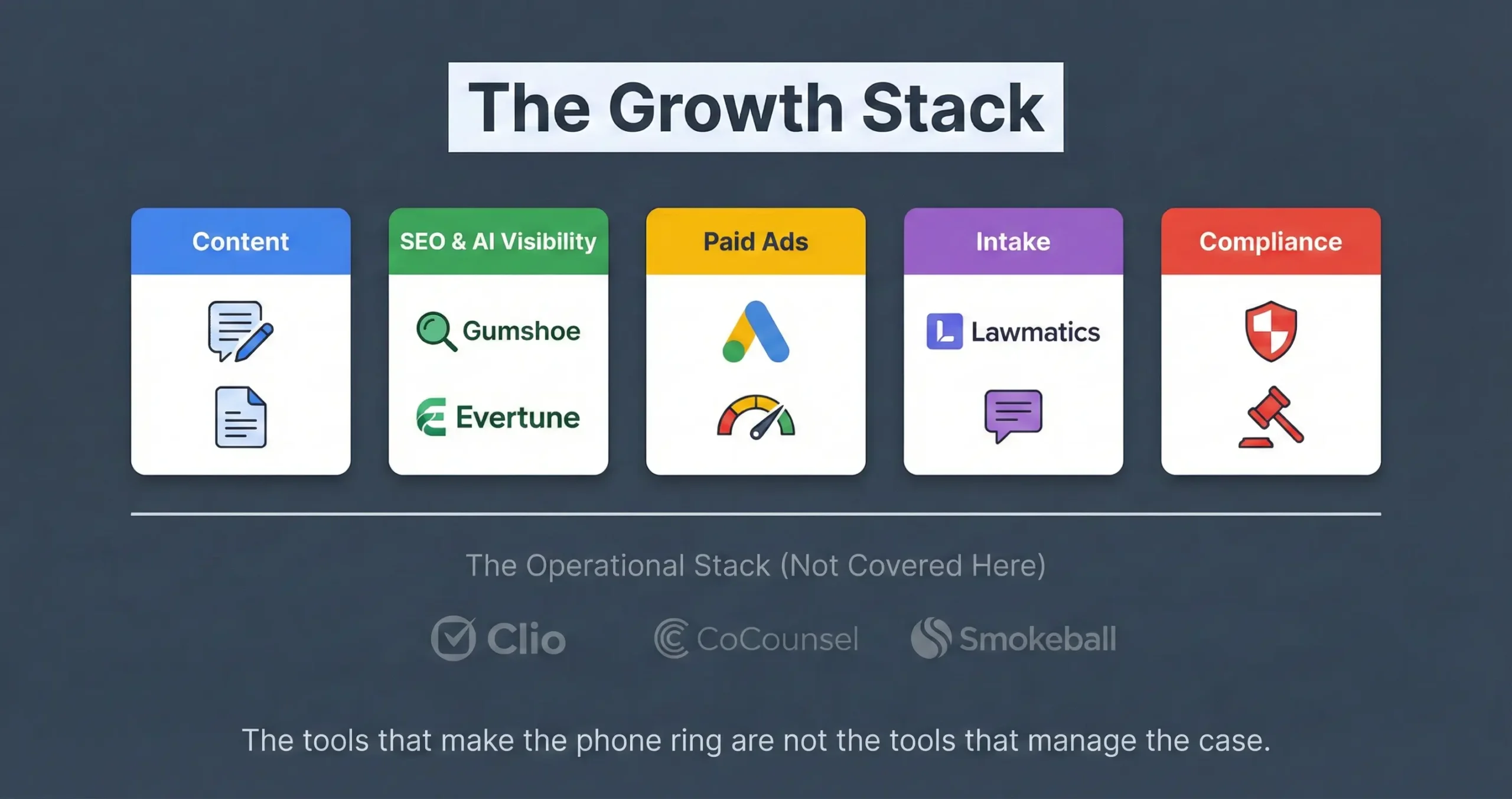
I’ve tested probably 30 or 40 AI marketing tools over the last year and a half and the thing that drove me crazy is that every “AI tools for lawyers” article I found online lumps everything together. They’ll list CoCounsel for legal research next to Jasper for blog posts next to Clio for case management and call it a “complete guide,” and an attorney reading that has no idea which tools actually bring in new clients versus which tools help you manage the clients you already have.
So I wanted to separate the tools that make the phone ring from the tools that manage the case after someone hires you, because those are two completely different jobs with completely different metrics and most firms are spending money on the wrong side of that line without realizing it.
The Distinction Nobody Makes
What is the difference between growth AI and operational AI for law firms? Growth AI covers the tools that generate revenue; content creation, search visibility, ad management, and intake automation. Operational AI covers the tools that deliver legal services; case management, document review, legal research, and billing. The metrics are different, the users are different, and the ROI calculations are different. A firm with the best case management system in the world still fails if the phone doesn’t ring. The growth stack feeds the pipeline. The operational stack processes it. Source: Jorge Argota, 10 years in legal marketing, Miami.
Every legal tech vendor in 2026 has AI in the product name and it gets confusing fast. Clio has AI, Smokeball has Archie AI, CoCounsel does AI research, and then you’ve got Gumshoe AI and Evertune and Lawmatics on the marketing side and they’re all “AI for lawyers” but they do completely different things for completely different people inside the firm.
The way I think about it is there’s a growth stack and an operational stack. The growth stack is everything that happens before someone becomes a client; the content that gets you found, the ads that drive calls, the SEO that ranks your pages, and the intake system that converts the inquiry into a retainer.
The operational stack is everything after; managing the case, doing research, billing hours, filing documents. Both matter but this post is only about the growth side because that’s where I see firms wasting the most money on tools that sound impressive but don’t generate a single new case.
Content Creation Tools That Don’t Sound Like a Robot Wrote Them
Which AI tools should law firms use for content marketing? Claude is strongest for long-form legal content because its large context window maintains accuracy over 2,000 words and its safety framework reduces hallucination risk. Claude also produces genuinely differentiated location pages by incorporating local courthouse details and county-specific regulations instead of template swapping, which Google penalizes as doorway pages. Jasper handles shorter-form brand voice consistency for email sequences, ad copy, and social captions. Copy.ai converts one blog post into LinkedIn, Instagram, and email versions automatically. The Emory University finding is critical: AI-generated content with light human editing ranked on Google’s first page 80% of the time, significantly higher than unoptimized human content alone.
So the content side has gotten interesting because there’s research from Emory University that found AI-generated content with light human editing ranked on page 1 of Google about 80% of the time, which is actually better than most purely human-written content that hasn’t been optimized. And the reason that matters for law firms is that the old way of doing content; paying a writer $500 for a blog post that an attorney never reviews; produces worse results than having AI draft the structure and then having a lawyer spend 20 minutes adding local examples and verifying the citations.
Claude is what I use for anything over 1,000 words because it can hold an entire research document in memory while it writes, which means a partner can feed it ten recent appellate decisions and get a coherent trend analysis back that doesn’t fall apart halfway through.
And for firms that need location-specific pages or multiple practice area pages, Claude is still the better option because you can feed it the local courthouse details and county-specific regulations and neighborhood references and it’ll produce genuinely differentiated content for each page instead of just swapping the city name in a template, which is what most tools do and which Google treats as doorway pages that can get your whole site penalized.
Jasper is useful for shorter-form marketing copy where voice consistency matters across a team; things like email sequences, ad copy variations, and social captions where you want every piece to sound like it came from the same firm. You upload examples of your best content and it replicates the tone, which keeps five different people writing for the firm from producing five different voices.
And for social media specifically, Copy.ai does the thing where you write one blog post and it generates the LinkedIn version and the Instagram caption and the email newsletter snippet all from the same source material, which saves maybe three or four hours a week if you’re active on multiple platforms.
But the Emory finding comes with a condition that I keep emphasizing to every firm I work with; the “human editing” part is not optional. A lawyer has to review every piece before it goes live because the bar rules on AI content make the attorney personally liable for anything published under the firm’s name, including hallucinated case citations that the AI invented and nobody caught.
SEO and Getting Found in the Answer Engines
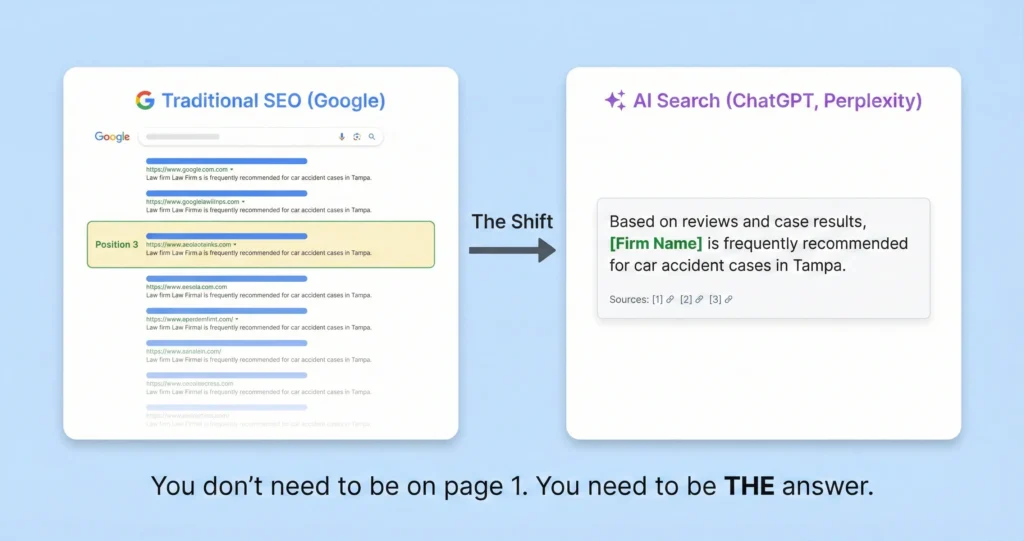
What AI tools help law firms rank in Google and AI search engines? The biggest shift in legal marketing is that ranking on Google is no longer enough; firms now need to show up when someone asks ChatGPT or Perplexity “who is the best car accident lawyer in Tampa.” Gumshoe AI tracks what every major AI model says about your firm across thousands of prompts and shows your “share of LLM” against competitors. Evertune monitors AI brand perception across ChatGPT, Gemini, Claude, and Perplexity while identifying which third-party sources drive AI recommendations. Profound processes 5 million citations daily and tracks real user prompts to show exactly where your firm appears or doesn’t in AI-generated answers. For traditional content optimization, Surfer SEO scores drafts against top-ranking competitors at $99 a month.
There’s a split happening in search right now where people still use Google but they’re also asking ChatGPT and Perplexity questions like “who is the best car accident lawyer in Tampa” and the answer they get from the AI is not based on who has the best website; it’s based on which firm the model associates most strongly with those specific terms across everything it’s been trained on. So traditional SEO still matters but there’s a whole new layer called generative engine optimization that most firms haven’t even started thinking about.
And the reason most firms haven’t started thinking about it is because until maybe six months ago there weren’t any tools to actually measure it. Now there are, and the one I keep coming back to is Gumshoe AI because it does something no traditional SEO tool can do; it runs thousands of prompts across ChatGPT, Gemini, Perplexity, and Claude and shows you exactly how often your firm gets mentioned versus competitors, which topics trigger your brand, and which sources the AI models are citing when they recommend someone else instead of you.
Evertune takes it a step further because it doesn’t just track mentions, it analyzes the sentiment and attributes AI models associate with your firm and then tells you which third-party publishers are driving those recommendations. Their partnership with impact.com means you can actually activate content with the sources that AI models trust most, which is a completely different strategy than traditional link building and most firms don’t even know it exists yet.
For firms with bigger budgets, Profound is the enterprise option and they’re processing 5 million citations daily with a Conversation Explorer built on 400 million real user prompts. They showed a case study where Ramp went from 3.2% to 22.2% AI brand visibility in about a month, and they have SOC 2 and HIPAA compliance which matters for law firms handling sensitive practice areas.
If you’re a smaller firm and you just want to start understanding where you stand in AI search without spending thousands a month, Geoptie is probably the best entry point at $49 a month because it combines visibility tracking with content optimization tools and a GEO audit and a cannibalization checker, and Otterly does basic AI mention tracking for around $25 a month which is about what most solos and small firms can justify while they figure out if this channel matters for their practice areas.
For the traditional SEO side, Surfer SEO and Clearscope still matter for optimizing content that ranks in regular Google results; Surfer scores your draft against the top 10 competitors for $99 a month and Clearscope grades content A through F for $189 a month.
But honestly the bigger opportunity right now is the AI visibility side because almost nobody in legal marketing is competing there yet, and the firms that start tracking and optimizing for AI search in 2026 are going to have a massive head start over everyone who waits until 2027 when the tools are more mainstream and the competition catches up.
For the AI search side specifically, the game is about getting your firm mentioned in places that the language models pull from; legal directories, news articles, bar association publications, scholarly citations. The more your firm name shows up next to “car accident lawyer Tampa” in trustworthy sources, the more likely ChatGPT or Perplexity is to recommend you when someone asks, and most firms have zero strategy for this even though it’s quickly becoming as important as traditional Google rankings.
Ad Tools That Optimize for Cases Not Clicks
What AI tools help law firms manage Google Ads and LSA campaigns? Scorpion’s advertising AI tracks leads through the case management system to see which ones became signed cases, then reverse-engineers the bidding strategy to target similar prospects. This “Revenue Intelligence” approach optimizes for business outcomes instead of form fills. For LSA campaigns, AI tools now transcribe calls and automatically file disputes for invalid leads, recovering thousands in wasted spend monthly. Supio uses case outcome data to inform which demographics and injury types to target with ad budget.
The ad management side is where AI has probably made the biggest practical difference because legal PPC is so expensive that even small improvements in targeting save thousands a month.
Scorpion has moved from being mostly a services company to building what they call Revenue Intelligence, which is the closed-loop reporting I wrote about in the marketing diagnostic post; the AI doesn’t just track whether someone clicked and filled out a form, it follows the lead through the case management system to see if it actually became a signed case and then teaches the bidding algorithm to find more people like that.
For Local Services Ads specifically, the dispute process used to mean someone on your team listening to every single call recording to figure out which ones were wrong numbers or solicitations and then manually filing for a refund with Google. Now there are AI tools built into CRMs like LeadDock and Lawmatics that transcribe the calls, analyze the intent, and file the disputes automatically, and for a firm running $5,000 or $10,000 a month in LSA spend the recovered credits from automated disputes can pay for the tool several times over.
And Supio is interesting because it works the other direction; instead of optimizing ads based on what people clicked, it analyzes your actual case outcomes to figure out which types of injuries and which demographics produced the highest settlements, and then tells your marketing team to target more of those specific profiles, which is the kind of feedback loop that used to require a data analyst and now runs automatically.
Intake AI That Replaces the 20 Question Form
What AI intake tools should law firms use in 2026? Lawmatics is the leading “agentic CRM” for law firms with QualifyAI scoring leads instantly based on intake form data and routing high-value cases to senior partners within seconds. Gideon replaces static intake forms with conversational AI that guides prospects through a natural language interview and can generate retainer agreements on the spot. LawDroid lets firms build no-code AI agents for specific tasks like bankruptcy screening or traffic ticket intake. Smith.ai combines human receptionists with AI data retrieval for after-hours coverage.
I covered intake operations in depth already so I won’t repeat the process side of it, but the tools available now are genuinely different from what existed even a year ago. Lawmatics has something called QualifyAI that scores incoming leads in real time based on what they put in the form; if someone indicates “commercial truck accident” and “severe injury” and “police report available,” the system flags it as priority and pushes a mobile notification to the senior partner within seconds while simultaneously sending the lead a scheduling link, and that whole sequence fires before a human touches anything.
Gideon is the one that I think changes the game for firms that still rely on static web forms, because it replaces the form with a conversation. Instead of making someone fill out 20 fields and hoping they don’t abandon halfway through, Gideon asks questions one at a time based on the previous answer, qualifies the case type, and can even generate a retainer agreement right there for the person to sign. It compresses what used to take two or three days of back-and-forth into maybe five minutes.
And LawDroid lets you build specific bots for specific case types without writing any code, so a bankruptcy firm can have a screening bot that walks someone through the means test questions and a family law firm can have a custody evaluation bot that gathers the basic facts before anyone at the firm spends time on it. The bots handle voice conversations too, not just text, which means they effectively function as an AI receptionist that creates a transcript and schedules the consultation automatically.
The Compliance Layer Most Firms Skip
How do law firms use AI marketing tools without violating ethics rules? Use Enterprise-tier tools with zero data retention policies that guarantee client data is not used to train the public model. Never input confidential case details into free or consumer-grade AI tools. Florida Opinion 24-1 requires AI chatbots to disclose “I am an AI, not a lawyer” to avoid misleading advertising claims. California and New York require attorneys to verify accuracy of all AI-generated content before publication. Every AI-drafted blog post must be reviewed by a licensed attorney because the lawyer is personally liable for hallucinated citations under bar advertising rules.
And none of these tools matter if using them gets you a disciplinary letter, which is a real risk that most “AI tools for lawyers” articles skip over entirely. The ethics rules around AI in legal advertising are still catching up to the technology but there are already specific opinions and requirements that apply.
And the confidentiality side is where firms get into real trouble. If someone at your firm inputs “draft a case study about our settlement in Smith v. Jones where the client got $500,000 for a herniated disc” into the free version of ChatGPT, you may have just exposed confidential client data to a public model’s training set.
Enterprise versions of these tools; ChatGPT Enterprise, Claude’s business tier, Jasper’s enterprise plan; have what’s called zero data retention policies meaning your inputs are not used to train the model and are deleted after the session, and using only those versions is not optional if you’re handling anything that touches client information.
Florida Opinion 24-1 says that if you have an AI chatbot on your website doing intake, it has to clearly state “I am an AI, not a lawyer” because otherwise it’s misleading advertising. And both California and New York now require that any AI-generated content published under the firm’s name be verified by a licensed attorney, which means the tools are safe as long as the workflow includes a human review step before anything goes live. Skip that step and the tool that was supposed to save you time becomes the thing that gets you sanctioned.
Not sure which tools are worth the money for your firm?
I can look at your current marketing stack and tell you where the gaps are and what’s redundant. If what you’re already running is working and you just need to tighten it up, I’ll say that. If you’re paying for six tools that don’t talk to each other and none of them track to signed cases, I’ll show you what to cut.
Secondary CTAs: