

 PPC advertising agency · Mobile, Alabama
Mobile Law Firm PPC for the Gulf Coast and Port Economy.
Google Ads and Local Services Ads for Mobile law firms. Tracking ties each click, call, and form to a retained file. Misdirected spend gets cut, not absorbed. Audit first. Retainer second. Alabama Bar review at the ad template level. One firm per practice area per metro. Managed from our principal strategy desk, customized to Mobile County ad auctions.
Marketing performance only, not legal counsel or guarantees of case outcomes. Ad templates are reviewed by the firm under Alabama attorney advertising rules.
How Mobile law firm PPC handles Alabama Gulf Coast intake, Port of Mobile logistics, and Mobile County workers compensation patterns.
Account diagnosis drives every budget decision.
The account does not move until the audit finishes. The pass covers query history, match type behavior, geographic results, device patterns, intake records, and closed file data. The point is to find where budget leaks and verify whether the structure matches what each practice line returns.
Channel split between Search and LSAs.
Search ads and Local Services Ads do not share a single budget by default. Each channel earns its allocation through the case quality it brings to intake, not the lead total it produces.
Landing page alignment matched to search intent.
Each landing page does two jobs at once: convert the right caller and protect a strong Quality Score. Scope sits above the fold, ad and page tell the same story, load weight stays light, layout is mobile first. Changes follow real behavior, not guesses.
Intake review as part of performance.
Campaign performance turns on what intake does next. Pickup speed, first call screening, and follow up cadence decide whether ad spend ever becomes retained work. Intake is part of the campaign, not separate from it.
Signed case reporting tied to retained matters.
Lead totals, form submissions, and call counts stay useful as background. The headline number stays on retained matters, the cost behind each signed client, and which practice and channel pairings deserve more budget.
- Audit before quoting. A complete audit of the account, intake, and creative comes before any spend recommendation.
- Score the intake. Intake quality is checked first, since a quick pickup converts far better than a delayed return call.
- Split LSAs and Search. Search and LSAs run on their own budgets and rules, separated by practice area instead of evenly.
- Cut curiosity terms. The costly curiosity terms come out first, since the negative list protects more budget than the keyword list spends.
- Report on signed. Reporting is anchored to signed cases and practice area CPA, not to the count of leads generated.
A law firm paid search account rises or falls on one number: the cost behind each retained client. Lead counts, click volume, and form fills function as diagnostics. They explain how that number ended up where it did.
Jorge Argota
Founder · Argota Marketing
What Mobile County paid search actually looks like at the auction level
Five things that change how paid search has to be run in this specific market.
Mobile sits in a different cost tier than the Florida and Georgia metros most legal agencies optimize for. Personal injury clicks in Mobile County typically clear well under the $150 to $400 range that defines South Florida, which changes the entire budgeting math. A Mobile firm exits the Google Ads learning phase faster and collects statistically meaningful data on a smaller monthly spend, so the early optimization window is shorter and the cost of testing a new practice area is lower.
The local economy shapes which campaigns are worth running. Port of Mobile logistics, Airbus final assembly, and Austal shipbuilding concentrate a large industrial and maritime workforce, which means workers compensation and maritime injury queries carry more weight here than in a tourism driven market. Jones Act and longshore queries are low volume but high value, and they need their own tightly scoped campaigns rather than being folded into a general injury account where broad match will bury them.
Hurricane litigation cycles drive seasonal spikes that a static budget misses. After a named storm makes landfall on the Gulf Coast, property and insurance dispute searches climb sharply for several weeks, then fall back. A Mobile account should hold reserve budget for those windows instead of spreading spend evenly across the year, because the signed case value during a post storm surge justifies temporarily outbidding the usual ceiling.
Geo fencing for Mobile has to account for the Eastern Shore and the Mississippi line. Daphne, Fairhope, and the Baldwin County commuter base search from outside Mobile County but retain Mobile firms, so the radius cannot stop at the county boundary. At the same time, spillover toward Pascagoula and the Mississippi coast usually is not worth bidding unless the firm is licensed there, and those terms get added to the negative list early. The result is an asymmetric geo profile that a template radius would get wrong in both directions.
Intake reporting in Mobile is judged the same way it is everywhere in the system: against signed retainers, not call volume. A cheaper Mobile click that produces a maritime or workers comp file the firm wants is worth more than three auto leads that never sign. The dashboard is built to show which corridor, which practice area, and which channel produced the retained work, so budget moves toward the combinations that actually pay.
Which channel earns its place in the account.
Google Ads, Local Services Ads, or both? The honest answer depends on practice area, intake bandwidth, the firm’s review history, and the math behind each retained matter. The mix earns its place by producing retained outcomes, not SERP coverage.
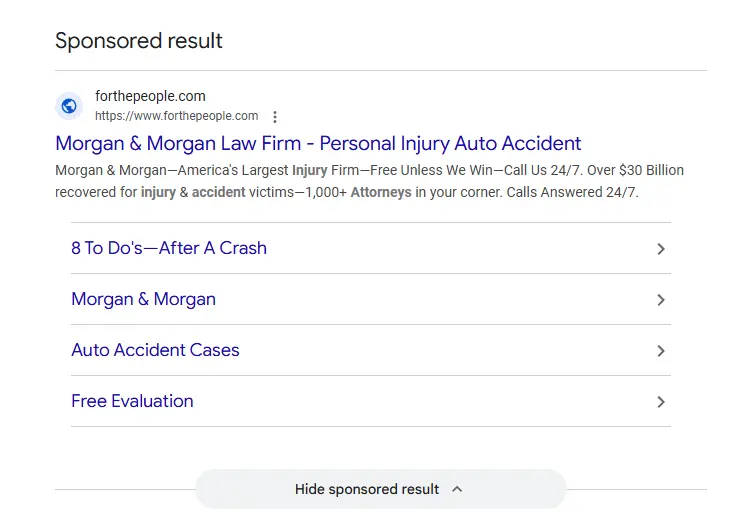
Google Ads usually fits when:
- Direct control over keywords, landing pages, and call routing by practice area matters.
- Campaigns need to chase specific case types or higher value subsegments within a practice line.
- Deliberate budget pacing and structured testing meaningfully change outcomes.
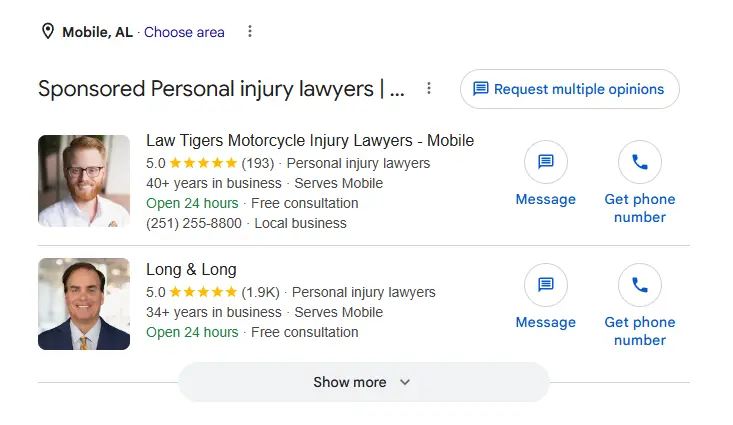
LSAs usually fit when:
- The firm wants a more direct call pipeline with less operational overhead.
- The review profile and intake capacity can absorb quick response volume.
- Local cost dynamics and the firm’s reviews justify paying competitive LSA rates.
A flat 50/50 split is rarely right. Run both only when each passes its own case economics test, then shift based on whichever channel produces retained matters.
Visible fees. Defined scope and accountable structure.
Pricing is simple. The harder question is whether the engagement can drive retained case growth and whether intake can keep pace. Fees appear on the page, tier by tier.
- Single practice area campaign
- Google Search and LSA setup
- Weekly call review
- Monthly signed case reporting
Solo attorneys handling a single practice area.
- Multi practice campaign structure
- LSA vs Search budget split
- Negative keyword and intake screening
- Landing page testing
- Biweekly intake QA and call scoring
- Shared signed case dashboard
Firms running multiple practice lines needing tighter channel and intake coordination.
- Budget allocation and strategy
- LSA vs Search reallocation cycles
- Landing page testing at scale
- Multi market planning
- Intake QA at scale
Firms past the build phase, where budget allocation and growth decisions matter more than initial setup.
Consistent engagement model, fees up front. Pricing tracks management scope, media spend, and reporting depth. Local conditions shape execution, not the offer. A one time setup fee can apply on new builds or messy migrations. Media spend goes to Google directly. No markup, no card on file.
The national law firm PPC framework covers how engagements scale across practice areas. Law firm website design cost covers the landing page side of the funnel.
About us.
Jorge Argota leads the legal marketing work. Ten years inside Percy Martinez P.A., a Miami medical malpractice firm, before agency work across 20+ markets. University of Miami BBA. Google Ads certified. Bilingual, English and Español.
 University of Miami BBA
 Google Ads certified
Questions that come up on PPC audit calls.
Direct answers to the questions firms ask before launching or rebuilding paid search.
Geographic targeting is a strategic call, not a coverage exercise. The right service radius depends on case economics and intake capacity, not how much territory the firm can reach. The city captures the most qualified traffic. Extending into the broader county and Baldwin County across the Bay adds volume at higher cost per retained matter. Practice mix matters too. Firms taking maritime or port adjacent work may extend further than a strict residential practice.
Usually yes when the practice area qualifies for LSAs and the market sustains both. Budget moves toward whichever channel produces better retained case economics, even when that means pulling back the other.
A first qualified call inside the first one to two weeks is typical for a clean build. Retained case data takes 30 to 60 days before the sample size is meaningful. Smaller budgets stretch that window further.
Most underperforming accounts fail in one of three places: targeting set too wide, intake follow up that does not convert calls, or reporting that ends at the lead instead of the retained matter. Struggling accounts usually carry more than one of those at once.
Yes, with conditions. Both get audited at onboarding. Pages that perform get kept with targeted change recommendations. Pages blocking conversion get flagged for separate rebuild scope. Intake gets repaired before any decision to scale spend.
The audit comes
before any proposal.
For firms still deciding whether paid search is worth scaling, repairing, or building from scratch. The audit covers account structure, channel fit, intake, and the case math behind the local market.
- Review of the current Google Ads and Local Services Ads setup, or a recommended structure if nothing is running yet.
- Direct answer on whether the firm’s budget, practice mix, and intake can carry retained case growth.
- Recommendations on keyword scope, geographic targeting, landing page direction, and channel allocation.
No card on file. No long term retainer. The audit is a fixed scope engagement ending with a written recommendation, whether or not the firm continues.