

Written by Jorge Argota · Legal Content Architecture · United States
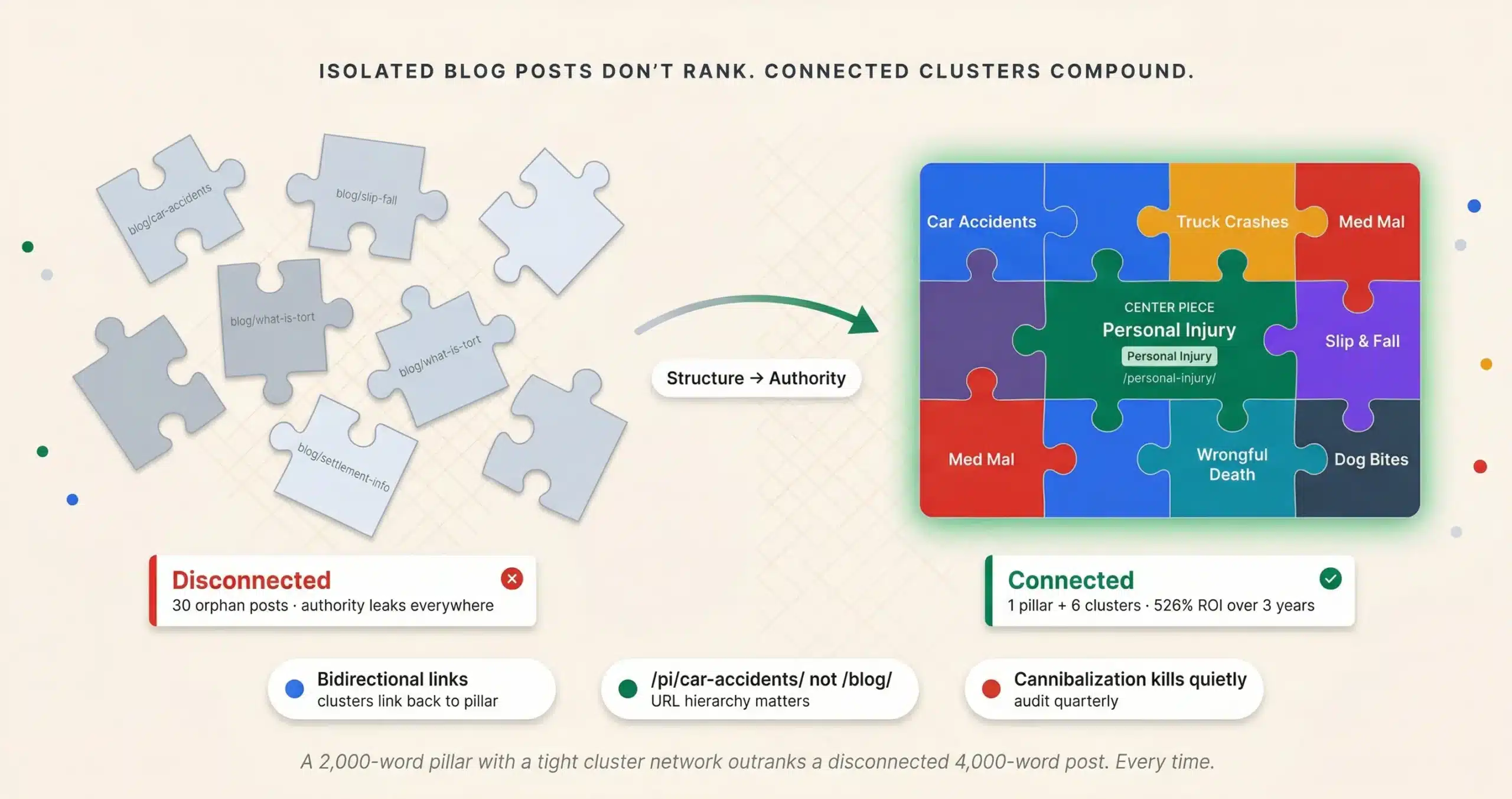
Publishing isolated blog posts and hoping they rank is the 2019 playbook. In 2026, search engines evaluate your site as a semantic network and if the connections between your pages are weak or nonexistent, no amount of keyword targeting saves you. A well organized 2,000 word pillar page with a tight cluster network outranks a disconnected 4,000 word post every time because the algorithm reads structure, not just text.
TL;DR
The architecture: pillar pages as hubs linking bidirectionally to specialized cluster pages (/personal-injury/car-accidents/ not /blog/car-accidents/).
The content: layered semantic grouping (core intent → thematic context → conversational long tail) instead of repeating one keyword.
The ROI: 526% over 3 years with a 14 month average break-even.
The threat: content cannibalization quietly erodes rankings when multiple pages compete for the same query. Source: Jorge Argota, 10 years legal content architecture.
HOW TOPIC CLUSTERS AND PILLAR PAGES WORK FOR LAW FIRMS
A pillar page is a hub that covers one practice area broadly and links out to specialized cluster pages that go deep on specific subtopics. Every cluster page links back to the pillar. This bidirectional linking creates a semantic network the algorithm can crawl as a single unit of authority instead of evaluating 30 disconnected blog posts that don’t know each other exist.
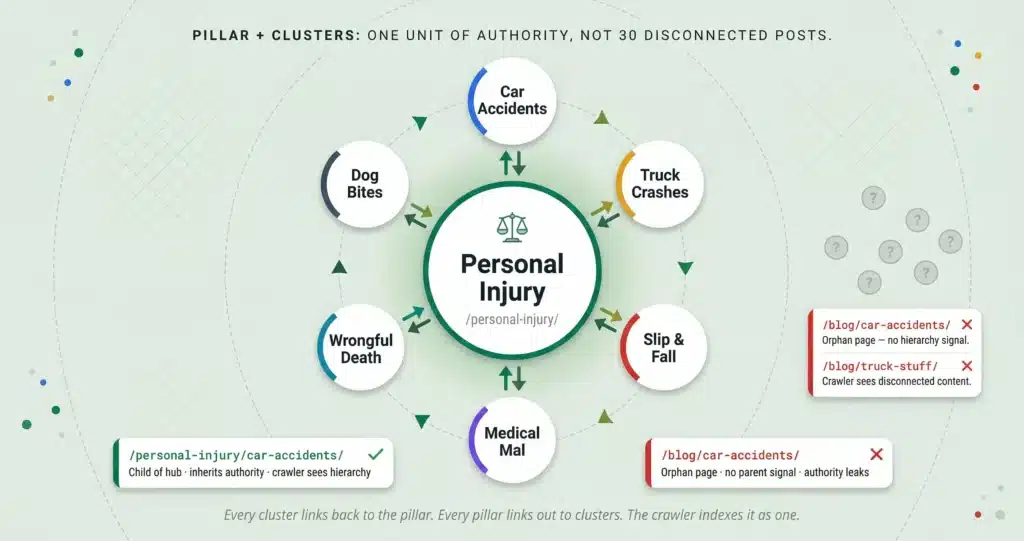
The URL structure matters. /personal-injury/car-accidents/ tells the crawler this page is a child of the personal injury hub. /blog/car-accidents/ tells the crawler nothing about hierarchy. When link equity flows from the pillar down through the clusters instead of leaking into orphan pages, the crawler indexes the entire network as a single unit of authority.
The pillar (hub)
“Personal Injury Law in Chicago.” Broad overview of the entire practice area. Links out to every cluster page. This page accumulates backlinks and distributes authority downward. Use the “First 200 Words” rule: link to your top 5 clusters in the opening section so the crawler hits them immediately.
The clusters (spokes)
“Statute of limitations for commercial vehicle accidents.” “Calculating future lost wages for independent contractors.” “How comparative fault affects insurance settlements in Illinois.” Each page goes deep on one subtopic and links back to the pillar. Anchor text rule: link from the cluster up to the pillar using exact-match anchor text (“Chicago personal injury lawyer”) but link from the pillar down to the cluster using conversational long-tail anchors (“how comparative fault impacts your case”) to avoid over-optimization penalties.
💡 43% organic traffic lift in 6 months
Proper silo structure (parent/child URLs like /personal-injury/truck-accidents/ instead of /blog/truck-accidents/) increases organic traffic by 43% in 6 months because link equity flows efficiently from the pillar down through the clusters instead of leaking into orphan pages that the crawler never finds.
SEMANTIC KEYWORD LAYERING AND CONTENT CANNIBALIZATION
Repeating one exact match keyword 20 times on a page is penalized as unnatural in 2026. Instead, build semantic depth using three layers of terminology that mirror how real people progress through a search session.
⚠ Content cannibalization: the 3 step kill switch
When two pages compete for the same query, Google splits your authority and both rank lower. Run this quarterly:
Step 1: Identify the conflict. Go to Search Console → Performance → Filter by query. If multiple URLs get impressions for the same query, you have a bleed.
Step 2: Select the Alpha. Choose the page with the better conversion rate (not just traffic). Usually this is your service page (the hub), not the blog post.
Step 3: Merge and redirect. Take the valuable content from the losing page (the Beta), move it into the winning page (the Alpha), and implement a 301 redirect from Beta to Alpha. This transfers 90 to 99% of the old ranking power to the consolidated URL.
SEO ROI BY LEGAL SPECIALTY AND BREAK-EVEN TIMELINE
The average law firm spends $120,000 to $150,000 annually on SEO and breaks even at month 14. But the ROI and timeline vary dramatically by practice area because the competitive density and case values are different. Business law breaks even fastest (10 months) and delivers the highest ROI (642%) because commercial client lifetime value is enormous and search saturation is lower than consumer-facing law.
💡 The case study: $20M pipeline from content clusters
A trial attorney generating 60 to 150 views per month invested in deep semantic clusters and E-E-A-T signals. By month 9, a single article on bad faith insurance tactics generated 6,000 views. By month 12, organic traffic had increased 4,300%. In January 2025, the firm secured 12 case leads including severe TBI, commercial trucking, and bad faith claims. They accepted 10 high-value cases with a potential pipeline value exceeding $20,000,000.
AI PARSING, CORE WEB VITALS, AND ABA COMPLIANCE
58% of Google searches now end without a click because AI Overviews synthesize the answer directly on the results page. To get cited by the AI instead of bypassed, your cluster pages need H2/H3 headings formatted as natural language questions followed immediately by a concise 40 to 60 word answer. That exact question-and-answer format is what the parser extracts for Featured Snippets and AI Overviews.
Core Web Vitals (the revenue leak)
Many custom legal websites score 15 to 60 on mobile PageSpeed. For PI firms paying $500 per click, LCP must be under 1.8 seconds. A 1 second delay reduces conversion rates by 7%; on a $150K ad spend, that’s $10,500 wasted every month. Pillar pages must be updated every 6 to 12 months with new case law, compressed images, and answers to emerging queries from intake calls.
ABA Opinion 512 compliance
AI tools can draft outlines and structure content but ABA Formal Opinion 512 mandates strict oversight. Rule 1.1 (Competence): you must understand hallucination risks. Rule 1.6 (Confidentiality): never input client data into public LLMs. Rule 3.3 (Candor): verify every citation; courts have already sanctioned lawyers for submitting AI-generated fake cases. Treat AI output like a first year associate’s rough draft.
TOPIC CLUSTERS AND PILLAR PAGES FAQ
The Cluster Architecture Audit
Cluster Map
Hub and spoke blueprint
Cannibalization Check
Which pages are bleeding
ROI Projection
Break-even by specialty
Send me your sitemap. I’ll map your existing pages against your Search Console data, identify where you’re bleeding authority, and build the hub and spoke blueprint with a break-even projection for your specific practice areas.
About Jorge Argota · 10 years building topic cluster architectures for law firms. Every pillar page I build uses layered semantic grouping, bidirectional internal linking, and quarterly cannibalization audits. Full bio.
Related: SEO for Lawyers · Content Marketing Statistics · Blog Post Length Guide · Multi-Location SEO · GEO for Law Firms · SEO vs PPC ROI