Written by Jorge Argota · Personal Injury SEO · United States
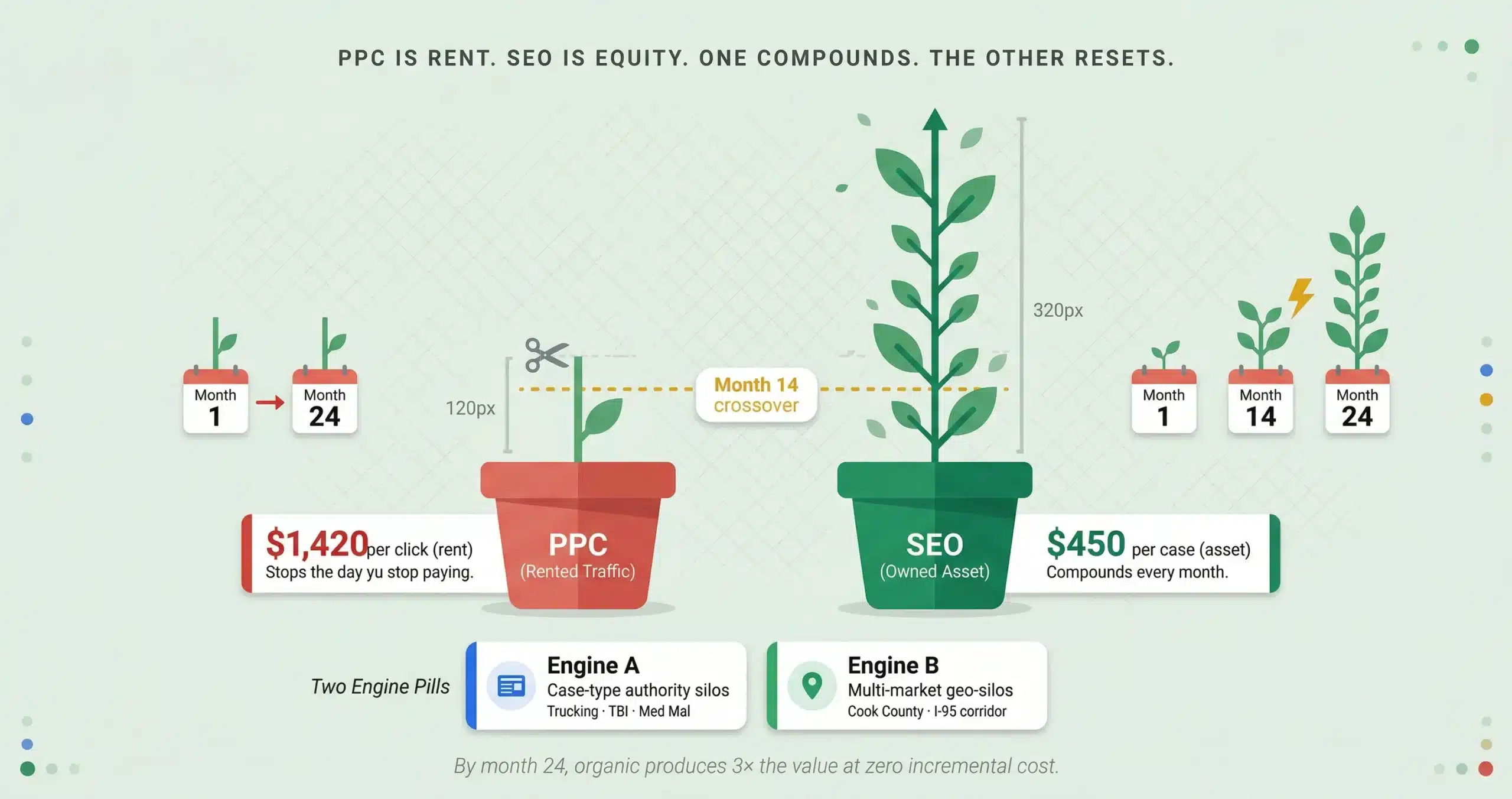
A single click on “trucking accident lawyer” costs $1,420 in 2026. That’s rent. You pay it every month and the second you stop paying, the traffic stops. SEO builds the same visibility as a permanent asset that compounds over time and costs $450 per case once it matures. This page is about the difference between renting your case volume from Google and owning it.
TL;DR
I build PI SEO as two separate engines. Engine A is the Case-Type Authority Silo: deep content clusters around high-value injury categories (trucking, medical malpractice, catastrophic TBI, spinal cord) that capture prospects at the research phase before they pick up the phone. Engine B is the Multi-Market Geo-Silo: hyper-specific local clusters targeting high-value venues (“Cook County Trucking Accident Lawyer”) instead of broad state terms. Together they build permanent search equity that compounds monthly instead of resetting to zero when the ad budget runs out. One firm per market, no conflicts. Source: Jorge Argota, 10 years PI SEO.
THE DUAL ENGINE SEO MODEL FOR PERSONAL INJURY FIRMS
Engine A: PI Case-Type Authority Silos
For high-value PI case types (trucking, medical malpractice, catastrophic TBI, spinal cord injury), I build deep content clusters that cover every angle: liability mechanics, settlement timelines, qualifying criteria, insurance negotiation. This includes emerging PI verticals like autonomous vehicle defects, social media adolescent injury, and algorithmic insurance discrimination. The depth signals to Google and AI platforms that your firm is the definitive authority on that injury category.
Engine B: Multi-Market Geo-Silo
For car accidents and catastrophic injury, you can’t rank nationally with one page. I deploy geo-specific content clusters targeting high-value venues: “Cook County Trucking Accident Lawyer” instead of “Illinois Truck Accident.” This exploits Google’s proximity algorithm for local intent and avoids the $1,420 CPC bidding war on broad terms.
The difference between these two engines matters because case-type research and geographic urgency are fundamentally different search behaviors. Someone researching whether a defective autonomous braking system caused their collision doesn’t search with local intent; they search with diagnostic intent. Someone who just got rear-ended on I-95 searches with immediate local intent. Treating both the same way, which is what most agencies do, means you’re either too broad on the local cases or too shallow on the case-type authority. I run them as parallel systems with separate content calendars, separate keyword maps, and separate performance reporting.
AI SEARCH VISIBILITY AND THE E-E-A-T STANDARD FOR PI
Google’s AI Overviews now appear on 75% of complex legal queries and they’ve cut traditional organic clicks by 34.5%. But firms that get cited inside the AI Overview see a 35% increase in clicks because the AI’s endorsement acts as a trust signal. The question isn’t whether AI Overviews help or hurt; it’s whether your content is structured to be the source the AI pulls from.
Personal injury content falls under Google’s YMYL classification (Your Money Your Life), which means it gets the strictest algorithmic scrutiny. After the December 2025 core update, 85 to 95% of pure AI-generated legal content lost all traffic. Firms that had their agencies pump out 200 blog posts with no attorney review saw a median 42% drop in search impressions. The algorithm now requires verifiable authorship by credentialed attorneys, real case examples, and jurisdiction-specific citations. I build every piece of PI content with an attorney byline, anonymized case references, and schema markup (LegalService, Attorney, FAQPage) so Google’s crawlers can verify the entity behind the content.
⚠ The AI content penalty is real
Google’s January 2025 Search Quality Rater Guidelines instruct evaluators to assign the “lowest quality rating” to AI-generated legal content with “little to no effort, originality, or added value.” Lightly edited AI content lost 60 to 80% of its traffic. The firms that survived and gained visibility are the ones where licensed attorneys write or extensively review every page. That’s how I build content and it’s why none of the sites I manage were hit by any of the three 2025 core updates.
WHY BOUTIQUE PI SEO BEATS THE BIG BOX AGENCIES
💡 The compounding effect (Month 14 crossover)
PPC traffic stops the day you stop paying. Organic content compounds. Month 1 you have 5 pages ranking. Month 6 you have 30. Month 12 you have 80+. Around month 14, organic case volume typically crosses over PPC case volume and the cost per signed case inverts: instead of spending more to grow, you spend less because the asset is doing the work. I’ve seen firms cut their cost per signed case by 40 to 70% over 18 months because organic took over the volume that PPC was paying for.
EMERGING PI TORTS AND EARLY MOVER SEO AUTHORITY
The firms that will own the highest value PI cases in 2027 and 2028 are the ones building content authority on emerging torts right now, before the search volume spikes and every competitor piles in. Three verticals I’m building content silos for in 2026:
Autonomous vehicle liability
Liability shifts from driver negligence to software defect, sensor failure, and algorithmic error. Data logs become the primary witness. Firms with deep content on ADAS failure modes and multi-party tech litigation will own this vertical before it peaks.
Social media adolescent injury
MDL 3047 in the Northern District of California: 2,200+ active cases. A 2025 ruling allowed negligent design claims to proceed. The March 2026 verdict against Meta established “Design Negligence” for teen addiction and search volume for “instagram lawsuit lawyer” is spiking. This PI litigation category is expanding rapidly and the firms with content authority now will own it.
Algorithmic insurance discrimination
AI-driven claim valuations that systematically undervalue injuries for marginalized communities. As regulatory scrutiny increases and litigation mounts, firms with authority content on algorithmic bias in insurance will capture high-value class actions.
Conflict free
I work with one firm per market. If I rank you for “Chicago Trucking Accident Lawyer,” I cannot ethically take your competitor in the same jurisdiction. Your SEO investment doesn’t subsidize someone else’s visibility.
The metric that matters
I spent 10 years in the intake chair. I know a “lead” isn’t a “case” until the retainer is signed. I optimize for net attorney fees, not traffic and not rankings. If the organic channel isn’t producing signed cases at a lower cost than your PPC, the strategy isn’t working and I’ll tell you that.
Apply for market exclusivity
Send me your case type mix, target markets, and current monthly spend. I’ll run the market equity analysis: the exact crossover point for your budget, the keyword gap between you and your top competitor, and the projected 24 month asset value of your content silos. I take one firm per market so if your geography is already taken I’ll tell you immediately. Your intake team needs to be ready for 50+ qualified leads per month once the asset matures.
About Jorge Argota · 10 years building organic search visibility for PI firms. Every content silo I build survives core algorithm updates because it’s authored by credentialed attorneys, not AI. Full bio.
Related: PI Marketing Service · PI PPC Management · AI Search Visibility · SEO for Lawyers