

Written by Jorge Argota · Legal Marketing · United States
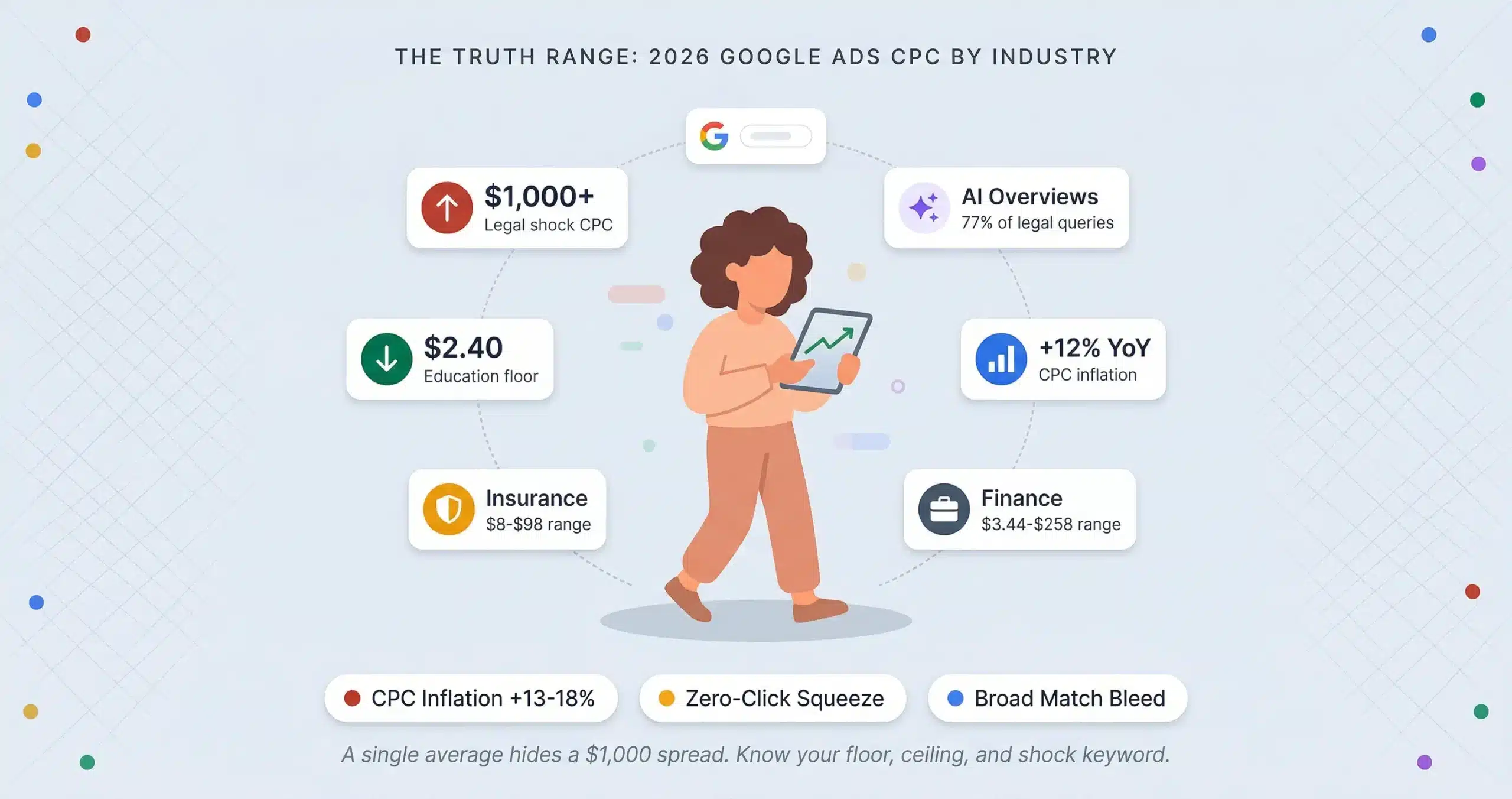
Global CPCs have climbed to an average of $5.26. That’s a 12% year-over-year surge. But for high stakes industries like Legal, Finance, and Education, “average” is a dangerous metric.
A standard $8.50 Legal CPC is a myth. It’s a mathematical blend of an $11 bankruptcy click and a $1,000 trucking accident click. Using one to plan the other is how budgets fail. The same distortion exists in Finance, where an $80 investment banking click averages down to $3.44 when blended with personal banking queries, and in Education, where a $70 online MBA click averages down to $2.40 when mixed with local tutoring. Most published benchmarks contradict each other because they fail to distinguish between broad match noise and exact match intent.
This page ignores the single number fallacy. Instead it gives you the Truth Range: the conservative floor, the aggressive ceiling, the shock keyword that represents the true market peak, and the three 2026 forces (AI Overviews, match type bleed, and a nine year antitrust finding against Google) that are changing these numbers faster than the annual reports can track them.
TL;DR
Legal is the most expensive industry on Google Ads. But “expensive” means different things at different match types. This page breaks down the real CPC ranges for Legal, Finance, Insurance, and Education with the conservative floor, the aggressive ceiling, and the shock keyword that represents the maximum. Plus the three macro trends reshaping all of these numbers in 2026: AI Overviews stealing clicks, broad match inflating volume while tanking conversion, and year-over-year CPC inflation running 13 to 18%.
THE TRUTH RANGE: 2026 INDUSTRY BENCHMARKS
The conservative column is what your account-level report shows. The aggressive column is what you pay for the keywords that actually convert. The gap between them is where most benchmarks articles mislead you.
THE HIDDEN TAX: PROJECT BERNANKE & THE 2026 CORRECTION
Legal advertisers spent over $2.5 billion on ads in 2024 across 26 million distinct placements. But the volume of digital ads actually decreased by more than 50% during the same period that digital spend increased by 84%. You paid more for fewer ads. And part of the reason is something most advertisers don’t know about.
Project Bernanke (DOJ Antitrust Findings)
Federal court proceedings in 2024 and 2025 revealed that Google engineers systematically manipulated the ad auction through an internal initiative called “Project Bernanke.” The system deflated competing bids while inflating the highest bid before it entered the auction, resulting in CPC increases of 4 to 5% annually independent of market demand for nine consecutive years (2016 to 2025).
For context: the most expensive legal keyword in 2019 (Florida mesothelioma) peaked at $485 per click. By 2025, the ceiling crossed $1,000. Some of that increase is real competition. Some of it was manufactured by the platform selling you the clicks.
Affected advertisers are currently being enrolled in class action reimbursement litigation and may recover up to 30% of overcharged spend from that window.
The 2026 defense: Because Google inflated bids to win auctions, running “Maximize Conversions” without a Target CPA became a blank check to the platform. Stop running open auctions. Set a strict Target CPA or Portfolio Bid Strategy cap on every campaign to prevent algorithmic inflation from consuming your margin.
THE BIG 4: HIGH-COST INDUSTRY DEEP DIVES
3 FORCES RESHAPING EVERY CPC IN 2026
CPC Inflation: 13 to 18% Year Over Year
The global average CPC rose from roughly $4.66 to $5.26 in the last 12 months. Legal services saw an even steeper climb at 12.88% to an average of $8.58. This isn’t a spike; it’s a structural trend driven by more advertisers entering every auction and Google reducing organic real estate to make room for ads and AI Overviews.
The Zero-Click Squeeze (AI Overviews)
58% of Google searches now end without a single click to an external website. AI Overviews answer the query directly on the results page. This reduces total click volume, which means the remaining clicks carry higher intent but cost more because the same number of advertisers bid on fewer interactions. LLM-driven traffic is projected to surpass traditional search traffic by 2028, and ChatGPT is now serving ads to its 800 million weekly active users.
Match Type Bleed: Broad Match Inflates Volume While Tanking Conversion
Google’s push toward broad match lowers the visible average CPC because it includes cheap, irrelevant queries in the blend. But the conversion rate drops because you’re paying for “lawyer salary” and “lawyer TV show” at the same price as “hire a lawyer near me.” The published benchmark CPC looks lower than what you actually pay for converting traffic.
PROTOCOL: THE “BEAT THE BENCHMARK” CHECKLIST
Audit your Search Terms report with N-gram analysis. Break your query data into single words and two-word phrases to find hidden budget drains. If the word “salary” or “free” appears across hundreds of different queries, one negative keyword blocks them all. In legal, you’re paying $8+ per click for “lawyer jokes” and “lawyer salary” if your broad match settings aren’t filtered.
Quality Score defense. In legal and finance where CPCs are the highest, your Quality Score determines what you actually pay per click in the auction. The CPC benchmarks page covers the full QS lever mechanics; the short version is that improving it from baseline to high-performance can cut your actual CPC by 30 to 50% on the same keyword. The negative keyword lists are the fastest path because they filter irrelevant impressions that tank your CTR.
Feed conversion data back to Google. If you don’t tell the algorithm which clicks became paying clients (via Offline Conversion Tracking), it optimizes for the cheapest conversions, which are usually the lowest quality. The CPSC page covers the full implementation protocol.
Match your bid strategy to intent, not volume. In finance and insurance where window shopping inflates CTR, switch from Maximize Clicks to Target CPA or Target ROAS. In education, adjust bids seasonally (increase Q3, decrease Q1) instead of running flat bids year-round.
Running ads in a high-CPC industry?
Pull your Search Terms report, your Quality Score distribution, and your conversion data. If any of those three are missing or broken, you’re paying benchmark prices for below-benchmark results.
Related: Legal CPC Benchmarks · Most Expensive Legal Keywords · Cost Per Signed Case · 350+ Negative Keywords