






TL;DR
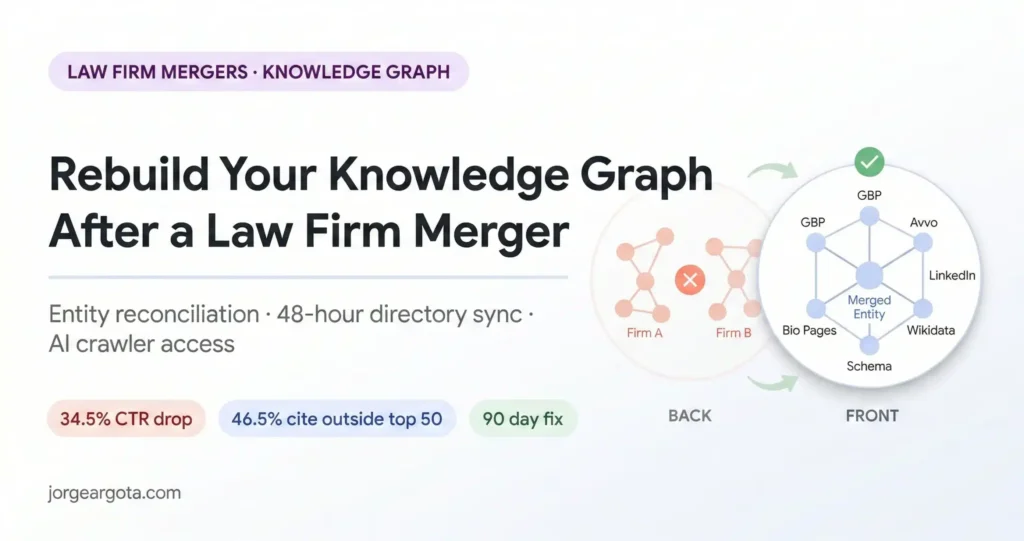
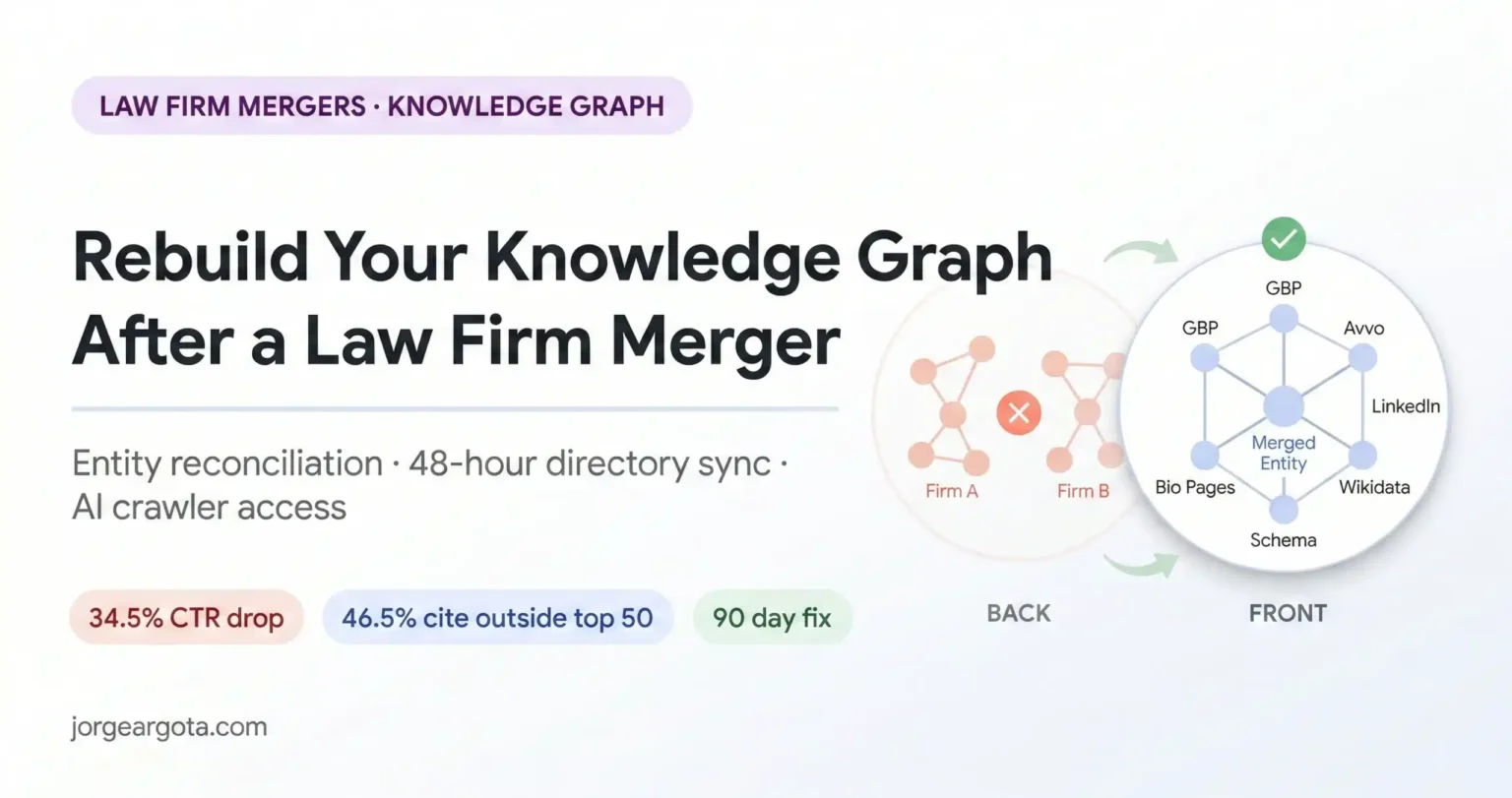
How do you rebuild a law firm’s knowledge graph after a merger? You treat entity reconciliation as a 90 day sprint; first 30 days you stop the bleeding by fixing robots.txt for AI crawlers and mapping every duplicate GBP and conflicting NAP listing, days 31 through 60 you deploy nested LegalService schema connecting legacy firms to the new entity and update all directory profiles within a 48 hour window, days 61 through 90 you build individual attorney entities with Person schema and start tracking AI citation share across ChatGPT and Perplexity. The firms that skip this lose their Knowledge Panel entirely; Google deleted billions of unstable entities in mid 2025 and unreconciled mergers were the first to go.
How do merged law firms fix their digital presence for AI search? When two firms merge the Knowledge Graph fractures because Google, Bing, and Wikidata can’t automatically reconcile two separate entities into one. The fix requires deploying LegalService schema with alternateName and sameAs properties linking legacy firms to the new entity, synchronizing all directory listings within 48 hours to prevent aggregator reversion, implementing 301 redirects with exact page to page mapping to preserve topical authority, and building individual attorney entities so AI engines recognize them as experts under the new brand. 46.5% of AI Overview citations come from pages outside the top 50 in traditional rankings which means entity clarity matters more than rank position. Source: Jorge Argota
“We merged eight months ago and ChatGPT still recommends the old firm.” That’s what a managing partner at a 40 attorney practice told me maybe six weeks ago and the frustration in his voice was the kind that comes from spending money on something nobody warned him about, because their agency had handled the domain migration and the redirects and technically everything was fine from a traditional SEO standpoint but nobody thought about what happens when an AI engine tries to figure out which firm this attorney actually belongs to now and finds two conflicting answers across Avvo, LinkedIn, Martindale, and the firm’s own schema markup.
And the thing is I’ve seen this exact scenario play out maybe four or five times in the last year alone which tells me it’s not a rare edge case; it’s what happens to every merged firm that treats the digital transition as a website project instead of an entity reconciliation project, and the difference between those two things is the difference between showing up in AI search results and being algorithmically erased from them, which sounds dramatic but isn’t when you look at what actually happened to unreconciled entities during Google’s mid 2025 Knowledge Graph cleanup.
WHAT ACTUALLY BREAKS WHEN TWO FIRMS MERGE
What is entity reconciliation?
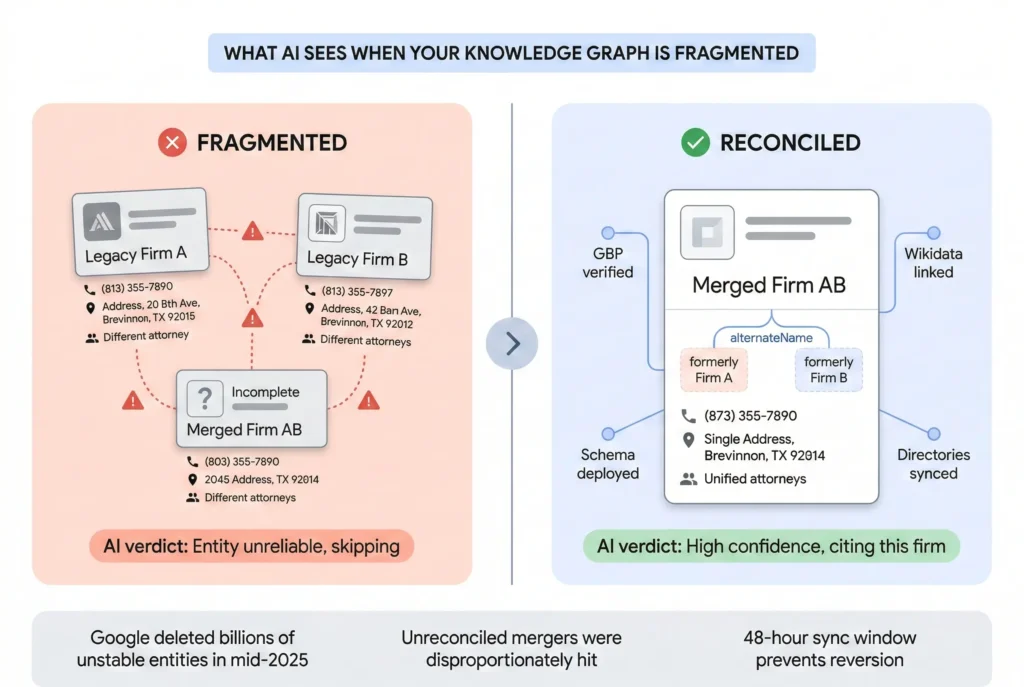
The process of giving computational systems an unambiguous identification of who you are. When Firm A and Firm B become Firm AB, Google’s Knowledge Graph doesn’t figure that out on its own; it sees conflicting names, addresses, and affiliations and either maintains separate panels for both legacy firms, creates a new incomplete panel, or merges them incorrectly.
So take a typical midsize merger and run through what actually breaks. You’ve got two domains, two sets of Google Business Profiles, two attorney rosters with independent E-E-A-T signals, two content libraries with overlapping practice area pages, and maybe 15 or 20 directory listings per firm across Avvo, Justia, Martindale, LinkedIn, state bar sites, and a handful of legal directories that Google’s AI already favors. When the merger happens the press release goes out, the new website launches, and everyone assumes the digital side is handled because the agency set up 301 redirects and updated the homepage.
But here’s what nobody checks; whether Google now maintains three Knowledge Panels instead of one, whether Bing’s entity store which directly feeds Copilot still points to the old firm’s Wikidata entry, whether the attorneys’ Person schema on the new site still lists the old firm in their worksFor property, or whether the 40 directory listings across both legacy firms are sending conflicting NAP signals that make AI crawlers treat the whole entity as unreliable and just skip it entirely.
⚠️ The part that makes this urgent: Google ran a “clarity cleanup” in mid 2025 that deleted billions of unstable entities from the Knowledge Graph. Unreconciled merged firms were disproportionately hit because the conflicting signals made their entities look like spam or data errors, not legitimate businesses. If your merged firm lost its Knowledge Panel and you don’t know why, this is probably why.
But how many firms actually audit their Knowledge Graph status before or after a merger?
THE 48 HOUR DIRECTORY WINDOW NOBODY TELLS YOU ABOUT
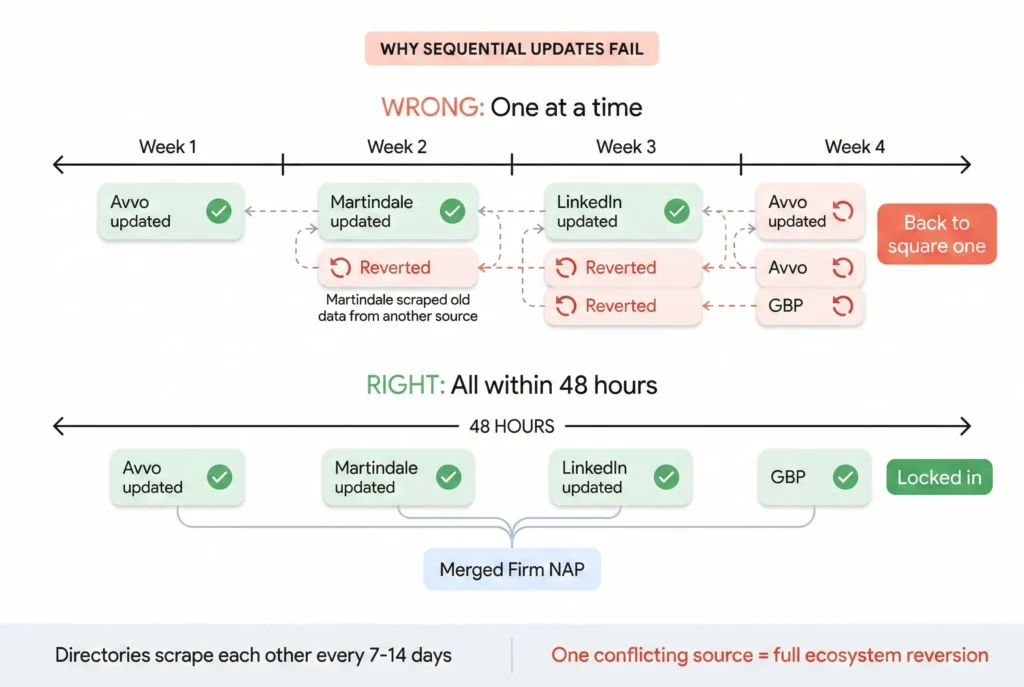
The data on this is something I didn’t fully appreciate until I watched it happen in real time; third party legal directories programmatically scrape each other for NAP data which means if you fix your listing on Avvo but Martindale still shows the old firm name then Avvo’s next automated refresh pulls the conflicting data from Martindale and reverts your update, and you end up in this loop where nothing stays fixed because the ecosystem keeps feeding itself stale information. Google’s 2026 guidelines make this worse because maintaining multiple profiles for the same physical location is an explicit policy violation that can trigger an automated hard suspension which removes your firm from Maps and local search entirely, and if two GBPs get manually merged by someone on your team instead of going through Google Support the reviews often vanish and the images are gone permanently.
Tier 1 — Foundational
Google Business Profile
Bing Places
Apple Business Connect
Wikidata
Tier 2 — Legal Specific
Avvo
Justia
Martindale-Hubbell
FindLaw / Super Lawyers
Tier 3 — Professional
LinkedIn (Firm + Attorneys)
State Bar Directories
PACER / Court Filings
University Alumni Pages
The protocol is to update all three tiers simultaneously within a 48 hour window. Not sequentially over a few weeks, not “we’ll get to Martindale next month.” Within 48 hours. Because the moment the aggregators detect a conflict between any two sources they revert to the older data which is the pre merger data and you’re back to square one, and I’ve watched this happen to a firm that spent three months slowly updating profiles one at a time and wondered why nothing was sticking. The directories kept pulling from each other and undoing every change because there was always at least one source still showing the old information, which is maddening but also completely predictable once you understand how multi location attribution actually works.
THE DOMAIN MIGRATION MISTAKE THAT ERASES TOPICAL AUTHORITY
Run the numbers on what a careless domain migration costs. You’ve got maybe 200 pages of content across two legacy sites and each one has built topical authority through internal linking, content clusters, and citation density over years. If someone on the team just dumps both sites onto a new domain without exact page to page 301 redirects and without maintaining the semantic hierarchy of the content clusters, LLMs lose the ability to evaluate that content as a coherent body of expertise. And here’s the number that should concern you; 46.5% of Google AI Overview citations come from pages that rank outside the top 50 in traditional organic search, which means the AI isn’t looking at your rank position, it’s looking at your entity clarity and content structure and whether it can extract a reliable answer from your page, and if the page relationships are broken because the migration was sloppy then you’re invisible to the system even if your traditional rankings recover.
HOW EACH AI ENGINE FINDS AND USES YOUR CONTENT DIFFERENTLY
ChatGPT pulls nearly 90% of its citations from pages ranking position 21 or lower and heavily favors encyclopedic, wiki style explanations with definitive phrasing. It loves business and service sites for entity queries.
Google AI Overviews cite an average of 13.3 sources per summary and rely on E-E-A-T signals plus structured elements like comparison tables, FAQ schema, and numbered lists.
Perplexity runs true RAG architecture and values extreme recency; it cites content updated within the last 30 days and relies heavily on dense statistics with explicit data attribution.
Bing Copilot feeds directly from Bing Places, LinkedIn data, and Wikidata. If your merged firm’s Wikidata entry still points to the old entity, Copilot will hallucinate the existence of the legacy firm.
This is why a blended formatting strategy matters; you can’t optimize for just one engine.
And then you’ve got the zero click acceleration problem on top of all of this. AI Overviews now trigger on roughly 18% to 30% of Google queries and the average CTR for top ranking pages drops by 34.5% when an AI summary appears, with some queries collapsing by up to 61%. Firms in the middle of a merger that lose entity clarity don’t just drop in traditional rankings; they get completely displaced from the AI summaries that are now the primary interface for legal consumers, because the LLM defaults to more stable competitor entities during retrieval. It picks the firm it can verify, and if it can’t verify yours because your Knowledge Graph is fragmented, it picks someone else, which is the kind of thing that most agencies never mention during the merger transition because they’re focused on the website build and not the entity architecture.
YOUR ATTORNEYS HAVE THEIR OWN ENTITIES AND THEY JUST BROKE
So the merger closes in January and the new site launches in February. By April the managing partner’s bio page on the new domain has zero connection to the 15 articles she published under the old firm’s domain, her Google Scholar profile still links to Legacy Firm A, her LinkedIn says Merged Firm AB but her Avvo profile says Legacy Firm A, and her Person schema on the new site either doesn’t exist or still has the old worksFor property pointing to a domain that now 301s somewhere else. By June AI engines have effectively forgotten she’s an authority on anything because the signals are contradictory and showing up in AI Overviews requires the kind of entity consistency that a fragmented post merger footprint simply cannot provide.
Side note: AI systems don’t hire law firms. They synthesize the perceived expertise of the individual attorney entity. Content published by an anonymous “Legal Team” consistently ranks lower and gets cited less than content attributed to a verified attorney with a transparent digital footprint. If your firm publishes blog posts without clear author attribution linked to Person schema, you’re invisible to the system at the individual level, which is where the actual citation happens.
The fix is a specific checklist that I’ve seen work when executed properly. You need precise 301 redirects from the old bio page to the new one, not a blanket redirect to the homepage. You update the worksFor property in the Person schema to point to the new organization’s @id. You log into every directory where the attorney has a profile; LinkedIn, Avvo, Justia, Martindale, university alumni page, state bar; and update the current employer link to the exact URL of the new bio page. You claim their Google Scholar profile if they’ve published anything. And if they’ve been quoted in media or spoken at conferences you make sure the host organization’s site uses Event schema with the performer property linking back to the new bio URL, because that’s what builds the kind of multi platform entity authority that AI engines trust.
An attorney’s E-E-A-T signals are independent of the firm. When they move to a merged entity without methodically reconnecting every digital thread, the AI doesn’t transfer their authority; it just loses track of them.
THE FILE MOST MERGED FIRMS FORGET EXISTS
In 2024 a bunch of publishers blocked AI crawlers to protect their content. By mid 2025 the distinction between training crawlers and search crawlers became the critical line, and by 2026 most professional service firms figured out that blocking search bots is fundamentally counterproductive if you want clients to find you. But merged firms have a specific problem here; the new domain’s robots.txt is often a copy of one of the legacy domains and nobody checks whether it’s actually allowing the right bots. OAI-SearchBot, ChatGPT-User, PerplexityBot, Claude-SearchBot, and Bingbot all need explicit access for your content to appear in AI generated answers. If any of them are blocked because someone copied an old robots.txt that was written before these bots existed, no amount of schema or entity work will matter.
💡 The llms.txt file: This is a markdown file you place at the root of your domain that acts like a robots.txt but specifically for LLM ingestion. It gives AI a curated summary of your firm’s practice areas, key personnel, and physical locations. Think of it as handing the AI a pre processed map of your knowledge graph instead of making it figure out your site on its own, which for a recently merged firm with a messy content hierarchy is particularly valuable because the AI doesn’t have to guess which content belongs to the current entity.
TRACKING WHETHER ANY OF THIS IS WORKING
Traditional SEO metrics don’t capture what’s happening in AI search and this is where I see merged firms make the second biggest mistake after the entity fragmentation itself; they keep measuring organic traffic and keyword positions while up to 75% of AI Mode sessions end without anyone clicking through to a website. The metrics that actually matter now are AI Citation Share which is the percentage of high intent prompts where your firm gets mentioned, AI Referral Conversion Rate which for ChatGPT traffic specifically converts at 15.9% versus 2.8% for traditional Google organic, and sentiment analysis tracking how the LLM characterizes your firm when it does mention you.
Profound — $99 per month starter
Tracks brand mentions and citations across ChatGPT, Perplexity, Gemini, Claude, Copilot, and Grok. Offers API access and sentiment analysis. Best for larger merged firms that need multi engine executive dashboards.
Otterly.AI — $25 to $29 per month
Detailed GEO audits and AI keyword research with multi client workspaces. The budget entry point for firms that need to track visibility shifts over time without spending enterprise money during the merger transition.
A/B Testing Protocol for AI Responses
Select 20 to 30 core buyer prompts and run them 50 times across target engines to establish a baseline citation frequency. Make one isolated change; add the schema, restructure the answer first capsule, update the P-A-R case study. Wait 48 to 72 hours for recrawl, then run the 50 prompts again and measure the delta. Traditional A/B testing doesn’t work here because LLM responses are probabilistic.
And honestly the part that frustrates me about all of this is that the agencies firms hire to handle mergers almost never include AI visibility tracking in the scope. They’ll give you a keyword ranking report that shows your positions recovering after the migration and everyone celebrates while ChatGPT is actively recommending your competitor because your Knowledge Graph is still fragmented and nobody’s checking. I’ve watched it happen to firms spending $15,000 a month on marketing and it’s the kind of thing where I don’t know who to blame because the industry hasn’t caught up to the fact that entity reconciliation is now a first order marketing concern and not a technical footnote.
Going through a merger and not sure if your entity architecture survived?
The 90 day window after a merger is when the damage happens and also when it’s cheapest to fix. Once the Knowledge Graph solidifies around the wrong data the unwind takes months. If you want someone to audit your Knowledge Graph status, check your robots.txt for AI crawler access, map your directory conflicts, and tell you honestly whether your entity architecture needs intervention or if you’re actually fine, that’s what I do. And if you’re fine I’ll tell you that too, which I know is a weird thing for a marketing person to say but I’ve been doing this long enough to know that the firms that trust me most are the ones I told “you don’t need this right now” when they didn’t, or at least that’s been my experience so far.