
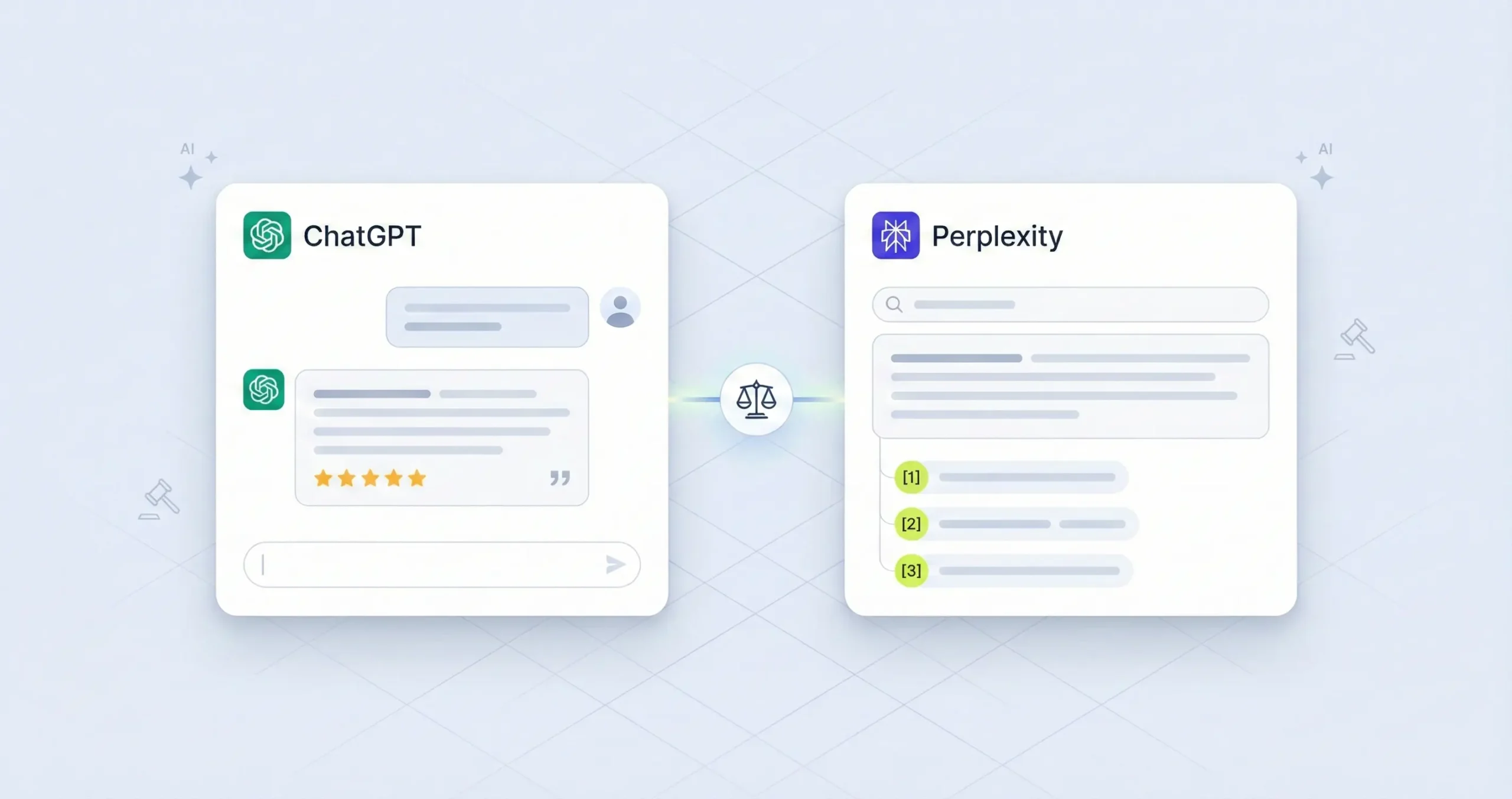
There’s a gap forming between firms that show up on Google and firms that show up when someone asks ChatGPT or Perplexity for a lawyer recommendation, and right now most attorneys don’t even know the second category exists. The two systems don’t work the same way. Google’s AI Overviews pull from the same index your regular SEO feeds into, so if you rank on Google you’ll probably show up in the AI summary. But ChatGPT and Perplexity have their own sources and their own way of deciding which firms to recommend, and the things they look for aren’t the same things that get you to page one on a traditional search.
I started testing this maybe six months ago after a few attorneys mentioned that they’d typed their practice area into ChatGPT and it recommended competitors instead of them, even though they were outranking those competitors on Google. That’s when I realized this isn’t just a different version of SEO, it’s a separate channel with separate rules, and most of what I’d been doing for Google AI Overviews didn’t transfer directly.
I’ve covered what GEO is and how entity authority works and how AI Overviews affect law firm traffic separately. This one is about what happens when the search doesn’t start on Google at all, and how to get your firm into the answers that ChatGPT and Perplexity give when someone asks them for a lawyer.
How ChatGPT Actually Decides Which Lawyer to Recommend
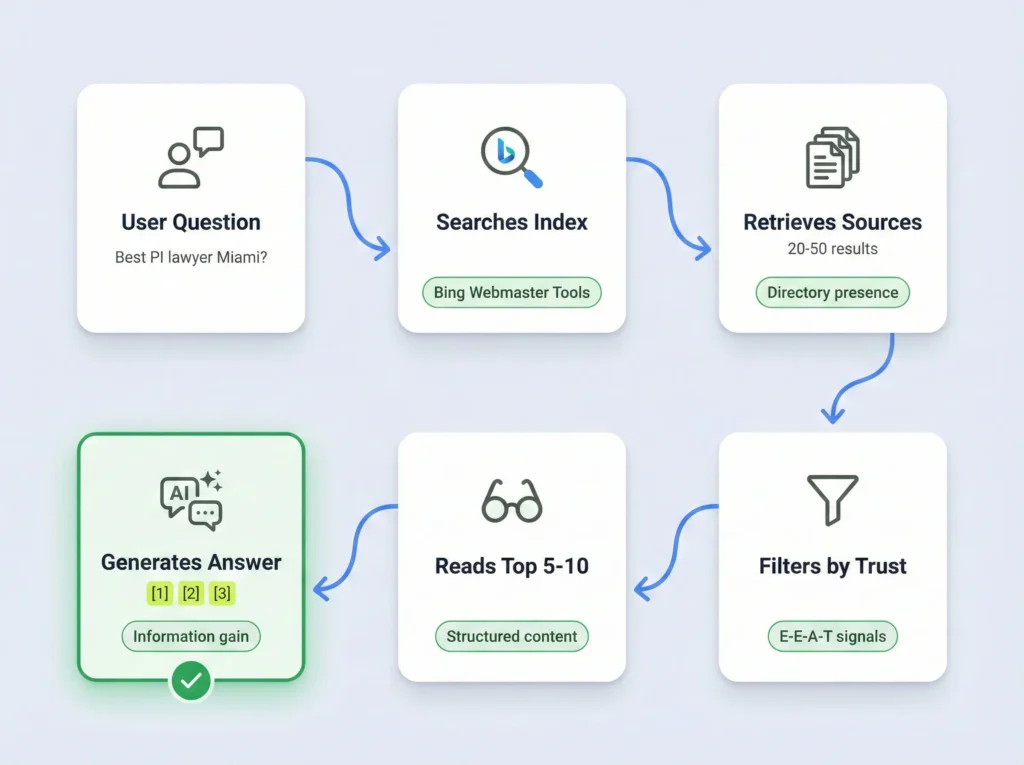
How does ChatGPT choose which lawyers to recommend? ChatGPT uses a process called RAG (Retrieval-Augmented Generation) where it searches the web in real time through Bing’s index, pulls maybe 20 to 50 sources, scores them for trust and relevance, reads the top 5 to 10, and then writes a response based on what it found. It doesn’t rank pages like Google; it reads multiple sources and writes one answer citing the ones it pulled from. If your site isn’t in Bing’s index or your content isn’t set up in a way the AI can easily read, you won’t show up no matter where you rank on.
So here’s the thing I didn’t understand until I started digging into the technical side. When someone asks ChatGPT “who is the best personal injury lawyer in Miami” the AI doesn’t just guess based on what it learned during training. It actually runs a live search, grabs a bunch of sources from the web, reads them, and then writes an answer based on what it found. The technical name for this is Retrieval-Augmented Generation or RAG and once you get how it works you can see why some firms show up and others don’t.
And the part that tripped me up is that ChatGPT uses Bing’s search index, not Google’s. So if your site isn’t verified in Bing Webmaster Tools or if Bing’s crawler is having trouble with your site, ChatGPT might not even find you. I checked a bunch of my clients’ Bing Webmaster accounts and half of them either weren’t verified or had crawl errors they didn’t know about, which means ChatGPT literally couldn’t find their content even though they were ranking fine on Google.
The other part that matters is how ChatGPT filters what it finds. It pulls maybe 20 to 50 sources and then it scores them based on whether they look trustworthy and relevant.
And this is where it gets interesting because ChatGPT doesn’t like sales pages; it skips over “hire us we’re the best” content and looks for pages that actually answer the question with real info. So your “About Us” page probably won’t get cited but a detailed page about what to do after a car accident in your state might, which is kind of backwards from how most firms think about their website.
Perplexity Is a Different Animal and Most Agencies Don’t Even Know It Exists
How does Perplexity AI recommend lawyers differently from ChatGPT? Perplexity positions itself as a research engine and shows its sources as footnotes like an academic paper. It has an internal accuracy benchmark called DRACO that scores 89.4% accuracy on legal queries; higher than finance or general knowledge. Perplexity heavily weights freshness and will skip your content if it looks outdated, and it relies on “Best Of” aggregator lists from sources like U.S. News, Forbes Advisor, and legal directories to filter which firms it recommends.
So Perplexity is the one I think most agencies are sleeping on and I’ll tell you why. Perplexity is what you’d get if you mixed Google with a research librarian who reads every source and puts footnotes on everything. When it answers a legal question it cites its sources with numbered footnotes at the bottom and those citations drive traffic because users click them.
And Perplexity built this quality test they call DRACO which stands for Deep Research Accuracy Completeness and Objectivity and I bring this up because their legal accuracy score is 89.4 percent which is higher than their scores for finance or general topics. That means Perplexity is built to trust high-quality legal sources more than other types of content, which is either great news or terrible news for your firm depending on whether those sources mention you or not.
The biggest difference from ChatGPT is that Perplexity is obsessed with freshness. If your practice area pages still say “2024 Legal Guide” or reference laws that have been updated, Perplexity will skip you and cite someone whose content looks current. I started adding current year dates and recent case references to my clients’ pages and I noticed a difference in Perplexity citations within maybe three or four weeks, although I can’t prove that’s the only reason.
And here’s the part that I think is the biggest tactical insight for law firms. I started searching “best personal injury lawyer” in various cities on Perplexity and looking at which sources it cited in the footnotes. And it wasn’t law firm websites; it was “Best Of” lists from aggregators like U.S. News and Expertise.com and Yelp and Justia. Perplexity uses those lists to filter its recommendations, which means if you’re not on the “Best Of” lists that Perplexity trusts, you’re invisible on Perplexity even if your website is perfect.
So the move is to search your practice area and city on Perplexity right now, look at which directories show up in the footnotes, and make sure you’re listed and optimized on every single one of them. Those directories are now the gateway to the gateway, and I think most firms treat directory optimization like an afterthought when it should probably be one of the first things they do.
The llms.txt File That Nobody Has Heard of Yet
What is llms.txt and why do law firms need it? The llms.txt file is a new standard for telling AI crawlers which pages on your site matter most. It works like robots.txt but instead of telling crawlers where not to go it tells them where they should go first. You put it at your root directory and it acts like a resume for your website; listing your attorneys, practice areas, and most important pages in a format the AI can read instantly. Almost no law firm websites have one yet which means this is a first mover opportunity.
And this is the one I’m most excited about because almost nobody knows about it yet. There’s a new file standard called llms.txt that’s basically robots.txt but for AI crawlers. You put a Markdown file at your root directory, like “lawfirm.com/llms.txt” and it tells AI agents exactly what your site is and which pages are most important.
I think of it like a resume for your website. Instead of making the AI crawl through your whole site trying to figure out who you are and what you do, you hand it a clean summary; here’s our firm name, here are our attorneys with their credentials, here are our practice areas with links to the deep content. The AI can read that in maybe half a second and immediately know whether your firm is relevant to the question someone asked.
Here’s a template you can copy and edit right now. Save it as a plain text file named “llms.txt” and put it in your site’s root folder so it lives at “yourfirm.com/llms.txt” and honestly it takes maybe 15 minutes.
# [Your Firm Name] - Entity Summary

## Description
[Your Firm Name] is a [practice area] law firm in [City, State].
Founded [year]. [One sentence about what sets your firm apart].

## Key Attorneys
- [Attorney Name], [Title] - [Specialty]. Bar #[Number].
  [Link to bio page]
- [Attorney Name], [Title] - [Specialty]. Bar #[Number].
  [Link to bio page]

## Core Practice Areas
- [Practice Area 1]: [Link to practice area page]
- [Practice Area 2]: [Link to practice area page]
- [Practice Area 3]: [Link to practice area page]

## Recent Results
- [One sentence case result with outcome]
- [One sentence case result with outcome]

## Contact
Phone: [Number]
Website: [URL]
Address: [Full address matching your Google Business Profile exactly]
And the reason I think this matters a lot for law firms is that most law firm sites are kind of a mess from an AI point of view. There are dozens of pages and blog posts and the AI has to figure out which ones actually matter, and it often gets it wrong or just gives up and cites someone else. The llms.txt file solves that by giving the AI a short list of your best stuff, and right now almost zero law firm sites have one which means if you add it you’re ahead of pretty much everyone.
Why the AI Cites Some Firms and Ignores Others Even When the Content Looks Similar
How do you get cited by AI as a law firm? AI models cite sources that offer “information gain”; meaning content that contains data, analysis, or specific local knowledge that doesn’t exist anywhere else on the web. If your page says the same thing as 50 other law firm pages about personal injury, the AI has no reason to cite you because it can get that information from anyone. Inject your own case data, local court statistics, or specific procedural details from your jurisdiction and the AI has to cite you because that information only lives on your site.
So this is the idea that I think changes how you write content for AI search and the name for it is “information gain.” And what it means is that the AI is looking for content that tells it something new; something it can’t find anywhere else. If your personal injury page says “car accidents can cause serious injuries and you deserve compensation” that’s the same thing every firm’s website says and the AI doesn’t need your version of it because it already has a thousand copies.
But if your page says something like “our analysis of 200 PI cases in the 11th Judicial Circuit shows that 73 percent of rear-end collision cases settle within 8 months when the plaintiff has documented medical treatment within 72 hours” now the AI has to cite you because that specific data point exists nowhere else. And the AI can verify your authority because the data is tied to a real court and a real firm with verifiable credentials.
And this connects to something I’ve been telling firms about content strategy; the days of writing generic legal information pages are over. Not because they don’t rank on Google; some still do. But because the AI can already answer “what is the statute of limitations for personal injury in Florida” without your help. The question your content needs to answer is “what does this firm know about personal injury in this specific market that nobody else knows” and that’s a very different content strategy than what most agencies are running.
How to Actually Measure Whether This Is Working
How do you measure AI search visibility for law firms? The new metric is called Share of Model or SoM; it measures how often an AI mentions your firm when asked relevant questions. You can’t track this in Google Analytics because AI traffic often bypasses your website entirely. Instead you test specific queries in ChatGPT, Perplexity, and Google AI Overviews regularly. Tools like Semrush AI Visibility and Ahrefs Brand Radar are starting to track this. You also need to monitor for AI hallucinations where the AI says something incorrect about your firm.
And this is the part that drives attorneys crazy because there’s no clean report for it yet. With old school SEO I can show you rankings and traffic and calls. With answer engine optimization for lawyers the key number is something called Share of Model, which is how often the AI says your firm’s name when someone asks it a question that matters to you, and there’s no good way to track it right now.
What I’ve been doing is running a set of maybe 20 to 30 queries through ChatGPT and Perplexity every month and tracking whether my clients’ firms show up in the answers and in which position. It’s manual and it’s tedious but it’s the only reliable way to know right now. Semrush has an AI Visibility feature that’s starting to track some of this and Ahrefs has something called Brand Radar, but honestly both are still early and I wouldn’t rely on them alone.
And the other thing you need to watch for is AI making stuff up about your firm, which they call “hallucinations.” I’ve seen ChatGPT tell someone that a firm handled a type of case they’ve never touched, and I’ve seen Perplexity attribute a quote to an attorney that they never said. You can’t fix the AI directly but you can fix the source data on your website and directories that’s confusing it, and if your information is clean and consistent across all the places the AI checks then hallucinations become a lot less likely.
What I’d Actually Do in the Next 90 Days If I Were Starting From Zero
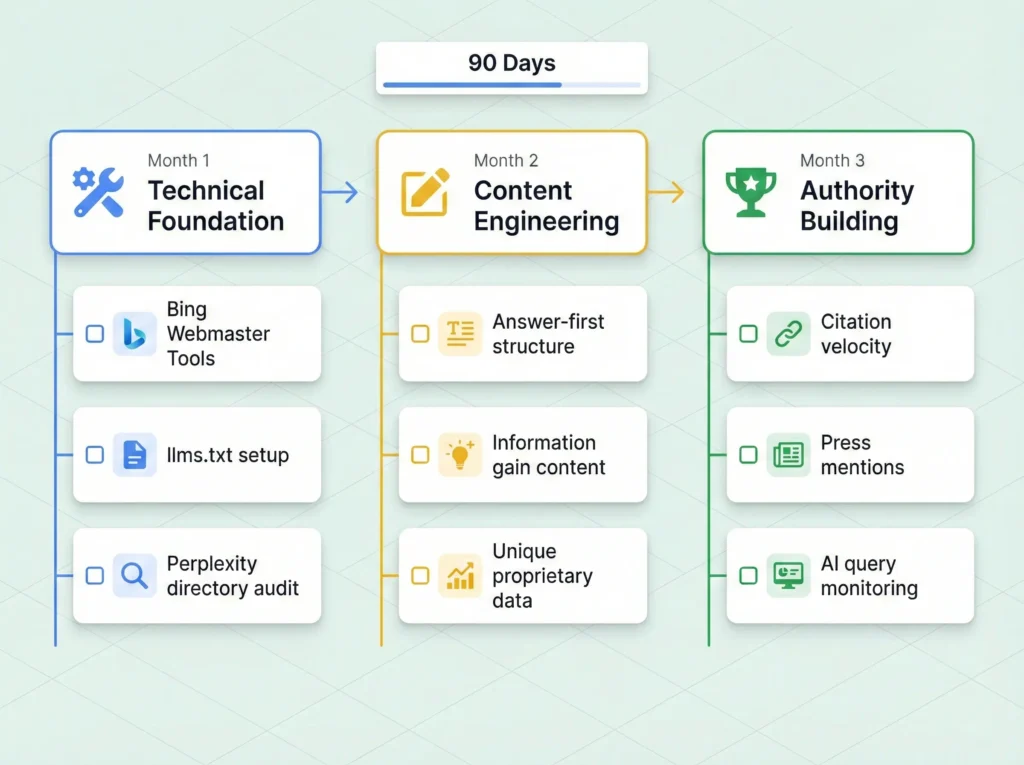
What is a practical AEO implementation plan for law firms? Month one; verify your site in Bing Webmaster Tools, create an llms.txt file, and search your practice area on Perplexity to find which directories you need to be on. Month two; rewrite your top 5 service pages so the first sentence of each section directly answers the question in the heading, and add one piece of original data or local insight to each page. Month three; start a citation velocity program getting your firm mentioned in local press and legal publications, and run your first round of AI query monitoring.
So if I were an attorney reading this and thinking “ok but what do I actually do” here’s what I’d tell you to do in the next 90 days.
First month you fix the technical stuff that’s probably been ignored. Verify your site in Bing Webmaster Tools because ChatGPT can’t find you without it. Create an llms.txt file listing your attorneys and practice areas and put it at your root directory. Search “best [your practice area] lawyer [your city]” on Perplexity and write down every directory that shows up in the footnotes, then make sure you’re listed and fully filled out on all of them.
Second month you fix your content so the AI can actually use it. Go through your top 5 or 10 practice area pages and make sure the first sentence after every heading directly answers the question. Not “many people wonder about…” but the actual answer right there up front so the AI can grab it. And add at least one unique data point or local insight to each page; something from your own case experience or your county’s court data that nobody else has written about. That’s what gets you cited instead of skipped.
Third month you start building what I call citation velocity, which is how fast new mentions of your firm appear across the web. Get quoted in a local news article, write something for a legal publication, do a press release about a case result or a new partner hire. Every time your firm name appears in a trusted source the AI’s confidence in your authority goes up.
And set up a monthly schedule where you test maybe 20 queries across ChatGPT and Perplexity and track whether you’re showing up, because that’s your early warning system for whether any of this is working or not.
And honestly most of this isn’t that hard; it’s just stuff that traditional SEO agencies aren’t thinking about because they’re still focused on Google rankings. The firms that start now are going to have a pretty significant head start over the ones that wait, because these AI systems learn from patterns over time and the sooner your firm starts appearing in their sources the stronger the association gets, which is kind of how all authority works when you think about it.
Want to know if ChatGPT and Perplexity can find your firm right now?
I can run your practice area queries through ChatGPT, Perplexity, and Google AI Overviews and show you exactly where you stand. If you’re already showing up I’ll tell you that and you can keep doing what you’re doing, or don’t call, up to you.