

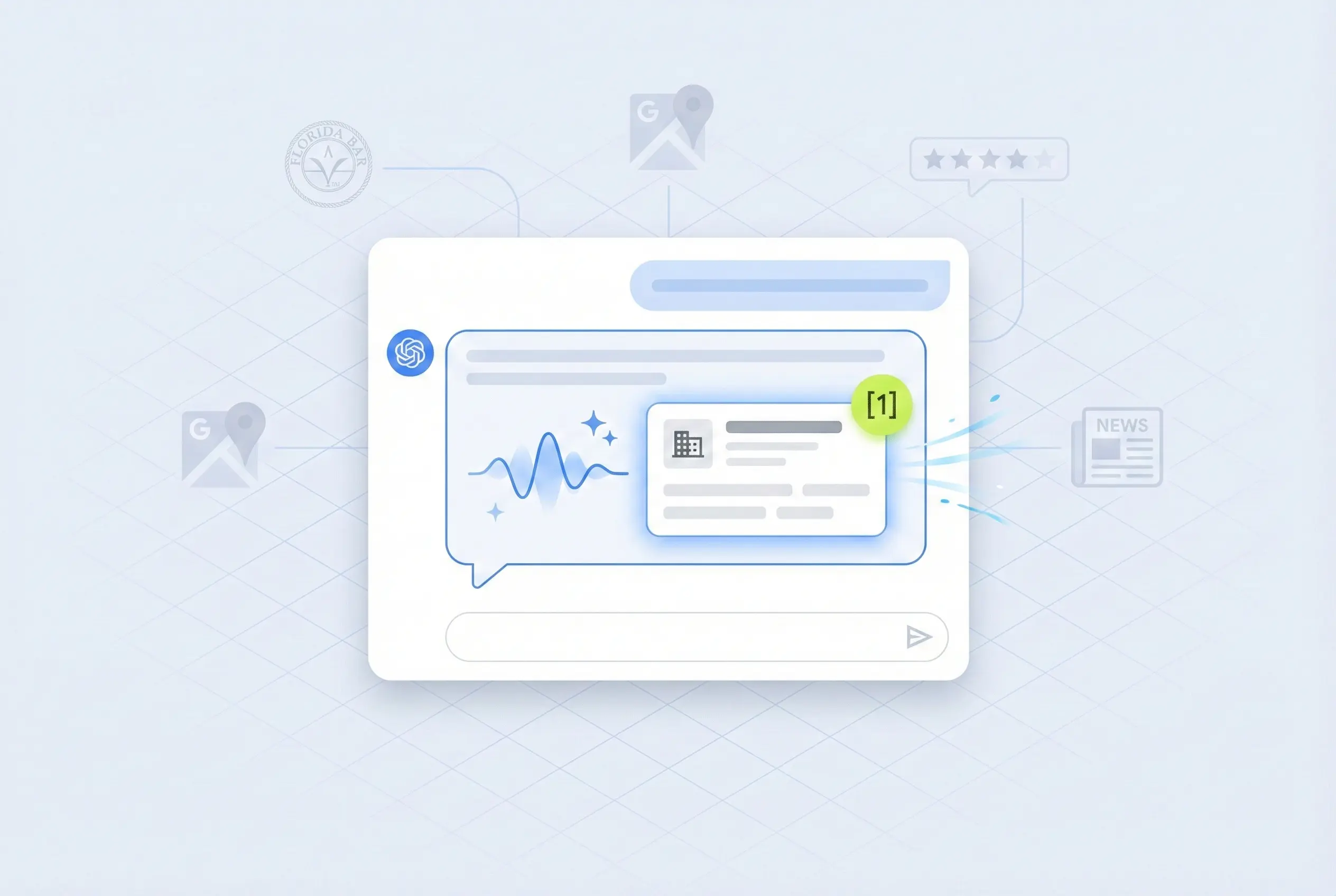
About a year and a half ago the traffic reports for some pages were still going up but the phone wasn’t matching, and I couldn’t figure out why until I looked at what Google was actually showing people for those searches. It wasn’t ten blue links anymore. Google was pulling the answer directly from the page and displaying it right there in the results, and the person got what they needed without ever clicking through to the site. The traffic number looked fine because Google was still crawling and indexing the content, but the calls were flat because the content was doing its job for Google instead of for the firm.
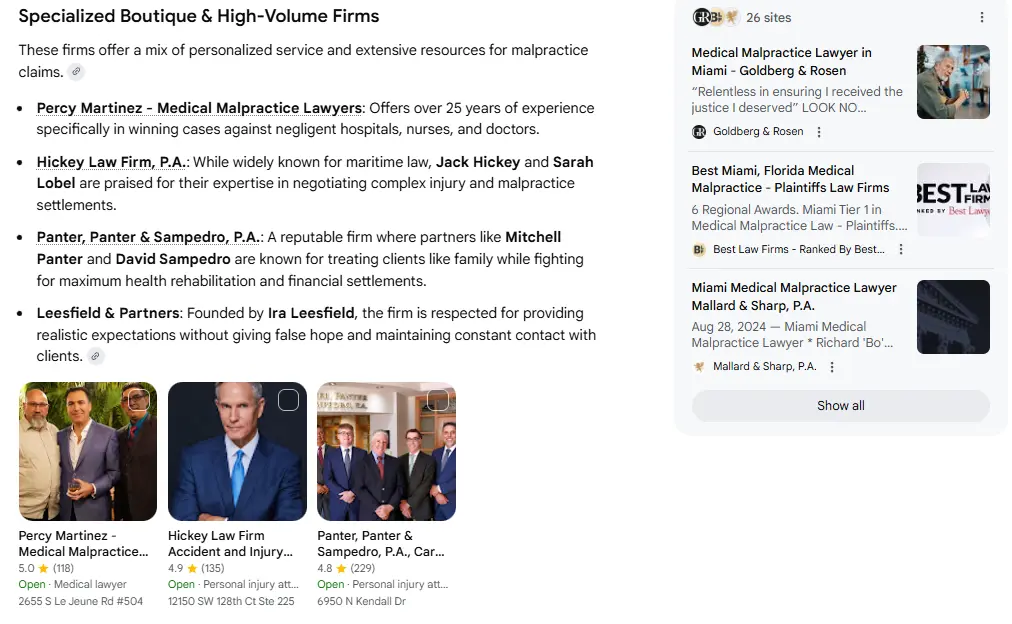
That’s when I started paying attention to how generative AI is changing what it means to “rank” for anything, because showing up on page one doesn’t mean what it meant three years ago if the search engine is just reading your content back to the user and keeping them on Google’s page instead of yours. And I don’t think most firms in Florida have noticed this yet because their agencies are still reporting on rankings and traffic without mentioning that the traffic is producing fewer calls than it used to, which is a conversation that’s uncomfortable to have when the monthly retainer depends on those traffic numbers looking good.
How AI Search Actually Works for Lawyers
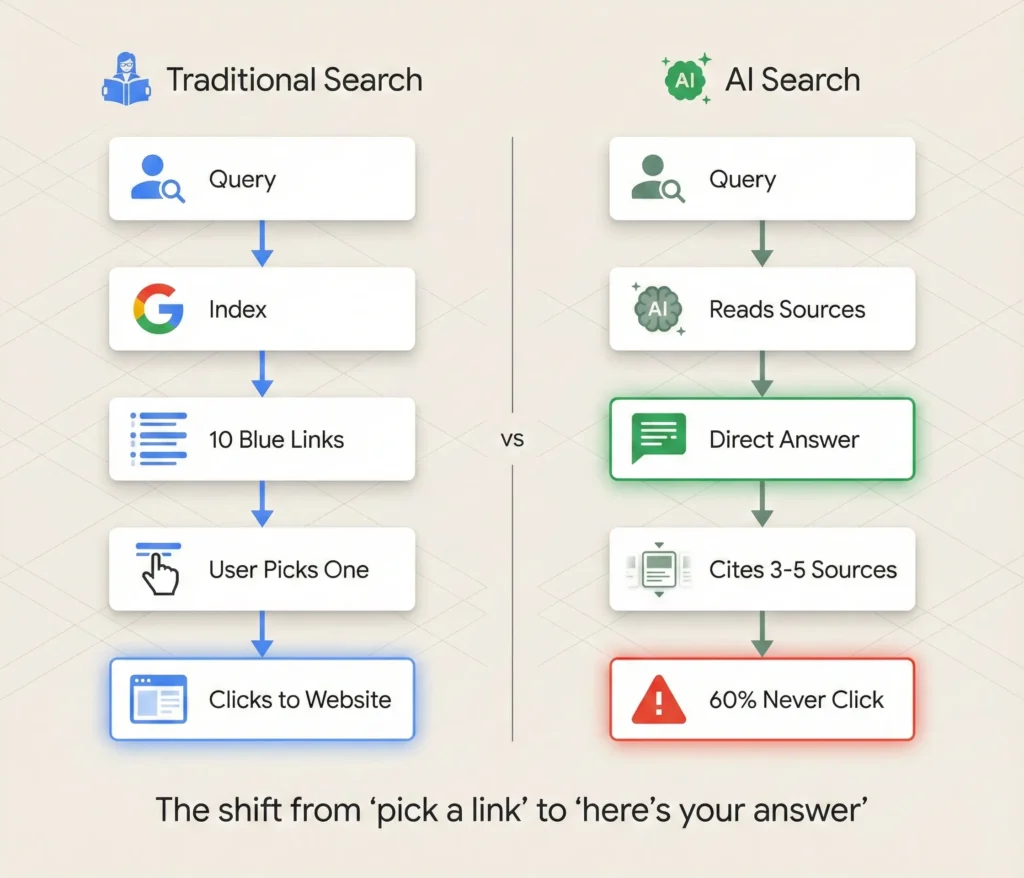
How does AI Overview work for lawyers in Miami? Google’s AI Overview reads your website, your Florida Bar profile, your reviews, court records, and news mentions, then stitches together an answer from the sources it trusts most. For Miami lawyers, about 77% of legal queries trigger these AI summaries; the AI picks maybe 3 to 5 sources to cite and if your firm’s content doesn’t directly answer the question being asked you won’t be one of them regardless of where you rank organically.
So the way I explain AI search optimization to attorneys is that traditional Google was like a librarian; you ask a question and the librarian points you to ten books on the shelf. And you go read them yourself and pick whatever looks best. But now Google and ChatGPT and Perplexity are more like a consultant; you ask a question and they read all the books for you and just give you the answer, and maybe mention which books they pulled from.
And the difference matters because in the old model you just needed to be one of the ten books on the shelf. In the new model you need to be the book the consultant actually opens and quotes from, and those are very different things.
Like at Percy we had pages ranking number one for certain keywords and the traffic was still dropping because Google was pulling our answer into the AI Overview. People were reading it right there without clicking through, which is kind of a weird problem because you’re technically winning but also losing at the same time and I still don’t fully know how to feel about it honestly.
And the way these AI models decide which sources to trust is different from traditional SEO too. The old model cared mostly about backlinks; how many other websites link to yours. The new model cares about what I’d call “entity authority” which is whether the AI knows who you are and has seen your name tied to the right topics in enough trusted places.
So if a firm keeps showing up in the Daily Business Review and on The Florida Bar website and in court records from the 11th Judicial Circuit, the AI is way more likely to mention that firm when someone asks ChatGPT for a recommendation. And that happens even without backlinks which throws traditional SEO people off, but here we are.
Entity Authority and Why It Matters in Miami
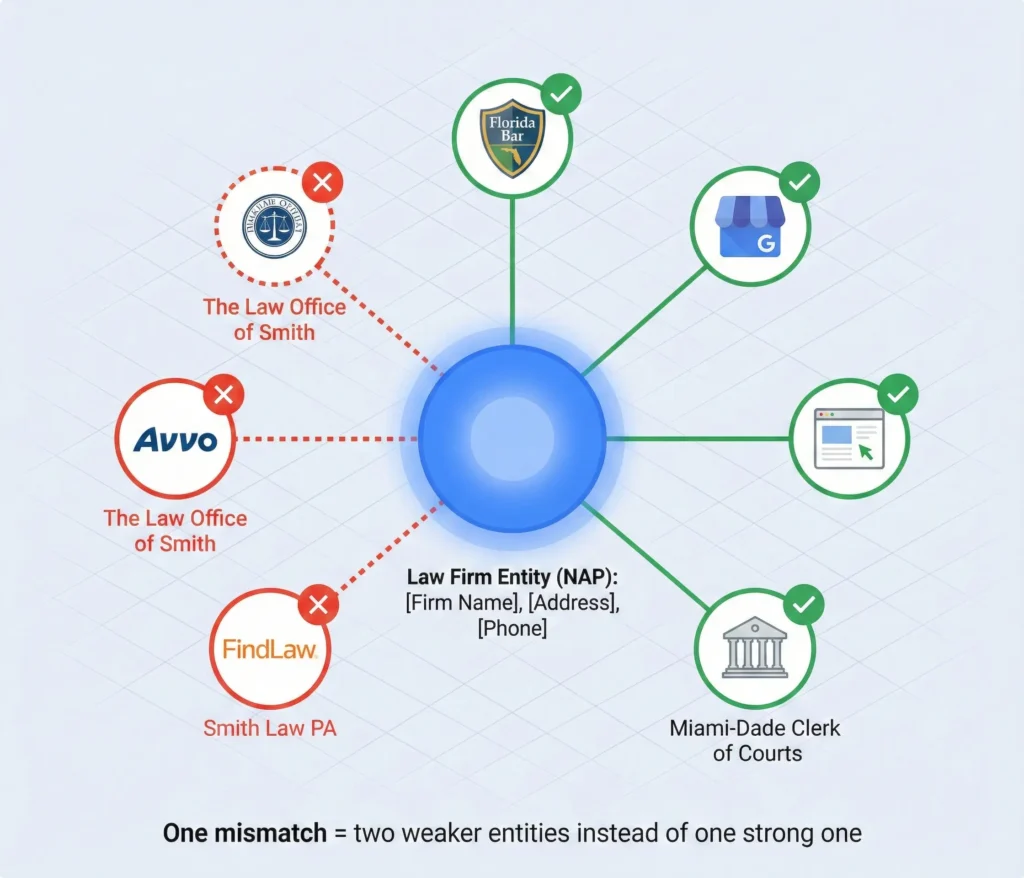
What is entity authority for Miami law firms? Entity authority is how well AI systems like Google’s Gemini and ChatGPT can identify your firm as a real, verified, and relevant source for a specific legal topic in a specific location. The AI cross-references your website against The Florida Bar, the Daily Business Review, Miami-Dade court records, Google Business Profile, and directory listings; if your firm name, address, and practice areas don’t match exactly across all of those your authority score drops and the AI might skip you entirely.
So building entity authority for a Miami law firm is honestly the part that most agencies skip because it’s not as flashy as running Google Ads or redesigning a website. There’s no dashboard that shows a nice chart going up and to the right.
But it’s probably the single most important thing for AI visibility right now. The AI doesn’t want to recommend a lawyer that might not actually be a lawyer. Legal advice is what Google calls a “Your Money or Your Life” topic meaning if the AI gets it wrong someone could get hurt.
So the AI is extra cautious and cross-checks everything. If your Florida Bar profile says one address and your Google Business Profile says another and your Avvo listing has a slightly different firm name, the AI treats those as maybe two or three different entities instead of one strong one. And your authority gets split across all of them. Same thing with your review profile; if you’ve got 4 reviews on Google and your competitor across town has 98, the AI reads that as a trust gap.
I’ve audited maybe a dozen Miami firms in the last six months. Every single one had at least a few of these mismatches. None of them knew about it, which you’d think would be easy to fix but apparently it’s not.
Learn more about ai search and what we do
How This Is Different from Traditional SEO
How is AI SEO different from traditional SEO for lawyers in Miami? Traditional SEO focuses on ranking your website URL in Google’s ten blue links by optimizing keywords, page speed, and backlinks. AI SEO; which is really GEO; focuses on getting your firm’s entity cited inside AI-generated answers by building trust signals across multiple platforms, structuring content so the AI can extract clean answers, and ensuring your name, address, and credentials match perfectly everywhere online. Both still matter but they work on different systems.
And look I’m not saying traditional SEO is dead because it’s not and we still do it and it still drives cases. But the difference between AI SEO and traditional SEO for lawyers in Miami is kind of like getting your name on a billboard versus getting personally recommended by someone the client trusts.
With traditional SEO you’re trying to get your URL higher than the other URLs. Google shows a list and the user picks one. With GEO you’re trying to get the AI to actually say your name in the answer. And the AI only does that if it’s confident you’re the right call based on everything it knows about you from your website and your bar profile and your reviews and news mentions and a bunch of other places.
So the strategy shifts from “how do I rank my page” to “how do I make the AI confident that I’m the right answer” and those are related but not the same. I think a lot of firms are still doing the first one without thinking about the second one at all, which I don’t know maybe works fine for now but probably not for much longer.
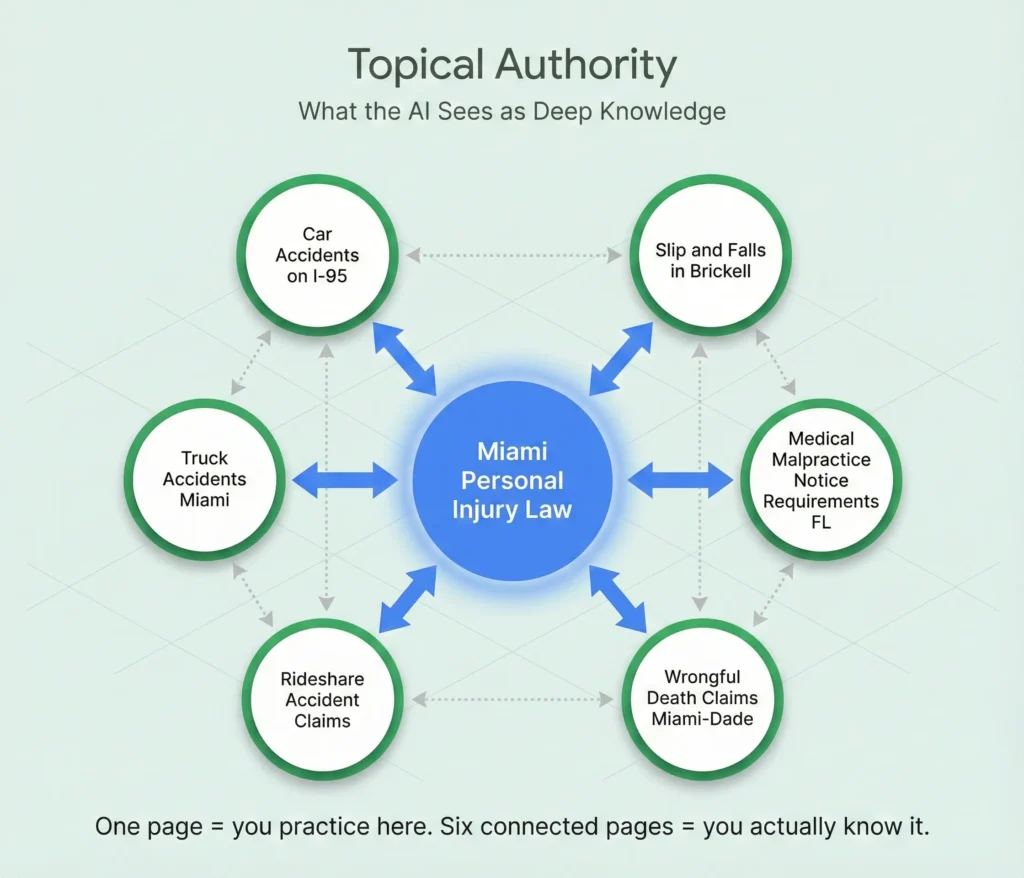
The other big difference is that traditional SEO rewards you for having one really strong page about a topic. You write the best page about “Miami car accident lawyer” and you rank for it. But AI search rewards you for having a whole cluster of connected pages because the AI breaks big questions into smaller sub-questions.
So instead of one “Personal Injury” page you maybe need a page about car accidents on I-95 and another about slip and falls in Brickell and another about medical malpractice notice requirements in Florida. And they all need to link to each other because that depth is what the AI reads as “topical authority.”
At Percy we stumbled into this accidentally because we kept writing about specific case types and it created this web of content. I didn’t realize it was building exactly the kind of authority the AI was looking for, but here we are.
How to Actually Show Up in ChatGPT and AI Answers
How do Miami lawyers show up in AI answers? You need three things; first your firm must exist as a verified entity with matching information across The Florida Bar, Google Business Profile, directories, and your website. Second your content needs to answer specific questions directly in the first paragraph of each section so the AI can extract clean answers. And third you need brand mentions in trusted local sources like the Daily Business Review or Miami Herald even if those mentions don’t include links back to your site.
So if you’re a Miami lawyer trying to figure out how to appear in ChatGPT or Google’s AI Overview, the honest answer is it’s not one thing. It’s a mix of things that all need to work together and there’s no single trick that does it, which I know isn’t what people want to hear because everyone wants the “one thing” they can do this week that fixes everything.
But the way I’ve seen it work is that you need to become an “entity” the AI recognizes, not just a website that Google indexes. And what that means practically is your schema markup needs to tell the AI what your firm is and does. Not the generic “LocalBusiness” schema that most web developers use but the “LegalService” or “Attorney” schema with your practice areas linked to their actual Wikidata identifiers. That’s something your web developer should be building into the site from day one honestly.
Your attorneys also need individual Person schema on their bio pages with their law school linked to its Wikidata ID and their bar membership spelled out. I know this sounds technical and it is.
But it’s the kind of thing your web developer can do in maybe a day if they know what they’re doing. It’s the difference between the AI treating your firm as a known entity versus just another website with text on it, and honestly most firms I audit don’t have any of this right, which is probably why they’re not showing up in AI answers.
The content structure matters too and this is where it connects to what we’ve been doing with traditional SEO. Your pages need to answer questions directly in the first 40 to 60 words after each heading. That’s the chunk the AI is most likely to grab for the AI Overview.
So if you have a heading about the statute of limitations for personal injury in Florida, the very next sentence needs to be the answer. Then you get into the details and exceptions after. But if you bury the answer three paragraphs down the AI skips you and pulls from someone who put it up front. Seems kind of unfair but that’s how the extraction works and I still don’t really understand why more firms don’t do this.
What I’d Actually Do If I Were Starting This Tomorrow
And look if I were a Miami attorney starting from scratch on this today here’s what I’d probably do. I’d make sure my Florida Bar profile is filled out with a real photo and my address matching my website exactly. I’d claim my Google Knowledge Panel if I have one and if I don’t I’d figure out why.
And I’d go through every single directory listing and make sure the firm name and address and phone number match everywhere. Not “The Law Office of” on one and “Law Offices of” on another because the AI reads those as different firms.
I’d get my web developer to add proper LegalService schema with knowsAbout properties linked to Wikidata and sameAs links pointing to every verified profile I have. And then I’d start writing content that answers specific questions in the first sentence instead of burying the answer under filler about “choosing the right attorney”.
And maybe the most important thing is brand mentions in trusted sources. The AI treats those as signals even if there’s no link back to your site. Getting quoted in the Daily Business Review or writing an op-ed for the Miami Herald or making sure your name shows up consistently in court records; all of that feeds entity authority.
I know that sounds like a lot of work and it is. But the firms that figure this out in the next year or two are going to have a big edge over the ones doing the same traditional SEO playbook that’s been slowly losing ground since AI Overviews started showing up on 77% of legal searches.
I think most firms know something has changed they just don’t know what to do about it yet, which I get because I was in the same spot maybe eighteen months ago and I’m still figuring parts of it out honestly. I put together answers to about 62 of the most common questions I get from attorneys about all of this if you want to dig deeper.
Not sure if your firm is set up for AI search?
I can run a quick audit of your entity authority signals and tell you where the gaps are. If everything looks good I’ll tell you that too and you can keep doing what you’re doing.