
TL;DR
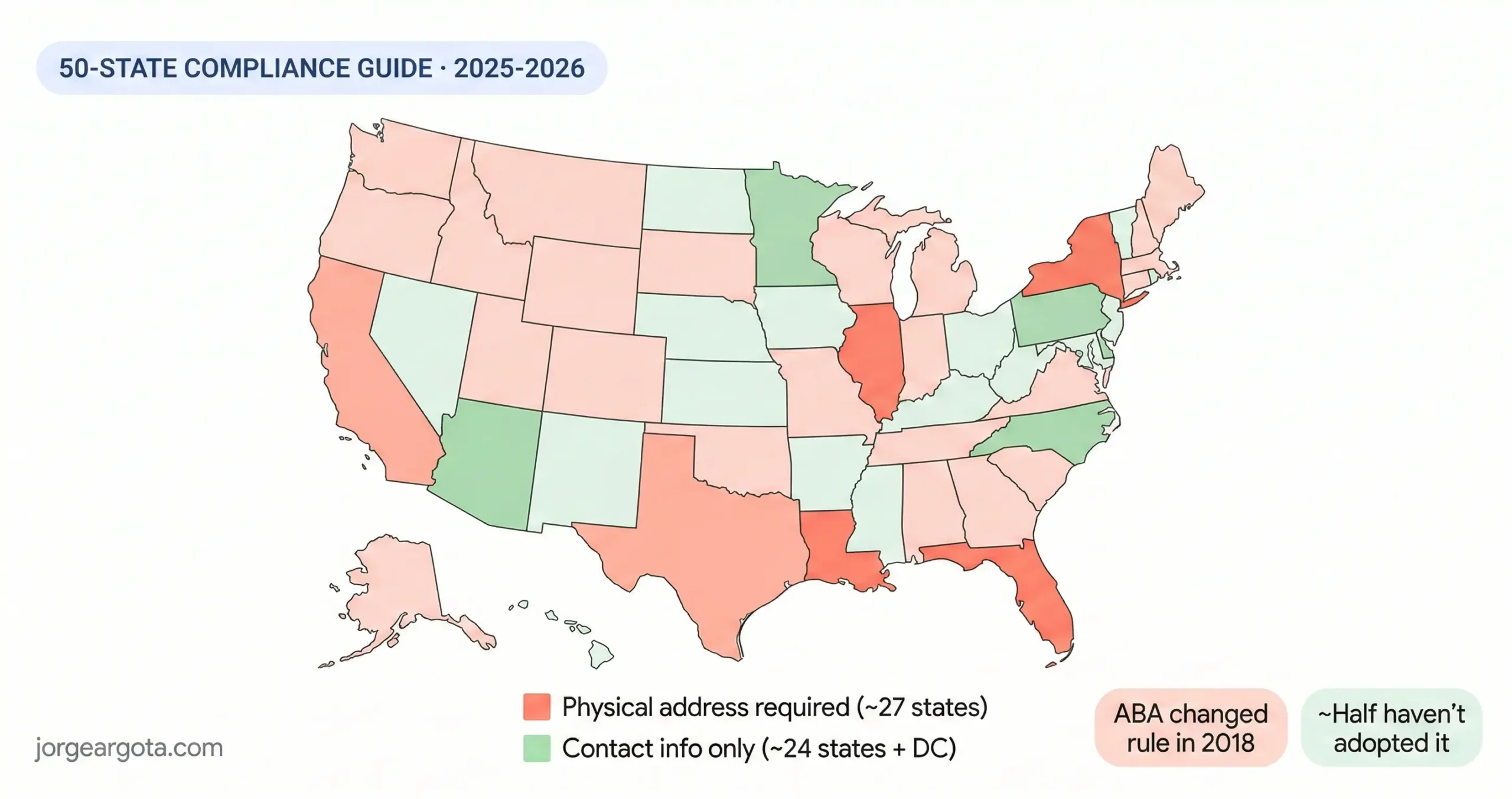
Does your state bar require a physical address on your law firm website? About 27 states still do. The ABA removed the physical address requirement in 2018 and replaced it with “contact information” which can be a phone number, email, or website URL. But adoption across states is wildly uneven. New York requires your principal law office address. Florida requires the city or town of a “bona fide office” which means staffed and regularly used for legal work; unstaffed virtual offices fail that test. States like Arizona, Pennsylvania, and North Carolina only require contact information. The full 50 state table with rule citations, virtual office status, and key ethics opinions is below.
Does a state bar require a physical address on a law firm website? It depends on the state. The ABA Model Rules dropped the physical address requirement in 2018 but roughly half the states haven’t adopted the change. Strict states like New York (Rule 7.1(h)), Florida (Rule 4-7.12(a)(2)), Texas (Rule 7.02(c)), Louisiana (Rule 7.2(a)(2)), and Illinois (Rule 7.2(a)) still require a physical office address or the city of a bona fide office on all advertising including websites. States that adopted the ABA amendment like Arizona (ER 7.2(c)), Pennsylvania (Rule 7.2(k)), Minnesota (Rule 7.2(d)), and North Carolina (Rule 7.2(d)) let you satisfy the rule with a phone number or email alone. Virtual offices are explicitly approved in New York (NYCBA Op. 2019-2), Virginia (LEO 1872), North Carolina (2012 FEO 6), and Ohio (Advisory Op. 2017-5) but explicitly fail Florida and Louisiana’s bona fide office test. Source: Jorge Argota, 10 years in legal marketing, Miami.
I was at a legal marketing conference maybe a year ago and overheard a virtual office sales rep telling an attorney that “all state bars require a physical address on your website” and that buying their $150 a month package was the only way to stay compliant, and the attorney was nodding along like this was established fact, and I almost said something because it’s not true and it hasn’t been true since 2018 when the ABA explicitly replaced the physical address requirement with “contact information” which can be a phone number or an email or just a website URL, but the adoption of that change across individual states is so uneven that you can understand why people are confused, and honestly the virtual office companies have a financial incentive to keep people confused which is probably why the misinformation persists.
So I went through every state’s version of Rule 7.2 and the ethics opinions that interpret it and mapped the whole thing because the question I get from attorneys maybe once a week now is “do I need a physical address on my website” and the answer is always “it depends on which state you’re licensed in” which isn’t satisfying but it’s accurate, and the firm I ran marketing for in Miami dealt with this directly because Florida has some of the strictest advertising rules in the country and what works in Arizona will get you a bar complaint in Florida, which is the kind of thing nobody explains until after the complaint shows up.
WHAT THE ABA ACTUALLY CHANGED IN 2018
Before 2018
ABA Model Rule 7.2 required a physical “office address” on all attorney advertising.
After 2018
Rule 7.2(d) now requires “contact information” which Comment 12 defines as a website URL, phone number, email, OR physical address. Any one satisfies the rule.
The critical word is “or.” Under the current ABA Model Rules a physical address is not required on a law firm website if you provide a phone number or email. But ABA Model Rules don’t bind anyone until a state adopts them, and that’s where the whole thing fractures because roughly half the states still haven’t adopted this specific change and some of the biggest legal markets in the country including New York, Florida, Texas, and Illinois are on that list.
And then in 2020 and 2021 the ABA released Formal Opinions 495 and 498 which addressed virtual practice directly. Opinion 495 said lawyers can practice remotely from a state where they’re not licensed as long as they don’t hold themselves out as having a local presence there, meaning if you put a physical address on your website in a state where you’re not admitted you’re creating what they call “systematic and continuous presence” which is an unauthorized practice problem. Opinion 498 confirmed that fully virtual practices are ethically fine. The tension between these opinions and the states that still demand a physical address is where the real compliance headaches live, and it’s the thing most agencies completely ignore when they build your website.
THE FULL 50 STATE + DC BREAKDOWN
~27
states require
a physical address
~24
states + DC accept
contact info only
Find your state below. If you practice in multiple states, comply with the strictest one.
States that require a physical address or office location on your website
Alabama · Rule 7.2 · Physical address required
Must list the city, town, or county of a bona fide office location. If the lawyer has no bona fide office in Alabama, that fact must be explicitly disclosed in the advertisement. A personal residence qualifies as a bona fide office if legal services are furnished there regularly. Effective January 1, 2026. Virtual offices are restricted to those meeting the bona fide standard. Did not adopt ABA 2018 amendment.
Arkansas · Rule 7.2 · Physical address required
Office address must appear on all advertising including websites. No recent ethics opinion published on virtual office use for advertising purposes. Did not adopt ABA 2018 amendment.
California · Rule 7.2(c) · Physical address required
Any advertising communication must include the name and address of at least one lawyer or law firm responsible for its content. California Business and Professions Code Section 6002.1 requires a current publicly available mailing address on State Bar records. Virtual office addresses are permitted if accurate and not misleading under Rule 7.1. Partially adopted ABA 2018 framework but retained the address requirement in the black letter text.
Colorado · Rule 7.2 · Physical address required
Office address required on communications concerning a lawyer’s services. Virtual offices are generally permitted. Partially adopted ABA 2018 amendments but retained the office address mandate.
Connecticut · Rule 7.2 · Physical address required
Office address must appear on attorney advertising. No recent modernized ethics opinion on virtual offices for website compliance. Did not adopt ABA 2018 amendment.
Florida · Rule 4-7.12(a)(2) · Physical address required
Must disclose the city, town, or county of one or more bona fide office locations where the advertising lawyer will actually perform services. A bona fide office means a physical location with full time staff where the lawyer is present on a regular basis and furnishes legal services in a substantial way. Unstaffed virtual offices, mail drops, executive suites used only occasionally for meetings, and commercial addresses without dedicated firm personnel explicitly fail this test. Websites are subject to general advertising rules but exempt from the pre filing review required for direct mail and broadcast ads. Did not adopt ABA 2018 amendment. This is one of the strictest states in the country.
Georgia · Rule 7.2 · Physical address required
Legal ads must include the name, phone number, and full physical address of the lawyer or law firm. If there is no physical office the lawyer must list the address appearing in their State Bar registration. Did not adopt ABA 2018 amendment.
Illinois · Rule 7.2(a) · Physical address required
Communications must include the name and office address of at least one responsible lawyer or law firm. Virtual offices are permitted. See ISBA Opinion 12-09 for strict interpretations of unauthorized practice and multijurisdictional presence issues. Did not adopt ABA 2018 amendment.
Indiana · Rule 7.2 · Physical address required
Office address required on advertising. No recent published ethics opinion on virtual offices for website disclosures. Did not adopt ABA 2018 amendment.
Kentucky · Rule 7.2 · Physical address required
Office address required. No recent ethics opinion on virtual office use for advertising. Did not adopt ABA 2018 amendment.
Louisiana · Rule 7.2(a)(2) · Physical address required
Must disclose the city or town of one or more bona fide office locations where the advertising lawyer will actually perform services. If the office is outside a city or town, the parish must be disclosed. A bona fide office requires a physical location where at least one lawyer is regularly and routinely present. Standard virtual offices and unstaffed mail forwarding centers do not meet this threshold. If no bona fide office exists, the lawyer must disclose their annual registration statement address. Did not adopt ABA 2018 amendment.
Michigan · Rule 7.2 · Physical address required
Office address retained in the rules. No recent modernized ethics opinion on virtual offices. Did not adopt ABA 2018 amendment.
Mississippi · Rule 7.2 · Physical address required
Office address required. No recent ethics opinion on virtual offices for advertising. Did not adopt ABA 2018 amendment.
Missouri · Rule 7.2 · Physical address required
Office address required on all advertising. Missouri also requires a specific mandatory disclaimer on all attorney advertisements stating “The choice of a lawyer is an important decision and should not be based solely upon advertisements.” Did not adopt ABA 2018 amendment.
Montana · Rule 7.2 · Physical address required
Office address required. No recent ethics opinion on virtual offices. Did not adopt ABA 2018 amendment.
Nevada · Rule 7.2 · Physical address required
Office address required. No recent ethics opinion on virtual offices. Did not adopt ABA 2018 amendment.
New Hampshire · Rule 7.2(c) · Physical address required
Office address required on communications. Virtual offices are generally permitted under the partially adopted ABA framework. Partially adopted ABA 2018 amendment but retained the office address mandate in the rule text.
New Jersey · Rule 7.2 · Physical address required
Communications must include the name and address of the attorney. P.O. Boxes are prohibited. Virtual commercial offices are permitted since the 2013 relaxation of the bona fide office requirement for the actual practice of law. New Jersey’s Daniel’s Law restricts publication of home addresses for judges, prosecutors, and law enforcement, creating significant privacy friction for attorneys holding those roles or married to covered persons; this has accelerated the use of commercial virtual addresses as privacy shields. Did not adopt ABA 2018 amendment.
New York · Rule 7.1(h) · Physical address required
All attorney advertisements must include the name, principal law office address, and telephone number of the lawyer or law firm. The website homepage must be labeled “Attorney Advertising.” Virtual law offices are explicitly permitted per New York City Bar Association Formal Opinion 2019-2, provided the VLO qualifies as an office for the transaction of law business under New York Judiciary Law Section 470, which requires nonresident lawyers admitted in New York to maintain a physical law office within the state. Did not adopt ABA 2018 amendment. One of the strictest states for attorney advertising compliance.
North Dakota · Rule 7.2(b) · Physical address required
Communications must include the name and office address of at least one responsible lawyer. Did not adopt ABA 2018 amendment.
Oklahoma · Rule 7.2(c) · Physical address required
Office address required on advertising communications. Partially adopted ABA 2018 framework but retained the office address requirement.
South Carolina · Rule 7.2 · Physical address required
Office address required. No recent ethics opinion on virtual offices for website disclosures. Did not adopt ABA 2018 amendment.
South Dakota · Rule 7.2 · Physical address required
Office address required. No recent ethics opinion on virtual offices. Did not adopt ABA 2018 amendment.
Tennessee · Rule 7.2 · Physical address required
Office address required on advertising. No recent ethics opinion on virtual offices. Did not adopt ABA 2018 amendment.
Texas · Rule 7.02(c) · Physical address required
Must disclose the name and primary practice location of the lawyer responsible for the advertisement content. Texas maintains strict oversight through its Advertising Review Committee. Websites are explicitly defined as communications subject to advertising rules. If a firm operates virtually, the address used for primary practice registration should be disclosed provided it does not mislead consumers about the attorney’s physical availability or jurisdictional limits. See Ethics Opinion 701 for multijurisdictional advertising guidance. Did not adopt ABA 2018 amendment.
Utah · Rule 7.2(c) · Physical address required
Communications must include the name and office address of at least one responsible lawyer. Did not adopt ABA 2018 amendment.
Washington · Rule 7.2(c) · Physical address required
Office address required on advertising communications. Virtual practice is explicitly permitted per Ethics Opinion 201601. Partially adopted ABA 2018 amendments but retained the office address requirement.
States + DC where contact information only is sufficient (phone, email, or URL)
Alaska · Rule 7.2 · Contact info only
Adopted ABA 2018 Model Rule verbatim. Any communication must include the name and contact information of at least one lawyer or law firm responsible for its content. A physical address is not required; a phone number, email, or website URL satisfies the rule. Virtual offices are permitted.
Arizona · ER 7.2(c) · Contact info only
The Arizona Supreme Court explicitly deleted the restrictive office address rules and adopted the contact information standard. No physical address is required on attorney websites. Virtual offices are permitted.
Delaware · Rule 7.2 · Contact info only
Modified adopter of ABA 2018 standard. Contact information satisfies the disclosure requirement. Virtual offices permitted.
District of Columbia · Rule 7.1 · No specific address requirement
DC does not have a separate Rule 7.2 for advertising mechanics. Advertising regulations fall under Rule 7.1 which prohibits false or misleading communications but does not explicitly mandate a physical address on websites. Ethics Opinion 303 allows unaffiliated lawyers to share office space, validating the use of shared and virtual spaces provided the public is not misled about attorney affiliations.
Hawaii · Rule 7.2 · Contact info only
Modified adopter of ABA 2018 standard. Contact information satisfies disclosure. Virtual offices permitted.
Idaho · Rule 7.2 · Contact info only
Modified adopter. Contact information satisfies disclosure. Virtual offices permitted.
Iowa · Rule 7.2 · Contact info only
Adopted ABA 2018 Model Rule verbatim. Phone number, email, or website URL satisfies the rule. Virtual offices permitted.
Kansas · Rule 7.2 · Contact info only
Modified adopter. Contact information satisfies disclosure. Virtual offices permitted.
Maine · Rule 7.2 · Contact info only
Adopted ABA 2018 Model Rule verbatim. Virtual offices permitted.
Maryland · Rule 19-307.2(d) · No specific address requirement
Rule requires only the name of at least one attorney responsible for the content. The black letter text does not demand an office address be displayed. Virtual offices permitted.
Massachusetts · Rule 7.2(d) · No specific address requirement
Rule requires only the name of at least one lawyer or law firm responsible for the content. Comment 1 notes the rule permits dissemination of an address, but the black letter text does not mandate it. Virtual offices permitted.
Minnesota · Rule 7.2(d) · Contact info only
Any communication must include the name and contact information of at least one lawyer. Physical addresses are optional. Virtual offices permitted.
Nebraska · Rule 7.2 · Contact info only
Adopted ABA 2018 Model Rule verbatim. Virtual offices permitted.
New Mexico · Rule 7.2 · Contact info only
Modified adopter. Contact information satisfies disclosure. Virtual offices permitted.
North Carolina · Rule 7.2(d) · Contact info only
Contact information required; Comment 9 explicitly confirms that a website address, telephone number, email address, or physical office location all satisfy this requirement individually. North Carolina 2012 Formal Ethics Opinion 6 explicitly permits a law firm to use a leased time shared virtual office address to satisfy advertising requirements provided it is not used to mislead the public. One of the clearest green light states for virtual practice advertising.
Oregon · Rule 7.2 · Contact info only
Modified adopter following the contact information standard. See Oregon Formal Opinion 2022-200 for guidance on virtual practice and advertising. Virtual offices permitted.
Pennsylvania · Rule 7.2(k) · Contact info only
Represents a significant recent shift. Pennsylvania’s Supreme Court adopted amendments mirroring the ABA 2018 standard. Current rule requires the name and contact information of at least one responsible lawyer or law firm. Comment 19 explicitly confirms that a website address, telephone number, email address, or physical office location all satisfy this requirement. PBA Formal Ethics Opinion 2010-200 previously permitted virtual law offices; under the new rules virtual offices are completely compliant as a physical address is no longer mandated on advertising. Major liberalization from the prior strict geographic disclosure requirement under old Rule 7.2(h).
Rhode Island · Rule 7.2 · Contact info only
Modified adopter. Contact information satisfies disclosure. Virtual offices permitted.
Vermont · Rule 7.2 · Contact info only
Modified adopter. Contact information satisfies disclosure. Virtual offices permitted.
Virginia · Rule 7.1/7.2 · No specific address requirement
Virginia lacks a direct counterpart to ABA Rule 7.2(d) regarding responsible attorney contact information in its advertising rules. General advertising rules require truthful communication but do not explicitly mandate a physical address. Legal Ethics Opinion 1872 explicitly permits the use of virtual law offices and executive office suites, confirming that while addresses must be truthful they need not be traditional exclusive brick and mortar spaces.
West Virginia · Rule 7.2 · Contact info only
Adopted ABA 2018 Model Rule verbatim. Virtual offices permitted.
Wisconsin · Rule 7.2 · Contact info only
Modified adopter of the contact information standard. Virtual offices permitted.
Wyoming · Rule 7.2 · Contact info only
Adopted ABA 2018 Model Rule verbatim. Virtual offices permitted.
Unclear or ambiguous; consult your state bar directly
Ohio (Rule 7.2) ; subject to ORPC 8.5 jurisdiction rules; Advisory Op. 2017-5 permits virtual offices but the advertising rule itself is ambiguous on whether contact info alone satisfies the disclosure requirement.
For states requiring “office address” where no recent ethics opinion exists on virtual offices (Arkansas, Indiana, Kentucky, Michigan, Mississippi, Montana, Nevada, South Carolina, South Dakota, and Tennessee): conservative compliance means listing the address that matches your official state bar registration. If you want to use a virtual commercial address in one of these states, formally request an advisory opinion from your local ethics counsel before relying on it.
And I know the instinct is to look at the green list and think “great I don’t need an address” but if you practice in multiple states you need to comply with the strictest rule that applies to you. ABA Model Rule 8.5 governs this; the applicable rules are those of the jurisdiction where your conduct has its “predominant effect,” and for a website that’s accessible everywhere, ethics opinions generally interpret that if you’re targeting clients in New York then New York’s rules apply to your site even if your main office is in Pennsylvania where no address is required. A firm licensed in New York and Arizona has to list a principal law office address because New York requires it, and trying to cherry pick the least restrictive rule is how bar complaints happen.
THE VIRTUAL OFFICE TRAP AND THE GOOGLE CONFLICT
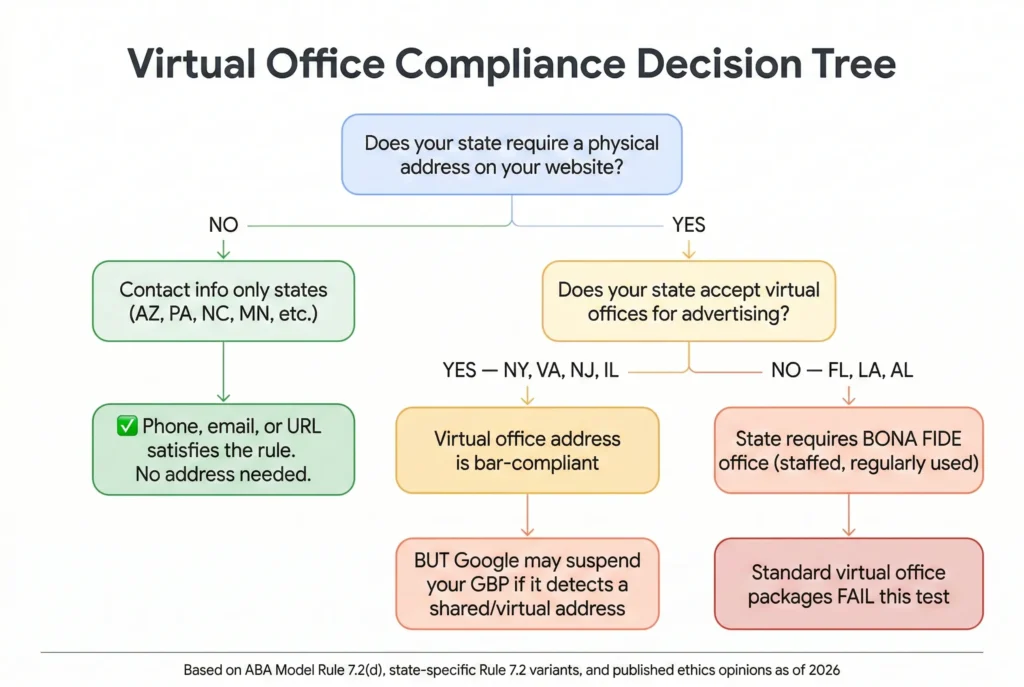
This is where compliance and marketing crash into each other. Your state bar says you need a physical address so you buy a virtual office in a downtown high rise for $150 a month. States like New York and Virginia explicitly permit this per NYCBA Op. 2019-2 and LEO 1872 so the bar is satisfied. But then Google’s algorithm detects that your address belongs to a Regus or Alliance shared building and suspends your Google Business Profile for deceptive practices, and now you’re bar compliant but invisible on Google Maps which is arguably worse for your practice than the compliance issue you were trying to solve.
THE THREE COMPLIANCE MISTAKES THAT CAUSE BAR COMPLAINTS
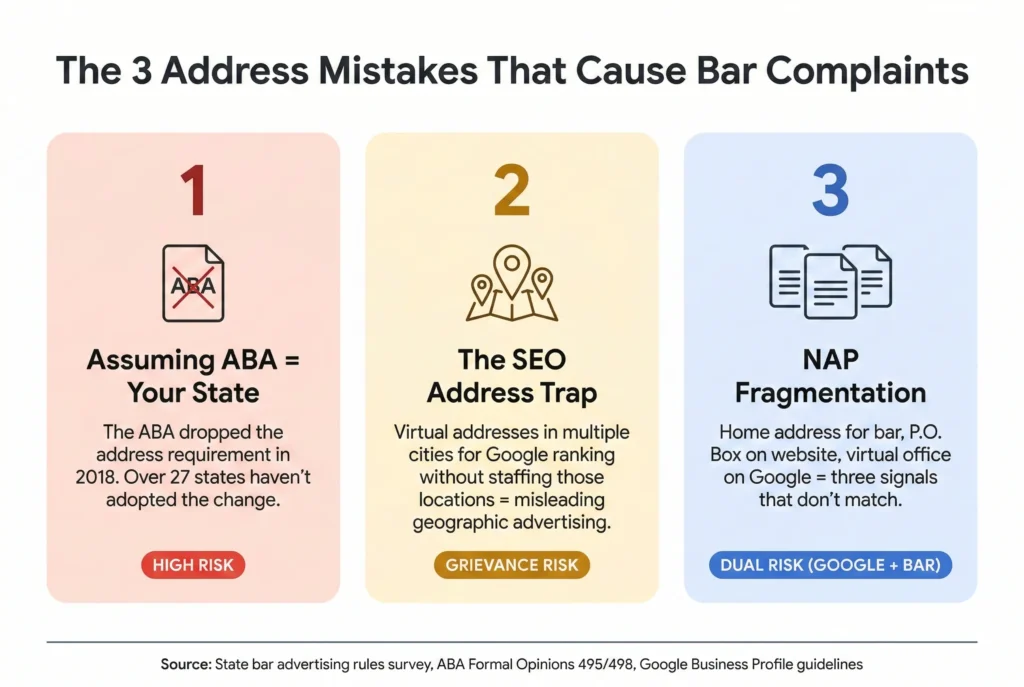
1. Assuming ABA rules apply everywhere. The ABA removed the address requirement in 2018 but over 27 states still haven’t adopted the change. Checking the ABA Model Rules instead of your state’s actual rule is how this starts.
2. The SEO trap. Listing virtual addresses in multiple cities to rank on Google Local without actually staffing those locations violates misleading geographic advertising rules in Florida, Texas, and Louisiana. This is the fastest path to a grievance and the thing competitive PI firms get caught on most often.
3. NAP fragmentation. Residential address for bar registration, P.O. Box on the website, virtual office on Google. Three different addresses triggers Google suspensions AND gives disciplinary committees evidence of misleading advertising under Rule 7.1. The entire attribution system depends on NAP consistency and the moment your compliance strategy creates address fragmentation across platforms you’ve introduced a marketing problem while solving a legal one.
The reverse problem: A solo attorney runs a legitimate practice from home and sets up a Service Area Business on Google to hide the residential address. But their state bar requires a physical address on all advertising. Some agencies solve this by embedding the home address in an image file instead of HTML text so Google can’t crawl it. This technically satisfies the bar’s human readable requirement but if the deliberate intent is to hide the address from search engines while maintaining a facade of compliance, you’re walking right up to the “truthful and non misleading” line under Rule 7.1, which no state bar has formally prosecuted yet but probably will eventually.
And the thing that drives me crazy about all of this is it’s preventable. Virtual office companies market blanket compliance promises that are “demonstrably overstated” in Florida and Louisiana where their basic packages fail the bona fide office test entirely, and SEO agencies push multi city landing pages with virtual addresses because it helps their traffic numbers even though it’s exactly the kind of misleading geographic advertising that state bars investigate. The vendor tells you it’s compliant, the agency tells you it’s good for SEO, and neither of them checked your state’s actual rule, which is kind of the whole problem if you think about it.
Not sure if your website’s address setup is actually compliant?
The tables above cover the rule citations but the real compliance work is matching your specific situation; which states you’re licensed in, whether your office qualifies as bona fide under the strict states, whether your GBP setup conflicts with your bar’s requirements, and whether your current NAP data is consistent enough to avoid both a Google suspension and a disciplinary inquiry. If you’re in one of the green states and your current setup is clean then you’re fine and you don’t need anyone’s help with this. If you’re in a red state or you practice across multiple jurisdictions and something about your address situation feels off, I’m happy to look at it and tell you whether it’s actually a problem or just something that looks like one, which in my experience is about a 50/50 split, or don’t call, whatever works for you.
Related
- Miami Law Firm SEO Cost
- Why Your Miami Law Firm Isn’t Ranking
- Attorney Advertising Ethics Rules
- SEO vs Google Ads vs LSA for Law Firms
- Answer Engine Optimization for Lawyers
- Law Firm Conversion Tracking and Attribution
- Personal Injury SEO Competitive Market Timeline
- Solo Attorney Marketing Budget
- When to Fire Your Law Firm Marketing Agency