Written by Jorge Argota · Personal Injury PPC · United States
A single PI click costs $150 to $500 depending on the market. At those prices, running Google Ads the way most agencies set them up, broad match on “personal injury lawyer” pointed at the homepage with 24/7 scheduling, is a guaranteed way to burn $10,000 a month and sign zero cases. The math only works when you track from the click to the signed retainer and train the algorithm on case value, not form fills.
TL;DR
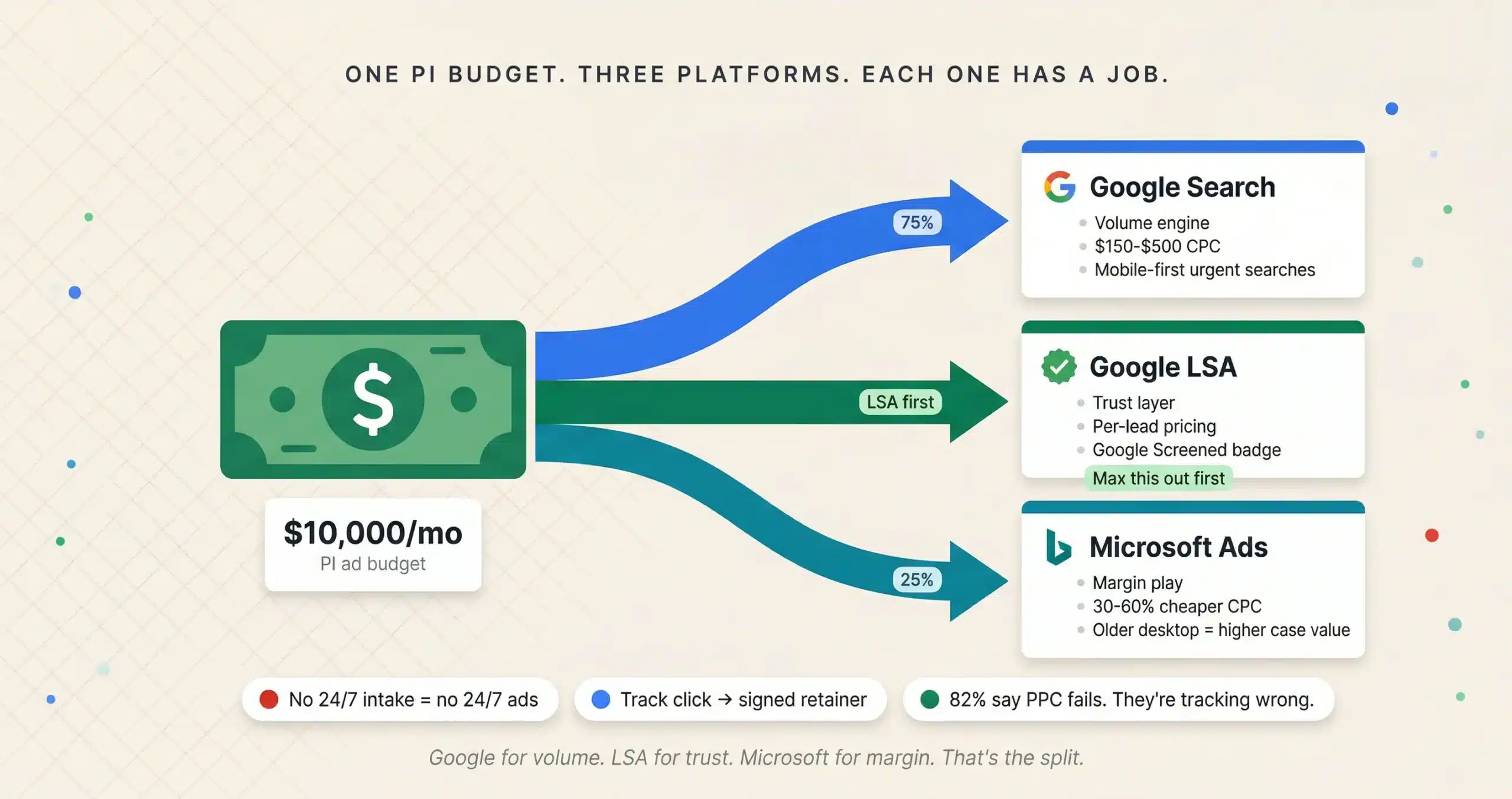
I run PI paid media across Google Ads, Local Service Ads, and Microsoft Advertising using a 75/25 budget split that blends volume with cost efficiency. Google gets 75% for scale. Microsoft gets 25% because the same PI keywords cost 30 to 60% less and reach an older desktop demographic that produces higher value cases. Every campaign is built on theme-based ad groups by injury type, dayparted to match your intake team’s hours, and tracked from the GCLID to the signed retainer through your CRM. If a click doesn’t produce a case within 90 days, I know which keyword wasted the money and I cut it. Source: Jorge Argota
GOOGLE ADS VS LSA VS MICROSOFT ADS FOR PERSONAL INJURY
Most PI firms treat Google Ads as the only paid channel and ignore the two platforms that could cut their cost per case in half. LSAs appear above PPC, charge per lead instead of per click, and come with the Google Screened badge that builds trust before the prospect even reads your ad. Microsoft Advertising reaches a slightly older, more affluent desktop demographic and charges 30 to 60% less for the exact same PI keywords because fewer advertisers compete there. I run all three as a unified system with a 75/25 split: 75% to Google for volume, 25% to Microsoft for margin.
PI CAMPAIGN STRUCTURE: THEME-BASED AD GROUPS BY INJURY TYPE
A single campaign targeting “personal injury” catches everything from property damage fender benders to catastrophic trucking cases and the algorithm can’t tell the difference. I separate campaigns by case value and ad groups by injury type so Google learns which clicks produce signed retainers worth $100,000 and which ones produce callers looking for free legal advice about a parking lot scratch.
The budget burners
Broad match “personal injury lawyer” with no modifiers. All traffic routed to the homepage. Running 24/7 without matching intake hours. Ignoring search query reports after launch.
The 2026 structure
Exact and phrase match with geo-modifiers (“[City] car accident lawyer”). Theme-based ad groups: “Trucking” separate from “Rideshare” separate from “Slip and Fall.” Practice-specific landing pages. Weekly search query reviews.
⚠ The dayparting rule
Do not run PI ads 24/7 unless your firm has a 24/7 live intake team or an AI intake agent answering the phone. If a $300 click calls at 2 AM and gets voicemail, that’s $300 burned. I schedule campaigns to match your intake team’s actual hours and implement dynamic number insertion so every call is tracked to the keyword that generated it. 60 to 70% of PI conversions come from phone calls, not forms; if no one answers, the lead calls the next LSA ad.
OFFLINE CONVERSION TRACKING AND VALUE-BASED BIDDING FOR PI
The reason 82% of law firms report underwhelming PPC ROI is that they’re optimizing for the wrong conversion. When Google sees a form fill as the goal, it finds the cheapest form fills on the internet: students, researchers, and people looking for free legal templates. When I feed signed case values back through the CRM, Google learns that a $300 click on “18 wheeler accident lawyer” produced a $100,000 fee and a $300 click on “car accident info” produced a hang-up. The algorithm stops guessing and starts hunting for the profile that signs retainers.
The technical setup runs through your CRM (Clio, Filevine, or Lawmatics). Every form submission captures an invisible GCLID field. When a lead progresses through your pipeline and signs, the case value pushes back to Google within the 90 day attribution window. The problem is that PI cases take 30 to 90 days to sign and if you wait that long the algorithm starves for data. I use a two-stage import: a “Qualified Lead” signal on day 2 (value: $500) keeps the bidding engine active while we wait for the “Signed Case” signal on day 30 to 60 (value: $5,000 to $15,000) that trains the real tROAS target. The campaign structure guide covers the full GCLID setup and the PMax page covers value-based bidding in detail.
⚡ LSA ranking: speed is the only variable
Google tracks your response time on LSA leads. If you miss 3 calls in a row or take longer than 15 minutes to respond to a message lead, your ad drops out of the top 3 rotation. As of late 2025, LSA reviews are fully merged with your Google Business Profile so you can’t start fresh with a new LSA profile to escape a bad GBP rating. They’re the same entity now. Response speed and review recency are the only two factors that matter for LSA visibility.
PI LANDING PAGE REQUIREMENTS AND THE RETARGETING BAN
The landing page rules
Sticky header phone number visible on every scroll. “No Fee Unless We Win” above the fold. Sub 2 second mobile load time; anything slower tanks your ad rank and spikes CPC. The H1 matches the ad phrase exactly. No navigation menu; one CTA only.
The retargeting constraint
Google classifies PI as a “Personal Hardship” sensitive category. You cannot retarget visitors who viewed your injury pages. Your landing page has to convert on the first visit because you don’t get a second chance to show that visitor an ad. The policy page covers the full Personal Hardship ban.
💡 The Microsoft Ads arbitrage for complex PI cases
Microsoft confirmed in late 2025 that exact match keywords always win in overlapping auction scenarios on their platform, giving you granular control that Google’s broad match expansion has eroded. For high-value, desktop-researched practice areas like nursing home abuse, complex medical malpractice, and severe TBI, Microsoft delivers the same quality leads at 30 to 60% lower CPC. The trap: Microsoft defaults all new campaigns to the “Audience Network” (MSN, Edge, Outlook) which is low-intent native traffic that eats your margin in days. You have to navigate to Ad Group Settings and select “Microsoft sites and select traffic” only. Once isolated, Microsoft’s demographic skews 73% homeowners which correlates with higher policy limits and fewer uninsured motorist claims.
Send me your market and case type mix
I’ll run the CPC projections for your specific practice areas, show you the 75/25 Google and Microsoft split, and tell you whether the cost per signed case math works at your budget level. If it doesn’t, I’ll say that too.
About Jorge Argota · 10 years running paid media for PI firms across Florida. Built campaigns that tracked from click to signed retainer at firms spending $5,000 to $50,000 per month. Full bio.
Related: PI Marketing Service · Campaign Structure · Performance Max · Google Ads Policy · Negative Keywords