

What are the most effective personal injury marketing strategies to consistently attract high-value accident and injury cases to a law firm? Stop bidding on “personal injury lawyer near me” and start targeting the case types where one signed retainer replaces 50 standard auto files. Trucking cases average $103,000 in settlements. Medical malpractice trials average $1.8 million. The marketing that produces these cases is built on long-tail SEO for specific injury types, segmented PPC campaigns that exclude soft tissue keywords, attorney referral networks with 40% to 60% close rates, and intake screening that rejects low-value leads on purpose. The average cost to acquire a PI client is roughly $3,200; how you spend that $3,200 determines whether you sign a $5,000 fender bender or a $500,000 trucking case. Source: Jorge Argota, 10 years in legal marketing including PI intake operations.
The median personal injury award for a motor vehicle crash is $16,000. The average commercial trucking settlement is $103,000. A medical malpractice trial averages $1.8 million. Product liability trials average $7 million. Those are four different practice areas inside the same “personal injury” category and the gap between the bottom and the top is roughly 437 times, which means the marketing that fills your pipeline with one type of case versus another isn’t a minor tactical choice. It’s the single decision that determines whether your firm runs on volume or on value.
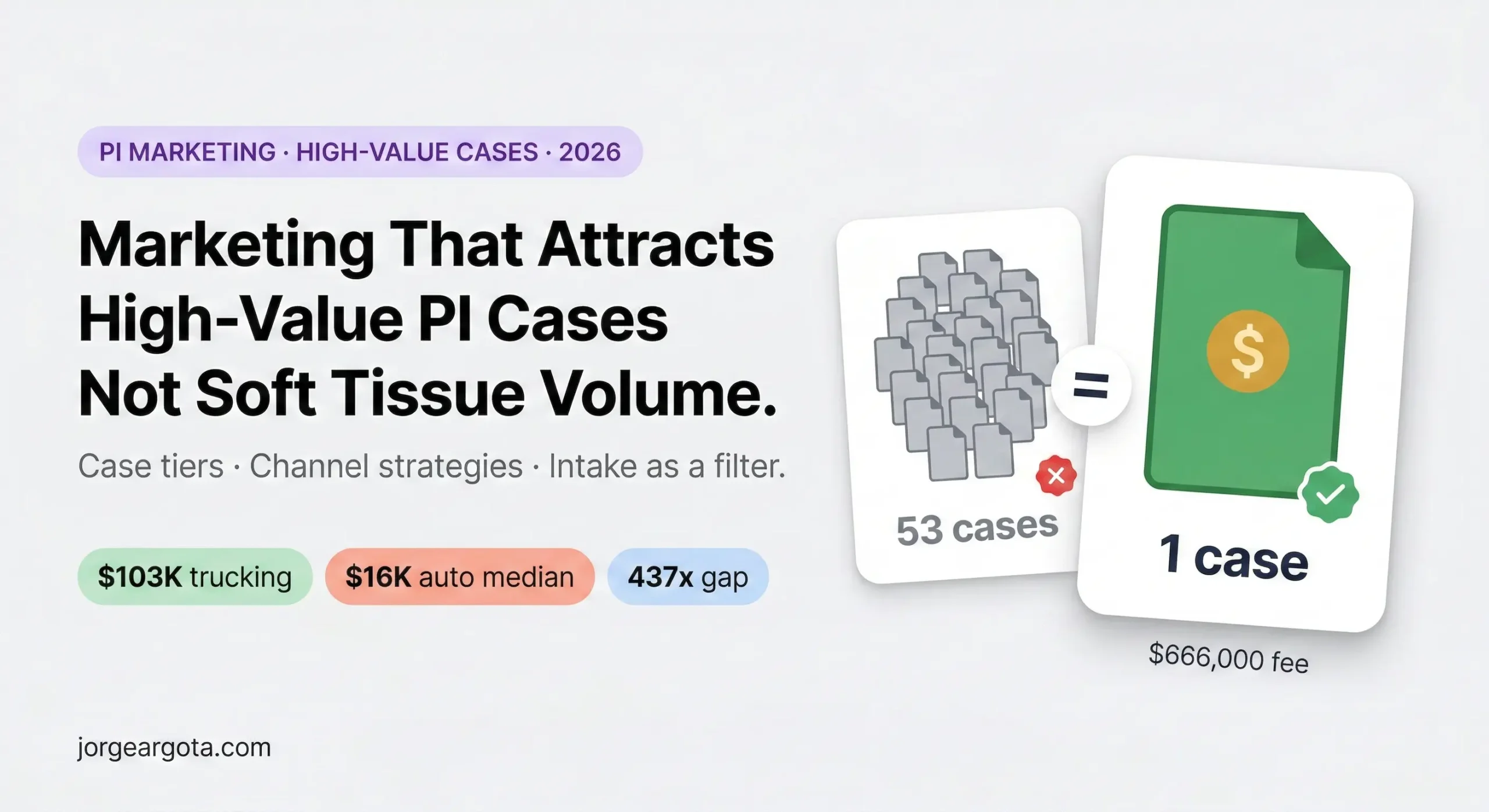
And here’s the math I keep coming back to. One $2 million settlement generates a $666,000 fee. To match that with standard auto cases averaging $12,500 in fees, you’d need to sign, process, and settle 53 separate files. That’s 53 intake calls, 53 medical record requests, 53 demand letters, 53 opportunities for something to go sideways. The firm handling 53 files needs a staff of maybe 15. The firm handling the single trucking case needs a staff of maybe 4. Both produce the same top-line revenue but the margins aren’t even in the same conversation.
$57 billion ; US personal injury market. 4% to 5% of cases reach trial. $1,000 ; max CPC for terms like “houston offshore accident lawyer.” $3,200 ; average cost to acquire a PI client. Only 19% of med mal claims result in any payout.
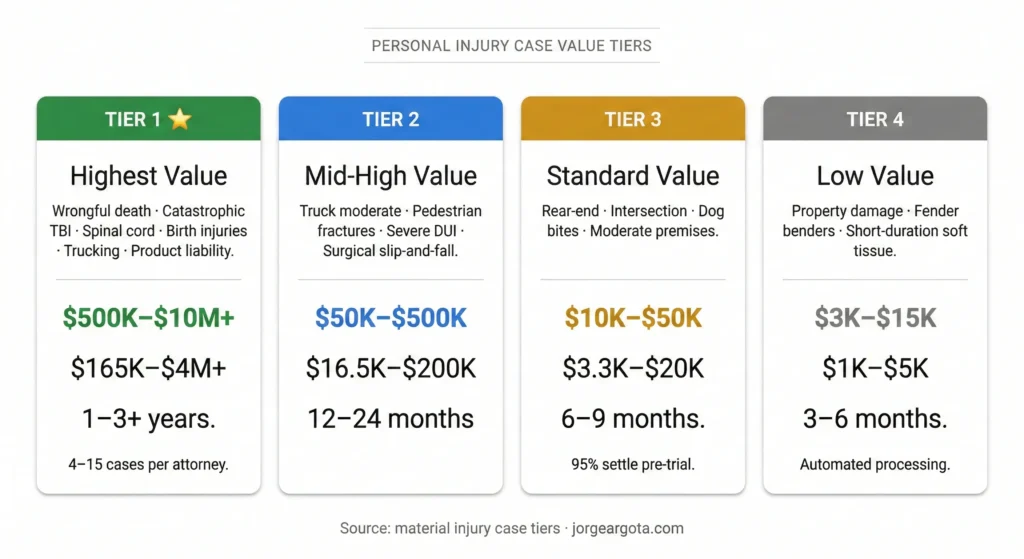
So the PI market splits into two operating models and most firms don’t realize they’ve accidentally chosen one. A high-volume attorney juggles 100 to 300 open files, serves maybe 400 clients a year, and needs a constant stream of billboard and TV leads to keep the machine fed. A catastrophic injury attorney manages 4 to 15 cases at a time. The marketing cost per signed retainer is higher for the second firm, sometimes tens of thousands of dollars for a single case, but the revenue per attorney hour is so much better that the math isn’t close. And the firms spending the most on marketing are actually the most profitable because they’re spending it on the right case types.
Which Case Types Are Worth Marketing For
The single biggest lever you have is which practice areas you choose to target. If you bid on “personal injury lawyer near me” you will get soft tissue auto cases because that’s what the search volume produces. The median auto crash award is $16,000 and 95% of those cases settle before trial. There’s nothing wrong with that business if you want to run it, but the marketing dollars that fill that pipeline look completely different from the dollars that produce trucking cases or med mal.
Trucking cases pay what they pay because the federal regulations create layers of liability, the commercial insurance policies run $1 million to $50 million, and the injuries from an 80,000 pound vehicle hitting a passenger car are almost always catastrophic. The average settlement is over $103,000, which is roughly six times a standard auto case. Marketing for trucking requires completely different content; instead of “what to do after a car accident” you need pages covering ELD data preservation, driver logbook violations, and corporate hiring negligence. Most general PI firms refer these cases to specialists because the accident reconstruction costs alone can run into six figures.
Medical malpractice is the highest reward and highest risk practice area in PI. Trial awards average $1.8 million but only 19% of claims ever result in any payout and 93% of the ones that do pay settle out of court. The upfront expert costs to file a certificate of merit run $50,000 or more, which is why general PI attorneys refer these out. The clients searching for med mal attorneys don’t type “personal injury lawyer”; they type condition-specific queries like “cerebral palsy birth injury lawyer” or “failure to diagnose cancer attorney” and that search behavior is what your marketing budget needs to target.
Product liability trials average $7 million in awards, which is the highest of any PI category. Wrongful death requires an entirely different tone; families searching for representation are grieving, not shopping, and the marketing that converts those leads relies on video testimonials, detailed attorney biographies, and a track record of holding corporations accountable. Negligent security cases like apartment shootings and parking lot assaults are a niche most firms ignore, but one firm recently secured a $102.7 million verdict in that space, which tells you something about the ceiling.
The part of this that I think is genuinely underappreciated is how much the wrong marketing channel warps your case mix without you realizing it. Daytime TV and billboards produce broad awareness and that broad awareness attracts the broadest possible cross-section of injury types, which statistically means mostly soft tissue auto cases because that’s what most injuries are. I wrote about the shift from broadcast to targeted digital separately, but the short version is that the firm ends up with a massive paralegal operation processing hundreds of small files and the overhead eats the margins even when the volume looks impressive on paper. The cost per signed case varies by channel from $200 for organic to $3,300 for PPC, but that range is even wider when you factor in which case types each channel actually produces.
What most firms do: Bid on “personal injury lawyer near me,” run the same ad for every case type, send every lead to the same intake script, measure cost per lead, celebrate when volume goes up.
What high-value firms do: Build separate campaigns for trucking, med mal, and catastrophic injury. Each campaign has its own landing page, its own ad copy, and its own negative keyword list that filters out soft tissue searches. They measure cost per retainer sent, not cost per lead. They track which keywords produce cases that actually settle for six figures.
SEO is the foundation because it compounds over time and the return runs $4 to $8 for every dollar spent once the content matures. But the SEO strategy for high-value cases has to go deep on specific injury types rather than wide on general terms. “Personal injury lawyer” is dominated by national aggregators. “Commercial truck accident lawyer” carries 68,000 monthly searches at $438 per click, meaning the people searching that term are valuable enough that firms will pay $438 just to get one person to click, and ranking organically for that same term costs you nothing per visitor. The play is building what the industry calls topical authority silos; a dozen interlinked pages covering everything from post-concussion syndrome to life care planning to the economic calculation of permanent cognitive impairment. That signals to Google and to the actual person reading it that this firm handles these cases at a different level than the office down the street.
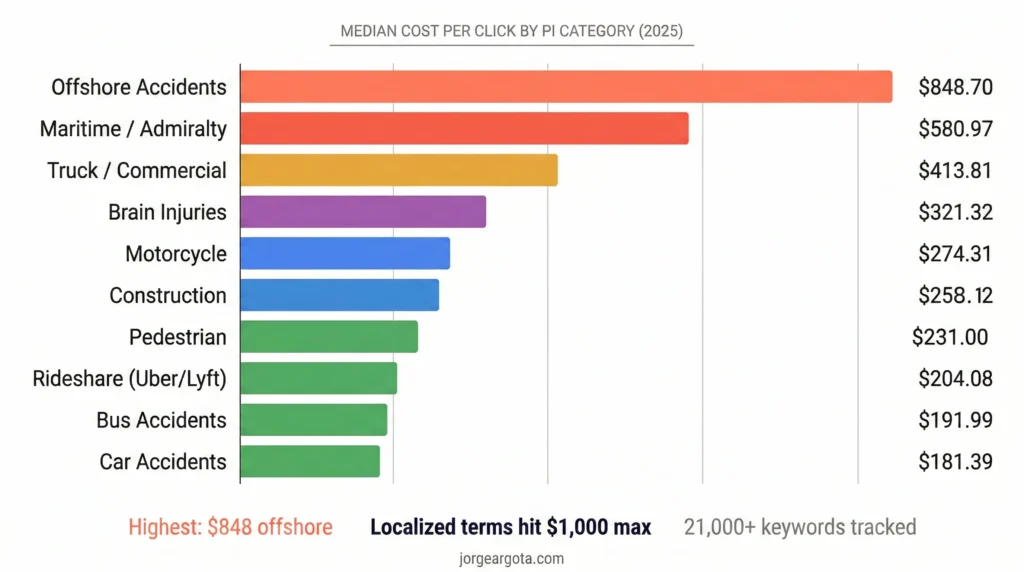
PPC for high-value PI is the most expensive paid search in any industry globally. Offshore accident keywords average $848 per click. Maritime runs $580. Trucking runs $413. Brain injuries run $321. The firms that make this work don’t group every case type into one campaign. They build isolated campaigns for each practice area with custom landing pages and aggressive negative keyword lists that block searches containing “fender bender” or “property damage only” or “minor injury” so the budget only feeds clicks from people with serious cases. The specific negative keyword categories, self-competition audit process, and Monday morning ritual for maintaining these lists is covered on the tactics page. They also geotarget by trauma center zip codes and heavy industrial zones rather than blanketing the entire state.
The highest value marketing channel for a PI firm targeting catastrophic cases isn’t Google Ads. It’s attorney referrals. When a general practitioner or a volume PI firm gets a case that requires $100,000 in expert fees and three years of litigation, they refer it out because they don’t have the capital to fund it. Becoming the firm that catches those referrals produces a 40% to 60% close rate on cases that are already pre-screened for value. You pay a 25% to 33% referral fee, but that fee is only paid when the case settles and the revenue hits your account. Compare that to $3,200 in digital marketing cost for a cold lead you know nothing about.
Building this network means treating other attorneys as your most important clients. That looks like hosting technical webinars on trucking litigation or publishing articles in the local Bar journal, running CLE presentations at state trial lawyer conferences, and building a secure referral portal where the referring attorney can track the case status without calling your office. Medical providers are the other pipeline; trauma surgeons, neurologists, and orthopedic specialists interact with catastrophically injured people before any lawyer does. The relationship has to be educational and non-remunerative because the Anti-Kickback Statute prohibits paying for medical referrals, but a firm that helps medical practices navigate insurance denials and subrogation liens builds the kind of trust that produces consistent introductions.
And then there’s the part that most marketing conversations skip entirely, which is that your intake department is either raising or destroying your average case value every single day. A firm that signs every lead the marketing produces will always drift toward the statistical mean, which in PI is a $16,000 auto case. The firms that attract high-value cases on purpose use intake as a filter, not a funnel. They train the team to identify catastrophic indicators in the first five minutes; ambulance transport from the scene, emergency surgery, multi-day hospital stays, loss of consciousness, commercial vehicles, corporate defendants. If those signals aren’t present, the case gets referred out or declined and the attorney’s time stays protected for the files that actually justify senior partner involvement.
Speed still matters even when you’re being selective. A catastrophic injury client has options and the response time data shows that even a 30-minute delay dramatically reduces sign rates; the full speed-to-lead benchmarks and intake SLA architecture are covered in the pipeline guide. If you don’t pick up, the firm spending $40 million a year on ads will, and they’ll sign the case before you check your voicemail. So the screening has to be fast and rigorous at the same time, which is the operational tension that separates firms pulling $50,000 average fees from firms pulling $5,000.
How Your Website Signals Which Cases You Want
Insurance companies track which attorneys settle cheap and which attorneys try cases. They maintain databases on this and it directly affects the opening offers you receive. A firm that positions itself as a “trial lawyer” rather than an “injury lawyer” gets different treatment in negotiations because the defense knows there’s a real chance this goes to a jury, and that shifts the math on what they’re willing to offer. Your website either reinforces that signal or contradicts it, and the contradiction usually happens when the site still has pages targeting “fender bender lawyer” and “minor car accident attorney” sitting next to the page about your $10 million trucking verdict. High-value clients looking at your site will notice that and it creates doubt about whether you’re actually the specialist you claim to be.
The boutique firms that consistently attract Tier 1 cases do a few things on their websites that volume firms don’t. They display specific verdicts with real numbers. They detail the science behind the injuries they handle, not just the legal process. They highlight their expert witness networks and their understanding of medical evidence. They keep their review profiles focused on catastrophic case outcomes rather than volume testimonials about “fast settlements.” And they explicitly position their low caseload as a benefit, not a limitation; partner-level attention on every file is the selling point, and it’s the opposite of what the billboard firms can offer.
80% Tier 3 and 4 case mix · 100-300 open files · $5K avg fee
versus
40% Tier 1 and 2 case mix · 4-15 open files · $50K+ avg fee
One more variable that I think gets overlooked is geography. Case value isn’t distributed evenly across states because tort law creates a ceiling on what you can recover. Nevada produced $8.4 billion in verdicts exceeding $100 million in 2024. California produced $6.9 billion. Texas produced $3 billion, driven by trucking and industrial accidents. Florida, which used to be a top-two state for large verdicts, dropped to number ten after the 2023 tort reform legislation changed comparative negligence and fee structures. A firm marketing med mal in a state with a $250,000 cap on non-economic damages has a very different ROI calculation than the same firm marketing the exact same practice area in a state with uncapped damages, and most marketing plans don’t account for that legislative ceiling at all.
The firms that have figured this out don’t try to own every case type in every market. They pick a niche, maybe maritime injury or commercial trucking or construction accidents, and they market it across multiple states instead of blanketing one city with broad PI ads. They become the regional authority on a specific type of catastrophic loss and they win referrals from local generalists who don’t have the content, the expert networks, or the trial record to compete on those terms.
The numbers on this aren’t ambiguous. A $103,000 average trucking settlement versus a $16,000 median auto award. A $1.8 million med mal trial average versus a $37,248 standard auto settlement. A 40% to 60% close rate on attorney referrals versus a $3,200 cold digital lead. These are the economics that separate firms charging through volume from firms operating on margin, and the marketing strategy that produces one doesn’t produce the other.
If you’re running a volume practice and that’s working for you, there’s no reason to change the model just because the numbers on high-value cases look attractive on paper. The capital requirements, the expert costs, the litigation timelines, and the risk profile are completely different and not every firm is set up to absorb a three year med mal case that might pay nothing. If you’re a small firm on a tight budget, the sequencing is different. But if you’re already handling some complex cases and you want your marketing to produce more of them instead of more soft tissue auto files, that’s a transition worth thinking through. The intake and measurement infrastructure has to be in place first or the high-value leads get lost in the same pipeline as everything else. Send me your current case mix and what you’re spending and I’ll tell you where the reallocation makes sense and where it doesn’t.
Related
- Marketing Channels Ranked by Signed Cases
- Predictable PI Lead Pipeline Guide
- Google Ads and GBP Tactical Playbook
- Cross-Channel Synergy: SEO + PPC + Local
- Small PI Firm Marketing on a Tight Budget
- What High Growth Law Firms Spend
- PI Lead Generation Benchmarks
- Mass Tort Lawyer Marketing
- PI Lead Gen Beyond TV and Billboards