

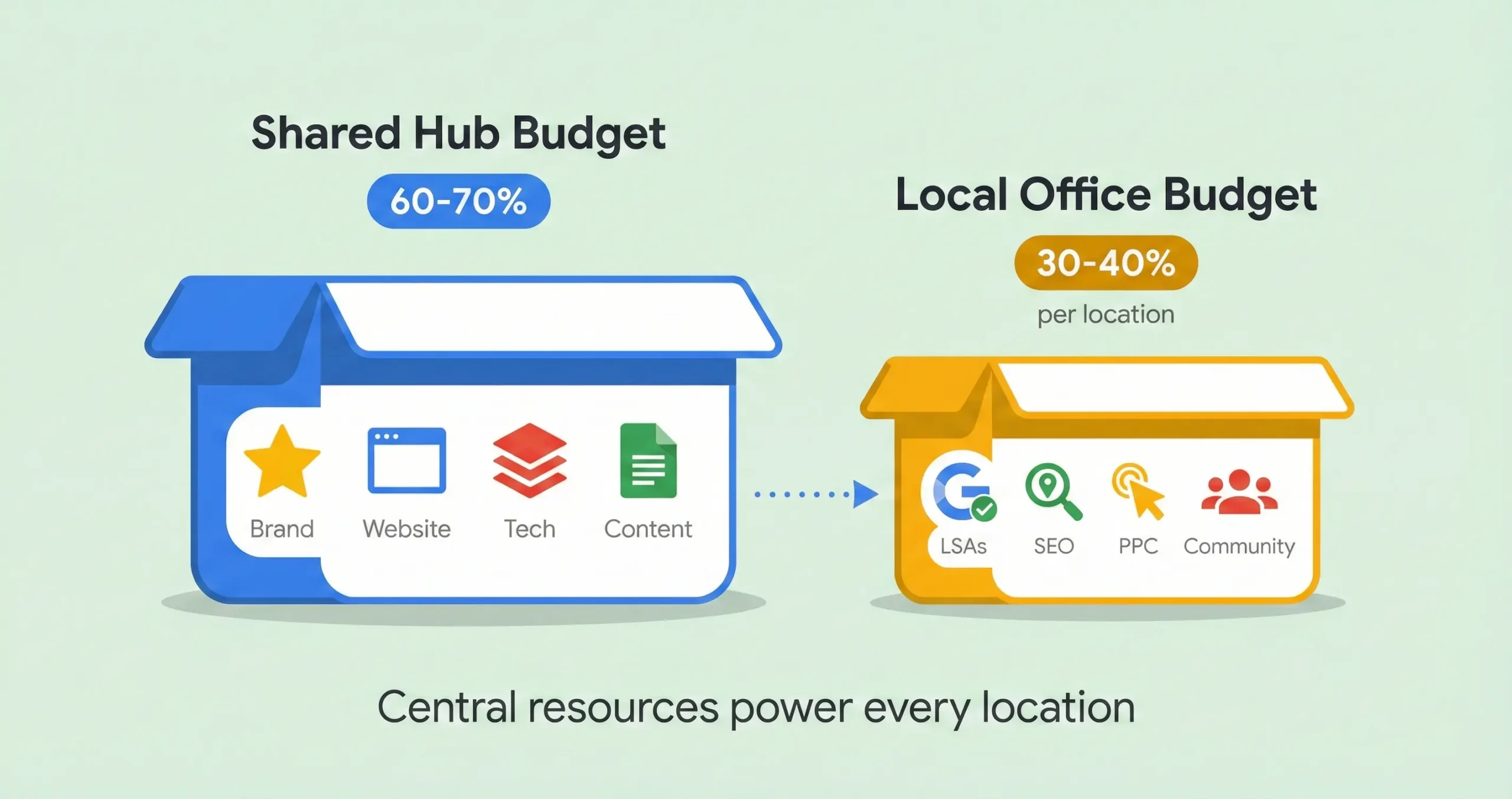
How should multi-office law firms budget for marketing? The most effective model splits the budget into shared infrastructure (60-70%) and dedicated local spend (30-40%) per office. Shared budgets cover the website, brand, tech stack, and content that benefit all locations. Local budgets fund geo-specific PPC, Local Service Ads, and community outreach. Allocations should be asymmetric; new offices need 15-20% of projected revenue while established offices may only need 4-5%.
Splitting the marketing budget evenly across offices sounds like the fair move. Most managing partners do it that way because it feels right and because nobody on the team wants to argue for one office getting more than another, and honestly I’d probably think the same thing if I hadn’t watched it play out at maybe four or five firms over the last few years.
The issue isn’t how much you’re spending. It’s that every office is at a different stage and needs a different amount to get where it’s going. A flagship that owns its market needs way less than a brand new office that’s starting from zero, but if you split the budget flat they both get the same number and one has too much while the other doesn’t have close to enough. I didn’t notice this at first either; it only clicked when I ran the math for a three-office firm and saw that the total spend was the same either way; the only thing that changed was where the money went.
The Flat Tax Problem
The reason most firms default to a flat percentage is because it feels objective. Nobody has to justify why one office got more than another; the formula handles it. But what the formula doesn’t account for is that a ten-year flagship in a market it already owns has completely different needs than a new office trying to build name recognition from nothing.
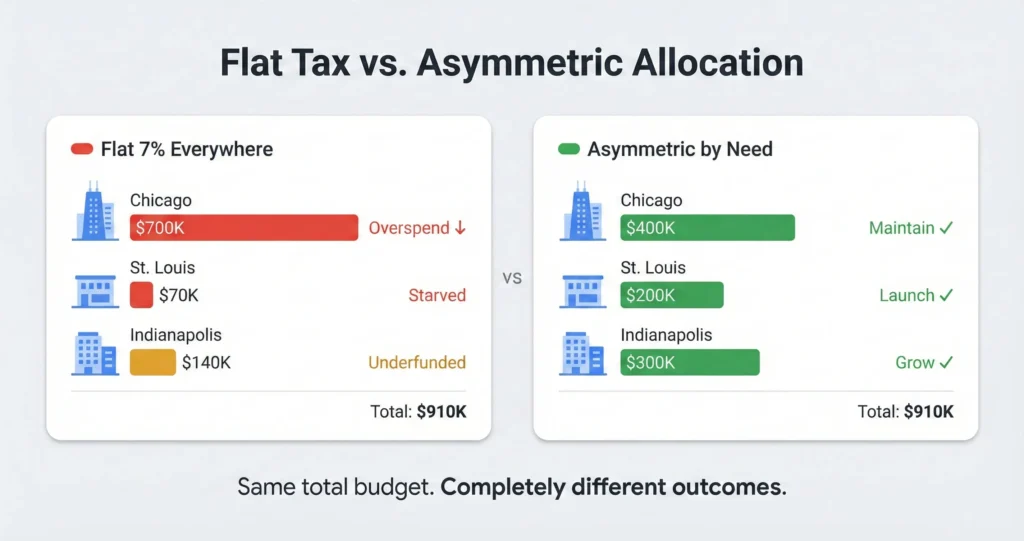
So take a three-office PI firm doing $13 million combined. A flat 7% across the board sounds reasonable. But look at what it actually does.
The math that breaks it:
Flagship ($10M, owns market): Needs 4% = $400K to hold position. Flat 7% hands it $700K; $300K sits unused.
Launch ($1M projected, zero name): Needs 20% = $200K to break in. Flat 7% gives it $70K; not enough to show up.
Growth ($2M, ranks 4th): Needs 15% = $300K to climb. Flat 7% gives it $140K; stuck where it is.
Same total spend. Completely different outcomes depending on where you put it. The flagship doesn’t need more money; it needs less. The launch office doesn’t need “its fair share”; it needs enough to actually enter the market, which is a number based on what the market requires, not what the firm’s revenue splits into. That’s the shift; budgeting by market need instead of by revenue percentage.
What Gets Shared and What Stays Local
Once you move away from the flat model the next question is what gets funded from a shared pool and what stays local. The idea is pretty simple; some things benefit every office at once and some things only work in one market, and paying for the shared stuff separately at each office means you’re buying the same thing three or four times for no reason.
I think of it as two buckets. About 60 to 70% goes toward things that work across all locations at once; your website, your brand identity, your CRM, your call tracking, your content. The other 30 to 40% stays tied to each market because it has to.
Where the hub dollars go: CRM, call tracking, analytics, content, website, brand. Where the spoke dollars go: PPC, LSAs, GBP management, directory listings, reviews, community. The split is usually 60-70% hub and 30-40% spokes, but it shifts depending on how many offices are new versus established.
The Domain Advantage Most Firms Miss
The website is where the shared budget matters most and it’s where multi-office firms hold an edge most of them don’t realize they have. One domain with location folders like lawfirm.com/chicago carries way more weight with Google than three separate sites because every link built to the parent domain lifts every page on it.
At Percy Martinez I watched this play out. We started in Miami and when we added pages for other parts of Florida they ranked within weeks; the parent domain had ten years of trust built up. Firms starting fresh domains for each office took twelve to eighteen months to show up for the same terms. Once you see that gap you stop debating whether to consolidate.
Same logic applies to tools. CRM, call tracking, content production; buying all of that as one contract saves maybe 20 to 30%. One team writing a guide then tweaking it for each market costs maybe 40% of what three shops would charge for three versions.
What Has to Stay Local
The stuff that can’t scale is anything tied to geography. Google Ads run by market; the auction in Miami doesn’t touch the one in Tampa. Same goes for your Google Business Profile, review work, directory listings. All of that has to feel rooted in the area or it loses the trust signals that drive map pack rankings. You can’t run that from two states away.
This is where the spoke budget goes and it’s the part that varies the most from office to office. A flagship in a market it already owns might spend 30% of its budget on local. A new office trying to get noticed might need 50% or more going to geo-specific ads and community presence just to build the initial visibility.
What Each Market Actually Costs
The part that trips up most expansion plans is that every market has its own price of entry and that price has nothing to do with how big your firm is or how good your attorneys are. It’s set by competition. The more firms bidding on the same keywords in the same city, the more it costs to show up, and the gap between a major metro and a small regional market is massive.
Media spend benchmarks by market tier
| Market Tier | Examples | Monthly PPC/LSA Budget | CPC Range (PI) |
|---|---|---|---|
| Tier 1: Major metro | NYC, LA, Chicago, Houston | $15,000 – $50,000+ | $100 – $300+ |
| Tier 2: Mid-size city | Austin, Nashville, Columbus | $5,000 – $15,000 | $50 – $150 |
| Tier 3: Small/rural | Smaller regional markets | $2,000 – $5,000 | $10 – $50 |
Those Tier 3 numbers look cheap but the issue isn’t cost; it’s volume. There might not be enough people searching to use a big budget. So the plan shifts toward local presence, reviews, word of mouth. I think that throws a lot of firms off because they expect more cash to mean more leads. Sometimes the search traffic just isn’t there.
For new offices there’s what I call the 3x Rule which says a new spot needs about three times what a stable office gets for the first twelve to eighteen months. You’re paying to force Google and the market to notice you exist. That’s a startup cost, not something you break even on right away. I think that makes most managing partners uneasy but it’s just how the math works and I’d rather say it now than have someone wonder six months in why the numbers aren’t moving.
Why One Agency Beats Three
When you have offices in multiple markets the temptation is to hire a local agency in each city because they know the area, they know the competition, and it feels like you’re getting specialized attention. That logic makes sense until you try to compare results across offices and realize you can’t, because each agency defines success differently.
At Percy we tried it both ways. The gap wasn’t close. What surprised me is how much of the difference came down to coordination problems that have nothing to do with marketing talent.
With a different vendor in each market you get separate contracts, separate calls, separate everything. But the part that actually matters; no shared way to define what counts as a lead. One vendor tracks form fills. Another counts phone calls. The third reports clicks. You can’t compare offices because the numbers aren’t measuring the same thing, which sounds small until you’re trying to decide where to shift $50K based on data that doesn’t line up.
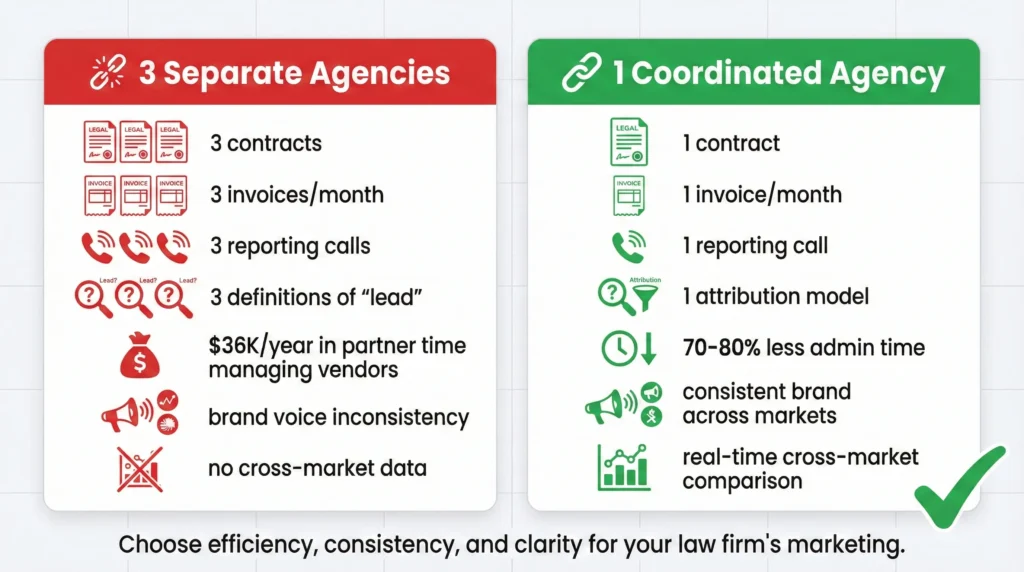
A partner spends maybe two hours a month per vendor on calls. That’s six hours at $500 an hour; $36,000 a year just to manage vendors. You still end up with one calling you tough litigators while another calls you caring counselors. Nobody caught it because nobody was looking at all three at once.
What breaks down:
Attribution. “Is our cost per signed case lower in Dallas or Houston?” You can’t answer that when the data sits in different platforms with different tracking, and you can’t move spend across markets if you can’t see across markets.
Speed. A new statute passes or a mass tort opens and one team pushes campaigns across all markets in a day, but getting three vendors aligned takes weeks and by then somebody else already owns the search inventory.
Quality. One team means one point of blame; when something goes wrong the fix happens everywhere at once instead of playing telephone between people who don’t talk to each other, which is how problems like bad backlinks or wasted spend go unnoticed for months and I’ve seen that happen more than once.
The Honest Part
I’d rather give you the real number now than have it come as a surprise later. Multi-office marketing costs more than most firms expect because you’re paying for both the shared systems and the local market presence at the same time, and those are two separate line items that both need real funding.
A three-office PI firm in competitive markets is probably looking at $600K to $900K a year. If that doesn’t fit right now, the better move is to pick one or two cities and fund those properly. I’d rather see a firm own two markets than spread thin across five, because three offices that are all kind of visible but none of them winning is worse than having one strong market and one that hasn’t launched yet.
If the third office doesn’t need to open this year, that’s fine. I’d rather say that than watch it get stretched thin. Weird thing for a marketing person to say, but it’s what I think.
Planning a multi office expansion in Florida?
We run coordinated campaigns across Miami, Tampa, Orlando, and Jacksonville; one strategy, one dashboard, one team that knows every auction in every city. If the math doesn’t work I’ll tell you that too.